
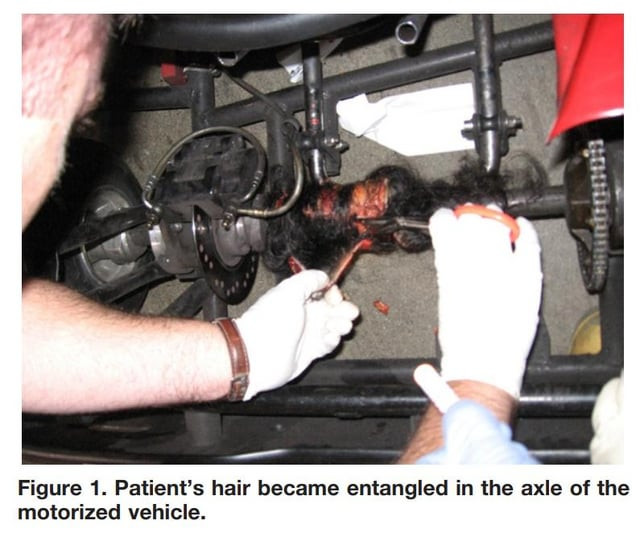
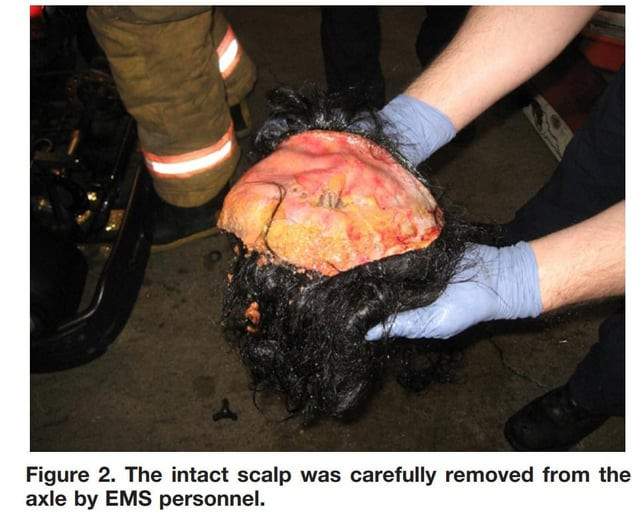
A 36-year-old woman with no pertinent medical history was brought to the Emergency Department via ambulance after a traumatic injury while driving a go-cart. The patient was the helmeted driver when her long hair became entangled in the axle of the motorized vehicle (Figure 1). There was no loss of consciousness. Her scalp was bandaged and her pain controlled with i.v. morphine. Emergency Medical Services (EMS) personnel carefully removed the intact scalp and hair from the axle and wrapped it in saline-soaked gauze and transported it with the patient (Figure 2).
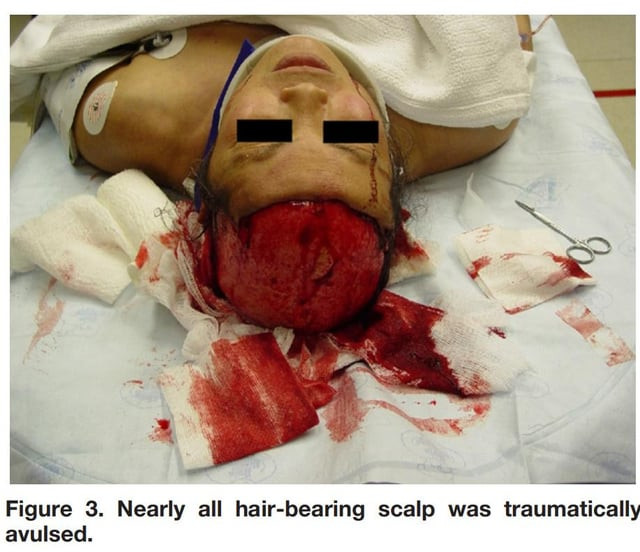
Trauma radiographs revealed no intracranial, cervical spine, or other associated injury. Removal of the bandage applied by EMS revealed the extent of the injury. The patient had suffered a complete scalp avulsion, with nearly all hair-bearing scalp traumatically removed during the accident (Figure 3). The injury was re-dressed and the appropriate surgical consultants were contacted.
The scalp is composed of five layers: skin, subcutaneous tissue (which includes the superficial fascia), galea aponeurotica, subaponeurotic areolar connective tissue, and periosteum. In this patient, active bleeding was minimal, as the rich vascular network of the superficial fascia was avulsed as well. Scalp replantation should be emergently considered, as multiple case reports and series of avulsed scalp replantation have shown significant success rates (1,2). With this in mind, the Emergency Physician should employ the same modalities in salvaging avulsed scalp as are used in any amputated part (3). Namely, this involves handling the tissue with care, wrapping it in salinesoaked gauze, and placing it on ice (or similar storage medium), and administering tetanus booster and antibiotics. The initial surgical approach is replantation. However, if this option fails or is not plausible, skin grafting followed by later reconstruction using tissue expansion is warranted (4). Finally, medical management should include psychological evaluation, as anxiety and depressive symptoms are observed in many of these patients, especially after unsuccessful scalp replantation (5).
After the initial injury, the patient was admitted for immediate replantation of her scalp. After a few days, there unfortunately remained several areas of her scalp that were not receiving adequate blood supply. She was subsequently transferred to a higher level of care. After multiple unsuccessful debridements, she eventually required skin grafting. Approximately 2 months after the initial injury, she underwent a meshed 3:1, 20 cm x 20 cm split-thickness skin graft from her left thigh. Nearly 1 year later, the patient is doing well and has suffered no further complications.