
Exploring how mixing different mechanics can create unique gameplay experiences. What mechanics work well together? Sharing my designs and experiments with supporters.
 Getting the mechanics of your game right is crucial to success. If there’s one thing that really gets me annoyed in a game, it is when mechanics are too varied and seem to almost fight against each other in play.
I always look for mechanics that align and give a seamless experience when playing so that it’s easy to pick up rules without referring endlessly to the Rules Booklet. Almost all games have a mixture of cards, dice, and tokens, but when all the components have the same underlying principle it makes understanding easier and game-play flows much smoother.
Perhaps it’s my old eyes but when I see a table hogging game littered with components of all descriptions and lots of different dice, I just back away in terror! Elegance is a key principle here and the best games stick to only a few core mechanics and let those mechanics permeate the whole game.
I’m afraid that I’m old school but in all the games that I design, I use the standard six-sided dice (D6). This is because my games are almost always ‘print and play’ (PNP) and you never take for granted that players have access to any D8, D12 or D100, but EVERYONE has some D6 lurking in an old board-game somewhere.
I also find that in terms of probabilities, I can just about get anything I need with 1D6, 2D6, 3D6 or a D6 x D6 table. Then you can halve a D6 to get a D3 – the varieties are fairly extensive.
In both Star Trek: Adventures in the Final Frontier (STAFF) and Doctor Who Solitaire Story Game (DWSSG), I have found that 2D6 gives me the ‘bell curve’ probability that I can use most effectively in designing mechanics and challenges for the player.
When going on a Mission in STAFF, players have to overcome Challenges. To do so, they roll 2D6 and add their linked Skills to gain ‘Progress’ in that Challenge. Each Challenge is overcome when a player gains a required Progress total, with more difficult Challenges requiring a greater Progress total to overcome that Challenge. What’s important is that it doesn’t matter if it’s a Challenge created through a Dilemma, or by the Mission itself, the process is THE SAME. In this way, a player quickly learns how a Dilemma Challenge or Mission Challenge works and the game flows quicker.
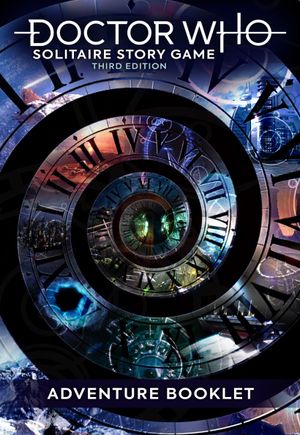
In DWSSG, a player has to get his TARDIS Characters (the Doctor and companions) to make Skill or Quality Tests to succeed in Defeating the Enemy. In each Test, whether it is Diplomacy (a Skill) or Brawn (a Quality), the player rolls 2D6 and adds his Skill/Quality, to equal a ‘target’ number. So I can write ‘Make a Diplomacy 8 Test’ or ‘Make a Brawn 12 Test’, and the player instantly knows what to do.
‘Conflicts’ in DWSSG follow the same pattern. Total your Quality for the Conflict (say Brawn), against the Enemy Quality (it could be Brawn, but conflicts in Doctor Who aren’t just battles, there’s mind control, capture, outwitting and so on), you find the difference and roll 2D6, adding the difference to equal a target number of 7 (so if you have Brawn 4 and the Enemy Brawn 8 that’s a -4 modifier).
However, if for example Skills and Quality Tests worked in different ways, like Quality Tests having to roll UNDER a total on 2D6, the mechanics are fighting each other and not meshing.
There’s so much more to add to this topic and one of my favourites is having ‘hero points’ (Luck, fate, Force, whatever) as a resource that you gain through a game and then ‘spend’ to reroll a crappy dice roll that could kill your character/team. It’s a great way to model ‘heroic’ games, is really simple to do and gives players agency in their choices.
I’d love to hear other people’s favourite mechanics.
All my games are available here on my coffee website: https://buymeacoffee.com/dragoncymru