

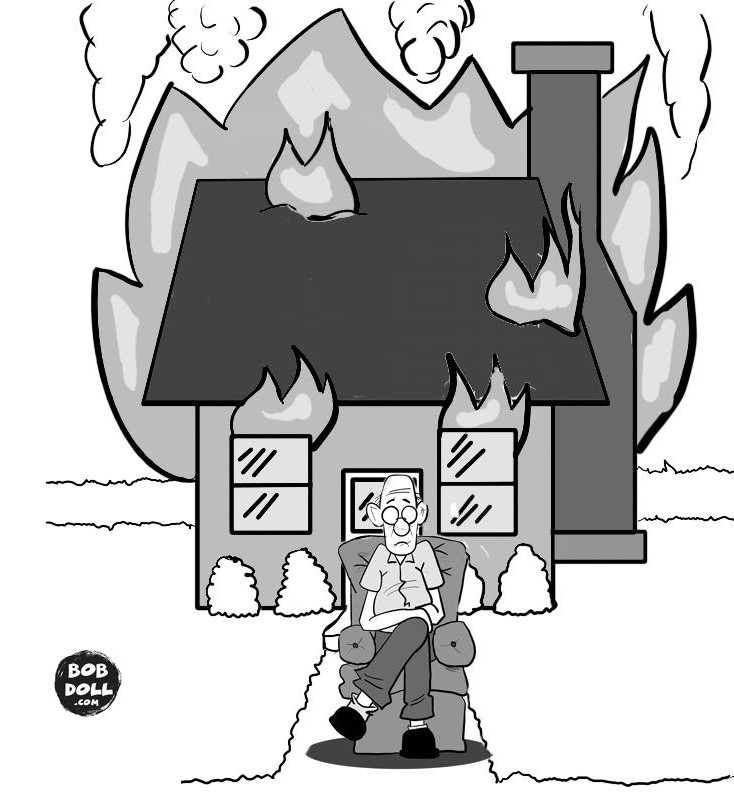
My humorous drawings have at times been described as a negative and pessimistic way of getting people to laugh and those who have said so could be right. In fact, they are right and I’ve never disagreed with anyone who has described them that way. One reason for not disputing them is because I have intentionally written and drawn gags depicting a certain side of life to which particular people can relate and even those positive thinking gurus who claim that everything is rainbows and unicorns know that reality can sometimes be grueling.
In my blog post about the 1976 movie Bad News Bears, I described the team’s coach as a dubious role model for the youthful ball players. He was an overdrinking, unkempt, underachiever who encouraged cheating and trash talking with no inspirational messages for his impressionable players. A team at any level is often described as an extension of its head coach and in this movie the writers orchestrated the perfect marriage between the coach and the natural personalities of the disadvantaged young players, and herein one may find why I find it one of my favorite stories.
I could very well have been one of those players. I was a latch-key kid who arrived home after school with no adults present as my single mother was working hard to keep a roof over my head. My father wasn’t very helpful, so my nearest role model was the coach of the little league teams, baseball and football, on which I played. No parents were ever present at practices, so the coaches had a free hand, and practice was a grueling two hours a day, five days a week with a game on Saturday.
Being brought up by a single mom in the 60’s and 70’s was much more difficult than it is today. My parents were divorced when I was very young, so I have no memories of a man in the house and in the ensuing years, my father was not very helpful. I was drawn to the kind of humor that helped me cope with my less than charmed youth and this approach is nothing new.
The modern mass media have a way of highlighting the gifted youth and whitewash what 95% of people’s experience and I feel not only does it give unrealistic expectations to young people but it leads to the thought of underachievement and mediocrity when one doesn’t meet the high achievers emphasized by Hollywood and media.
Self-deprecating humor is a coping mechanism. Humor and comedy have always used misfortune and personal shortcomings as not only as a coping mechanism but also to get others who are grinding out life to move forward.
· Charlie Brown was plagued with bouts of depression and anxiety.
· Mad magazine emphasized the darker side of everyday life.
· The comic strip Herman underscored job loss and mediocre marriages.
· Charlie Chaplain was a perpetual tramp.
· Laurel and Hardy were bumbling, mistake prone failures.
· Don Rickles insulted people.
· Rodney Dangerfield got no respect and his wife was unfaithful.
Phylis Diller is worth pointing out. The image she portrayed was one who was unattractive and lived in a bad marriage. Earlier in life she found humor to be a way of getting her through difficult times in her life. It relieved her stress and put things in a different perspective by using hard times as motivation to accentuate a positive outcome. She wasn’t bashful to analogize humor as a way many people use religion to get them from day to day.
I discovered that most people don’t live the charmed life of celebrities and the few who ignore negatives who always smile and put a nice pretty bow on everything are ignoring the fact that sometimes life stinks, (Mel Brooks), and I like addressing those who don’t ignore it.