

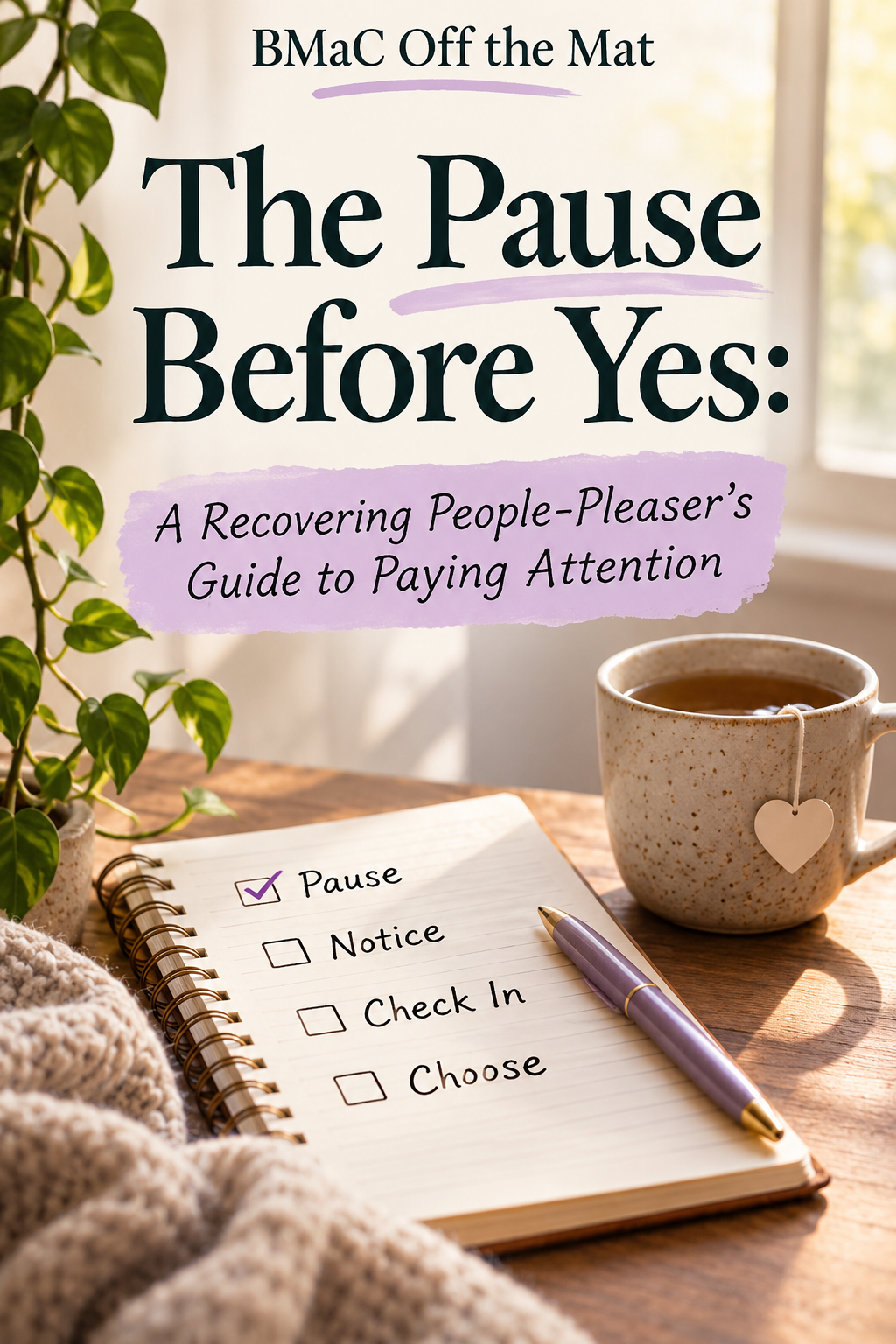
There is a particular kind of exhaustion that comes from agreeing to things before you've even had the opportunity to decide whether you want to do them. It's the exhaustion of a calendar filled with other people's priorities, of responsibilities you never intended to accept, and of discovering that you've somehow become the designated problem-solver for situations that weren't yours to solve in the first place.
As a recovering people-pleaser, I know that exhaustion rather well.
People-pleasing has a way of disguising itself as kindness. We tell ourselves that we're being helpful, considerate, generous, or compassionate. And sometimes we genuinely are. The difficulty comes when we can no longer distinguish between helping because we want to and helping because we feel that we have no acceptable alternative.
Somewhere along the way, the ability to recognize another person's needs becomes an assumed responsibility to meet them. We notice someone's disappointment and immediately begin searching for ways to make it disappear. We recognize frustration in someone's voice and start adjusting our behavior to prevent a confrontation. We hear that somebody is struggling and begin mentally rearranging our schedules before they've even asked us for assistance.
The awareness itself isn't necessarily the problem. It's what we've learned to do with that awareness.
When Paying Attention Becomes a Survival Strategy
People-pleasing isn't always rooted in a desire to be liked. For some people, particularly those who have experienced unpredictable relationships or environments, learning to anticipate other people's reactions can become a way of navigating uncertainty.
Recognizing a subtle change in someone's tone might once have helped prevent an argument. Knowing when someone was becoming frustrated might have provided an opportunity to avoid conflict. Learning to identify expectations before they were spoken might have made an otherwise difficult environment feel more manageable.
Those habits can remain long after the circumstances that encouraged them have changed.
What once served a protective purpose can gradually become an exhausting pattern of monitoring everyone else's emotional state while neglecting our own. We may find ourselves feeling responsible for preventing disappointment, smoothing over disagreements, or maintaining harmony even when doing so requires sacrificing our own comfort and capacity.
Of course, not every people-pleaser developed these habits in response to adversity. Family expectations, cultural messages about politeness, gender roles, workplace pressures, and the desire for belonging can all contribute. The reasons vary, and no single explanation captures everyone's experience.
What many of these experiences share, however, is the belief that recognizing another person's needs creates an obligation to respond.
It doesn't.
Dhyana and the Difference Between Awareness and Responsibility
This month's HeartFire exploration brings together gratitude and Dhyana, the seventh limb of yoga. Within Patanjali's eight-limbed framework, Dhyana describes meditation, often understood as a sustained flow of attention toward an object of contemplation.
That understanding offers an interesting perspective on the way we approach our relationships and responsibilities outside formal meditation.
Attention allows us to recognize what's happening. It doesn't automatically tell us what we're required to do about it.
We can notice that a friend is disappointed without assuming we've caused that disappointment. We can recognize that a family member needs assistance without concluding that we're the only person capable of providing it. We can acknowledge that someone is having a difficult day without accepting responsibility for transforming their entire experience.
Awareness, compassion, and responsibility are related, but they are not interchangeable.
Awareness means recognizing that something is happening. Compassion involves caring about the experience of another person. Responsibility depends on our actual commitments, circumstances, relationships, and choices.
Sometimes those three overlap. Parents have responsibilities toward their children. Partners make commitments to one another. Communities depend on people fulfilling obligations and offering mutual support.
Boundaries don't erase those responsibilities, nor should they become an excuse to disregard the people who depend on us.
But the existence of genuine responsibilities doesn't mean every request carries the same weight, or that every expression of disappointment creates a new obligation.
Learning to recognize that distinction is an important part of developing a healthier relationship with our attention.
The Automatic Yes
For a recovering people-pleaser, one of the most revealing moments often occurs immediately after someone asks for help.
The answer arrives before the assessment.
Yes, of course. Absolutely. No problem. I'll take care of it.
Only afterward do we begin considering whether we have the resources, energy, or availability to follow through.
Sometimes the consequences are relatively minor. We agree to attend an event we don't particularly enjoy or volunteer for a task that makes an already busy week more complicated.
Other times, the consequences are substantial. We repeatedly set aside our own needs, accept responsibilities beyond our capacity, or remain available to people who have come to expect that our boundaries are negotiable.
The problem isn't necessarily that we've agreed to help. Generosity can be deeply meaningful, and supporting the people we care about is an important part of building relationships.
The problem arises when agreement becomes so automatic that genuine choice disappears.
That's where the pause becomes valuable.
Creating Space Between the Request and the Response
A pause doesn't have to be dramatic. It doesn't require a lengthy explanation or an elaborate declaration of independence. Sometimes it's simply the decision not to answer immediately.
We might tell someone that we need to check our schedule, consider our existing responsibilities, or think about whether we can make a commitment.
That small interruption creates an opportunity to ask questions we might otherwise overlook.
Do I actually want to do this? Do I have the capacity? Am I agreeing because this matters to me, or because I'm uncomfortable with the possibility of disappointing someone? What responsibilities am I already carrying, and what would accepting another one require me to set aside?
There won't always be a perfectly clear answer. Sometimes we choose to help even when it's inconvenient because the situation matters to us. Sometimes we make sacrifices for people we love. Sometimes we accept responsibilities because we've made commitments that deserve to be honored.
The goal isn't to eliminate inconvenience or ensure that every decision feels comfortable.
It's to recognize the difference between making a considered choice and responding automatically to pressure, guilt, or fear.
And occasionally, after considering everything, the answer will be no.
For someone accustomed to people-pleasing, that can be remarkably difficult.
Disappointment Is Not Always an Emergency
One of the harder lessons in recovering from people-pleasing is accepting that other people are allowed to be disappointed.
Someone may genuinely wish we could help. They may feel frustrated when we're unavailable. They may need to change their plans because we've declined a request.
Those feelings can be real without automatically meaning we've behaved badly.
Naturally, context matters. If we've broken a promise, neglected an obligation, or treated someone unfairly, their disappointment may be telling us something important about our behavior. Boundaries don't exempt us from accountability.
But when we've communicated honestly, considered our responsibilities, and made a reasonable decision, another person's disappointment doesn't necessarily require us to reverse that decision.
We can acknowledge their feelings without accepting ownership of them.
We can express regret that we're unable to help without apologizing for having limits.
We can care about the outcome without becoming responsible for controlling it.
Just because we can read the room doesn't mean we've volunteered to redecorate it.
And for those of us who have spent years trying to keep everyone comfortable, learning that distinction may require considerable practice.
Making Room for Our Own Needs
There is an irony in people-pleasing that becomes increasingly apparent once we begin examining it: we can become exceptionally skilled at recognizing other people's needs while struggling to identify our own.
We notice when someone else is tired but dismiss our exhaustion. We encourage friends to establish boundaries while explaining away our own discomfort. We remind loved ones that they deserve rest while treating our own need for it as an inconvenience.
This is where bringing awareness back toward ourselves becomes especially meaningful.
Our needs aren't inherently more important than everyone else's, but they aren't automatically less important, either.
Recognizing that we have limited energy, competing responsibilities, or a genuine desire not to participate in something doesn't make us selfish. It gives us information we can use when deciding how to respond.
And those decisions become more sustainable when they're based on an honest understanding of our circumstances rather than an imagined obligation to remain endlessly available.
A HeartFire Reflection
As we explore Dhyana this week, there's an opportunity to consider how attention influences our choices beyond the meditation cushion.
When someone asks for something, what happens internally before we respond? Do we consider our own circumstances, or do we immediately begin calculating how to avoid disappointing them? Are there relationships in which we're comfortable expressing limitations, and others where the possibility of saying no feels threatening?
It may also be worth considering what we believe a caring person is supposed to do. Have we confused kindness with constant availability? Have we mistaken generosity for self-sacrifice? Have we developed expectations of ourselves that we would never impose on someone we love?
These questions don't demand immediate answers. They simply invite us to recognize patterns that may have become so familiar we've stopped noticing them.
The purpose of awareness isn't to criticize ourselves for developing those patterns. It's to give ourselves more opportunities to choose how we respond.
Caring Without Disappearing
Recovering from people-pleasing doesn't mean becoming indifferent to other people. It doesn't require abandoning compassion, refusing every request, or treating relationships as transactions in which we must receive something in exchange for everything we offer.
It means recognizing that genuine care can include consideration for ourselves.
We can be generous without being endlessly available. We can participate in community without accepting every responsibility. We can honor our commitments without volunteering for obligations we cannot sustain.
And we can recognize another person's needs without assuming that meeting them must always come at the expense of our own.
The next time a request arrives and an automatic yes begins forming, consider giving yourself a moment before answering.
That moment may not change your decision. You might still choose to help, and you might be genuinely glad that you did.
But it allows your response to come from awareness rather than reflex.
For a recovering people-pleaser, that small distinction can be the beginning of a very different relationship with generosity, responsibility, and self-respect.
Attention is not obligation. Compassion is not unlimited capacity. And caring for other people does not require abandoning ourselves.
Keep the HeartFire burning, both ON and OFF the mat. 💜