
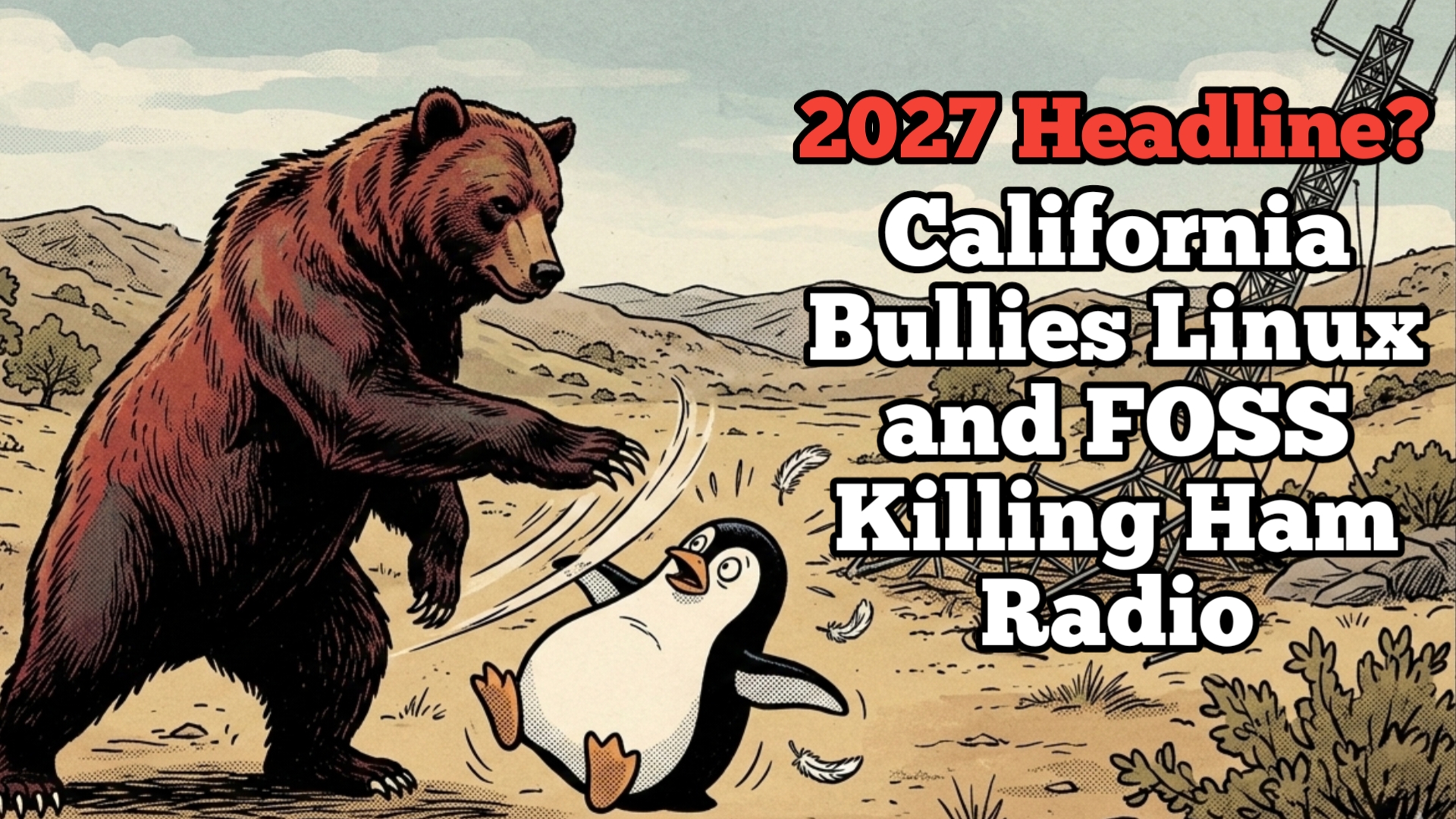
 Amateur radio has always been a hobby of volunteers, experimenters, and self-taught engineers. We pride ourselves on building the tools we use, from homebrew antennas to the open-source software that powers our digital modes. But as of 2026, a new legal hurdle in California is threatening to mute the very software that keeps our hobby alive—not just in the Golden State, but across the country.
The Digital Age Assurance Act (AB 1043) was signed into law with enforcement set to begin on January 1, 2027. While its stated goal is to protect minors from "addictive" or "harmful" content, its technical definitions are so broad that they inadvertently sweep up niche, volunteer-driven open-source projects.
The Regulatory Burden: A "Compliance Trap"
The law creates a massive technical and legal mandate for any entity classified as an Operating System Provider, an Application Developer and a Covered Application Store.
The OS Mandate: Any OS must provide a mandatory age-declaration interface at setup and provide a real-time "age signal" API that apps can query.
The "Updated" Trigger: Any app updated on or after January 1, 2026, is legally required to request this signal. If a developer pushes a simple bug fix today, they suddenly "opt-in" to the entire regulatory framework.
The Penalty: Fines reach $2,500 per affected child for negligence and $7,500 for intentional violations. For a hobbyist project with $0 in revenue, a single enforcement action can be an "extinction-level event."
The "All-in-One" OS Trap: The Burden on ISOs
For projects distributed as a bootable ISO (a complete, standalone Operating System), the impact of AB 1043 is immediate. Under the literal text of the law, these projects are no longer just "apps"—they are Operating System Providers.
1. DragonOS & Skywave Linux
These distributions are the gold standard for Software Defined Radio (SDR) and signals intelligence. Because they provide the entire environment, the maintainers are now legally tasked with building California’s mandatory age-gate into the system installer. For a project run on "freedom and free beer," the cost of adding state-mandated tracking and verification APIs is a non-starter.
2. arcOS (Amateur Radio Community OS)
A modern, Mint-based distribution focused on standardized digital communication. Because arcOS is intended for portable "plug-and-play" use with devices like the Digirig, AB 1043's requirement for a mandatory age-declaration interface at account setup adds a layer of friction and confusion that could hinder rapid deployment during emergency drills or in-the-field operations.
3. Andy’s Ham Radio Linux (KB1OIQ)
One of the longest-running and most consistently updated distributions, this project provides a full Debian-based Live environment. Since it is updated multiple times a year (with Version 26e hitting in Jan 2026), it triggers the 2026 mandate immediately. The developer becomes legally responsible for ensuring every pre-installed tool correctly handles a mandatory age signal.
The "Script" Trap: Why 73 Linux is at Risk
You might think a project like 73 Linux is safe because it is technically a set of scripts run on top of an existing OS like Debian. Unfortunately, the law focuses on "functional control" rather than file types and implementation details.
1. The "Environment Controller" Problem
AB 1043 applies to any entity that "controls the operating system software." By providing a script that transforms a standard OS into a "Ham OS"—changing the desktop, adding custom repositories, and managing core utilities—projects like 73 Linux can be legally classified as the entity in "control" of the user's experience.
2. The "App Store" Liability
Even if a project isn't considered an "OS," its installation menu (like the bapp system) could be classified as a "Covered Application Store." The law defines an app store as any interface used to download or launch applications. If your script provides a menu to install FT8 tools or SDR drivers, California law expects you to have a built-in age-gate before those downloads occur.
At-Risk Software: Specific Nuances
The risk extends to the most popular tools in our kits. Here are some examples:
CHIRP (Radio Programming): Updated almost weekly to support new radios. Every update after Jan 1, 2026, forces the team into the compliance loop.
WSJT-X & JS8Call: These digital mode core applications are often "respun" by third parties. Under the law, every person who forks and re-releases a modified version could be held responsible for ensuring the age signal API is queried (WSJT-X Improved, JTDX, WSJT-Z).
Dire Wolf (APRS): Often runs on "headless" systems (like a Raspberry Pi with no monitor). AB 1043 mandates an "accessible interface" at setup. How do you implement a graphical age-gate on a terminal-only TNC?
Every app that enables communication with another amateur radio operator: So many of our apps allow communication with adults globally. As a developer you now have "actual knowledge" that a user is 12, but if the app doesn't have a specific "minor-safe" mode or parental control, the app developer is knowing providing and "adult" service to a child. This is now a $7,500 / "intentional violation".
The "California Effect": A National Threat
This isn't just a California problem. Because developers rarely maintain two separate versions of a free app, the restrictions required for California will become the default for everyone.
The "California Blackout": We are already seeing projects announce they will block California IP addresses to avoid the risk. MidnightBSD took the unprecedented step of modifying its license to explicitly exclude California residents. This highlights the "nuclear option" many projects are considering. This cuts off one of the largest ham populations in the US from global innovation.
 ⚠️ COMPLIANCE NOTICE: RESIDENTS OF CALIFORNIA
Effective January 1, 2027, this software is not authorized for use, download, or execution within the State of California.
Due to the excessive liability risks and technical mandates created by AB 1043 (Digital Age Assurance Act), the developers of this project cannot provide the mandated age-assurance infrastructure. By downloading this software, you affirm that you are not a resident of California and are not accessing this software from within California borders. Use of this software in California constitutes a violation of the License Agreement.
The Copycat Crisis: Other states are already drafting similar bills. Without an explicit exemption for hobbyist-led, non-commercial software, we face a patchwork of 50 different laws that make it legally impossible to release a simple ham radio app.
Call to Action: Protect Our Airwaves
We cannot allow "Big Tech" regulations to crush "Little Tech" innovation.
Educate Your Club: Share this post on your local repeater or club mailing list.
Contact the ARRL: Ask the ARRL Legislative team to lobby for a "Non-Commercial Open Source Safe Harbor."
Write to California Representatives: If you are a CA resident, tell your Assembly Member that AB 1043 is forcing volunteer hobbyists to abandon the state.
Support FOSS Legal Defense: Support organizations like the Electronic Frontier Foundation (EFF) that challenge tech-illiterate legislation in court.
The spirit of ham radio is defined by he freedom to experiment, build, and connect. If we allow fear of fines and legal fees to become a barrier to innovation, we aren't just losing software but the next generation of engineers and amateur radio operators.