

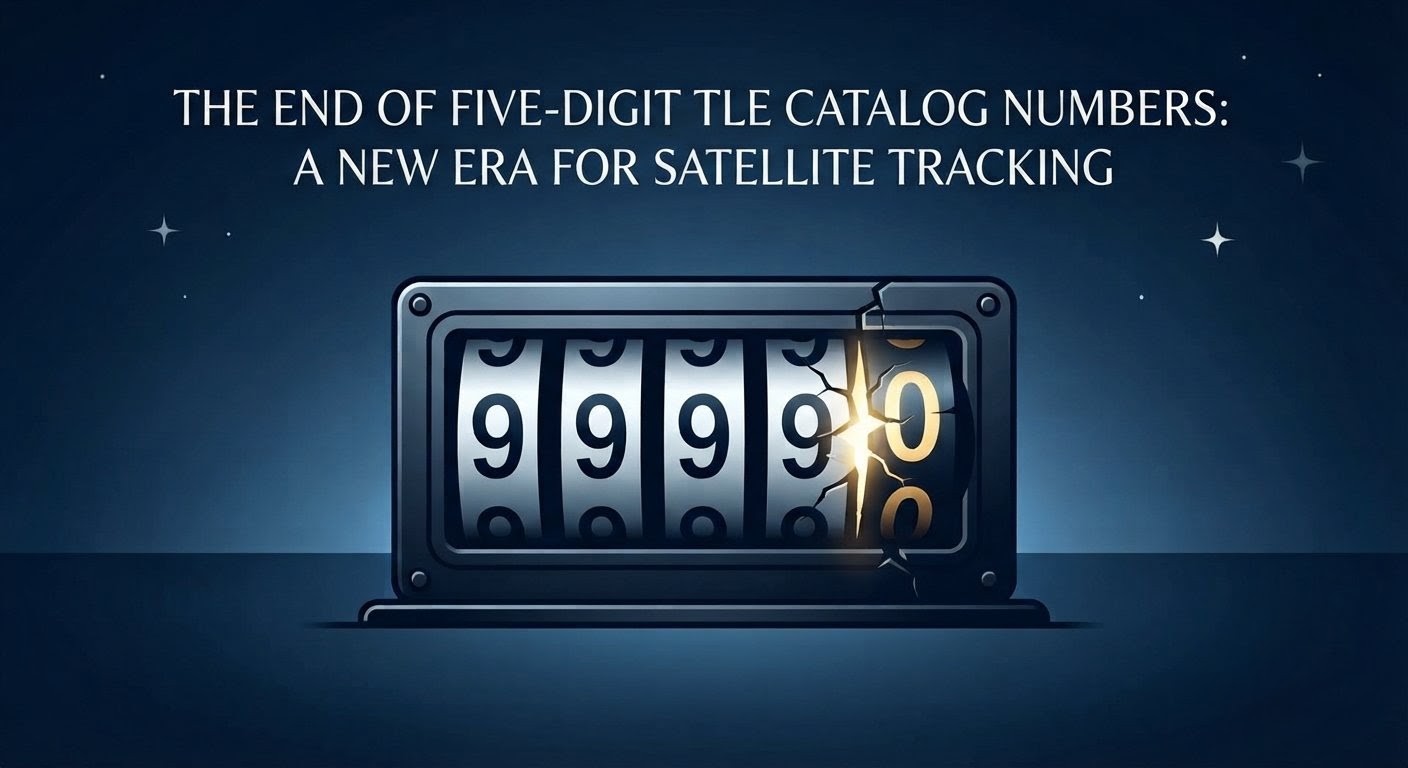
 Update: While this article was being prepared, the five-digit object catalog pool (1-6999) was exhausted. Newly cataloged objects now use IDs at 10000+, with modern GP packaging. The guidance below still applies - the transition is no longer "soon". It is here!
At the heart of every satellite pass, circle guide, and Doppler prediction lies a single, permanent numeric ID: the NORAD (North American Aerospace Defense Command) catalog number. Managed by the U.S. Space Force, this catalog is the backbone of all orbital tracking. However, the system is rapidly outgrowing the technical assumptions that have defined it since the age of punch cards.
This ID is the anchor around which the TLE (two-line element set) format was built. For decades, the industry has relied on this short, fixed-width text format to deliver orbit data to your station. When you (or your app) download a TLE, your software is specifically hunting for that ID within a rigid, pre-defined column layout - and that is where the trouble begins.
That file specification reserved only five character positions for the catalog number, strictly limiting them to digits. This design was perfectly suited for the punch-card systems of that era, but it created a legacy constraint.
Today, the number of tracked objects is surging due to increased launches, rideshares, and the deployment of massive constellations, combined with improved sensors that detect smaller debris and fragments. Although the volume of space traffic has changed, the software still relies on that original five-digit limit.
The public catalog is already approaching the end of its capacity (1 - 69999). As newly cataloged objects exceed this pool, they will outgrow the legacy pattern. When will this happen? The transition point is determined by the rate of orbital launches and debris detection, rather than a fixed calendar date.
What Happens When You “Update Keps”
Most satellite tracking systems rely on the same four steps:
1. Someone publishes orbit data for tracked objects (today, primarily Space-Track and CelesTrak).
2. Your software downloads that data and for some apps it's still in the classic TLE format.
3. The program reads each record, finds the catalog number, finds the orbital details (inclination, mean motion, and so on), and stores them.
4. Using these values it predicts when the satellite will be in view, it's path across the sky, and the Doppler impact to the frequencies of any transmissions.
When people say “update keps” or “update TLEs,” they mean step 2: refresh the orbital data the program uses. The program still has to complete step 3 correctly.
Step 3 is where the five-character limit impact is realized. The classic TLE is a fixed-width layout: each data element resides in a fixed location in the format. The catalog number occupies columns 3–7 on both line 1 and line 2 of a standard two-line set. Many programs were written expecting that location to always hold a simple numeric value. Because the TLE format is fixed-width, parsing logic treated this field as a string to preserve leading zeros, but often converted it into an integer to simplify sorting and database lookups. This created a legacy assumption: that the catalog number would always be an integer, an assumption that eventually breaks when the ID format changes or expands.
What Is Changing
The transition to six-digit IDs is not about renumbering existing satellites—they keep their five-digit IDs (the ISS remains 25544). The change is about how we handle newly cataloged objects that exceed the original five-digit capacity.
Catalog number ranges
In pure decimal form, the five-character TLE catalog field can write values up to 99999. However, the catalog does not use that full range for ordinary tracked objects:
1–69999 - Assigned to tracked objects (satellites, debris, and the like). This object pool is what is running out.
70000–99999 - Reserved for administrative use. Not available to be assigned to new objects.
As of July 7 2026, the catalog has reached 69935, leaving very little room under the old scheme.
100000 and above — new objects and new delivery formats
After the five-digit pool is exhausted, new objects receive catalog numbers starting at 100000 and they will not fit the classic TLE Five digit packaging layout.
Same orbit data, different packaging
For decades, operators have used mean element data for pass prediction — numbers that describe the orbit so software can project where the satellite will be. That product family is called GP (general perturbations). Tracking programs often consume GP data with SGP4 (Simplified General Perturbations 4) or similar models. A classic TLE was one common way to describe GP data in a short fixed-width text format. A new way is required to describe this data that scales to six-digit (and larger) catalog IDs.
Modern ways to package GP data
Today, publishers provide the GP product in formats that can hold a full integer catalog ID and descriptive field names, instead of opaque fixed strings of data.
OMM: a modern data format
One standard package is the OMM (Orbit Mean-Elements Message). CCSDS (Consultative Committee for Space Data Systems) defines OMM as a formal message for mean orbital elements. Think of it as a documented container for the same kind of element set you used to get from a TLE, without the rigid field size limitations.
Public GP distributions are provided in common machine-readable forms such as JSON, CSV, XML, and KVN (key-value notation). The data download options are no longer limited to classic TLEs.
Alpha-5: a stopgap
Alpha-5 is an encoding scheme that keeps the five-character TLE catalog field but allows a letter in the first position so larger IDs can be represented. A means 10, B means 11, and so on (I and O are skipped to avoid confusion with 1 and 0). The other four characters are digits. Example: A0000 is how the integer catalog ID 100000 is written in five characters. The field is still five characters wide, but the definition of those characters has changed. That legacy assumption has become a legacy trap. This scheme solves the data size problem but software has to be updated to decode that letter-and-digit scheme; if it still assumes five digits, it can fail or misread the ID.
What this means for software
1. New objects need software that can load full integer catalog IDs — from modern GP files (OMM and related formats), or by correctly decoding Alpha-5.
2. If an app only understands the classic five-digit TLE slot, the best case is that it gracefully omits or ignores new objects. Depending on how it handles bad or unexpected catalog fields, it may also fail an update, mis-label an object, or stop working all together.
Conclusion
Because newly cataloged objects will require full-integer IDs and modern GP packaging, the classic TLE text format is no longer a viable long-term solution. When working with element data, prioritize primary publishers and verify that your software supports full-integer catalog IDs. For a live readiness status of common tools and the legacy TLE format, see satellitehunter.com.
Reader Checklist
[ ] Does my software support IDs > 69999?
[ ] Can my app ingest OMM/JSON/CSV, or Alpha-5
[ ] Where can I find primary GP data? (Space-Track/CelesTrak)
Community list and channel links: bit.tz/cl, bit.tz/dr, youtube.com/@digital.rancher.
Learn more at satellitehunter.com
Interactive TLE Explorer — click the data field on a sample TLE to learn about the orbital elements defined within
Catalog Readiness — live board tracking the status of common satellite tools for 6 digit catalog ID and modern GP packaging readiness
References
Space-Track - Primary public catalog portal; GP data and documentation (including Alpha-5)
Space-Track documentation - Official format and API notes
CelesTrak GP elements - Public GP redistribution
CelesTrak GP formats - How modern GP files are structured
CCSDS OMM (502.0-B-3) - OMM standard
CelesTrak software tutorials - Implementation help for builders
AMSAT GP beta - Sample modern GP feeds (JSON / XML / KVN) for testing