

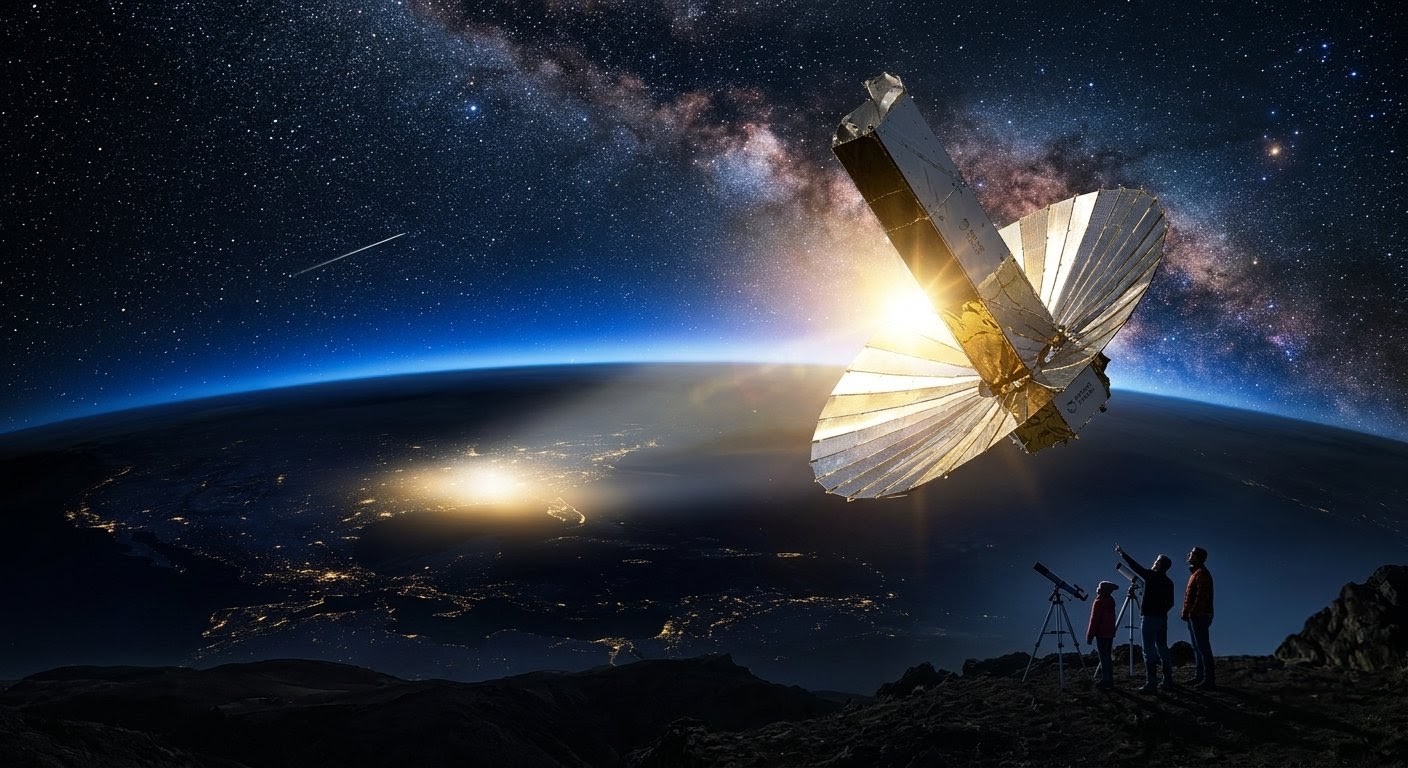
 Reflect Orbital is a U.S. company that wants to put large, thin mirrors in low Earth orbit and use them to redirect sunlight onto chosen places on the ground after local sunset. The first step is a demonstration satellite named Earendil-1. If the idea works at larger scale, the company describes a future service in which customers would pay for temporary light, and later for extra sunlight on solar equipment. That commercial vision is why the project draws attention. It is also why it is important to be precise about what regulators have and have not decided.
On 9 July 2026, the Federal Communications Commission (FCC) Space Bureau granted Reflect Orbital’s application for that demonstration satellite. The decision is DA 26-706, ICFS File No. SAT-LOA-20250701-00129. The application is titled as a request for authority to construct, launch, and operate a non-geostationary satellite. That wording is standard on satellite applications. The scope of the grant is narrower. The FCC authorized Reflect Orbital to deploy and operate a space station using radio frequencies in the UHF, S-band, and X-band.
In everyday terms, “space station” here means the satellite’s radio system: the equipment that transmits and receives by radio. The license covers telemetry, tracking, and command (TT&C): health and status data, tracking, and commands to the spacecraft, including commands used to deploy and steer the reflector. It also covers payload data downlinks, which send experiment and operations data to the ground. The FCC also reviewed radio interference and orbital debris under its satellite rules (Part 25). The license term is limited to about two years for this demo mission, as described in the order (roughly one year of operations plus time to deorbit).
Because the company’s long-term pitch involves redirecting sunlight, many readers will hear the FCC decision as approval of that whole business. The order does not work that way. The grant authorizes the radio operations needed to fly and control this one demonstration satellite. In the same decision, the Space Bureau states that concerns about the reflector’s effects on optical astronomy (telescopes and cameras that work with light, not radio) fall outside its review of the space station. This grant does not regulate the proposed service, its uses, or optical thresholds such as brightness.
Public reporting describes a company roadmap that starts with a demo and may grow to many thousands of satellites if the concept works and later applications are approved.
A longer discussion of the same topic aired on Late Shift on 24 July 2026: Late Shift: Reflect Orbital.
What the company plans to fly
Reflect Orbital is building satellites that carry a large deployable thin-film mirror. After the mirror unfolds in orbit, the satellite can point it so that sunlight that would otherwise miss a given ground area is reflected onto a chosen target. The result is a temporary bright patch on the night or twilight side of Earth.
This is not a laser weapon and not a laser power system. It is also not microwave space-based solar power (SBSP), where sunlight is converted to radio energy, beamed to Earth, and converted back to electricity. A mirror does not create energy. It only redirects existing sunlight. You cannot get more energy out of the system than the sunlight that hits the mirror allows.
Company materials and secondary reporting describe the planned Earendil-1 design roughly as follows. The satellite mass is on the order of about 140 kilograms (about 310 pounds). The mirror is about 18 meters by 18 meters, or about 59 feet by 59 feet (roughly 324 square meters, or about 3,500 square feet), a thin reflective film folded for launch and deployed in orbit. The intended orbit is low Earth orbit (LEO), roughly in the 600-650 kilometer altitude class (about 370-400 miles), with sun-synchronous geometry, an orbit family often used so the satellite sees similar lighting conditions on repeated passes. The FCC grant describes related altitude and inclination limits for this mission. The ground spot is on the order of about five kilometers (about three miles) across. Useful light from a single satellite pass lasts only a few minutes, because the satellite moves quickly across the sky. Pointing uses control moment gyroscopes (CMGs), devices that reorient the spacecraft without large thruster firings for every turn. The company describes an “off” mode that tilts the mirror so the ground is not illuminated when service is not requested. Longer light or brighter light would require many satellites timed over the same place.
If a commercial service worked as the company describes, a customer would request light for a location and time window. Reflect Orbital says service would run only where allowed by applicable local or other rules. One or more satellites that can see both the Sun and the target would point their mirrors. The bright spot would follow the site for the short time geometry allows, then the mirror would be pointed away when the window ends. A large constellation would be needed for longer sessions, higher brightness, or many customers at once.
Proposed uses
On the energy side, if many mirrors could add useful sunlight on solar farms after sunset, those farms might produce more evening electricity without adding panels for that time of day. Remote sites, mines, and disaster recovery might use temporary light without hauling generators, and the light itself would not require new infrastructure. Those ideas face hard limits. Short passes in low Earth orbit mean many satellites for long sessions. Building and flying a large fleet has high cost and adds collision and debris risk. Whether reflection ever costs less than batteries or other storage for evening solar is not proven. Early company language about brightness is often in lighting terms (how bright things look). Later energy language is about power per area on the ground, such as watts per square meter (about 0.09 watts per square foot for the same intensity).
Agriculture and civil lighting are also part of the pitch. Plants and farming schedules depend on day length (photoperiod). Research plots, greenhouses, or high-latitude seasons are sometimes mentioned as possible users. Disaster response, search and rescue, construction, and events are easier near-term lighting stories than powering the grid from orbit. Crop and climate benefits should be treated as unproven and speculative.
Public reporting also cites an AFWERX Small Business Innovation Research (SBIR) award (a U.S. Air Force innovation path) on the order of about $1.25 million for Phase II. Company materials discuss contingency lighting and power support. The same kind of system could interest both civilian and military customers. That does not make the demo satellite a weapon. It does mean who the customers are, and what rules apply to them, matter as much as the hardware.
Concerns and open questions
For optical astronomy, the problem is structural: making light on the ground at night is the product, not an accidental glint from a solar panel. Researchers and observatories, including discussion linked to the European Southern Observatory (ESO) and others in 2026, have argued that large reflector constellations could be among the brightest proposed systems: very bright inside the main beam, still noticeable outside it, and able to raise background sky brightness enough to harm wide-field surveys such as those planned for the Vera C. Rubin Observatory. Exact numbers depend on design and fleet size. The core conflict remains even if the numbers change: dark-sky science and a commercial night-lighting service pull in opposite directions. DarkSky International and other groups have opposed the concept on night-sky and related grounds.
In DA 26-706, the Space Bureau states that its authorization is for the radio station (radio-frequency use and orbital debris), not a full environmental review of reflected sunlight. Optical-astronomy impacts are treated as outside that review and not a basis to deny the license or to add special brightness conditions beyond the company’s stated commitments. The order records Reflect Orbital’s commitments to work with NASA, the National Science Foundation (NSF), and the wider astronomy community.
Other U.S. processes still apply to other parts of a mission. For example, Federal Aviation Administration (FAA) processes address launch and reentry. State and local rules may address light at night on the ground. There is not yet a single U.S. license whose main job is how bright a commercial satellite may make the sky. That is a real policy gap, and it needs to be addressed before large reflector fleets, not after the first big deployment has already set the standard.
Night also matters for human sleep cycles, wildlife, insects, and marine life that already deal with ground light pollution. Light from orbit would be an additional source. Fairness questions follow: who can buy temporary daylight, and who lives under spill light they did not request? Liability questions follow: mis-pointing, glare for pilots or drivers, or light that crosses a border.
Engineering limits are straightforward. One satellite can deliver only a few minutes of useful light on each pass. A large thin mirror also presents a large cross-section in orbit, which matters for collision risk and debris analysis. The FCC reviewed debris plans for this single satellite under its rules; any future large fleet would need its own application and face its own challenges.
Success is not guaranteed beyond the demo. The technology might remain useful for short lighting tests and never deliver enough ground power to matter for solar farms. Reflect Orbital also makes safety claims: that the spot can be kept within a defined area, that illumination can be stopped by tilting the mirror away, and that the light will not be concentrated beyond natural sunlight levels. Those claims still need to be proven in practice, not only in presentations and filings.
Earlier attempts
Redirecting sunlight from orbit is not a new physics idea. What is new is a private company treating it as a product to sell, with venture funding and a modern regulatory path for a demo satellite.
People have written about space mirrors for a long time. In the early twentieth century, Hermann Oberth described large mirrors in space for lighting and climate-related ideas. Those were concepts on paper, not commercial services.
The closest real flight test came much later. In 1993, Russia flew Znamya 2, a reflective sail about 20 meters (about 66 feet) across, released from a Progress spacecraft associated with the Mir program. For a short time it produced a bright spot on the order of five kilometers (about three miles) wide over parts of Europe. That experiment is the main flown predecessor people compare to Reflect Orbital’s mirror class. A follow-on attempt, Znamya 2.5, failed during deployment in 1999.
What has changed since those earlier efforts is the setting. Low Earth orbit is busier. Large satellite constellations have already forced public fights over astronomy, debris, and licensing. Reflect Orbital arrives in that environment: not the first to imagine orbital light, but one of the first to try to productize steerable reflected sunlight with today’s launch market and today’s spectrum process.
Common misunderstandings
Three mix-ups show up often in short summaries. They are about the present demo and the July 2026 grant, not about far-future fleets.
First, the FCC decision is easy to overstate. The Commission authorized radio use for one demonstration space station and reviewed debris plans under its rules. It did not issue a general approval of commercial sunlight as a product, and it did not set brightness rules for the night sky.
Second, the hardware is a steerable mirror. It is not a laser and not a microwave power-beaming system. It does not create energy; it only redirects sunlight that already exists.
Third, one low Earth orbit satellite cannot light a city all night. A single pass can put light on a spot for only a few minutes. Longer sessions or more light would require many satellites working over the same place over time. That is a constellation and operations problem, not a feature of Earendil-1 alone.
How the technology might evolve
It is fair to ask where steerable orbital mirrors could go if the demo works. One useful lens is early science fiction and technology. In the 1930s, rockets, global radio and television, nuclear power, and machine computation often sounded like pure fantasy. Roughly a century later, related capabilities exist in some form, not as the stories pictured them, and not all at once. Many ideas stayed fiction; others needed orders-of-magnitude gains in industry and institutions. “Impossible then” is a weak argument by itself; “inevitable now” is just as weak.
Military interest belongs in that long view. Rockets, early networks, satellite navigation, and much of the launch industry started with defense money and later found wide civilian use. That mix does not make every system a weapon, but early government funding does put security questions on the table. That pattern is already visible here. Public reporting describes an AFWERX Small Business Innovation Research (SBIR) award (a U.S. Air Force innovation path) on the order of about $1.25 million for Phase II work. Company materials also discuss contingency lighting and power support for defense customers. Those points show early interest and research funding. They do not mean Earendil-1 is destined to be an operational military asset.
Near term is what the current license is about. Success means the mirror deploys, points sunlight, and turns off as claimed.
Further up the ladder, more satellites could stack light for longer sessions. That is where evening support for solar farms, limited agriculture trials, and more serious contingency lighting for military use or disaster response become realistic topics, but only if cost and operations work. Night operations support and better use of cameras and sensors in dark areas would also need a much larger fleet, plus clearer rules on spill light and government control of the fleet.
Far up the ladder, and many orders of magnitude away, are continuous regional lighting, light sold like infrastructure, space-to-space power, climate-scale ideas, and security concepts such as lighting a whole theater or denying an adversary the natural night. Those are long-horizon thought experiments, not next year’s product features. Defense budgets can push technology that serves both civilian and military customers up this ladder faster than commercial demand alone. Markets, treaties, and public pushback still help decide what gets built.
Stay curious, not credulous. Ask what the next step needs, how many mirrors, who pays, who must agree, and how long it might take. Success on one satellite is still just the first rung on a challenging ladder of innovation.
Questions that still need answers
Several policy questions remain open. Who may order light over people who did not request it? How are observatories and dark-sky areas protected if brightness is the product? Who is liable for spill light, glare, or cross-border illumination? How should civilian and military customers be disclosed and limited? Which agency, if any, should set rules for commercial reflected sunlight before large fleets are proposed?
One demo satellite does not end the night sky. Leaving the rules undefined while the technology is still small means the first large deployment will set precedent by default.
Where to learn more
Funding totals, brightness roadmaps, and constellation sizes move as reporting updates. Prefer primary documents when a number matters.
Reflect Orbital: company product and plans
FCC DA 26-706: Order and Authorization for Earendil-1 (SAT-LOA-20250701-00129); radio space-station authority in UHF, S-band, and X-band; optical astronomy treated as outside that review
Late Shift: Reflect Orbital (24 July 2026): longer discussion of the same topic
SpaceNews: FCC approves first Reflect Orbital satellite: secondary reporting on the July 2026 grant
ESO public note: large or bright satellite constellations: astronomy impact discussion, including Reflect-class mirrors
Hainaut study PDF (ESO archive): peer-reviewed constellation brightness analysis
DarkSky International organizational statement on Reflect Orbital: opposition and night-sky framing
DarkSky: orbital illumination systems explainer: risks of orbital illumination systems
Wikipedia: Znamya (satellite): 1990s flown space-mirror experiments (Znamya 2 and 2.5)
BBC Culture: How Russia launched a giant space mirror in 1993: accessible Znamya history
Wikipedia: Hermann Oberth: early spaceflight and space-mirror concepts
Reflect Orbital AFWERX SBIR Phase II announcement: company release on about $1.25 million Phase II award
AFWERX: What is the SBIR/STTR program?: program background
satellitehunter.com: satellite tools and explainers
Community list: bit.tz/cl
Digital Rancher link tree: bit.tz/dr