

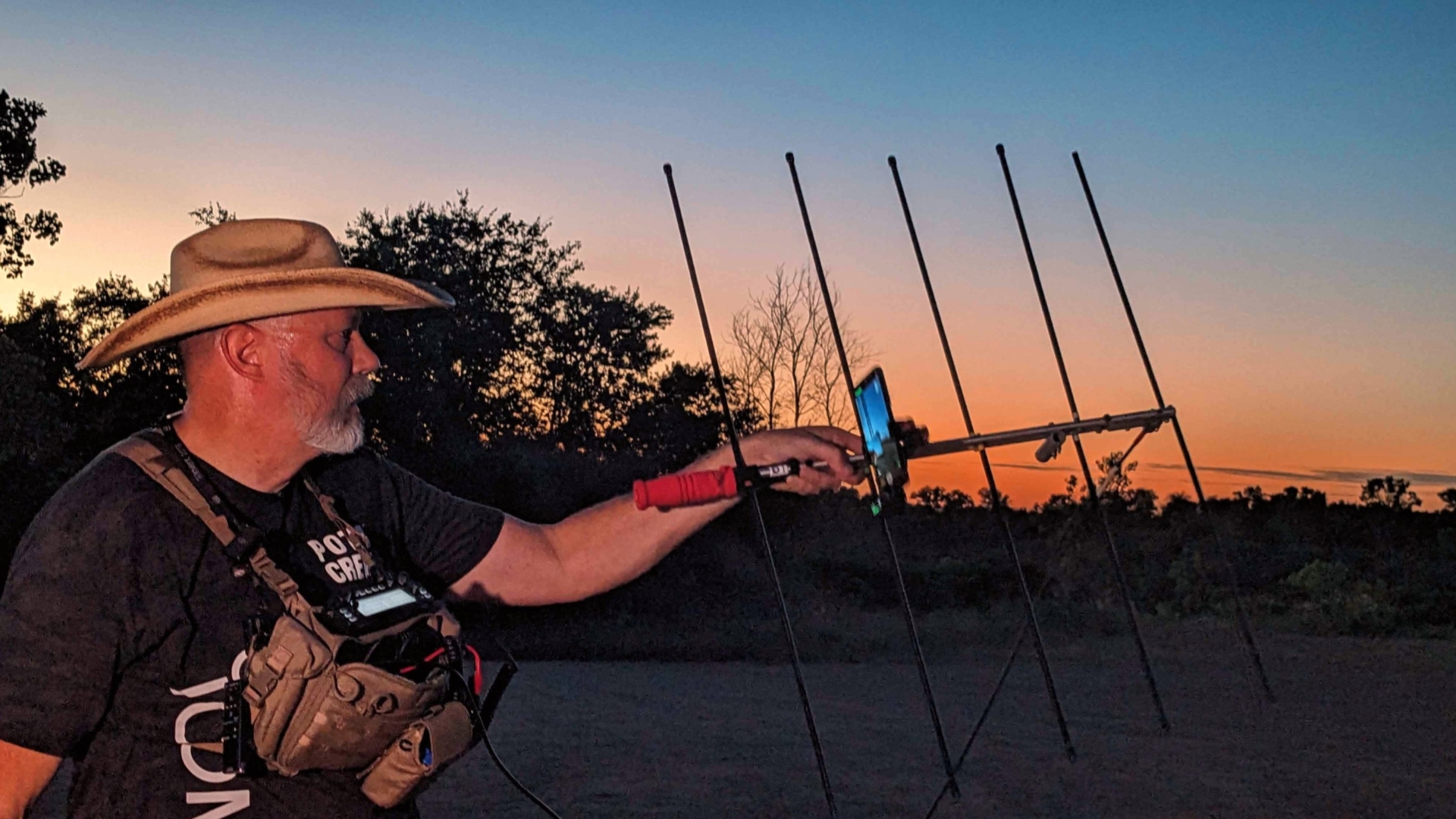
 ARRL Field Day and AMSAT Field Day run the same weekend — 1800 UTC Saturday, June 27 through 2100 UTC Sunday, June 28, 2026 — but they are not the same contest.
ARRL Field Day treats satellites as a bonus: one FM pass can check a box. AMSAT Field Day is built around the birds themselves. Linear transponders, CW, digital modes, and careful FM discipline all matter. If you are packing up for a portable site this weekend, it helps to know which satellites are in play, which modes they support, and where the rules draw the line.
This article pulls together the current AMSAT guidance from amsat.org/field-day and the live satellite pages linked below. Check amsat.org/status before you go — satellite health changes week to week.
Quick Rules That Change Your Strategy
Before the satellite list, four AMSAT Field Day rules that shape how you operate:
FM voice satellites: one completed QSO each. Every bird on the live FM satellites page counts — but only one scored contact per satellite. Plan one clean pass per bird and move on.
Linear transponders: multiple QSOs welcome. SSB and CW on the live linear satellites list can keep you busy all weekend. Each phone, CW, and digital segment on each transponder counts as a separate band for scoring purposes.
CW and digital count triple. CW, RTTY, PSK31, and verified APRS/digipeat exchanges score 3 points each. Analog phone is 1 point.
No gateways. EchoLink, IRLP, and other internet/terrestrial gateways are not allowed for AMSAT Field Day contacts.
Submit AMSAT Field Day scores by 11:59 PM CDT, Tuesday, July 28, 2026 to [email protected] (cc [email protected]). Use the Satellite Summary Sheet at the end of the rules document: PDF or DOCX. Include any SSTV or image files you captured during the event. AMSAT has also asked operators to send Field Day photos and short anecdotes for a follow-up piece in the AMSAT Journal — include those with your submission.
North America: Two Birds to Skip
Most satellites on the AMSAT live lists are normal LEO passes over North America. Two exceptions worth calling out before you build a pass list:
QO-100 (Es’hail-2) is geostationary at 25.9°E — not visible from North America. Operators in Europe, Africa, the Middle East, and western Asia can work it; continental NA stations should not plan around it.
IO-86 (LAPAN-A2) is a low-inclination equatorial bird. AMSAT notes Field Day activation over Central America with roughly 5° max elevation at Miami and 1° at Houston — not practical for most US and Canadian sites. Southern Florida, Caribbean-adjacent locations, and Hawaii may fare better.
Everything else below gets regular passes over North America. Run your predictions and focus there.
FM Voice Satellites (One QSO Each)
These are the satellites most Field Day operators already know — handheld-friendly, FM repeater style, usually busy. AMSAT limits you to one scored contact per satellite, so pick your pass and make it count.
Frequencies and tones: amsat.org/live-fm-satellites
Plan for these FM birds (one QSO each):
SO-50 (SaudiSat-1C) — arm if you hear nothing; unlikely with Field Day traffic
AO-91 (RadFxSat / Fox-1B) — avoid eclipse passes; battery is marginal
AO-123 (ASRTU-1) — also transmits SSDV images
PO-101 (Diwata-2) — on the status page; work sunlit passes only — bird is failing
RS95S (QMR-KWT-2) — on intermittently; watch status page and AMSAT-BB; also does SSTV
CAS-3H (LilacSat-2) — no fixed FM schedule; verify before the pass
TEVEL2-3, TEVEL2-5, and TEVEL2-7 — only these three are currently active; one QSO per bird
ISS — one voice QSO if the FM repeater is active; check ARISS status
ARRL bonus tip: With several FM satellites available this year, you have more options to snag the ARRL satellite bonus without fighting the SO-50 pileup alone. Still — for AMSAT scoring, one per bird.
Linear Transponders (SSB / CW - The AMSAT Sweet Spot)
This is where AMSAT Field Day diverges from the FM handheld crowd. Inverting SSB transponders support multiple simultaneous contacts and reward patience, tracking, and modest antennas.
Frequencies and passbands: amsat.org/live-linear-satellites
AMSAT specifically calls out AO-7, RS-44, AO-73, FO-29, and JO-97 as less congested and well worth your time during Field Day. Expect 20-meter-weekend energy on the pass.
Plan for these linear birds (SSB/CW — multiple QSOs welcome):
AO-7 Mode B (U/v) — sunlight only; the mode most NA stations chase
AO-7 Mode A (V/a) — 10m downlink when active; less common than Mode B
RS-44 — reliable Field Day workhorse
FO-29 (JAS-2) — schedule and battery dependent
AO-73 (FUNcube-1) — check status page and AMSAT-BB for transponder schedule
JO-97 (JY1Sat) — narrow passband
CAS-6 (TO-108) — intermittent transponder; verify live before the pass
No FM on linear birds. Low duty-cycle modes only — SSB and CW.
Digipeater Satellites
Verified APRS digipeater contacts score 3 points each. The one-QSO-per-FM-satellite limit does not apply to digital transponders.
Frequencies and callsigns: amsat.org/live-digipeater-satellites
Plan for these digipeaters (3 points per verified exchange):
ISS — standard ARRL exchange via packet; 3-way exchange required
SONATE-2 — also listed on the image satellites page for SSTV
NO-44 — check current status before the pass
KNACKSAT-2 — verify activity on the status page
CroCube — new satellite; limited digipeater activity so far
RS-44 and other linear transponders may also carry PSK31 and digital modes on their passbands — those count as 3-point digital contacts on the appropriate transponder segment.
Image and SSTV Satellites
If any of these satellites transmit images during Field Day, capture the files and include them with your scoring submission alongside the summary sheet.
Frequencies and modes: amsat.org/image-transmitting-satellites
Monitor these for SSTV or SSDV during the weekend — attach any captures to your AMSAT submission:
ISS — check AMSAT Status and ARISS for SSTV events
RS40S (UmKA-1) — watch AMSAT-BB and Libre Space Community for schedule
RS95S (QMR-KWT-2) — also on the FM list; on intermittently — watch status page
SONATE-2 — schedule-dependent
AO-123 (ASRTU-1) — SSDV images documented on AMSAT page
SO-127 (HADES-SA) — SSDV image identifiers 0–255
How This Maps to a Field Day Site
A workable split for a multi-operator portable site:
FM station: Rotate SO-50, AO-91, AO-123, and RS95S passes for ARRL bonus + one AMSAT FM QSO each
Linear station: RS-44 and FO-29 for sustained SSB/CW activity; AO-7 when Mode B is sunlit
Digital op: ISS, SONATE-2, or CroCube digipeater passes; monitor image satellites for SSTV/SSDV captures to attach to your submission
That is roughly the plan we are running at KN5TR in northeast Texas this weekend — FM birds for the ARRL bonus, linear birds for AMSAT Field Day.
Pre-Flight Checklist
Update your grid square/location and pull fresh TLEs and run pass predictions (AMSAT online pass predictions / TLE resources)
Check amsat.org/status within 48 hours of Field Day
Bookmark the live satellite pages: FM · Linear · Digipeaters · Image/SSTV
Pre-program all the satellites you intend to work
Verify your kit is complete and operational, including a charged voice recorder and your radio batteries
Download the Satellite Summary Sheet (PDF) or DOCX for logging
Conclusion
AMSAT Field Day is the excuse to point your antennas up and keep them there. The FM satellites get crowded fast — know the one-contact rule and do not camp on the FM birds. The linear transponders are where the real AMSAT weekend happens, and this year there are more than ten transponders and repeaters in the mix.
Work the birds, log your contacts, attach any SSTV captures, and send your summary sheet to AMSAT by July 28. AMSAT is also collecting Field Day photos and anecdotes for a follow-up in the AMSAT Journal — send those along with your submission. If you are on the air this weekend, I’d love to hear what you worked — drop a comment or catch me on a pass.
73 from the ranch.