

Not Getting SEO Results? Learn Practical SEO Training
Many businesses and site owners dedicate a lot of time to SEO optimization but are unable to get higher rankings in searches, organic traffic and visibility for their websites. They do blog posts consistently, incorporate keywords into the web pages and acquire backlinks but their website fails to respond to these activities. This may be caused by the absence of SEO expertise and its application.
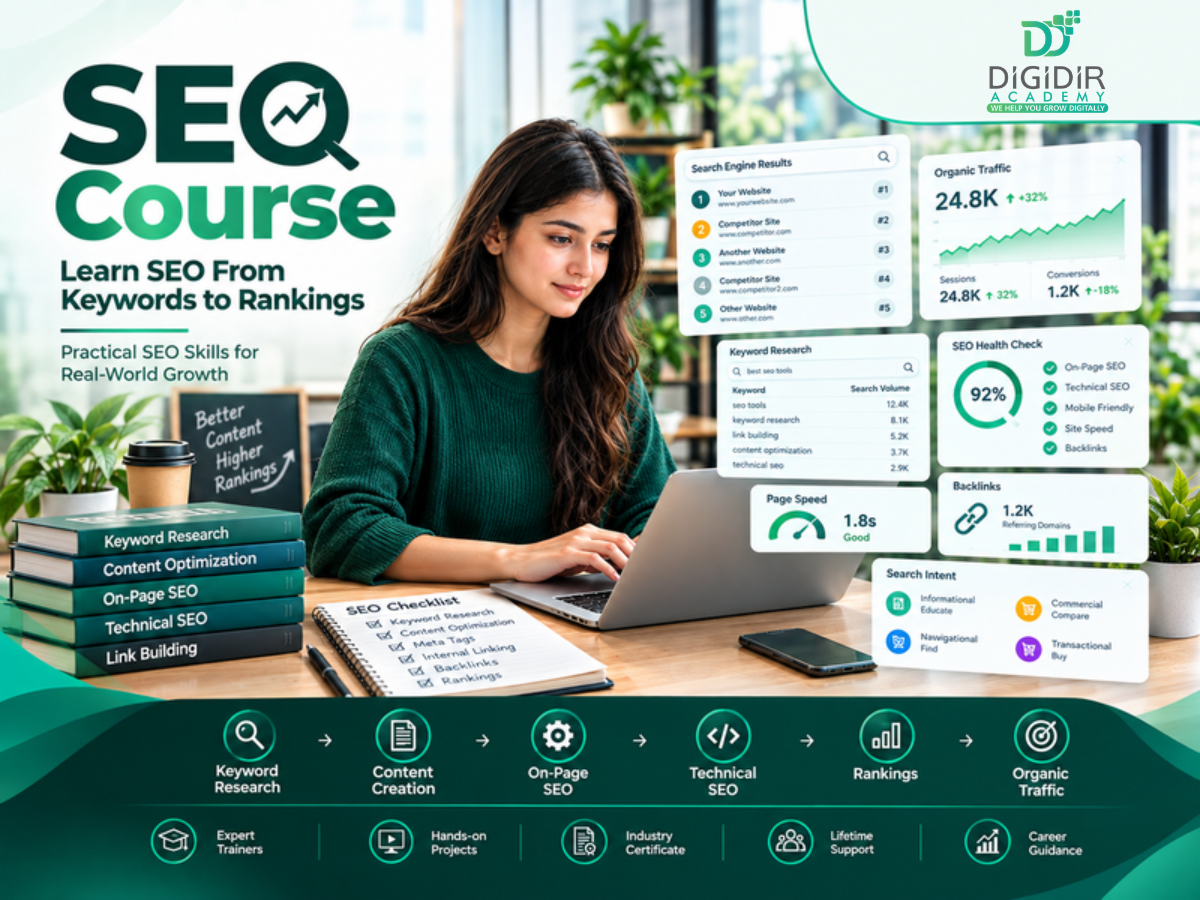
Learning how search engines work and how to apply effective optimization techniques can make a significant difference. An SEO certification course provides step-by-step instructions for students to understand the basics of search engine optimization, learn to diagnose problems with their website, and gain the skills needed to optimize their website.
Why Do Websites Struggle to Get SEO Results?
SEO involves more than adding keywords to website content. It requires a combination of technical improvements, quality content, keyword research, and a better understanding of search intent.
Here are some common reasons why websites fail to achieve their SEO goals:
1. Choosing the Wrong Keywords
Targeting keywords without understanding what users are searching for can bring irrelevant traffic. For example, a website may target broad keywords with high competition instead of focusing on specific search terms that match its products or services.
Proper keyword research helps identify relevant search queries, understand user intent, and select keywords that align with website goals.
2. Ignoring On-Page SEO
On-page SEO helps search engines understand website content and its relevance to user queries. Missing title tags, poorly written meta descriptions, incorrect heading structures, and weak internal linking can affect page optimization.
Understanding these elements helps website owners create well-structured and search-friendly pages.
3. Overlooking Technical SEO
Technical issues can make it difficult for search engines to crawl and index website pages. Problems such as broken links, slow-loading pages, duplicate content, and poor mobile usability may affect website performance.
Learning technical SEO helps identify these issues and understand how to address them.
4. Publishing Content Without a Clear Strategy
Publishing content regularly does not automatically improve search rankings. Content should answer relevant questions, provide useful information, and match the search intent of the target audience.
A well-planned content strategy focuses on topic relevance, useful information, natural keyword placement, and content quality.
How Practical SEO Training Helps Solve These Problems
Reading SEO blogs and watching tutorials can help beginners understand basic concepts, but applying those concepts to real websites requires practice.
Practical SEO training helps learners understand how different optimization activities work together. Instead of focusing only on definitions, learners can develop the ability to research keywords, analyze websites, identify optimization opportunities, and understand SEO performance.
Important areas of practical SEO learning include:
1. Keyword Research and Search Intent
Keyword research is one of the first steps in an effective SEO strategy. Learners understand how to find relevant keywords, analyze search intent, identify long-tail opportunities, and organize keywords according to website pages.
This knowledge helps create content that addresses what users are actually looking for.
2. On-Page SEO Optimization
On-page SEO training covers essential elements such as:
SEO-friendly title tags and meta descriptions
Proper H1, H2, and H3 heading structures
Keyword placement and content optimization
Internal linking strategies
Image optimization and descriptive alt text
URL structure and page relevance
These practices help make website pages more understandable for both search engines and visitors.
3. Technical SEO Fundamentals
Technical SEO focuses on the website's structure and performance. Learners can develop an understanding of crawling, indexing, XML sitemaps, robots.txt, canonical tags, website speed, mobile usability, and broken links.
These skills help identify technical barriers that may affect search visibility.
4. Off-Page SEO and Link Building
Off-page SEO involves activities that help establish a website's online presence and authority. Practical learning introduces different approaches, including relevant business listings, digital PR, quality link building, and brand mentions.
The focus should remain on relevance and quality rather than simply increasing the number of backlinks.
5. SEO Performance Tracking
SEO requires continuous monitoring and improvement. Learners should understand how to use tools such as Google Search Console and Google Analytics to evaluate website performance.
Important performance indicators include organic clicks, impressions, search queries, average search positions, and user engagement. These insights help identify opportunities for further optimization.
How AI Is Changing Modern SEO Practices

Artificial intelligence is influencing how digital marketers research keywords, analyze content, and understand search trends. Modern SEO professionals can use AI-powered tools to support their research and content planning activities.
AI can help with:
Generating keyword and topic ideas
Understanding search intent
Identifying content gaps
Creating content outlines
Analyzing competitor content
Supporting content optimization
However, AI-generated content still requires human review, factual accuracy, originality, and useful insights. AI tools should support SEO professionals rather than replace their understanding of search optimization.
Learning how to combine traditional SEO techniques with AI-powered tools can help learners adapt to changing search technologies and marketing practices.
Why Choose an SEO Course for Skill Development?
A structured SEO course provides a learning path for understanding different aspects of search engine optimization. It helps beginners move from basic concepts to more advanced optimization practices.
An SEO certification course can also provide a structured way to learn and demonstrate knowledge of important SEO concepts. However, a certificate alone does not guarantee rankings or employment. Practical understanding, consistent learning, and the ability to apply SEO strategies are equally important.
Learners interested in broader digital marketing knowledge can also explore a digital marketing certification course covering SEO, social media marketing, Google Ads, content marketing, and other online marketing skills.
Develop Practical SEO Skills with DigiDir Academy
For learners who want to understand search engine optimization beyond theory, choosing a practical learning platform is an important step.
DigiDir Academy is a digital marketing learning platform based in Noida, offering digital marketing training for students, beginners, aspiring digital marketers, freelancers, and working professionals.
Its learning areas include SEO, Social Media Marketing (SMM), Google Ads, video creation, and AI-powered digital marketing. The focus is on helping learners understand essential marketing concepts, modern tools, and practical applications.
Learners interested in developing their SEO knowledge can explore an SEO course, practical SEO training, and SEO certification course to build a stronger foundation in keyword research, on-page optimization, technical SEO, off-page SEO, and performance analysis.
Conclusion
Not getting the expected SEO results can be frustrating, especially when optimization efforts do not produce meaningful improvements. However, understanding the reasons behind poor performance and learning the correct optimization techniques can help address these challenges.
Practical SEO training provides an opportunity to develop skills in keyword research, content optimization, technical SEO, link building, and performance tracking. By combining these skills with modern AI-powered tools and continuous learning, aspiring digital marketers can become better prepared to handle real-world SEO challenges.
Contact Details-
Our location- 201, Second floor, D-247/ 4A, Block, Sector 63, Noida, Uttar Pradesh 201309
Email us- [email protected]
Call us- +91-8882811078