

Surrogate markers are intended to stand in for clinical outcomes we care about:
The US Food and Drug Administration defines a surrogate as "a laboratory measurement or physical sign that is used in therapeutic trials as a substitute for a clinically meaningful end point that is a direct measure of how a patient feels, functions, or survives, and that is expected to predict the effect of therapy." [Perry T]
For example, some researchers believe that LDL is a surrogate marker for clinical outcomes. Although LDL and clinical outcomes are distinct entities, they interpret changes in LDL as equivalent to changes in clinical outcomes, due to an apparent association between the two.
However, as the Institute for Quality and Efficiency in Health Care wrote:
The demonstration of a correlation between the surrogate and the clinical endpoint is in itself insufficient to validate a surrogate.
In other words, a mere association or correlation between two variables does not mean that one is a valid surrogate of the other. We require more.
Validating LDL
In part, a surrogate marker is validated by demonstrating a strong association between the surrogate and clinical outcome. Specifically, a treatment effect on the surrogate should predict, with high accuracy, the treatment effect on the outcome.
On April 22, 2024, Wallach and colleagues published an analysis that evaluated the strength of association between alleged surrogate markers and clinical outcomes. They included 37 markers, including LDL cholesterol (the focus of this post).
For LDL, their analysis was based on 11 published meta-analyses, each of which evaluated the association between LDL and clinical outcomes such as cardiovascular disease and mortality outcomes.
The strength of association was assessed by standard methods (correlation coefficients and coefficients of determination) and defined "according to criteria proposed by the Institute for Quality and Efficiency in Health Care (r ≥ 0.85 or R2 ≥ 0.72)."
The Results
If LDL were a valid surrogate, as LDL-lowering supporters claim, Wallach and colleagues should have found consistent evidence of strong associations between treatment-induced changes in LDL and clinical outcomes.
But this was not the case.
According to the authors, only one out of the 11 meta-analyses reported high-strength coefficients of determination. As a result, strong or moderate evidence was lacking for LDL as a surrogate marker, and the evidence for most outcomes was "weak" or "limited."
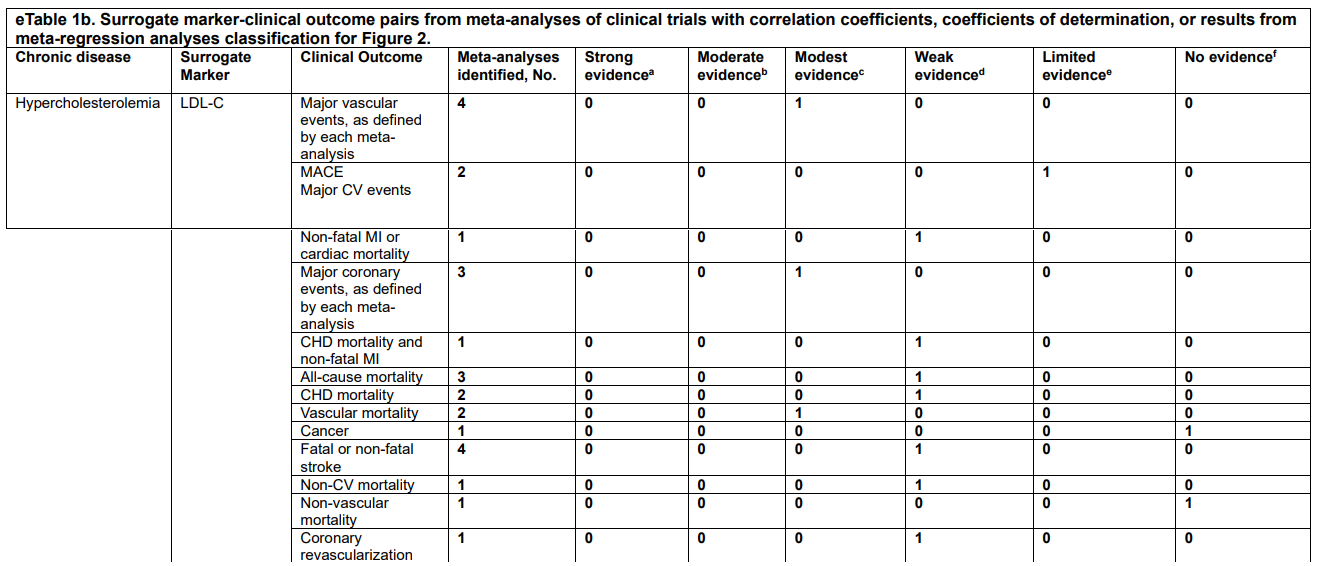
(Image: Adapted from Wallach et al. The evidence system here penalizes incomplete reporting, weak associations, and statistically nonsignificant results. Note all the zeros under the "Strong evidence" and "Moderate evidence" categories, indicating insufficient evidence for LDL as a valid surrogate for all-cause mortality, CHD mortality, major cardiovascular events, etc.)
Notably, these conclusions were also supported by the findings of Ennezat et al. (2023) and Byrne et al. (2022), who reported inconsistent, weak, and statistically nonsignificant associations between treatment-induced changes in LDL and clinical outcomes.
In the end, Wallach et al. found that only three markers had sufficient evidence of surrogacy for a clinical outcome:
Only 3 surrogate markers, FEV1 for chronic obstructive pulmonary disease for the outcome of time to first occurrence of a moderate to severe exacerbation, hemoglobin A1c for type 2 diabetes mellitus for the outcome of fatal stroke, and proteinuria for primary glomerular disease treatment, were found to have consistent evidence from published meta-analyses demonstrating a high-strength treatment effect association with a clinical outcome [Wallach et al.].
Fast Forward the Following Year
If that wasn't enough, in February of this year, another independent group published an analysis with the prime objective to determine whether LDL cholesterol and non-HDL cholesterol are reliable surrogates of cardiovascular events.
Unlike Wallach and colleagues, these French researchers (Liaigre and colleagues) focused on statin trials alone, which is often regarded as the best evidence for the use of LDL as a surrogate marker.
Because they set out to test "trial-level" surrogacy, the data were based on meta-analyses of randomized trials. In total, they included 20 randomized trials and a total of 194,686 participants.
Another Blow for LDL
After running their analyses, Liaigre et al. found that associations between reductions in LDL and reductions in clinical outcomes were "weak." Thus, estimated R2 values ranged from 0 to 0.1, meaning that variations in LDL could not reliably "explain" variations in clinical outcomes.
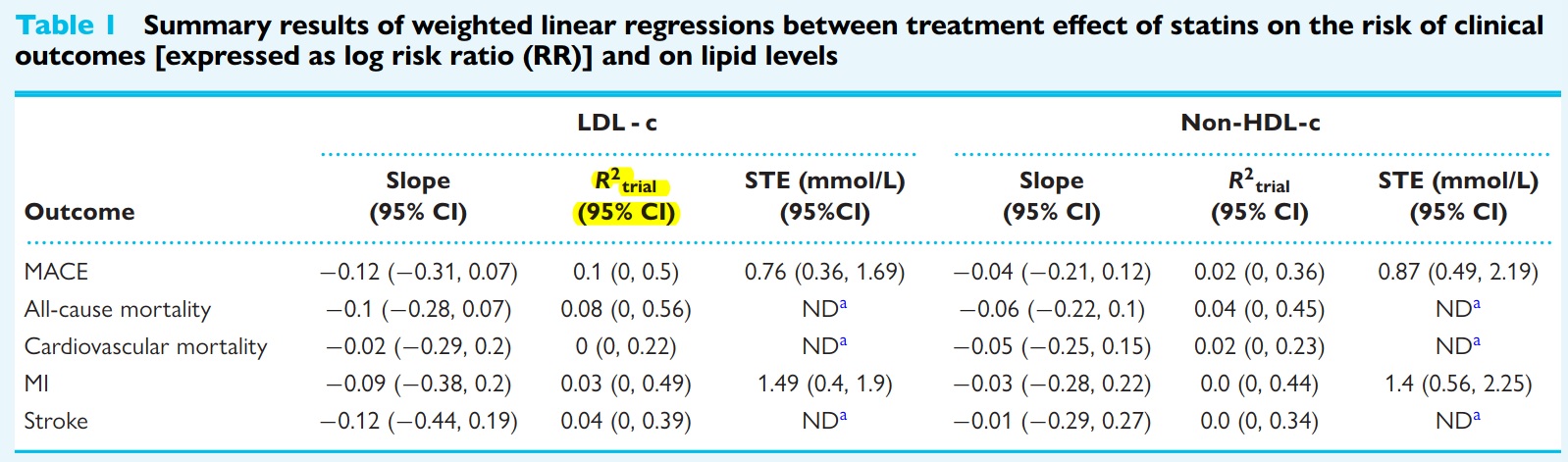 (Image: Note the R2 values and their confidence intervals)
In conclusion, Liaigre et al. wrote:
Neither non-HDL-c nor LDL-c should be relied upon as surrogate markers for predicting treatment effects on clinical endpoints in pivotal clinical trials.
Recent Findings on Atherosclerosis
In my book, I cited many analyses showing little to no association between LDL and atherosclerosis, and several papers published since have further confirmed this position.
Rivera et al. (2024) assessed the relationship between LDL and PAV or percent atheroma volume (their primary measure). Interestingly enough, there was apparently no association between LDL and PAV across trials on meta-regression, although this was not explicitly stated. (I did email the lead author to confirm, but they never responded. I can only suspect they buried an inconvenient finding.)
More importantly, a few studies published in 2024 and 2025 reported individual-level data on atherosclerosis.
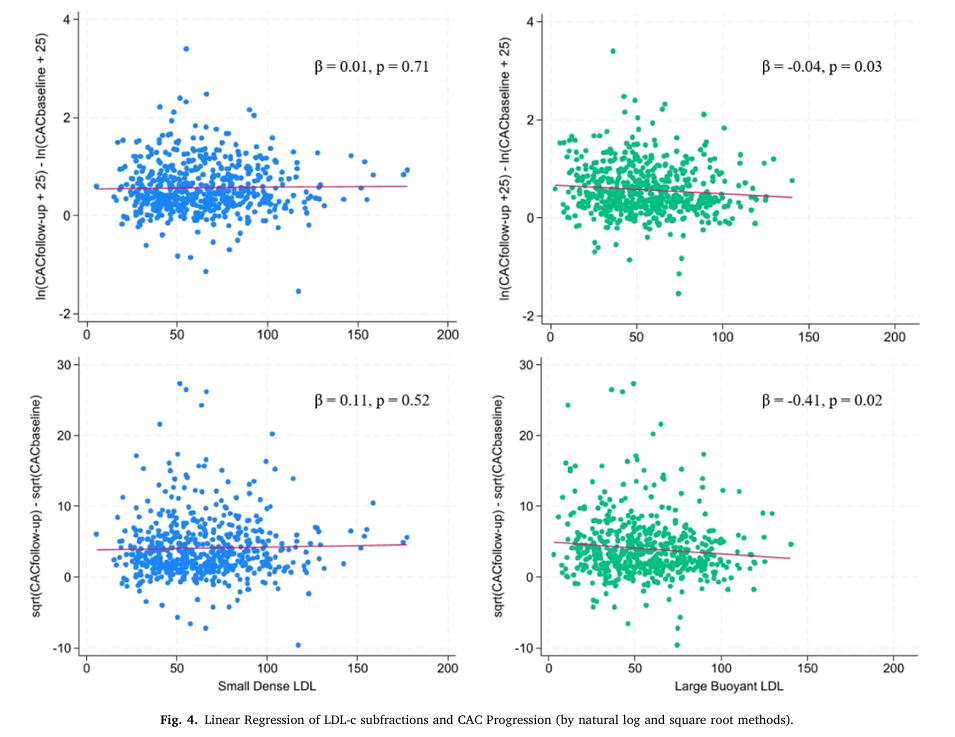
In the ELSA–Brasil cohort, published in 2025, LDL cholesterol was not associated with coronary calcium. If anything, larger LDL particles were associated with less coronary calcium buildup over time, though the association was too weak to be relevant:
A few months before the ELSA-Brasil study, Kolossváry and colleagues reported a secondary analysis of the REPRIEVE trial conducted on HIV patients. They found that changes in LDL cholesterol were not associated with most plaque categories, including total plaque volume, calcified plaque, noncalcified plaque (their primary outcome), and fibrous plaque.
Also in 2025, Nerlekar and coworkers published the results of the CAUGHT-CAD trial, which was designed to demonstrate whether the progression of coronary artery disease could be altered by the use of coronary artery calcium (CAC) scoring. The CAC score–informed group experienced a reduction in LDL cholesterol and had less plaque progression compared with the control group.
However, the authors also reported a few interesting results for LDL and atherosclerosis, including:
No difference in total plaque progression between individuals who achieved LDL-C levels less than 70 mg/dL at follow-up compared with individuals who achieved LDL-C levels greater than 70 mg/dL.
No significant individual-level association between the change in LDL-C and the change in plaque.
No association between statin dose intensity and the change in plaque volume, even though LDL-C was reduced by a greater amount with a higher dose.
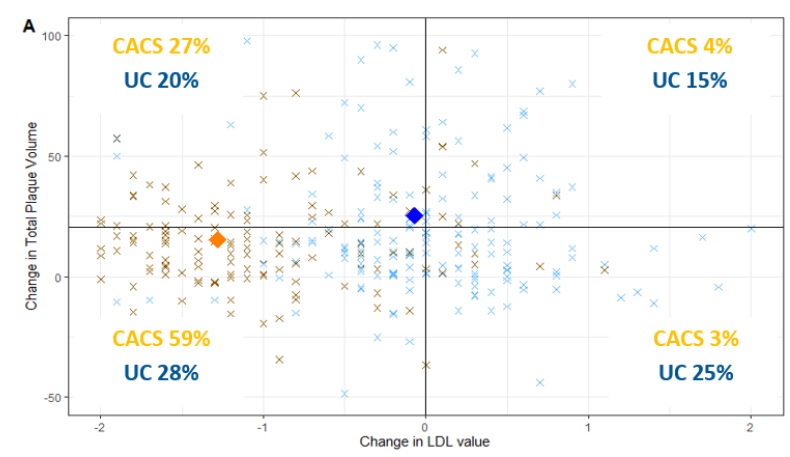
(Image: At the individual level, note the lack of association between changes in LDL and changes in plaque within both the CACS and UC groups — a random scatter of datapoints)
As a bonus, while writing this post, Feldman revealed data from the KETO-CTA cohort. Again, there was no individual-level association between LDL (or apoB) and atherosclerosis, as assessed by multiple methods:
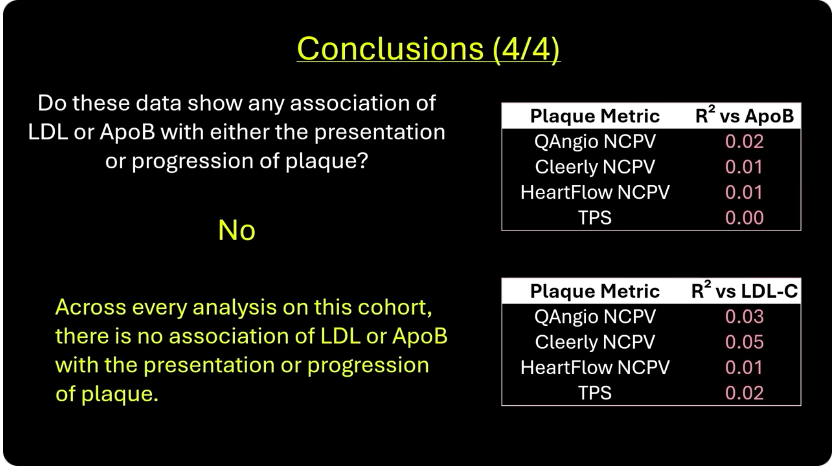 (Image taken from Feldman's presentation on youtube. Clearly, LDL is an unproven surrogate for atherosclerosis as well)
Conclusions
Despite the lack of rigorous evidence, some researchers continue to publish papers claiming that LDL is a valid surrogate.
Christensen et al. (2024), for example, noted that LDL is a frequently used example of a "successful surrogate endpoint." But unfortunately, they didn't question the claim or were not aware of the propaganda surrounding it.
Luckily, in a letter to the editor, Mariana Barosa wrote:
I read with great interest Christensena et al’s clarification of the concept of a surrogate endpoint. However, their example of low-density lipoprotein (LDL) cholesterol as a successful surrogate endpoint was rather unfortunate. . . . LDL as a replacement for clinical (patient-important) endpoints lacks robust scientific evidence, which, as Christensena et al argue, is a requisite of a surrogate endpoint.
To their credit, Christensen et al. replied and acknowledged that LDL does not qualify as a surrogate marker for all drug classes, stating that "robust scientific evidence should be a prerequisite for considering a proposed surrogate endpoint as a replacement for a patient-important outcome."
To date, this "robust scientific evidence" is nowhere to be found.