

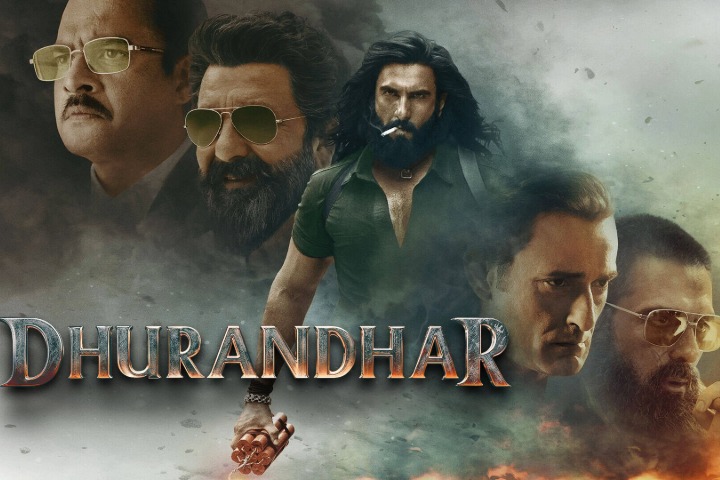
A film that mistakes noise for narrative, rage for politics, and repetition for conviction.
What follows is not a review, but a sort of an autopsy of a genre that increasingly confuses nationalism with storytelling, and spectacle with substance. Told in eight chapters (because the film itself insists on self-importance), this is a chronicle of how espionage cinema collapses into gunfire, and politics dissolves into effect.
Chapter 1 - Immediate Revenge!
A plane gets hijacked. Instant outrage. “We need revenge. Right now.”
Cut to two years later. Parliament is attacked. Again the same chorus: “We need revenge. Immediately.”
So, what is the plan? Send a spy across the border. Deep cover. Long game. One-man espionage.
Small problem. That kind of infiltration takes a decade. Maybe more.
Umm. Yeah.
Chapter 2 - Looks Khilji. Speaks Lootera.
Our undercover hero looks like Khilji but talks like Varun from Lootera. He enters the neighbouring country to blend in with a terrorist outfit.
Sounds intense. But patience is required.
Year 1: He gets a job at a juice.
Serving juice. Not revenge. Juice.
Year 2: Still at the shop. Now serving milkshakes.
Year 8828: Still serving. This time, just… looks.
Then what?
Nothing.
Just plug in - Guns! Guns! Guns! Trigger! Trigger! Trigger! Fire! Fire! Fire! Blood! Blood! Blood!
Chapter 3 - Khilji meets Khanna!
Khilji-Lootera finally earns a place in Rehman’s terrorist gang. By impressing the boss.
How? The gangster’s son is dying. So, does our hero saves him? No.
Wait! What? Then what happens?
Nothing.
Just insert - Guns! Guns! Guns! Trigger! Trigger! Trigger! Fire! Fire! Fire! Blood! Blood! Blood!
Chapter 4 - Who the F is who?
70 years into the film, we are suddenly introduced to a flood of characters:
Pappu Arshad
Donga
Faheem
Saleem
Rahman
Rahim
Mahfooz
Bro...
Then?
Nothing.
Just add - Guns! Guns! Guns! Trigger! Trigger! Trigger! Fire! Fire! Fire! Blood! Blood! Blood!
Chapter 5 - Jamal Kuddu revisited.
Akshay Khanna makes what feels like his 486th entry. This time, dancing to FA9LA.
Pure Jamal Kuddu energy. Why? Instagram Reels, bro. Social media pe bhi viral hona hai. (And honestly, it worked. Banger song.)
Then?
Nothing.
Just add - Guns! Guns! Guns! Trigger! Trigger! Trigger!
Fire! Fire! Fire! Blood! Blood! Blood!
Chapter 6 - Khilji Lootera babysits (read: romances) a baby!
She’s half his age. But apparently, it’s destiny. Both have amazing hair. They can even share their shampoo Clinic Plus.
Then what?
Nothing.
They ride a bike. They sing a song. Gotcha!!! Haha.
Chapter 7 - 81728th character introduced.
192 years into the runtime, a brand-new character appears. SP Chaudhary. It’s Sanjay Dutt.
The audience claps. I grow older. The film slows down so much that I can literally see my hair greying in real time. Each hair. One by one.
Chapter 8 - in the movie is literally called Et Tu Brutus
Yes, “Et Tu Brutus”. Straight from Shakespeare. Caesar. Betrayal. Brutus. But hello, our mythology already has Vibhishan betraying Ravan. Why not use that? So much for ‘Bharat Mata Ki Jai’. Hehe.
The film ends with heads flying like chopped salad, blood spraying like ketchup, because, why not, Game of Thrones, bro. And just like a sad ‘get ready with me’ Instagram reel, it ends on an outfit reveal.
Part 2 is coming in March. They even show a teaser. So unique. So incredible. So full of… Come on, say it with me… Guns! Guns! Guns! Trigger! Trigger! Trigger! Fire! Fire! Fire! Blood! Blood! Blood!
The politics hiding behind the gun smoke
Strip away the bullets, and Dhurandhar reveals itself as less a spy thriller and more a fantasy of instant nationalism. The film performs urgency where patience is politically inconvenient. Espionage, in reality, is slow, boring, bureaucratic, and morally grey, but the film refuses that discomfort. Instead, it collapses time, ethics, and geopolitics into a neat audiovisual loop: outrage → revenge → spectacle.
This is not about strategy; it is about affect.
The neighbouring country is never a lived-in space but only a hostile backdrop populated by interchangeable villains with Muslim names and no interiority. Civilians don’t exist. Politics doesn’t exist. History doesn’t exist. What exists is a permanent state of exception, where violence needs no justification because hurt sentiment becomes sufficient cause.
The undercover spy, ironically, is never really undercover. He doesn’t assimilate; he hovers. He is not shaped by the place he inhabits; he merely waits for permission to explode. This is not infiltration cinema; it is occupation cinema disguised as sacrifice.
Even the betrayal trope (Et Tu Brutus) feels imported rather than organic. Instead of engaging with indigenous mythological frameworks where betrayal is often tragic, ethical, and conflicted; the film opts for a Western shorthand. Shakespeare becomes décor, not discourse. Symbolism without reflection.
What we finally get is a cinema of reassurance. The nation is always right. Violence is always justified. Masculinity is always loud. Complexity is always the enemy.
In that sense, Dhurandhar is less interested in geopolitics and more invested in algorithmic nationalism which designed for reels, reaction videos, and applause breaks rather than thought.
It does not ask the audience to think. It asks them to feel. Preferably angry. Preferably proud. Preferably unquestioning. And when the smoke clears, what remains is not a story but a promise:
Don’t worry. Part 2 is coming. So is the rage. So are the guns.