

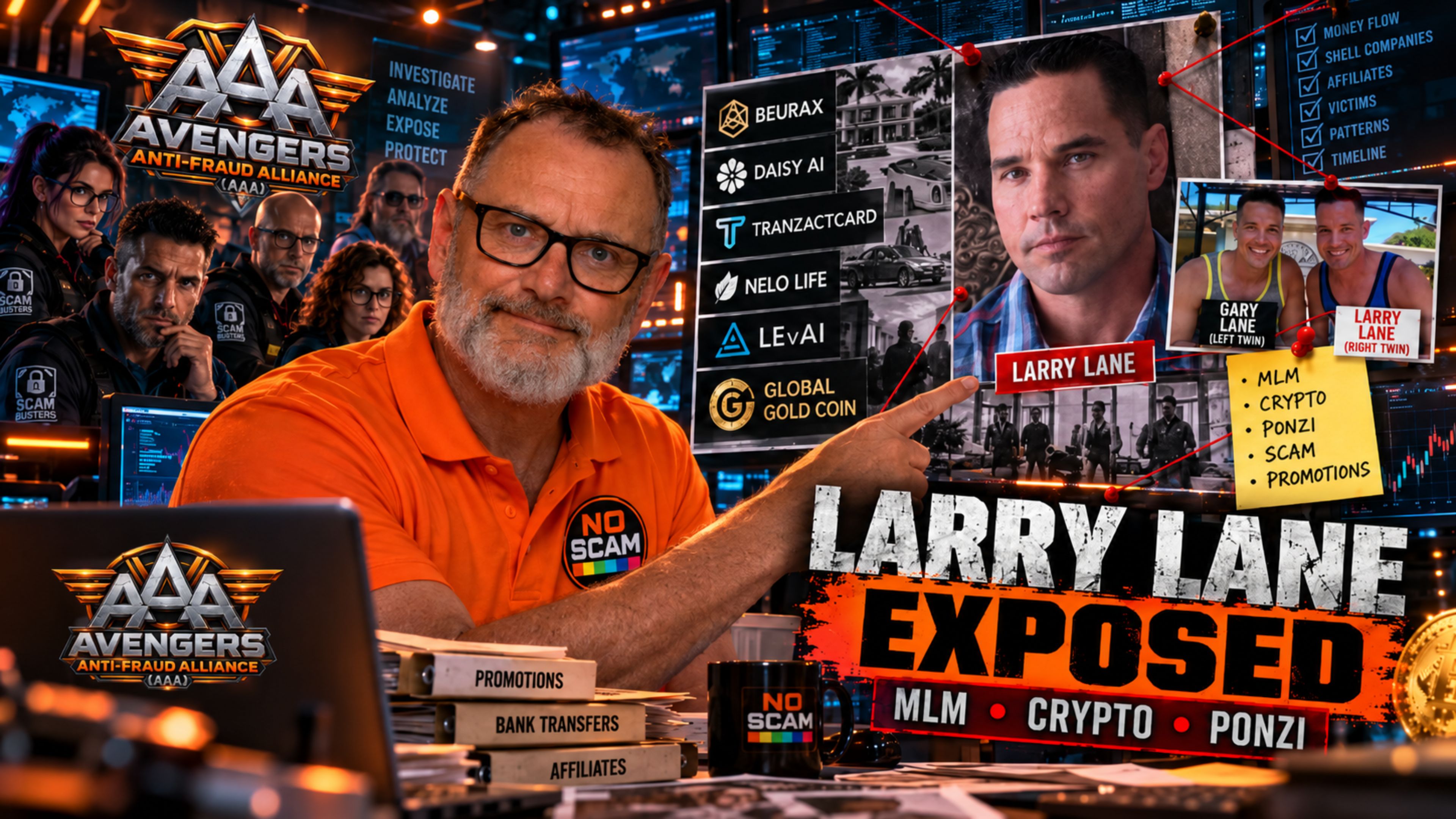
“At what point do you stop evaluating the opportunity and start evaluating the person promoting it?”
I have spent years investigating multilevel marketing schemes, crypto investment opportunities and supposedly revolutionary businesses built around whatever technology happens to be fashionable at the time.
The companies change, the products change and the terminology changes, but one thing I have learned is that the history of the promoter often tells you more than the presentation in front of you.
That is why I started looking closely at Larry Lane.
Larry has spent more than a decade moving through network marketing and investment-style opportunities. His history includes Rippln, B-Epic, One World Network, Beurax, Daisy AI, Solar Oil Project, VIP Global Stars, TranzactCard, FinMore, Nelo Life, VIDME and LevAI. Today, he is associated with Global Gold Coin, where he appears on the President’s Advisory Board.
Not every company on that list can automatically be described as fraudulent. Some simply failed. Others attracted regulatory warnings, withdrawal complaints, questions about recruitment or serious concerns about the underlying business model.
But taken together, the pattern deserves scrutiny.
This investigation is not about attacking Larry Lane personally. It is about examining the opportunities he promoted, what participants were told, what eventually happened, and whether his promotional history should matter when he appears with the next supposedly life-changing opportunity.
Because if somebody repeatedly asks people to trust their judgment, their previous judgment becomes part of the due diligence.
From MLM To Crypto
Larry Lane’s history starts in traditional network marketing.
One of the earliest ventures I could trace him to was Rippln, an MLM built around social networking, apps and recruitment. The business generated enormous hype around building large organisations, but it did not develop into the sustainable opportunity affiliates had been promised. By early 2014, Rippln was effectively finished.
Larry later became Master Distributor at B-Epic, a health-and-wellness MLM, before moving on again. He also appeared around One World Network, another recruitment-driven business built around nutritional products and monthly affiliate activity.
Those companies matter because they establish the foundation of Larry’s career: building networks, recruiting teams and using personal credibility to create momentum around new opportunities.
Then the type of opportunity changed.
By around 2021, Larry was no longer appearing only around conventional MLM products. His name was connected with Beurax, Daisy AI and Solar Oil Project — businesses built around crypto, automated trading, artificial intelligence and passive returns.
That shift is significant.
Selling supplements through a compensation plan is one thing. Encouraging people toward opportunities where returns supposedly come from trading, algorithms or tokenised assets creates a much higher level of financial risk.
The marketing also became more sophisticated.
Instead of selling a product people could see and use, participants were being asked to trust systems operating behind the scenes. Trading bots, AI algorithms and crypto infrastructure became the explanation for why the money was supposedly being generated.
That is where due diligence becomes critical.
When the claimed profits depend on technology participants cannot independently verify, the promoter becomes part of the trust mechanism. People often assume that an experienced leader has already checked the company, the trading activity and the legal structure before recommending it.
Larry Lane’s move from conventional MLM into crypto therefore marks an important turning point in this investigation.
Because the next three opportunities did not simply sell products.
They sold the promise of returns.
Beurax, Daisy AI And Solar Oil Project
The clearest warning signs in Larry Lane’s history appear when he moved into investment-style opportunities.
Beurax promoted automated crypto trading and advertised returns of about 1.4% per day. By March 2021, investors were reporting that they could no longer withdraw their money. Australia’s financial regulator ASIC issued a public warning, highlighted the unrealistic daily returns and told consumers not to send the operation any further funds.
That alone should have been a major lesson.
Around the same period, Larry was also associated with Daisy AI, which promoted forex and crypto trading supposedly powered by artificial intelligence. The company later attracted regulatory attention in Canada, where the British Columbia Securities Commission warned that Daisy was not registered to trade in or advise on securities or derivatives in that jurisdiction. The project also went through repeated reboots and changes, raising questions about what participants were actually invested in and how sustainable the original model was.
Then there was Solar Oil Project.
This opportunity linked cryptocurrency with supposed oil production and promoted long-term passive returns, including claims stretching over ten years. It also used a multilevel compensation structure, meaning participants could earn additional rewards by bringing others into the scheme.
The stories were different, but the basic mechanics were similar.
Participants were being asked to believe that returns were being generated by trading, AI or real-world assets, while also being encouraged to recruit others. In each case, the most important question was the same: could the underlying source of revenue be independently verified?
That is the question promoters should be asking before they encourage others to join.
By this point, Larry Lane was no longer just moving between ordinary MLM companies. He was attaching his name to opportunities where people were being asked to risk money based on claims they could not easily verify for themselves.
And the next chapter raised the stakes again.
Because with VIP Global Stars, Larry was no longer just a promoter.
He became co-CEO.
VIP Global Stars
By the time VIP Global Stars appeared, Larry Lane had moved from promoter into a much more senior role.
He was presented as co-CEO, alongside Eric Caprarese. That matters because an executive position carries a different level of responsibility from simply joining an opportunity as a distributor. A co-CEO is much closer to the business model, compensation structure and claims being put in front of participants.
VIP Global Stars returned to familiar MLM territory, selling health and weight-loss products through a recruitment-based compensation plan. The key question was whether genuine retail customers were driving sales, or whether much of the volume came from affiliates buying products because they wanted to remain active and qualify for commissions.
That distinction is critical in any MLM.
A physical product does not automatically make a business sustainable. If most of the purchasing comes from participants inside the compensation plan, the product can become little more than the vehicle used to move money through the network.
VIP Global Stars did not become the long-term business participants had been encouraged to expect. By early 2023, its website and social-media activity had effectively disappeared.
For me, this is where Larry Lane’s track record becomes more significant.
He was no longer simply associated with failed or controversial opportunities. He had now held an executive title in one that also disappeared.
The next chapter would take him into something even more sensitive:
banking, payment cards and financial services.
TranzactCard, FinMore And Nelo Life
TranzactCard was presented as something more substantial than another ordinary MLM. The pitch centred on banking, payment cards and financial services, giving the opportunity an added layer of credibility because participants were being asked to believe that recognised financial infrastructure sat behind the business.
Larry Lane became one of the prominent figures around the company.
The problems became serious when the banking story began to unravel. Questions emerged over the financial institutions supposedly supporting the operation, including a claimed relationship with Bangor Bank that the bank itself later denied. That struck at the heart of the proposition, because a financial-services opportunity is only as credible as the infrastructure behind it.
TranzactCard was then replaced by FinMore.
Rather than resolving the uncertainty, FinMore became another short-lived chapter. In April 2024, the TranzactCard/FinMore operation announced an immediate shutdown, with regulatory complications cited as part of the reason the business could not continue as planned.
Then came Nelo Life.
Larry was one of the original founders, alongside other people who had also been involved with TranzactCard and FinMore. Nelo Life shifted the product story toward lifestyle and travel memberships, but the familiar recruitment structure remained. Affiliates paid to participate and were rewarded for building organisations beneath them.
That sequence is important because it shows how the network survived even when the company did not.
TranzactCard failed. FinMore followed. Nelo Life became the next opportunity.
By March 2026, Nelo Life had also collapsed.
None of those outcomes, by themselves, prove criminal wrongdoing by Larry Lane. But taken together they raise an obvious question about judgment. If the same experienced promoter repeatedly appears around businesses that fail, rebrand or shut down, prospective participants should not treat the next recommendation as though the previous history never happened.
And after Nelo Life, Larry Lane moved again.
This time the story would involve VIDME, questions around more than 1,500 affiliate accounts, and another shift into AI through LevAI.
VIDME And LevAI
After Nelo Life, Larry Lane’s name appeared again around VIDME, but this time the controversy centred on the affiliate structure itself. A backend review reportedly identified more than 1,500 unpaid affiliate accounts stacked beneath Larry Lane’s referral organisation, raising legitimate questions about how those accounts were created, who created them and whether they gave the appearance of substantially greater network growth than actually existed.
I want to be precise about that finding. I have not seen evidence proving that Larry Lane personally created those accounts, and I am not alleging that he did. What can be established is that the accounts were reportedly located beneath his referral structure, making their existence relevant to any serious examination of how the VIDME organisation was being built and presented to prospective participants.
Larry subsequently appeared around LevAI, another opportunity using artificial intelligence as a central part of its marketing. He was also connected with the movement of people from Infinity Grid into LevAI, demonstrating something I have observed repeatedly while investigating network-marketing schemes: when one opportunity loses momentum, the promoters, relationships and existing audience can often be redirected very quickly into another.
By this stage, Larry’s promotional history had moved through traditional MLM, crypto, passive-return opportunities, financial services, lifestyle memberships and artificial intelligence. The products and technology kept changing, but the reliance on established networks and promoter credibility remained remarkably consistent.
His next opportunity would move into another increasingly popular investment narrative: Global Gold Coin and the promise of digital assets supposedly connected to physical gold.
Global Gold Coin
That brings us to Global Gold Coin, the opportunity Larry Lane is associated with today.
This time, Larry appears on the company’s President’s Advisory Board, alongside his twin brother Gary Lane and other figures from the network-marketing world. The project is built around a familiar combination of digital assets, referral incentives and the claim that the coin is connected to real-world value through gold.
That gold story is important because it gives the project a sense of security that ordinary crypto schemes often lack.
But saying a digital asset is backed by gold is not the same thing as proving it.
For me, the key questions are straightforward: where is the gold, who owns it, who independently verifies it, what quantity supports the coins in circulation, and what legal rights does a coin holder actually have over the underlying asset? Those are basic questions whenever a project uses the phrase “gold-backed.”
The referral structure also deserves attention.
Promotional material around Global Gold Coin encourages people to create wallets, collect rewards and introduce others. That means the value proposition is not simply about owning a digital asset. Recruitment and network growth are also part of the ecosystem.
That combination immediately puts Larry Lane’s history back into focus.
He has already promoted opportunities built around crypto, AI, financial services and supposedly innovative technology. Several of those ventures later collapsed, attracted regulatory attention or failed to deliver the long-term outcome participants were expecting.
That does not prove Global Gold Coin is fraudulent.
But it does mean I would not accept the sales story without independent evidence.
Larry Lane’s involvement should make prospective participants ask more questions, not fewer.
The company should be judged on what can be verified: the assets, the ownership structure, the legal framework, the economics of the coin and the source of any value being promoted.
Because after everything that came before, another polished presentation is not enough.
The Pattern Behind The Promotions
Once these companies are placed side by side, the pattern becomes much easier to recognise. Larry Lane has moved through social-media MLM, health products, crypto trading, AI trading, oil-linked tokens, banking cards, lifestyle memberships and gold-backed digital assets. Each opportunity arrived with a different product or story, but Larry repeatedly appeared in a promotional or leadership role while participants were being encouraged to believe they had discovered something with significant future potential.
Several of those ventures subsequently collapsed, disappeared, rebooted, attracted regulatory warnings or raised serious questions about withdrawals, recruitment and the source of revenue supporting their claims. Any one failed company can be explained by bad management, changing markets or circumstances outside a promoter’s control. A sequence stretching across more than a decade deserves a different level of scrutiny.
That is why I do not assess Larry Lane simply on how convincing his latest presentation might sound. If someone repeatedly uses their experience and reputation to build confidence in new opportunities, their previous recommendations become part of the evidence prospective participants should consider.
Larry’s history does not prove that every future opportunity he promotes will fail, nor does it prove that he personally caused the failures documented in this investigation. What it does demonstrate is why his involvement should never be treated as evidence that an opportunity has already been properly vetted.
The track record deserves to be examined alongside the pitch.
Accountability And Due Diligence
 Larry Lane – The Next Big Thing
The purpose of this investigation is not to suggest that Larry Lane personally caused every failure connected to the companies he promoted. It is to document a promotional history that prospective participants may never see when they are introduced to the latest opportunity.
Promoters occupy an important position in businesses like these because they help transform an unfamiliar company into something people feel comfortable trusting. They explain the opportunity, introduce the leadership, repeat the claims and encourage others to follow their lead. When that credibility has been built over many years, participants may reasonably assume the promoter has already investigated the company before recommending it.
That assumption can be dangerous.
Larry Lane’s history demonstrates why due diligence should never be outsourced to the person presenting the opportunity. Anyone considering a business involving crypto, trading, digital assets, passive returns or supposedly asset-backed value should independently verify the company, its regulatory position, the source of its revenue, the people controlling it and the evidence supporting the financial claims being made.
Experience in network marketing does not automatically equal good judgment, just as confidence during a presentation does not establish that the underlying business is legitimate or sustainable. The relevant question is not simply how long somebody has been promoting opportunities, but what happened to the opportunities they previously encouraged others to join.
Larry’s record now stretches across more than a decade and includes businesses with very different products, structures and outcomes. That history cannot tell us with certainty what will happen to Global Gold Coin or whatever opportunity might come after it.
But it gives prospective participants something valuable that a sales presentation rarely provides: context.
Before trusting the next opportunity, look at the previous ones. Examine what was promised, what could actually be verified and what ultimately happened.
A new company deserves to be judged on its own evidence, but a new logo should never erase the history of the person promoting it.
Disclaimer: How This Investigation Was Conducted
This investigation relies entirely on OSINT — Open Source Intelligence — meaning every claim made here is based on publicly available records, archived web pages, corporate filings, domain data, social media activity, and open blockchain transactions. No private data, hacking, or unlawful access methods were used. OSINT is a powerful and ethical tool for exposing scams without violating privacy laws or overstepping legal boundaries.
About the Author
I’m DANNY DE HEK, a New Zealand–based YouTuber, investigative journalist, and OSINT researcher. I name and shame individuals promoting or marketing fraudulent schemes through my YOUTUBE CHANNEL. Every video I produce exposes the people behind scams, Ponzi schemes, and MLM frauds — holding them accountable in public.
My PODCAST is an extension of that work. It’s distributed across 18 major platforms — including Apple Podcasts, Spotify, Amazon Music, YouTube, and iHeartRadio — so when scammers try to hide, my content follows them everywhere. If you prefer listening to my investigations instead of watching, you’ll find them on every major podcast service.
You can BOOK ME for private consultations or SPEAKING ENGAGEMENTS, where I share first-hand experience from years of exposing large-scale fraud and helping victims recover.
“Stop losing your future to financial parasites. Subscribe. Expose. Protect.”
My work exposing crypto fraud has been featured in:
Coffeezilla 2026): Featured in the investigation exposing the alleged $328M Goliath Ventures Ponzi scheme
Bloomberg Documentary (2025): A 20-minute exposé on Ponzi schemes and crypto card fraud
News.com.au (2025): Profiled as one of the leading scam-busters in Australasia
OpIndia (2025): Cited for uncovering Pakistani software houses linked to drug trafficking, visa scams, and global financial fraud
The Press / Stuff.co.nz (2023): Successfully defeated $3.85M gag lawsuit; court ruled it was a vexatious attempt to silence whistleblowing
The Guardian Australia (2023): National warning on crypto MLMs affecting Aussie families
ABC News Australia (2023): Investigation into Blockchain Global and its collapse
The New York Times (2022): A full two-page feature on dismantling HyperVerse and its global network
Radio New Zealand (2022): “The Kiwi YouTuber Taking Down Crypto Scammers From His Christchurch Home”
Otago Daily Times (2022): A profile on my investigative work and the impact of crypto fraud in New Zealand