

“When an investment opportunity is making money, the promoters want you to remember who introduced you. When it collapses, suddenly you’re reminded that investing was always your responsibility.”
E-Estate has collapsed, withdrawals have stopped, and investors are left wondering whether they will ever see their money again.
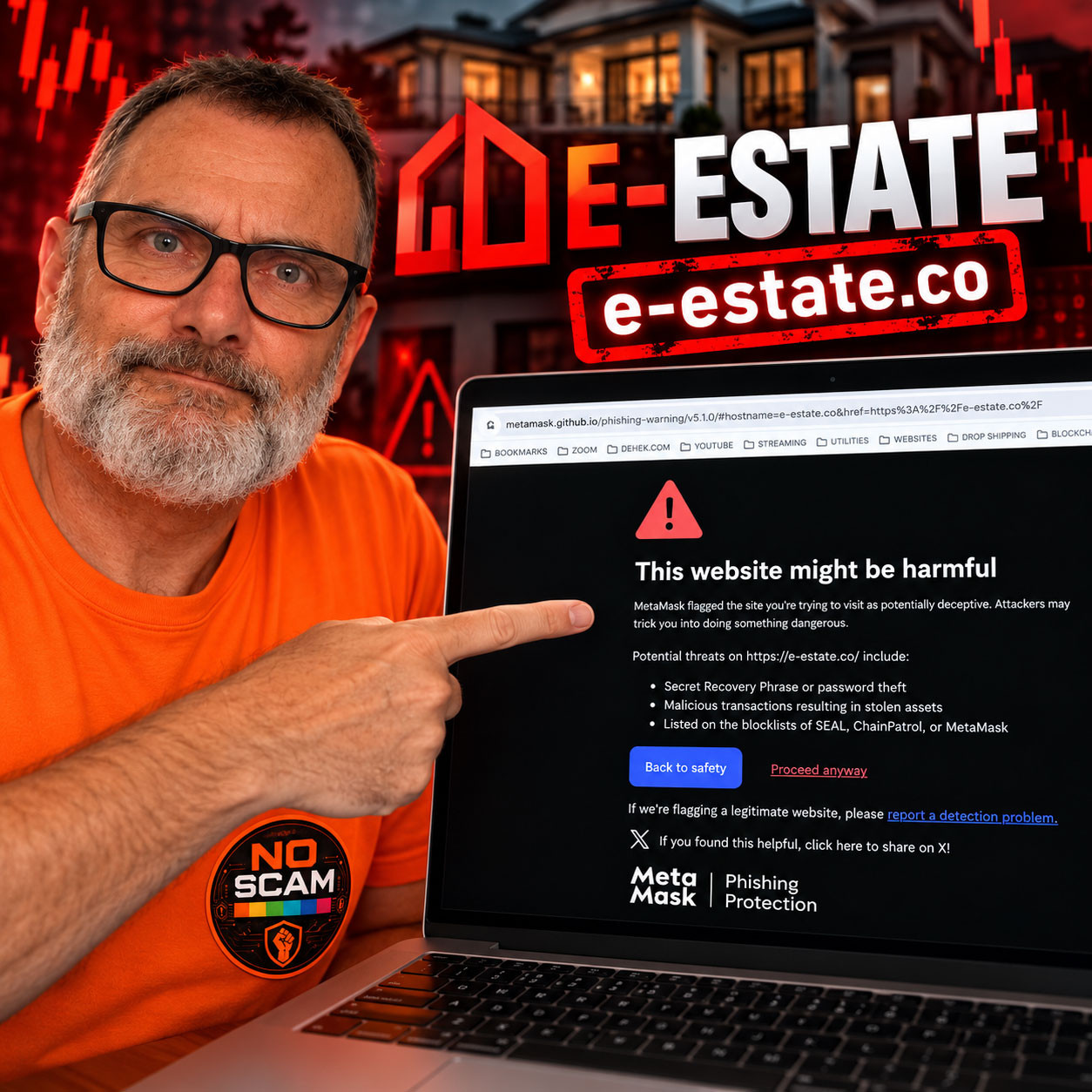 “e-estate.co” – This website might be harmful
But the people who helped promote this supposed real-estate investment opportunity have a different problem: how to explain their involvement without accepting responsibility for the confidence they encouraged others to place in it.
On 5 October 2026, Brandon Ivey hosted an extraordinary 100-minute ILCA Community Update Call. What should have been a straightforward discussion about missing investor funds became a mixture of excuses, motivational speeches, attacks on critics, buyback promises and preparations for future investment opportunities. Ivey wasn’t simply an unfortunate investor caught in the collapse. By his own admission, his organisation had a commercial promotional relationship with E-Estate. As he explained towards the end of the recording: “They were promoting my company. I was promoting their company.”
What makes this recording particularly damning is that Ivey acknowledged recognising serious warning signs before becoming involved. He questioned the securities arrangements, the company’s leadership and the source of its returns. He later admitted he couldn’t independently verify whether E-Estate owned the properties supposedly supporting its investment model. Yet he continued promoting the opportunity, and when the withdrawals stopped, he began reminding investors that they should have diversified, recovered their original capital and never invested more than they could afford to lose.
How convenient. The promoter gets to celebrate the opportunity when money is flowing, then deliver a lecture about financial responsibility when investors can’t withdraw it.
The warning signs were not imaginary. On 1 June 2026, the Texas State Securities Board issued an Emergency Cease and Desist Order alleging fraudulent and unregistered securities offerings involving E-Estate. The order raised serious questions about the company’s representations concerning real estate assets and the investment arrangements being sold to the public. Those allegations were not criminal convictions, but they were more than enough to demand independent verification before anyone continued encouraging confidence in the business.
Instead, the October recording captures Ivey speculating about regulators and critics, expressing optimism about buybacks without producing evidence of available funds, and explaining how his ILCA community could evaluate future income opportunities. Other speakers, including Darryl Porter, Anthony DeLoatch and Marnita Casa, joined the discussion. Dacosta described her family’s $50,000 home-equity borrowing while also defending the experience and encouraging members to consider Ivey’s paid education programme.
Perhaps the most revealing contradiction came when Ivey suggested E-Estate had enough money to honour buybacks. How could he have confidence in the company’s ability to repay investors when he had already admitted he couldn’t verify the assets supposedly generating its income? An accessible dashboard, an optimistic promoter and another promised announcement are not evidence that the money exists.
I’ve spent years investigating investment schemes and the people who promote them. I’ve heard the promises of passive income, the claims about innovative technology and the reassurances that everything is different this time. I’ve also watched what happens when the payments stop. The explanations change, the responsibility shifts, and the people who encouraged participation suddenly become experts in coping with financial loss.
This investigation examines Ivey’s own words, the contradictions in his explanations and the promotional relationships surrounding E-Estate. It also looks at what investors were told about pending withdrawals, EST token buybacks, regulatory intervention and the possibility of a rug pull.
Because investors don’t need another speech about staying positive.
They need to know why the people promoting E-Estate couldn’t verify its fundamental claims, why they continued supporting it, and what happened to the money.
Brandon Ivey’s Red Flags — What He Knew Before Promoting E-Estate
 Brandon Ivey’s Red Flags — What He Knew Before Promoting E-Estate
Brandon Ivey didn’t discover E-Estate’s warning signs after the collapse. He admitted recognising them before he became involved. That is one of the most extraordinary revelations from his 5 October 2026 ILCA Community Update Call, and it raises a serious question about the judgement of someone presenting himself as an experienced cryptocurrency educator.
At approximately 12 minutes into the recording, Ivey explained that he had been approached around October 2025 to provide cryptocurrency education to E-Estate’s community. He described examining the opportunity before agreeing to participate. What he discovered should have made any responsible investment promoter extremely cautious.
Ivey identified concerns about securities regulations, the legitimacy of the company’s leadership and the source of the money being distributed to investors. He even recognised the danger of an operation using money from new participants to pay earlier investors — the fundamental mechanism of a Ponzi scheme.
These were not insignificant technical questions. They went directly to whether E-Estate was operating a legitimate investment business.
Yet instead of demonstrating that those concerns had been independently resolved, Ivey described accepting explanations provided by the company itself.
One of those explanations involved the EST token. Ivey said he became more comfortable after being told investors were not directly purchasing real estate and that the token was not speculative because it was not intended to trade on an exchange.
Neither explanation establishes that an investment is exempt from securities regulation. Whether an arrangement constitutes a security depends on its actual legal and economic characteristics, not simply what its promoters call it or whether its tokens appear on a public exchange.
Ivey also questioned where the advertised returns were coming from. According to his account, E-Estate explained that income was generated through underlying real-estate operations. Apparently, that explanation helped satisfy him.
But where was the evidence?
Where were the independently verified property ownership records, rental agreements, financial statements and operating accounts demonstrating that these properties existed under the company’s ownership or control and were generating sufficient income to support investor payments?
Being told that money comes from real estate is not the same as proving that money comes from real estate.
The situation becomes even more remarkable when Ivey discusses E-Estate’s leadership. He acknowledged concerns about whether some of the individuals presented as company executives were genuine, given their apparent use of artificial intelligence or digital representations. He later attended an event in Miami, where he said he met Mike Hamilton and other people associated with the business.
Meeting someone at a conference may establish that the person exists. It does not establish that they control a legitimate investment company, own the advertised properties or have the financial resources they claim.
Then, at approximately 22 minutes, Ivey made another admission: he had never personally met Brandon Stephenson, a central figure associated with E-Estate. He said he intended to meet him at a forthcoming event in Los Angeles and ask further questions about the company’s properties and business arrangements.
Think about that.
Ivey had already become commercially involved in promoting E-Estate, yet he was still planning to ask fundamental questions about the assets supposedly supporting the investment.
This wasn’t a case of a novice investor overlooking a complicated technical detail. Ivey presented himself as someone with years of experience in cryptocurrency and blockchain education. He understood enough to recognise securities concerns and the possibility of a Ponzi-style payment structure.
What he has not demonstrated is that he obtained independent evidence resolving those concerns before helping promote the opportunity.
And the warnings became considerably more serious on 1 June 2026, when the Texas State Securities Board issued its Emergency Cease and Desist Order alleging fraudulent and unregistered securities offerings connected to E-Estate. The regulator also challenged representations involving the underlying real-estate assets and the rights associated with them.
These were regulatory allegations rather than criminal convictions. Nevertheless, they directly concerned the questions Ivey claims to have asked before becoming involved.
The obvious response should have been to demand documentary proof.
Instead, Ivey continued to describe his confidence in the opportunity through its apparent performance, the people he had met and the explanations he had received. He discussed testing the platform himself and seeing transactions operate as expected.
But successful withdrawals are not proof of a legitimate investment. Ponzi schemes can pay early participants precisely because those payments encourage confidence, reinvestment and recruitment.
The most damaging admission came later in the call, at approximately 28 minutes, when Ivey acknowledged that he could not substantiate E-Estate’s claims about its properties.
He stated:
“The only thing I cannot back up and verify is their claim about ownership of the properties that ESA was advertising. We only know what ESA was telling us.”
That statement cuts through the promotional language.
E-Estate was being marketed around tokenised real estate and returns supposedly supported by property operations. Yet one of its prominent commercial promoters was admitting that he could not independently verify whether the company owned the advertised assets.
That wasn’t a minor gap in his research. It was the central claim underpinning the investment opportunity.
Ivey’s admissions do not prove that he knew E-Estate was fraudulent. But they expose a serious failure in the due diligence he described. He recognised major warning signs, relied on assurances from the people selling the opportunity, and continued supporting the business without establishing the truth of its most important asset claims.
And when E-Estate collapsed, rather than making those unresolved questions the centre of his explanation, Ivey began reminding investors about the importance of diversification and personal responsibility.
He knew enough to ask the right questions. The problem is that he promoted the opportunity without demonstrating that he had obtained the right answers.
The Diversification Defence — Blaming Investors After The Money Stops
 The Diversification Defence — Blaming Investors After The Money Stops
When E-Estate was operating, Brandon Ivey was helping promote an opportunity built around passive income and tokenised real estate. When withdrawals stopped, he began explaining why investors should have protected themselves better.
That was one of the most infuriating aspects of his 5 October 2026 community update. People were facing the possibility of losing substantial amounts of money, yet Ivey devoted considerable attention to reminding them of the financial rules he claimed to have taught all along.
At approximately 20 minutes into the recording, Ivey outlined four principles: educate yourself, never invest money you cannot afford to lose, recover your original investment as quickly as possible, and have a financial plan.
There’s nothing wrong with those principles. The problem is using them as a defence after helping build confidence in an investment whose fundamental claims were never independently verified.
Diversification is not a substitute for due diligence. And telling investors to expect risk does not excuse a promoter from checking whether the opportunity is legitimate in the first place.
Ivey went on to explain that investors should aim to recover their original capital within approximately five to nine months. Once that money had been withdrawn, he suggested, the remaining balance represented profit, meaning participants would no longer be risking their original investment.
That sounds reassuring until you examine what it actually means.
If a legitimate business generates sufficient revenue to pay investors, recovering your original capital may reduce your financial exposure. But if an operation is paying earlier participants with money collected from newer ones, the ability to withdraw does not demonstrate profitability. It simply means some people received money before others.
And that is precisely why verifying the source of investment returns matters.
E-Estate was not being presented as a speculative gamble in which participants knowingly placed bets on a token’s market price. It was promoted around supposedly income-producing real estate. The attraction was the impression that tangible assets and business operations supported the payments.
Investors were entitled to ask whether those representations were true, not merely whether they had withdrawn enough money before the system stopped paying.
The contradiction became even more obvious when Ivey discussed his own behaviour later in the call.
At approximately 56 minutes, he admitted becoming caught up in E-Estate’s one-to-one matching promotion. He described setting himself a target of $25,000, then increasing it to $30,000, $40,000 and eventually approximately $50,000.
He acknowledged that greed had influenced his decisions. When he finally attempted to withdraw, he couldn’t get the money out.
The recording does not establish that he deposited or personally lost $50,000 in cash. The amount concerned what he described as the balance or target associated with his account. Nevertheless, his admission is revealing.
Here was an experienced cryptocurrency educator explaining to investors why they should have recovered their original capital promptly, while acknowledging that he himself had continued chasing a larger account balance until withdrawals were no longer available.
He was telling the community to follow financial discipline that, by his own admission, he had failed to follow himself.
Then there was Marnita Casa.
At approximately 1 hour and 5 minutes, Casa disclosed that her husband had obtained a $50,000 home-equity line of credit connected to their involvement in E-Estate. She also described withdrawing approximately $31,000 and enjoying experiences that she attributed to the opportunity.
Borrowing against a family home to participate in an investment is a serious financial decision. If the investment fails, the borrowing obligation does not simply disappear.
Yet Casa spoke positively about the experience and criticised members who were upset about what had happened. She argued that participants had been warned about the risks and should take responsibility for their decisions.
I find that attitude extraordinary.
People had been encouraged to trust an investment opportunity associated with real-estate assets and supposedly sustainable returns. When the operation stopped processing withdrawals, they were now being lectured about their personal choices.
Investors asking where their money has gone are not behaving irresponsibly. They are asking the questions that should have been answered before their money was accepted.
There is also a significant difference between an ordinary investor and someone who publicly promotes an opportunity.
An investor may rely on presentations, testimonials and assurances from people who appear knowledgeable. A promoter who describes himself as an experienced educator, enters a commercial relationship with the company and helps introduce the opportunity to others has a different responsibility for the representations he makes.
That responsibility does not vanish because the promoter also invested money or claims to have suffered losses.
Nor does a disclaimer about investment risk establish that the underlying business was legitimate.
Ivey maintained that he had repeatedly warned his community. The October recording documents him repeating those warnings, but it does not establish how prominently they featured in his earlier promotional presentations or whether they adequately balanced the positive claims about E-Estate.
That distinction matters. A warning buried beneath enthusiastic presentations and attractive earnings examples is not necessarily the same as giving prospective investors a clear understanding of the risks.
The most important question is not whether Ivey ever said, “Don’t invest more than you can afford to lose.”
It is whether he had sufficient independently verified evidence to justify the confidence he helped create in E-Estate.
When the opportunity was paying, the promoters could point to its apparent success. When it collapsed, investors were reminded that the risks had always been theirs.
That is a convenient arrangement for the people doing the promoting.
And it becomes even more convenient when those same promoters begin suggesting that regulators and critics, rather than the company’s own unverified claims and financial arrangements, were responsible for bringing the opportunity down.
Blaming The Critics — Turning Regulatory Scrutiny Into A Conspiracy
 Blaming The Critics — Turning Regulatory Scrutiny Into A Conspiracy
When an investment operation collapses, there’s a familiar excuse that promoters reach for: it wasn’t the business model, the missing evidence or the people running the company. It was the critics who exposed the warning signs.
Brandon Ivey appeared determined to give that explanation serious consideration during his 5 October 2026 ILCA Community Update Call. Rather than concentrating on why E-Estate could no longer process withdrawals, he spent part of the recording questioning the motives of investigators and suggesting that the company had been deliberately targeted.
At approximately 28 minutes, Ivey argued that E-Estate was not sufficiently large to have attracted regulatory attention naturally. He suggested that someone had brought the company to the authorities’ attention and indicated that he believed he knew which organisation was responsible.
He acknowledged that this was his opinion, not something he could prove.
But that didn’t stop him from advancing the narrative.
Ivey portrayed critics as people motivated by website traffic, advertising revenue and the attention generated by negative publicity. He also suggested that information appearing in the Texas regulatory action resembled material previously published by investigators.
So what?
If a journalist identifies potentially unlawful investment activity and a regulator subsequently examines similar allegations, that is not evidence of a conspiracy. It is entirely consistent with how public-interest reporting and regulatory scrutiny are supposed to work.
The Texas State Securities Board issued its Emergency Cease and Desist Order on 1 June 2026, alleging fraudulent and unregistered securities offerings associated with E-Estate. The order also raised serious concerns about representations involving the company’s supposed real-estate assets and the legal rights being offered to investors.
Those allegations required evidence-based answers.
Did E-Estate own or control the properties it advertised? Could it demonstrate that rental income was sufficient to support the returns being distributed? Were the investment arrangements being offered in compliance with applicable securities laws?
Those questions did not become irrelevant simply because Ivey disliked the people asking them.
And there was a glaring contradiction in his argument.
During the same recording, Ivey admitted that he could not independently verify E-Estate’s advertised property ownership. He said the community knew only what the company had told them.
In other words, he was criticising investigators for questioning claims that he himself could not substantiate.
That should have been a moment of serious reflection.
If an experienced cryptocurrency educator with a commercial relationship with E-Estate could not establish whether the underlying properties belonged to the business, the appropriate response was to investigate further, not attack the credibility of those raising concerns.
Instead, Ivey compared E-Estate’s regulatory difficulties with disputes involving other cryptocurrency businesses, including Ripple. His apparent argument was that regulators sometimes get things wrong and that regulatory enforcement does not automatically establish wrongdoing.
That general principle is correct. A regulatory allegation is not a criminal conviction, and companies have the right to challenge enforcement action.
But Ripple’s regulatory history does not prove that E-Estate owned a single property, generated legitimate rental income or had sufficient funds to repay its investors.
The comparison offered no answer to the allegations against E-Estate.
The discussion became even more revealing when Ivey described advice he claimed to have given Brandon Stephenson, a central figure associated with the company.
According to Ivey, he suggested that E-Estate stop operating in the United States while regulatory uncertainty continued and concentrate on its international business. Stephenson reportedly rejected the suggestion, arguing that the Texas action concerned only one jurisdiction.
Consider what that tells us.
Ivey understood that the regulatory situation was serious enough to threaten the company’s continued operation in the United States. He recognised the possibility of further enforcement action and additional negative publicity.
Yet his account of the conversation focused on where the company might continue operating rather than on establishing whether the investment claims challenged by regulators were actually true.
Changing jurisdictions would not answer the question of whether the advertised properties existed under E-Estate’s ownership or control.
Nor would operating internationally establish that the company’s financial arrangements were legitimate.
Ivey also made allegations about critics disrupting online presentations and behaving inappropriately. Those accusations should be judged on their own evidence. But even if an investigator behaved badly during a presentation, that would not invalidate a regulatory order or prove the investment was sound.
A promoter cannot answer allegations about financial misconduct by complaining about the manners of the person asking the questions.
The discussion took another turn when Ivey described information he said he had received about events at E-Estate’s offices in Panama. According to his account, authorities had entered the premises and seized electronic equipment, including phones and computers.
He also speculated about whether Stephenson might have been arrested, while acknowledging that he could not confirm it.
These were unverified claims made by Ivey, not established findings from the recording. Nevertheless, they added another layer of uncertainty to an operation whose investors were already unable to access their money.
What is particularly troubling is the way these explanations can influence a community that has trusted its promoters.
Instead of examining why E-Estate’s financial claims could not be substantiated, members are encouraged to consider whether journalists, critics or regulators somehow caused the failure.
That reverses the responsibility.
Investigators did not create E-Estate’s investment model. Regulators did not invent its advertised property claims. And critics were not responsible for demonstrating that the company possessed the assets it claimed to hold.
Those responsibilities belonged to the people operating and promoting the opportunity.
By the time of the October call, Ivey was facing the consequences of an investment he had helped promote, regulatory allegations that had been public for months, and his own admission that a fundamental part of the company’s business model remained unverified.
Yet he was still prepared to question the motives of the people who had warned investors.
The scandal is not that E-Estate attracted scrutiny. It’s that people were encouraged to trust the opportunity without the evidence needed to justify that trust.
And while Ivey was discussing critics and regulators, investors had a much more urgent concern.
Their withdrawals had stopped. Their money was inaccessible. And they were being asked to believe that a promised token buyback might somehow make everything right.
The Buyback Promise — Pending Withdrawals, Missing Money And Another Round Of Reassurances
 The Buyback Promise — Pending Withdrawals, Missing Money And Another Round Of Reassurances
E-Estate investors weren’t asking for another motivational speech. They wanted their withdrawals processed and their money returned. Instead, Brandon Ivey was offering explanations about a proposed buyback process that nobody on the call could demonstrate was financially possible.
At approximately 36 minutes into the 5 October 2026 ILCA Community Update Call, Ivey admitted that he had personally experienced the problem investors were reporting. He had attempted to withdraw money from E-Estate, but the transaction had not gone through as expected.
According to Ivey, he contacted the company and was initially reassured that operations were continuing normally. Shortly afterwards, withdrawals were suspended.
That sequence deserves attention. If the company was still telling its promoters that business was operating normally while withdrawal requests were failing, what did its management know about the developing crisis, and when did it know it?
The recording does not establish the answer. But it does establish that even someone with Ivey’s promotional relationship was apparently receiving reassurances that did not reflect what happened next.
For investors, the immediate concern was not the future of ILCA, the importance of positive thinking or whether critics had upset the company.
It was their pending withdrawals.
Ivey explained that some investors had submitted withdrawal requests before operations were suspended. Those transactions had not been completed, and the amounts were apparently not included in the balances being displayed for the proposed buyback process.
According to Ivey, E-Estate had indicated that pending withdrawals would eventually be added back into the relevant account balances so they could be included in the buyback arrangements.
He also suggested that further instructions would be provided during the following week.
But an assurance that pending withdrawals will be included in a future buyback is not the same as processing those withdrawals.
There was no independently verified evidence presented during the call demonstrating that the company had sufficient money to honour those obligations. No bank statements, audited financial accounts, confirmed cash reserves or verified asset valuations were produced.
Investors were effectively being asked to wait for another announcement from the same operation that had already stopped processing their payments.
Ivey also explained that new deposits, additional EST token purchases, certain bonuses and other platform activities had been suspended. Investors could apparently still access their dashboards and review their balances and transaction histories.
That might have provided some comfort to people worried about losing access to their records, but it did nothing to establish whether the displayed balances were recoverable.
A number on a dashboard is not money in a bank account. An EST token is not proof that sufficient cash or property exists to redeem it.
I’ve investigated enough questionable investment platforms to recognise the danger of confusing an accessible website with a functioning financial operation. A dashboard can continue displaying balances long after the underlying business has stopped making payments.
The real test is whether investors can withdraw their money.
And E-Estate investors could not.
The most extraordinary part of Ivey’s explanation came at approximately 43 to 45 minutes, when he began discussing whether the company had enough money to honour its promised buybacks.
He expressed confidence based on what he believed he understood about E-Estate’s business model. He suggested that the company might be able to complete the buybacks without needing to sell its underlying properties.
Then he addressed the central question of whether sufficient cash was available.
His answer was effectively yes, based on the business model and information he had seen.
That is a remarkable claim from someone who had already admitted he could not independently verify E-Estate’s ownership of the advertised properties.
How can you confidently assess a company’s ability to repay investors when you cannot establish whether the assets supposedly generating its income belong to the company in the first place?
Where was the independent evidence of its cash reserves? Where were the verified rental-income statements? Where was the accounting showing how much E-Estate owed investors compared with the money and assets it actually controlled?
None of that was established during the call.
Instead, Ivey relied heavily on his understanding of how the company was supposed to operate and the assurances he had received.
That is precisely the kind of reliance on company explanations that should have been challenged during his original due diligence.
Ivey also pointed towards previous buybacks as a reason for optimism. Later, Darryl Porter, who was named in the Texas regulatory order, discussed an earlier buyback that he believed involved approximately $700,000.
Even assuming that figure was accurate, it would not establish that E-Estate had sufficient funds to honour every outstanding withdrawal and token redemption after suspending operations.
A company paying some investors previously does not prove it can pay everyone now.
And if the underlying business was not generating the revenue it claimed, earlier payments could raise further questions about where the money originated.
At approximately 45 to 47 minutes, Ivey considered whether E-Estate’s collapse might represent a rug pull or exit scam. He did not rule out those possibilities, but he questioned why the company would disappear at that particular moment when, in his view, an ongoing promotional matching offer could have attracted additional investment.
That reasoning is speculative.
The fact that a company might have collected more money by continuing to operate does not establish that its existing funds were safe, that its management intended to repay investors or that its collapse was legitimate.
A suspected exit scam cannot be dismissed simply because a promoter thinks the operators could have waited longer.
Nor does the recording establish conclusively that E-Estate’s collapse was a deliberate rug pull. That question requires evidence about the movement of investor funds, control of company assets and the actions of those operating the business.
But what was already clear was serious enough: withdrawals had stopped, the advertised property claims remained unverified, and investors were being offered a proposed buyback process without independently demonstrated funding.
The distinction between a promise to buy back tokens and a legally enforceable, financially achievable repayment arrangement is fundamental.
Investors needed to know how their buyback amounts would be calculated, whether pending withdrawals would be recognised in full, what funds would be used, who controlled those funds and when payments would actually begin.
They also needed to understand whether accepting any buyback arrangement might affect their existing contractual rights or future recovery options.
The call did not establish those answers.
To his credit, Ivey encouraged members to preserve their contracts and account records. That was sensible advice. Anyone affected by a failed investment should retain their transaction histories, communications, wallet records and promotional materials.
But preserving evidence is not the same as recovering money.
And expressions of optimism from promoters cannot replace independent proof that repayment is possible.
This is where Ivey’s explanation becomes particularly difficult to accept. He recognised warning signs before promoting E-Estate, admitted he couldn’t verify its property ownership, experienced a failed withdrawal himself, and was still expressing confidence that the company could fund its buybacks.
Investors deserved something considerably more substantial than that.
They deserved verified figures, a transparent accounting of their funds and a credible explanation of why the promised income-producing investment had stopped paying.
Until those answers were available, the buyback remained exactly what it was: another promise from an operation whose earlier promises were already under serious question.
And while investors waited for that promise to become reality, the community call was about to take an even more extraordinary turn.
Rather than concentrating on recovering the missing money, the promoters began explaining how investors should emotionally process the collapse, remain positive and prepare for the next opportunity.
The Motivational Recovery Script — When Promoters Turn Investor Losses Into Life Lessons
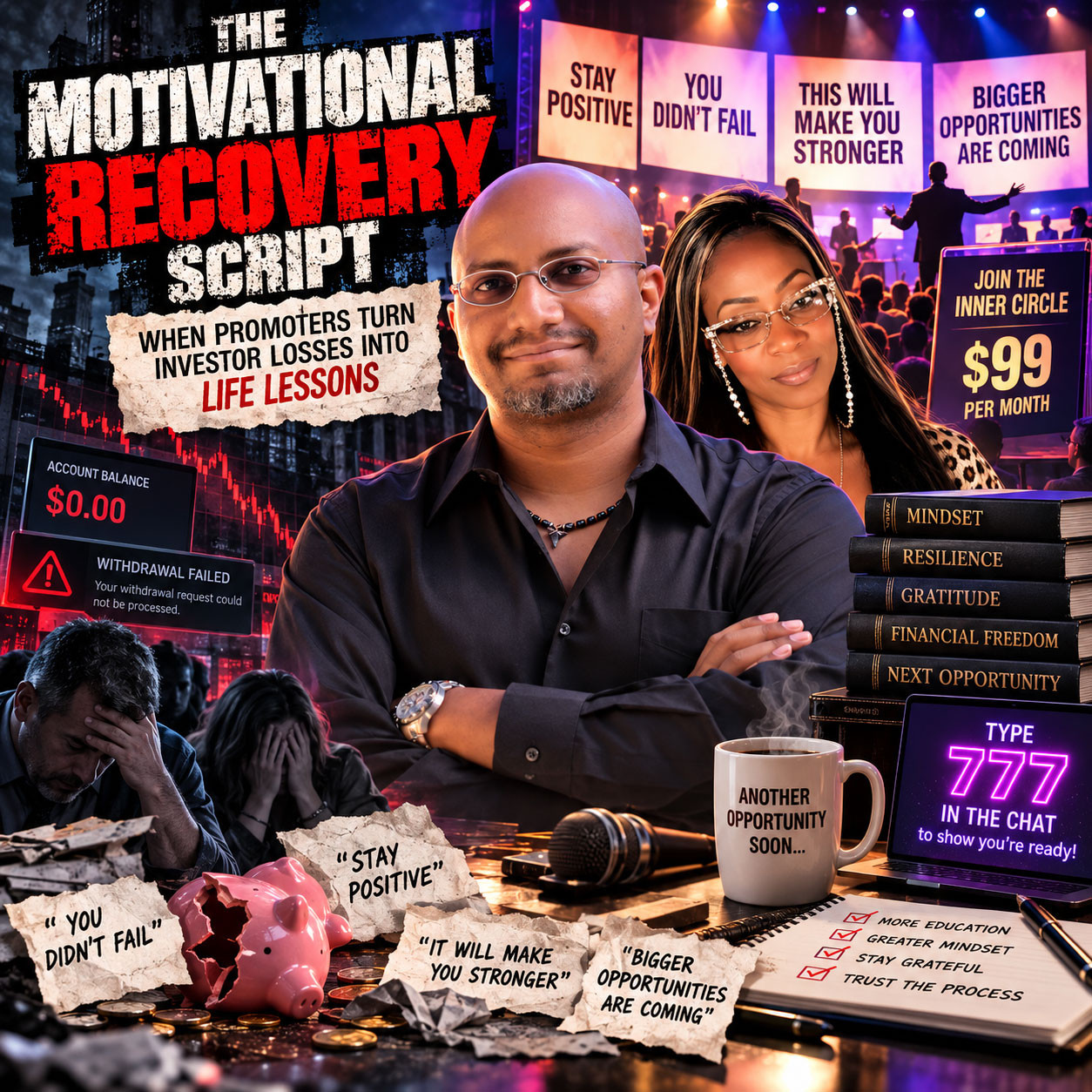
The Motivational Recovery Script — When Promoters Turn Investor Losses Into Life Lessons
Imagine investing your money in a company promoted by people you trusted, watching withdrawals suddenly stop, and then being told that you haven’t failed, you should stay positive, and the experience will make you stronger.
That was the extraordinary atmosphere surrounding Brandon Ivey’s 5 October 2026 ILCA Community Update Call.
Near the beginning of the recording, at approximately 7 minutes and 45 seconds, Ivey delivered a message to investors who were facing the possibility of substantial financial losses:
“You didn’t fail. Not one single one of you failed. You stepped out. You took a risk.”
It sounds encouraging until you consider who was delivering the message.
This was not an independent financial counsellor helping victims recover from a traumatic experience. It was a promoter who had entered into a commercial relationship with E-Estate, acknowledged identifying warning signs before becoming involved, and admitted he could not independently verify the company’s advertised property ownership.
Now that the investment had collapsed, he was positioning himself as the person who could help the community understand the experience and move forward.
The man who helped promote the opportunity was now helping investors come to terms with its failure.
At approximately 50 minutes, Ivey introduced a motivational video featuring a woman discussing serious personal adversity, financial setbacks and her eventual recovery. The underlying message was that successful people overcome difficulties, learn from their experiences and refuse to give up.
There’s nothing wrong with resilience. People who have suffered financial losses often need emotional support.
But this wasn’t an ordinary investment experiencing a temporary market downturn. E-Estate had suspended withdrawals after months of regulatory concerns and unanswered questions about its supposed real-estate assets.
Investors didn’t need to be persuaded that life could get better. They needed to know whether their money was recoverable and whether the people who had encouraged them to participate had properly investigated the business.
A motivational video cannot establish property ownership, explain missing funds or make a suspended withdrawal go through.
The contradiction became even more striking when Ivey discussed his own financial experiences. He described previously losing approximately $2.2 million in another project, presenting that setback as something he had managed to overcome.
That figure was his claim, not an independently verified loss.
If accurate, it raises an obvious question: what lessons had he learned from that experience, and why hadn’t those lessons prevented him from becoming commercially involved with another investment opportunity whose fundamental asset claims he could not verify?
Ivey also acknowledged becoming greedy while pursuing E-Estate’s promotional matching offer. That admission deserves attention because it undermines the impression that experience and financial education necessarily protected him from the incentives being offered.
He was presenting himself as an educator capable of guiding others through investment risk while admitting that he had been drawn into chasing increasingly attractive returns himself.
Then came Darryl Porter.
At approximately 59 minutes, Porter addressed the community, speaking about integrity, relationships and maintaining a positive outlook. He acknowledged that he had been named in the Texas regulatory action and described having experienced a similar situation before.
Porter was not merely another disappointed investor expressing frustration. He was one of the individuals named in the Texas State Securities Board’s June 2026 Emergency Cease and Desist Order.
That distinction matters.
When someone associated with the regulatory allegations speaks to investors after the collapse, I want to hear substantive answers about the allegations, the underlying business and the evidence supporting its financial claims.
Instead, much of Porter’s contribution focused on personal character, friendships and the value of the community.
Friendships may be genuine. The experiences people shared may have been meaningful. But none of that establishes that E-Estate operated a legitimate investment business.
Investors cannot pay their mortgages with friendships, and a speech about integrity is not evidence of financial integrity.
Marnie Casa’s contribution was equally revealing.
Having described her family’s involvement in E-Estate, she spoke enthusiastically about the experiences and opportunities she believed the investment had provided. Her account was filled with gratitude, even as other members faced uncertainty about their money.
She also criticised people who were complaining about what had happened, arguing that they had been given warnings and education.
This is where the motivational messaging becomes particularly objectionable.
Being angry about an investment collapse does not mean an investor lacks gratitude, resilience or financial education. It may simply mean they recognise that something has gone seriously wrong.
People have every right to demand answers when an operation stops paying, particularly when its advertised business model has already attracted regulatory allegations.
And there was another uncomfortable feature of Dacosta’s contribution.
At approximately 1 hour and 11 minutes, she encouraged members to consider Ivey’s $99-per-month Inner Circle, presenting continued education as part of preparing for the future.
Think about the timing.
Members were waiting for pending withdrawals and information about a proposed buyback. Some may have been facing serious financial hardship. Yet they were hearing encouragement to continue spending money within the educational community associated with the promoters of E-Estate.
That doesn’t establish that ILCA’s educational services were fraudulent. But it does demonstrate that the organisation was continuing to market its services while members were dealing with the consequences of the failed investment.
The investment had stopped paying, but the opportunity to sell education to the community had not disappeared.
Anthony DeLoatch reinforced the motivational atmosphere when he spoke at approximately 1 hour and 14 minutes.
He encouraged members to remain positive, continue pursuing financial success and view the experience as part of their personal development. He acknowledged that the promised buyback might never happen, yet emphasised the importance of moving forward.
At one point, he encouraged participants to type 777 into the chat as a declaration of their readiness for the next stage.
I find that remarkable.
People were potentially facing the loss of life savings, unanswered withdrawal requests and an investment operation under serious regulatory scrutiny. And the response included encouraging them to type a number into a chat window to demonstrate their positive mindset.
What exactly was 777 supposed to accomplish for someone who couldn’t withdraw their money?
The problem isn’t that these speakers wanted people to remain hopeful. The problem is the extraordinary imbalance between the time spent encouraging emotional recovery and the lack of independently verified answers about E-Estate’s finances.
Throughout the call, the emphasis repeatedly shifted towards gratitude, resilience, education and community loyalty.
Those themes can serve a useful purpose. They can also discourage people from examining whether the individuals they trusted deserve criticism.
When an investor becomes angry, the response is that they should remain positive. When they question their decisions, they’re reminded that investing always involves risk. When they worry about the money, they’re encouraged to concentrate on the future.
And when they begin questioning the promoters, they’re told about the importance of maintaining relationships and moving forward together.
That is not accountability. It is a remarkably convenient way to manage the fallout from an investment collapse.
Ivey and the other speakers may genuinely have believed they were helping members cope. Their intentions cannot be established from the recording alone.
But their words and conduct can be examined.
The community was being encouraged to accept the experience as another financial lesson while the fundamental questions remained unresolved: what assets did E-Estate actually control, where did its payments come from, and what money was available to repay investors?
Those questions deserved more attention than another motivational exercise.
And the recording reveals why maintaining the community was so important.
Because while E-Estate investors were being encouraged to recover emotionally, ILCA was already discussing how to introduce them to future income opportunities
The Next Opportunity — Keeping The Community Ready For Another Investment
 E-Estate had collapsed. Investors couldn’t withdraw their money. The promised buyback remained uncertain. Yet Brandon Ivey and his colleagues were already discussing how to identify the next income-producing opportunity for their community.
That is perhaps the most revealing part of the entire 5 October 2026 ILCA Community Update Call.
At approximately 1 hour and 23 minutes, Ivey offered an analogy that neatly illustrated how he wanted members to think about the collapse.
He compared investment opportunities to vehicles, explaining:
“Vehicles have flat tires. They break down. You got to get in a new vehicle.”
A flat tyre?
We’re talking about an investment operation facing serious securities allegations, unresolved questions about its advertised real-estate assets and investors unable to access their money.
E-Estate wasn’t a car that needed a new tyre. It was an investment opportunity whose promoters could not independently substantiate some of its most fundamental claims.
Yet Ivey’s analogy reduced the collapse to an unfortunate interruption on the road to financial success. The solution, apparently, was to find another vehicle.
This is precisely the pattern that concerns me about serial investment promoters. When one opportunity stops paying, the community, the relationships and the promotional infrastructure can survive. The failed company may disappear, but the people who built an audience around it can remain in a position to introduce something new.
Ivey explained that ILCA was an education business, not a multi-level marketing company. He described its services, including cryptocurrency education, coaching, marketing programmes and paid memberships.
He also made clear that he was not introducing a specific replacement investment during the call.
That distinction is important. The recording does not establish that Ivey had already selected another questionable scheme or that ILCA was launching a replacement for E-Estate.
What it does establish is that ILCA intended to identify and evaluate future income opportunities for the same community.
At approximately 1 hour and 28 minutes, Ivey outlined plans to gather information about potential opportunities that members could consider. Rather than allowing the community to disperse after E-Estate’s collapse, ILCA would continue providing education and developing its network.
Then Marnie Casa explained how the process would work.
The organisation intended to use two forms. One would allow members to express interest in future opportunities. The other would allow people to submit opportunities for consideration.
Those submissions would include information about the business, presentations and, significantly, referral links.
Dacosta indicated that ILCA hoped to narrow the submissions down to approximately three to five opportunities that could be presented to members.
There it was.
Investors were still waiting for E-Estate to explain what had happened to their money, while the same community was preparing a process for reviewing new opportunities and collecting referral links.
Referral links can be used simply to identify where a prospective customer came from. They can also be used to track referrals and calculate commissions or other rewards.
The recording does not establish whether ILCA would receive compensation from any future opportunities it selected. But the request for referral links makes financial transparency particularly important.
Would ILCA disclose any referral commissions or commercial agreements? Would members know whether someone recommending an opportunity stood to benefit from their participation? And, most importantly, what independent evidence would ILCA require before allowing another investment to be promoted to its audience?
Ivey had already admitted that he could not independently verify E-Estate’s advertised property ownership.
So what exactly would be different about the due diligence next time?
Would ILCA demand independently verified financial statements? Evidence of real business revenue? Corporate ownership records? Proof of the assets supposedly supporting investor returns? Proper legal analysis of securities compliance?
The recording described a process for collecting and considering opportunities. It did not establish a detailed independent verification framework addressing those questions.
And then, towards the end of the call, Ivey made an admission that puts his entire relationship with E-Estate into sharper focus.
At approximately 1 hour and 35 minutes, he acknowledged that his involvement had included a formal commercial arrangement.
He explained:
“They were promoting my company. I was promoting their company.”
That statement matters enormously.
Ivey was not simply an independent cryptocurrency enthusiast who happened to invest in E-Estate. By his own account, there was a contractual promotional relationship between his organisation and the investment company.
The recording does not establish the financial terms of that contract or whether he received particular commissions. But it does establish mutual commercial promotion.
Investors deserve to understand that distinction.
When someone presents themselves as an educator, their audience may reasonably expect independent analysis. But when that educator also has a commercial relationship with the company being discussed, there is a potential conflict of interest that should be clearly disclosed and carefully managed.
Was Ivey evaluating E-Estate solely as an independent educator, or was he also protecting a commercial relationship that benefited his organisation?
His own statement makes that a legitimate question.
It also raises concerns about ILCA’s proposed approach to future opportunities. If the organisation intends to review businesses and introduce selected projects to its members, transparency about referral arrangements, commercial relationships and the standards used to assess those businesses becomes essential.
There is nothing inherently wrong with running an education company or helping people learn about investments.
But after E-Estate’s collapse, I would have expected a serious examination of how the opportunity passed Ivey’s original due diligence, why its advertised property claims remained unverified, and what safeguards would prevent a repeat.
Instead, the community heard about finding another vehicle.
The most telling moment came near the end of the recording, at approximately 1 hour and 39 minutes, when Ivey warned that the call was not intended for public distribution because critics might obtain it and twist what had been said.
He stated:
“This is not a recording to go public because the moment the critics get their hand on it, they’re going to want to twist this.”
But why should investors have to rely on critics to hear what promoters are saying after a collapse?
The statements in this recording are important precisely because they allow the public to examine Ivey’s explanations in his own words.
He acknowledged the red flags. He admitted he couldn’t verify the property ownership claims. He described his commercial relationship with E-Estate. He discussed the failed withdrawals and proposed buybacks. And he outlined how ILCA intended to consider future income opportunities.
None of those admissions needs to be twisted. They deserve to be examined.
The recording does not prove that ILCA’s next opportunity will be fraudulent. Nor does it establish that everyone involved in the community acted dishonestly.
But it reveals a promotional network preparing to continue operating after an investment collapse, without demonstrating during the call how the failures of its previous due diligence would be corrected.
E-Estate may have stopped paying, but the people who helped build confidence in it were already discussing how to keep the community together for whatever came next.
And before any investor considers climbing into another vehicle recommended by the same people, there is one question worth asking:
Why should they trust the next opportunity when the promoters still haven’t adequately explained how they verified the last one?
Promoter Accountability — E-Estate Collapsed, But The Questions Haven’t Gone Away
 E-Estate Scam: Brandon Ivey’s Snake Oil Show
Brandon Ivey wanted his community to move forward. I want to know why investors were encouraged to move into E-Estate in the first place.
That is the question at the heart of this investigation, and no amount of motivational speaking, criticism of regulators or talk about future opportunities makes it disappear.
The 5 October 2026 ILCA Community Update Call gave us something unusually valuable: an opportunity to examine a prominent promoter’s explanations after the investment he helped promote had stopped processing withdrawals.
We didn’t have to guess what Ivey was thinking. He spent approximately 100 minutes telling his community.
And what emerged was not a convincing account of rigorous independent due diligence. It was a series of admissions, justifications and reassurances that raised more questions about his judgement and the commercial interests surrounding E-Estate.
One of the most important questions concerns what Ivey knew and when he knew it.
He described identifying significant concerns before becoming involved. He acknowledged the possibility that the investment arrangements might constitute securities. He understood the danger of payments being funded by incoming participants rather than genuine business revenue.
Yet he proceeded with a promotional relationship while relying on explanations from the company itself.
That is not evidence that Ivey knowingly participated in fraud. But it is evidence that his claimed expertise did not translate into independently verified answers about some of the most important aspects of the business.
An experienced promoter should not need an investment to collapse before discovering that company assurances are not a substitute for evidence.
The second issue is the relationship between education and commercial promotion.
Ivey presented ILCA as an organisation helping people develop financial knowledge and identify opportunities. But he also acknowledged that E-Estate and his business had a contractual arrangement involving mutual promotion.
That creates an obvious question about independence.
When an educator recommends an investment while maintaining a commercial relationship with the company behind it, investors deserve to know the nature of that relationship and whether it influences the recommendations they receive.
The recording did not establish the financial terms of Ivey’s agreement. It did, however, establish that the relationship was more substantial than an independent educator simply expressing an opinion.
If you are promoting a company that is also promoting your business, your audience deserves to know that before deciding how much weight to place on your recommendations.
The third issue is the extraordinary confidence expressed about investor recovery.
Ivey had no independently verified evidence of E-Estate’s available cash reserves to present during the call. He had acknowledged that he could not substantiate the company’s advertised property ownership.
Yet he still offered reasons to believe the proposed buybacks might be honoured.
For someone waiting on a pending withdrawal, those reassurances could be enormously influential.
And that is precisely why they required evidence.
A promoter who helped build confidence in an investment should be particularly careful about making optimistic statements after it stops paying. Otherwise, the same people who encouraged investors to trust the opportunity may end up encouraging them to trust another promise that has not been substantiated.
Investors need evidence of available money, not another expression of confidence from someone who was already wrong about the reliability of the investment.
There is also the question of responsibility for the regulatory warnings.
The Texas State Securities Board’s 1 June 2026 Emergency Cease and Desist Order was a serious public warning about E-Estate’s securities offering and associated representations. It did not establish criminal guilt, but it placed substantial allegations into the public domain months before withdrawals stopped.
Anyone continuing to promote confidence in the opportunity after that point had a responsibility to take those allegations seriously.
Ivey’s suggestion that critics may have helped trigger regulatory scrutiny does not answer the allegations. Nor does comparing E-Estate with unrelated cryptocurrency enforcement cases.
The issue is whether the investment claims were true and supported by reliable evidence.
If the company could not demonstrate that its advertised assets and income streams existed as represented, the problem was not the people exposing that failure.
And then there is the question of what happens next.
ILCA’s proposed process for considering future opportunities may be presented as education and community support. But after E-Estate, investors should insist on knowing exactly what independent checks will be performed and whether the people introducing those opportunities have financial incentives to promote them.
No one should have to discover another commercial relationship only after an investment has collapsed.
The most revealing moment came at the end of Ivey’s recording, when he expressed concern about critics obtaining it and twisting his words.
I have no interest in twisting his words.
I want investors to hear them.
They can listen to his explanations, examine the regulatory allegations, consider the unanswered questions and reach their own conclusions.
And they should be able to do that without being told that questioning the promoters amounts to negativity, disloyalty or a failure to embrace personal growth.
The people who lost access to their money are entitled to be angry. They are entitled to question the people who introduced them to E-Estate. They are entitled to demand transparency about commercial relationships and the evidence used to support promotional claims.
They are also entitled to reject the suggestion that the collapse was simply an unfortunate flat tyre on their journey towards financial freedom.
For some investors, the consequences may be far more serious than an inconvenience. Borrowed money still has to be repaid. Retirement savings do not magically reappear. And a promised buyback means very little until actual payments are made.
I cannot establish from this recording exactly where E-Estate’s investor funds went, whether its operators deliberately engineered an exit scam or what individual promoters privately knew about the company’s financial position.
Those questions require further documentary evidence and investigation.
But I can establish what Ivey publicly admitted during this call, and those admissions are more than enough to justify scrutiny of his promotional conduct.
He recognised serious warning signs. He entered a commercial promotional relationship. He could not independently verify the advertised property ownership. He continued expressing confidence in possible investor repayment without demonstrating that sufficient funds existed.
And while investors were still waiting for answers, his organisation was discussing how to evaluate future income opportunities.
That is not the record of due diligence and accountability I would expect from someone asking a community to trust his financial education and judgement.
The lesson here is not simply that investments carry risks. Everybody knows that.
The lesson is that promoters who profit from building trust in an opportunity should be held accountable for the claims they make, the evidence they rely upon and the commercial relationships they disclose.
E-Estate investors deserve to know what happened to their money. They deserve a transparent explanation of the buyback process and the status of their pending withdrawals. They deserve to know whether the assets used to promote the investment were ever independently verified.
And before Brandon Ivey or anyone else involved in promoting E-Estate introduces another opportunity to the same community, those questions deserve answers.
Because when a promoter cannot properly explain what happened to the last investment, why should anyone trust him with the next one?
Brandon Ivey And Marnita Casa — Formal Notices Sent
I have contacted both Brandon Ivey and Marnita Casa regarding their involvement in promoting E-Estate and their statements during the 5 October 2026 ILCA Community Update Call.
Brandon Ivey —[email protected] and [email protected]
I emailed Brandon directly, challenging his questionable due diligence, his attempts to blame critics and regulators, and his continued discussions about future income opportunities while E-Estate investors were struggling to recover their money.
Marnita Casa — [email protected]
I also emailed Marnita, challenging her promotional activities, her unverified claims about borrowing against her home and her encouragement of further income opportunities following E-Estate’s collapse.
However, the email bounced because connectwithqc.com could not be found, despite being publicly advertised on her YouTube channel, The Connectress. Her website, marnitacasa.com, also appears inactive.
I subsequently forwarded the letter through Brandon Ivey in an attempt to bring it to her attention.
It is concerning when people promoting financial opportunities have publicly advertised contact details that no longer work, especially when investors may be trying to recover their money.
Both individuals are welcome to provide verifiable evidence, factual corrections or a substantive response.
Add the actual email textClarify what was sentUse more neutral legal wording
Disclaimer: How This Investigation Was Conducted
This investigation relies entirely on OSINT — Open Source Intelligence — meaning every claim made here is based on publicly available records, archived web pages, corporate filings, domain data, social media activity, and open blockchain transactions. No private data, hacking, or unlawful access methods were used. OSINT is a powerful and ethical tool for exposing scams without violating privacy laws or overstepping legal boundaries.
About the Author
I’m DANNY DE HEK, a New Zealand–based YouTuber, investigative journalist, and OSINT researcher. I name and shame individuals promoting or marketing fraudulent schemes through my YOUTUBE CHANNEL. Every video I produce exposes the people behind scams, Ponzi schemes, and MLM frauds — holding them accountable in public.
My PODCAST is an extension of that work. It’s distributed across 18 major platforms — including Apple Podcasts, Spotify, Amazon Music, YouTube, and iHeartRadio — so when scammers try to hide, my content follows them everywhere. If you prefer listening to my investigations instead of watching, you’ll find them on every major podcast service.
You can BOOK ME for private consultations or SPEAKING ENGAGEMENTS, where I share first-hand experience from years of exposing large-scale fraud and helping victims recover.
“Stop losing your future to financial parasites. Subscribe. Expose. Protect.”
My work exposing crypto fraud has been featured in:
Coffeezilla 2026): Featured in the investigation exposing the alleged $328M Goliath Ventures Ponzi scheme
Bloomberg Documentary (2025): A 20-minute exposé on Ponzi schemes and crypto card fraud
News.com.au (2025): Profiled as one of the leading scam-busters in Australasia
OpIndia (2025): Cited for uncovering Pakistani software houses linked to drug trafficking, visa scams, and global financial fraud
The Press / Stuff.co.nz (2023): Successfully defeated $3.85M gag lawsuit; court ruled it was a vexatious attempt to silence whistleblowing
The Guardian Australia (2023): National warning on crypto MLMs affecting Aussie families
ABC News Australia (2023): Investigation into Blockchain Global and its collapse
The New York Times (2022): A full two-page feature on dismantling HyperVerse and its global network
Radio New Zealand (2022): “The Kiwi YouTuber Taking Down Crypto Scammers From His Christchurch Home”
Otago Daily Times (2022): A profile on my investigative work and the impact of crypto fraud in New Zealan