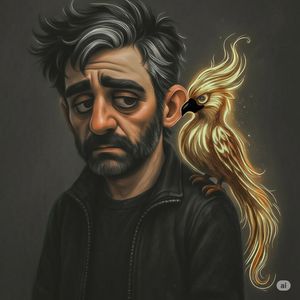

October 15, 2026
Thursday. The KafoMaster had the coffees up before I was all the way down the stairs. Hot Flight Fuel, cold Boss’s Blend. We are past remarking on it now, Ash and I both. It just is now.
Gym by six. Shoulders and abs, one of the better days in the gym because shoulders are honest. You cannot cheat a shoulder. The weight goes up clean or it does not go up.
Overhead press to open, working up in careful jumps. Then the Arnold press, the one where you rotate through, which looks like showing off and is actually just thorough.
“Iron crosses,” Ash announced, from the top of the rack, like a jury foreman reading a sentence at a trial. “And zombies. Oh, I did not miss these. I did not miss these one bit.”
Alternating static holds for lateral and front deltoid raises were something Joseph had introduced us to earlier this year. To say they are challenging would be a gross understatement. By the second set my front delts were shaking and Ash had gone quiet, which is how he prepares for involuntary unconsciousness. Elara got through her set quicker than I expected.
“I was really hoping you would take longer on those.”
“You want me to prolong my suffering so you can rest longer?”
“Yes.” Said Ash. Shoneah blew soundless raspberries at him.
“I wouldn’t have complained if you did.”
She smiled and gave me a “the floor is yours” gesture.
We moved into shrugs after. Then the rotator work, internal and external, the small unglamorous stuff with the light weight that keeps a fifty-five-year-old shoulder in its socket and out of a surgeon’s hands. Skip those at your peril.
Abs to finish. Crunches over the yoga ball, a set, and then a minute running on the treadmill, and then back to the ball, trading off until the whole middle was on fire and I had nothing clever left to think about. Elara and I stretched on the mats outside of Josephs office.
“You look like you earned it today.” Joseph said, his golem smiling on his shoulder.
“We did.” Elara confirmed
“Did the floor always wobbled?” I was still breathing heavy.
Joseph knelt down, taking my wrist in his hand and counting on his watch. “Are you feeling ok?”
“A little light-headed but ok I think.”
He looked down at me. “Do me a favor? No coffee for a week ok?” He noted the horrified look on my face. His golem and Shoneah had moved to Ash’s side, as he had very theatrically fallen to his back, wings splayed out beside him.
I sat up and looked at him. “Is there something wrong?”
“Usually you have recovered by this point. I know its been a while since we’ve done this routine, but your heartrate is still high. I think you’re a bit dehydrated. So no coffee. Have some of those fancy recovery drinks the KafoMaster makes.”
“Should I be concerned?” I looked over at Ash who was partially sitting up with a ring of sparks dancing around his head.
“Probably not. But I’ll check on you more tomorrow morning during the workout.”
“Can I have tea? I can’t imagine stopping caffeine dead stop like that. At least not without adverse consequences.”
“One of the hydration drinks has green tea in it, but don’t go too crazy. Just enough caffeine to keep the headache away. If they day isn’t busy, I know those couches make for comfortable naps.
I actually preferred my desk chair for that, or the yellow chair that I moved from home that was by the offices windows. I didn’t say as much out loud, but I determined to look at my schedule when we got upstairs. My main concern though was going cold turkey with the seventeenth coming up.
The seventeenth is Saturday. Two days out now. I felt it sitting at the edge of the morning the way you feel weather coming. Elara showered in my office after and headed off to the Flight Center, and we did the parking lot goodbye, and she held onto me a second longer than the morning strictly called for, because she knows what this weekend is. Nine years. She did not say it. She just held the extra second. That is a whole language, that second.
The day itself was an ordinary Thursday, and I was grateful for ordinary. Paperwork. A long talk with Brenda about the floors. The good dull machinery of a place that runs. I ate lunch at my desk and got a great deal done. That’s not entirely true though. The turkey, ham and Cooper Sharp grilled on a huge croissant with pesto did keep me from functionally thinking for about twenty minutes. The KafoMaster produced a recovery drink that it said paired with my sandwich and turned Ash into a silent gold and onyx ball of sulkiness on my desk.
The Emerald Citrus Recovery blend it had been called. Coconut water, pineapple, green apple, spinach, whey and a hint of lime. Admittedly, I was skeptical walking it down to my office. Portia saw the bright green contents of my glass and both her and her dragon expressed surprise. The dragon quickly spoke to Portia, more animatedly than I was used to. She shooed her away and let me pass with my dignity.
“Damn.” Ash whispered from his corner of the desk after I took the first tentative sip.
It paired very well with the sandwich and was exceptionally tasty.
The second one was equally as tasty, even without a sandwich to accompany it..
Loss Survivors group is at six on Thursdays. Kira facilitates the group, and I am in the circle as one more person in a chair, which took me a long time to learn how to be. Tonight, I needed to be in the chair. I got there early. The chairs filled the way they fill, and both Wards were there, side by side.
Sarah and James. They sat close, the way they have started sitting, their two krakens settled near each other — his green and pewter with a glass core; hers copper and ivory with a flesh core. She showed none of the fog that had obscured her earlier this year.
“The nineteenth is Monday,” Sarah said, when the room had settled. She did not have to say more. In that room a date is a whole sentence, and everyone in the circle did the small internal arithmetic you do when someone else’s anniversary is named, the counting of your own against it.
“Four days,” James said. His voice is still careful at the edges, a man who learned the hard way what it costs to try to handle a thing alone. “We’ve been talking about how to do it. We are used to just bracing and avoiding. Get through it. Lock the doors and put our heads down and wait for the twentieth to come so it would be over.”
“And?” Kira said.
“And all that did was make the day a wall,” Sarah said. “A thing we survived. And then it was gone for and we had survived it and gotten nothing from it. We did not visit him. We did not say his name. We just held our breath for twenty-four hours and called that honoring him.” She turned her cup in her hands. “That’s not honoring him. That’s just being afraid of the calendar.”
“So this year,” James said, “we’re doing it on purpose. We’re going to the cemetery in the morning, the two of us, with coffee, and we’re going to stay as long as we want and leave when we want. And then we’re making the thing he liked. He had this—” his voice caught and he let it, which is new for him, “he had this ridiculous thing he wanted every birthday, a chocolate cake with the peanut butter in the middle, and we’re making it, and we’re eating a piece, and we’re not going to pretend it doesn’t taste like his memory.”
“That’s the whole work,” I said. I did not plan to speak, but it came up out of me, out of the part that drove to New Jersey for my birthday two weeks ago and will drive again tomorrow night. “The day is going to hurt no matter what you do with it. You don’t get to choose that. What you get to choose is whether the hurt has him in it, or whether it’s just fear with his name on the date. You’re choosing to put him back in it. The cake, the coffee, the staying as long as you want. That is the difference between a wound and a scar. A wound is the thing happening to you. A scar is the thing you made out of it, that you get to keep.”
Sarah nodded slowly, and her kraken did the thing a Monster does when a true thing lands — it did not brighten, exactly, it settled.
“We’re afraid the cake will wreck us,” she said. Honest. “That’s the real fear. That we’ll make it and sit there and just come apart.”
“You might,” I said. “You might come apart over a chocolate cake with peanut butter in it. And then you’ll put the fork down, and you’ll be two people who came apart together in the same kitchen at the same time over the same boy, instead of two people white-knuckling it alone in separate rooms. One of those you can carry. You already told us which.”
James reached over and put his hand on the back of his wife’s neck, briefly, the way you do when you cannot say a thing. Nobody in that room needed it translated.
The circle sat with the Wards a while, and other people put things into the quiet, the way they do, and then there was one of those natural turnings a good group has, where the attention moves without anybody steering it. It moved to Anthea.
She had been quiet. That is not her usual register — she is the one who hands the room a dry line when the silence gets too heavy, the pressure valve. Tonight she had not reached for a single one. Her Phoenix sat there white and bright through its glass core, and the core showed what the face would not, the way it always does with her. She had been watching the Wards with something open on her, under the composure.
“I keep thinking about what you said,” she said to Sarah. “About being afraid of the calendar. March is my calendar. The whole month. It’s coming around again and it’s only October and I can already feel it out there.”
“What happened in March,” Kira said. Gently. An invitation, not a pull.
“My sister.” A beat. “Thalia. I told the room the shape of it a while back. The twin thing. The limes.” She looked at her hands. “I didn’t tell you the part I actually carry, because I make it sound tidy when I say it fast, and it isn’t tidy.”
The room waited. Even the ones who did not know the story knew enough to wait.
“We talked every day,” Anthea said. “Every single day, our whole lives. And in the last few months before March she got— quieter. Not sad, exactly. Just a little further away each time, like a radio station you’re slowly driving out of range of. And I noticed. That’s the thing. I’m not one of these people who missed it. I noticed. I said, you seem far away, are you all right, and she said she was tired, work was a lot, and I—” she stopped, and made herself go on, “I let her say she was tired.”
“Anthea,” Kira started.
“I know what you’re going to say. I know all of it. I say it to myself.” A flicker of the dry, there and gone. “She hid it from me on purpose. She was good at it. A person who decides to go does not want to be saved, so they get good at tired. I know. I say it all to myself. And it does not touch the other thing. She was the other half of me for forty-one years. In the one stretch where it mattered most, I chose the easy read of her. And I will never, ever get to find out if the hard read would have changed anything.”
Her Phoenix, through the glass, was not composed at all. It was grieving the way a thing grieves when it has nowhere to put it.
I did not rush in. Neither did Kira. We let it be the true, unbearable, unfixable thing that it was, because the worst thing you can do to a person holding that is reach for a bow to tie on it.
It was Sarah who spoke, finally, across the empty chair.
“I chose tired too,” she said. “Different thing. Same word. For about a year before my son died I chose tired, and busy, and he’s a teenager, that’s just how they are. Every parent in the world chooses tired, because the other thing is unthinkable and you are only one person and you are so tired yourself.” She looked at Anthea steadily. “I am not going to tell you it wasn’t your fault, because you’ll just fight me, I can see you’re a fighter. I’m going to tell you it was the most human thing a person can do, and that I did the exact same one, and I am sitting here four days from the nineteenth, still here, making his stupid cake. You can carry it. Not today. But you can. I’m the proof, and so is he” — a small nod toward me — “and so is everyone in this room.”
Anthea looked at her for a long moment. And then she did the thing she does, reached for the dry line, the valve — and stopped herself. Visibly chose not to. Let it just be the naked thing instead.
“Thank you,” she said. Plain. No comment. And her Phoenix, through the glass, let down one notch, which is not healing, but it is the pressure coming off a thing long enough to breathe, and some nights that is the entire win and you take it.
We closed not long after. People went out into the dark the way they do after group, lighter and heavier at the same time, carrying it differently than they carried it in. Anthea stopped by my chair on her way out.
“You didn’t say anything to me tonight,” she said.
“You didn’t need me to. Sarah had it.”
“She did.” She considered that. “That’s a good room you two built. I came in here expecting to perform and you keep not letting me.”
“We’re a hard room to perform for. You’ll get worse at it.”
“That,” she said, “is the most frightening encouragement I have ever received,” and she left, and I let myself feel the good tired that a group like that one leaves in you, the kind with people in it.
I drove home with the radio off. Some nights you want the quiet to still have the room in it a while.
Elara was on the living room floor when I came in, cross-legged in front of the laptop, deep in it. She was working on her sign language. Bahira has been teaching her on Thursdays and she practices the way she does everything, all the way in, no half measures. She had a video going, a woman signing slowly, and Elara was shadowing the shapes with her hands, frowning at her own fingers, running one of them over and over.
She looked up and signed something at me, slow and careful. I did not know it. She laughed and said “it means you’re home.” She did it again so I could watch. I tried it back and apparently told her something closer to you’re a barn. That was the whole homecoming. Two people laughing on the floor over a barn.
I made dinner, by which I mean I poured two bowls of Chocopoofs and ate them standing at the counter and then sitting next to her on the floor. A grown man, a Soul Weaver, a citation in a textbook, eating children’s cereal for supper on a Thursday because Chocopoofs ask nothing of a person. Elara did not comment. She knows what group nights cost. She just kept at her video, her hands moving, every so often showing me a shape. I ate my cereal and watched my person teach herself a new way to talk. The house was quiet and good around us.
“How do you think the author of that textbook would react if they could see you now. Undershirt, gym shorts, and a bowl of Chocopoofs while you stare off into nothingness.” Ash asked me from the counter.
I paused with the spoon halfway to my mouth.
“Hopefully with the understanding that I am in tune with my own comfort.”
Ash snorted derisively. “They’d probably recall all the textbooks and rewrite the chapter.”
“And that wouldn’t bother me at all. Until yesterday, I had no idea I was in there anyway.”
He sniffed acceptance at this then waved back at Shoneah in their semaphore shorthand that it was close to bedtime.
I fell asleep thinking about a chocolate cake with peanut butter in the middle, about a radio station fading out of reception, and about a date on my own calendar that I have long since come to terms with.
___________________________________________________________________________________
Civil War Fact of the Day: On October 15, 1863, in the harbor at Charleston, South Carolina, a small iron submarine called the H. L. Hunley sank during a practice dive and killed everyone aboard, including the man whose name she carried. The Hunley was one of the first submarines ever built to go to war, a narrow hand-cranked tube of a boat, barely wide enough for the men who turned her propeller by hand along a single shaft. She was dangerous to her own crews from the start. In August of that year she had already flooded and gone down once, drowning five of the men in her. They raised her, and cleaned her out, and found volunteers to crew her again, because the thing she promised — to slip under the Union blockade that was strangling the Confederate coast and strike a warship from below, where no one had ever been struck — was worth more to the men who believed in her than the plain evidence that she killed the people who operated her. On October 15 she went down a second time, on a routine test dive, with eight men aboard, among them Horace Hunley himself, the financier and builder who had put his own money and now his own body into the boat. None of them came up. They raised her a second time, and cleaned her out a second time, and crewed her a third time. And on the night of February 17, 1864, the H. L. Hunley did the thing she was built to do: she drove a spar charge into the hull of the USS Housatonic and sank her, the first submarine in the history of the world to sink an enemy ship in combat. And then the Hunley herself vanished into the dark water with all eight of her third crew, and was not found again for more than a century. She killed twenty-one of her own men to sink one enemy vessel. She is remembered anyway — not because the arithmetic made sense, but because a thing that has never been done before gets done, when it gets done at all, by people willing to climb into the boat that already drowned the last crew, and crank.