
October 27, 2025
The alarm went off at 6:00 AM, but I was already awake. My body, which had been a lead weight on Sunday, was now thrumming with a nervous, electric dread. It was the same feeling I used to get before a major briefing in a war zone: the knowledge that the next few hours would be unavoidable, catastrophic, and perhaps cleansing. I was going to tell the story of December.
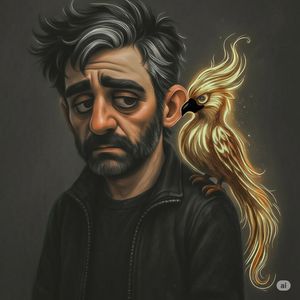
Ash was quiet this morning. Not gleeful or defensive; just a steady column of warm, dark gold light hovering over my desk.
“Showtime,” Ash murmured, voice deeper than usual, stripped of its usual phoenix bravado. “Remember what you told the ghost of dead relationships yesterday. You have to climb out.”
The drive to the Center was silent. I arrived before 7:30 AM, expecting the usual quiet hum of the building before the day officially started. Instead, I found a low murmur of activity. The conference room door was open, and two facilities staff were furiously rearranging furniture, pulling in folding chairs from storage. Clearly today wasn't going to follow the script I'd written in my head. The script where I'd have a quiet conversation with maybe fifteen people—current mentees, a few colleagues—and then return to normal work. Controlled. Manageable.
People are already arriving—faces I recognize from my teaching years, therapists I supervised a decade ago, colleagues from other centers. Two people I haven't seen since my own training are standing near the windows, having apparently traveled from out of state.
Claire met me at the door to my office, her face a mixture of concern and a certain fierce pride. She didn’t offer a platitude.
“Word got out,” she said, her voice barely a whisper. “The email about an informal Edge Weaver gathering was forwarded. They’re all coming, Willie. Current mentees, the last two graduating classes, hell we’ve had requests to retocast it.”
I grimaced good naturedly in her direction, a cold, heavy rock settled in my stomach. The scale of this felt wrong. This wasn't supposed to be a spectacle; it was supposed to be a small, painful confession to a trusted few. Now it was a performance. My instinct screamed to run, to retreat into the sterile safety of my office and cancel the entire day.
“Bleedin’ ‘ell, guvnor!”
“Ok, no more falling asleep to British baking shows.”
“No not the crumpets!”
I walked straight to reception. Brenda, our long-time, unflappable admin, looked up, her expression sympathetic.
“Clear my schedule,” I instructed, my voice flat and authoritative, resorting to my clinical, "Edge Weaver Director" persona to hold myself together. “Reschedule everything. Cancel appointments, postpone meetings, turn away solicitors. Unless someone is actively dying on the premises, I’m unavailable until 5:00 PM.”
Brenda didn’t flinch. She just offered a genuine, warm smile—the kind that makes you realize you’re surrounded by people who care. “Way ahead of you, boss. The entire day is blocked out. We’ll hold the perimeter. Go do what you have to do.”
By 9:00 AM, the conference room was filling beyond capacity. It was standing room only along the walls. The air was thick with a nervous, electric energy—not judgment, but anticipation, fear, and shared professional anxiety. They weren't here for answers; they were here for permission to feel what I had been feeling, the need to hear that failure doesn't end careers, that loss doesn't disqualify you from the work.
I felt Joseph’s quiet presence at my shoulder just as I was about to walk to the podium. His hand rested lightly on my arm. “You don’t have to do this today, Willie,” he said, his own Golem, a steady bronze shepherd, manifesting beside him. “They’ll understand if you need more time.”
I shook my head. “No. I’m good.”
He turned to look at me appraisingly, his golems look of surprise would have been comical in any other setting and moment.
“Ok well maybe not good, but screw it.”
“Go get ‘em boss.”
We shared a brief memory of the many years working together and the running joke of he and Claire calling me boss, going so far as to program and lock one of the coffee presets as “Caffeine Boss.”
“mmmm Caffeine Boss and a crumpet would be so nice right now.”
The room goes quiet when I walk in. That particular silence that precedes something everyone knows will be difficult. Ash manifests smaller than usual, protective rather than performative.
I stepped up to the front, feeling the weight of two hundred eyes on me. I didn’t use the microphone; I wanted this to feel raw, personal, unamplified. I looked at the sea of faces, faces I had trained, mentored, argued with, and supported.
I took a deep breath, grounding myself, and started where I always should have started.
“His name was Arcturus Joffe,” I began, the words tasting like metal. “He went by Archie. Captain, retired. Thirty-eight years old. He’d survived two deployments to two different hostile zones, but he couldn’t survive coming home.”
I pause, take water from the bottle Claire placed on the table. My hands are steady. That surprises me.
I recounted the history. Archie had come in for six months. He was making progress—slow, agonizing, two-steps-forward-one-step-back progress.
"The work went well. Or I thought it did. Archie's Golem showed the typical fracturing—stress cracks from sustained trauma, the kind we see in extended combat exposure. But they were healing. He was doing the work. Showing up to sessions. Talking about his wife, his three kids. Making plans. That's what I told myself. He was making plans."
On that day in December, his Golem, which was always a chaotic, fractured thing that looked like glass held together by static electricity, had been cracking more noticeably. Spreading fractures, but not breaking. Not yet.
The conversation had been deceptively light. We weren't talking about his trauma; we were talking about trivialities. He spoke about his wife, Sarah, and their three kids. He talked about how he felt better about things now, more stable. He even mused aloud how maybe his path, his recovery, could serve as a lesson for others. He talked about planting a garden in the spring. It was all a performance, brilliantly executed. It was the calm before the edge.
I have to stop. Breathe. Count. Ash presses against my neck, warm and insistent.
"I should have heard it. The finality in 'hopefully his path could serve as a lesson.' The past-tense quality of 'made his choices easier.' But I didn't. I heard a man getting better. I heard success."
"We talked for forty-five minutes. Light conversation. Progress updates. He smiled. Made a joke about Army coffee versus therapy office coffee.” Soft murmurs of understanding the therapeutic capabilities of the KafoMaster 2000 rippled across the room.
And then came the moment, the moment that had been replaying on a loop in my head for ten months. It felt like watching a movie of myself: detached, witnessing, but unable to influence the outcome.
Archie smiled. It was a completely genuine, unburdened smile, and he locked eyes with me. “Thank you for everything, Doc.”
That was the key, the final message. It wasn't a cry for help; it was a final, terrible act of gratitude, releasing himself from the burden of recovery. In the next instant, he pulled a compact, matte-black handgun from his coat pocket.
The sound that followed was not the movie-loud blast I remember from combat. It was a sharp, percussive crack that shattered the silence of the conference room ten months later. The smell—the metallic, acrid, chemical stench of gunpowder—was suddenly real again, burning the back of my throat.
I could still see the red blooming on the pristine glass of the observation wall, a shocking, vibrant stain against the institutional white. I could still see the frantic, silent screams of his Golem, misunderstanding the imminent and immediate threat. Just before the blast, the shattered glass figurine that was his Monster had lifted its single remaining hand towards me one last time, and then it simply dissolved into memory.
I look up at the ceiling, trying to hold it together. Continuing anyway.
"The next three months are a blur. Crisis response. Review boards. Mandatory leave. Therapy for the therapist. And the question that wouldn't stop: Why didn't I see it coming? That's what Edge Weavers do—we see the edge before people reach it. We're supposed to intervene. We're supposed to save them."
I let them talk, let the professional questions dissipate the personal shock. When the noise settled, I answered them with the raw, brutal honesty that I had kept locked down for so long.
“I have reviewed that session, those notes, those tapes, time and time again. I’ve run simulations on every variable—my reaction, his Golem’s behavior, the conversation content. I don’t know if anything could have been different. I can’t tell you there’s a missing protocol. Sometimes people are just determined. Sometimes the edge finds them faster than we can intervene, faster than we can slow them down or divert them.”
The silence that followed was different from the pre-session silence. This was heavy, shared, and absolute.
Kira raises her hand—she's one of my current mentees, three years into her training. Her voice shakes when she speaks: "How do you come back from that? How do you get back in the chair and do the work the next day, knowing you missed the one thing you were trained to see?”
It's the question resting silent on everyone’s face. Inside, I’m thankful for Kira in that moment.
I smiled, a thin, painful smile that didn't reach my eyes. I looked towards the wall behind me, towards my office where the yellow chair sat—the chair I had dragged out of the wreckage and into my new, temporary space.
“Apparently,” I said, the answer surprising even myself, “you bring a chair to your office. And you spend ten months trying to figure out if you’re allowed to keep doing this work. If you’re allowed to keep sitting down. If you’re allowed to keep existing when he couldn't.”
Joseph speaks from the doorway: "But…you did come back."
“You forgot to thank him for not helping at all with getting the chair into your office.”
“I don't know if anything could have been different. Archie was determined. He'd made his choice before he walked into my office that morning. Sometimes people stand at the edge and we can pull them back. Sometimes they're already falling and we just can't see it yet."
A man in the back—someone I don't recognize—asks, "Then what's the point? If we can't save everyone, if we can miss it even when we're trained specifically not to miss it, what's the point?"
I look at the Soldier in the corner. His face is Archie's face now. He nods once. On his dark green uniform, the captain's bars were bright, and his name tag, previously blank, now clearly read “Joffe.”
"The point is we show up anyway. We do the work knowing we'll fail sometimes. Knowing we'll lose people. Knowing that being an Edge Weaver doesn't make us immune to the edge ourselves. The point is that most of the time—not every time, but most of the time—we do help. We do see the signs. We do pull people back. And for those people, our showing up matters."
"We can't save everyone," I say quietly. "But we can show up. That's the work. That's all it's ever been."
The room’s energy shifted profoundly. The searching for answers ceased. Instead, the focus became one of bearing witness. One by one, stories were shared. A colleague spoke about a client who disappeared just before their final session. A former student talked about a near-miss, a soldier who they had to physically hold together in the waiting room while the police arrived. They spoke of the clients they couldn’t save, the grief they carried, and the quiet fear that they weren't enough.
“The promise we make is not to achieve infallibility. The promise is that we will show up. That we will sit in the fire with them, even if we are terrified of the burns. That’s the work. That’s all it’s ever been.”
The room emptied slowly. There were no enthusiastic handshakes or professional congratulations. Instead, people approached me individually—a tight hug from a former student, a silent, knowing squeeze of the shoulder from a colleague, a moment of shared, silent grief with Joseph.
Claire and Joseph stayed until the very end, long after the last folding chair had been put away. Claire walked over and simply fixed my tie.
“That was brave,” she said, her eyes shining.
I felt hollowed out, scraped clean by the truth, but lighter than I had been in months. “That was necessary,” I replied, the exhaustion finally settling into my bones.
I walked back to my office and collapsed into the yellow chair, the chair that had started this whole terrifying process. Ash settled on the armrest, a warm, soft weight.
Around lunchtime, my phone buzzed.
Heard you had a rough morning.
My throat felt thick. I hadn't realized I was starving until I read the last sentence.
You are very well informed for a neighbor.
Yes I am! Soup on your porch when you get home? Nothing that requires talking. Just sustenance.
I hadn't realized I was starving until I read the last sentence.
“A crumpet with jam would be amazing right now.”
Did you have a soup in mind?
“Crumpet, jam and an extra big CB…”
Nothing that requires construction experience. haha
Count me in. I’ll pick up some bread from Dante’s on the way home.
I meet Ash halfway and stop at the KafoMaster and hit the familiar button, feeling a fluttering sensation that tells me his dance is both flamboyant and non-rhythmic. Back at my desk I think about Archie. Not about December 18th, but about the earlier sessions. The moments when he genuinely laughed. The day he brought pictures of his kids. The session where he talked about wanting to coach his son's Little League team.
Those moments were real too. The work mattered too. Even if it wasn't enough in the end.
My phone buzzes again. Joseph: "Proud of you. That's what leadership looks like."
I don't know about leadership. But maybe it's what honesty looks like. Maybe that's enough.
The Soldier appears one more time before I leave for the day. He's wearing captain's bars again. Name tag says "JOFFE."
"Thank you," he says.
"For what?"
"For saying my name."
He fades. But this time, it doesn't feel like haunting. It feels like release.
I pack my bag, turn off the lights, and head home to Dante’s and whatever soup Elara has decided we were going to explore. Tomorrow I'll process this further. Tonight, I'll eat soup and let someone take care of me and count it as the victory it is.
_________________________________________________________________________________________________________________
Civil War Fact of the Day: After heavy casualties, chaplains held informal gatherings where soldiers could speak about losses—not official services, just space to acknowledge what couldn't be fixed. These gatherings had no formal structure, no religious requirement. Just men sitting together, bearing witness to what they'd survived and who they'd lost. The military didn't mandate these gatherings. The soldiers created them because humans need to speak the names of the dead, need to acknowledge that the loss matters, need to know they're not alone in their grief. Sometimes the most important healing happens in unofficial spaces, when we stop performing competence and start sharing truth.