
November 1, 2025
I woke up, and the world was quiet. The anxiety, that low-grade professional hum that had been my baseline for months, had receded. It wasn't gone—it’s never gone—but it was muted, like a radio playing in another room. The light, the November light, was thinner, sharper than October's golden hue.
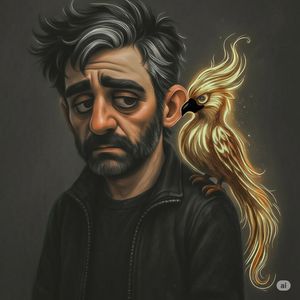
Ash, however, was vibrating like a faulty appliance, his plumage a riot of gold and onyx pulsing with barely contained energy. He had taken to practicing tiny parade steps around the dresser as if ceremony could conjure confidence.
"Date day! The grand adventure! The potential for awkward silences and meaningful glances! Are you ready to not screw this up?"
The apartment smelled faintly of cookies and last night’s dishes; the red sneakers by the door seemed to hum with their own nervous energy.
Pick you up at 9. Wear those red sneakers. They make you look less like you’re attending a funeral.
Bold of you to assume I own other shoes.
“She's got you pegged, funeral casual is your default."
Siobhan appeared by my closet, leaning against the doorframe, inspecting the expansive collection of gray and black.
“Don’t overthink it, Willie,” she said, her voice softer than usual. “Just show up and let her take the lead.”
“That’s surprisingly supportive advice,” I said, tying the laces on the conspicuous red sneakers.
She shrugged, a gesture I hadn’t seen her make since before… well, since before. “I’m dead, not heartless. Besides, she’s good for you. Better than I was.” Her voice caught slightly on the last part, a rare, visible admission of fault.
My throat tightened. The casual mention of her own past mistakes, the subtle confession in her tone, it was destabilizing. “Siobhan—”
“Go. Have fun. Stop arguing with ghosts.”
Ash whistled low. "Well, that was... well….you know… For her.”
When Elara drove up she was in hiking boots and a backpack, her golem a silver and viridian presence at her shoulder as if it had volunteered for the day’s errands. The highway out of town fell away in the usual forty-five minutes of easy talk—blemished with a few confessions about Brennan and a little, unexpected laughter over an ancient, awful playlist she used to blast on deployment.
Her voice softened when she asked about the Colonel. “He sounds like every officer who thought looking good was more important than doing good,” she said.
“That’s exactly it,” I said.
She squeezed my hand once as we exited onto the back roads. That small squeeze was permission more than comfort—permission to be ordinary, permission to be nervous, permission to be human.
The park was stripped of late October color—branches mostly bare, the ground a quilt of brown and brittle gold. The trail rose in a gentle, lung-burning way that challenged my illusion of physical fitness.
"Walking from the bed to the shower every other day for ten months isn’t anyone’s idea of cardio.”
Ash stayed mostly out of the way, perching on my backpack strap and throwing off muffled, sarcastic observations to keep me honest. Elara walked with a steady cadence I found easy to match when I stopped trying to be charming and started trying to be present.
We traded stories neither of us expected to share on a trail: her worst landing in a sandstorm, my worst cookie disaster. There was a rhythm to confession that didn’t demand performance; we tossed up small truths and caught them like stones, polished and ordinary.
Halfway up, a lookout opened over a shallow valley. The wind cut through the thin trees and felt like a small clean thing. Elara sat on a rock and handed me a sandwich wrapped in wax paper. There was coffee in a thermos that tasted like hospital-issue consolation which made me wonder if there was a home version of the KafoMaster.
“This is where I come when I need to remember the world is bigger than whatever I’m stuck in,” she said.
It felt like an honest sentence that deserved nothing more dramatic than a nod. I told her about the novel in a way that wasn’t hedged with excuses while looking over land and towns that very well could have been home to the characters: the tent rituals, the letters, Eleanor’s voice that keeps surprising me by insisting on tenderness where grief wants to stay raw. She asked soft, steady questions—the kind that let you answer without armor.
When she asked about the yellow chair—why I’d dragged it into the clinic, what I was trying to do—I surprised myself. “I brought it to stop making grief a private prison,” I said. “It was a way of saying the private thing belongs in public if I’m going to work on it in public.”
She considered that, then put a hand on my knee. “That was brave,” she said. Her golem relaxed beside her like an exhale.
Bravery is a strange measure when your chest is raw. Sometimes it’s a loud headline; sometimes the bravest thing is the small, almost ridiculous act of moving a chair.
The picnic was mostly bread and things that didn’t try too hard to be art.
“Oh! We should get a bread machine. Can’t be much harder than cookies!”
Elara’s sandwiches were precisely imperfect. We ate, and talked about our monsters. She called hers Shoneah who kept her alive on bad days and made landing harder on good ones. I called Ash a merciless friend and a trained agitator who pulls me out of the spiral because he refuses to let pity calcify into consequence. The act of sharing made both Ash and Shoneah flush appropriately.
“Have you noticed how incredibly bare the trees are this year. I mean like not a single leaf, like they all gave up at once and just ‘poompf’ right on the ground.” Decidedly avoiding eye contact with Shoneah.
We compared notes on the cost of being useful and the quiet currency of being the kind of person others can trust to show up, even when showing up costs something. That trust is a strange economy—paid by repeated small payments rather than one dramatic rescue.
When she asked, tentatively, if she could read the novel, I stalled. The instinct is always to hedge, to protect the thing that feels fragile. But then I looked at her face—steady, not hungry for fix or confession—and swallowed. “Yeah,” I said. “I’d like that.”
“Or….we could see how she feels about monster manuals and sophomoric grandiosity.”
She smiled in a way that assured me she meant it. It was a small, generous tilt of the world.
The surprise plan was a climbing gym on the way home. I misread “minor physical exertion,” which is why my palms were suddenly sweaty for reasons other than being pulled into the harness. The wall looked like a cartoon demon of verticality.
“You’re joking.”
Elara’s eyes were bright and certain. “Trust the rope,” she said, handing me the gear like a piece of practical magic.
The belayer clipped me in. I started awkwardly: feet fumbling, muscles unfamiliar with the specific math of holds. Halfway up, my chest forgot to breathe somewhere between a foothold that was too far away and a handhold that was too far away.
"Left foot! No, your other left! Pretend it's a metaphor for life—climb or fall!"
Panic arrives in a precise way—tunnel vision, the small refusal of the limb to obey. The metaphor was unavoidable. I laughed nervously.
“Don’t worry, this rope was tied in. I made sure of that.”
Elara’s voice came calm from slightly above. “Look at me, not the top. Just the next hold.”
I focused on her face, the cadence of her instructions. The mantra became accidental and absurdly effective: one hold, then the next. Ash counted with me in an absurdly clinical rhythm—1,2,3,4—and the breath returned.
At the top, the bell felt ridiculous and triumphant. I rang it like someone who had just completed a minor miracle. Coming down, my muscles trembled in a way that felt like honest equipment—a body used, a fear moved through instead of folded into secrecy.
"See?" she said, unhooking me. "You can do hard things."
“Was that a metaphor or actual climbing?”
“Both,” she said, grinning. “You did the thing.”
She did not make it sound cheesy or like a test. She made it sound true.
We cleaned up at the gym and went to a no-frills diner that smelled like grease. We drank bad coffee and argued, gently, about which of us had the worst taste in terrible reality shows.
“Baking shows cannot be terrible.”
The conversation slipped into small, ordinary pleasures—neighbors, cats, books we’d lied about liking in college. No performance. No therapy sessions. Just two people existing side by side.
When she drove me home she parked and walked me to my porch. The air was colder, the porch light a small halo. We stood there, a comfortable distance apart, charged and careful.
“Can I kiss you?” she asked.
My brain did the arithmetic of terror and possibility and then failed to compute something as simple as yes. “Yeah,” I said. The word came out too loud and not loud enough.
The kiss was brief and soft, an exchange that felt more like a promise than a conclusion. When she pulled back she asked, instantly vulnerable, “Was that okay?”
“Very okay,” I said, which was the only honest, unqualified answer I had.
She smiled like someone who’d been given permission to keep trying. “Good. Because I’d like to do this again.”
“The climbing or the kissing?” I asked, trying to wedge in a joke that hid the way my stomach had gone soft and right.
“Both,” she said. “All of it.”
Civil War Fact: November 1st, All Saints' Day, was observed even during the war—a day to honor the dead while affirming the living's right to continue, to find joy, to build futures the fallen couldn't see.