
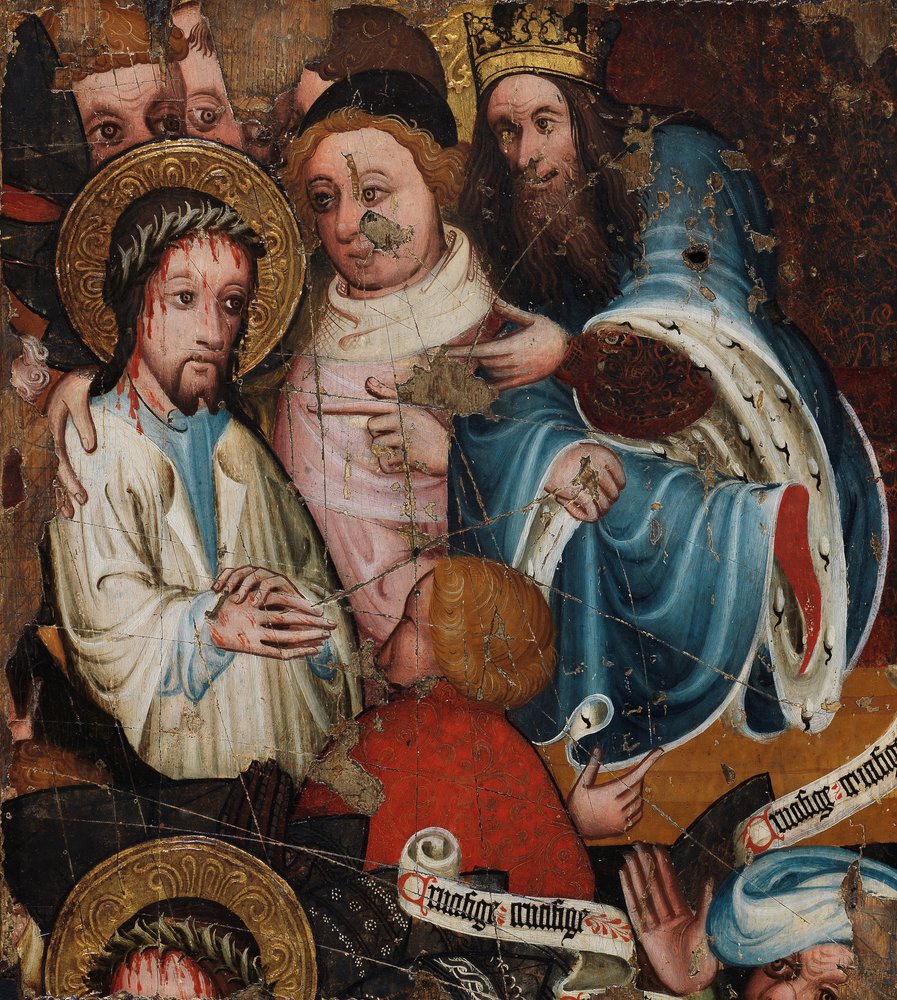
 Artwork: Christ before Pilate, c.1400-25
Before we enter the heartbreak of the cross, we pause at this chilling encounter between Jesus and Pilate — where truth, justice, and kingship all stand trial. We've already reflected on Jesus’s arrest and Peter’s denial (John 18:1–27), and now we continue with this next scene: Jesus before Pilate.
This is a moment of high drama, full of irony, tension, and betrayal — but also profound truth. And maybe more than anything else, it reminds us that Jesus’s kingdom doesn’t play by the world’s rules. It exposes the religious, political, and social systems we often trust — and reveals how fragile and hollow they can be when truth stands in their midst.
📖 Political and Religious Power Plays (John 18:28–32)
The religious leaders bring Jesus to Pilate, but they refuse to enter the headquarters to avoid ritual defilement during Passover. The irony is striking: they’re obsessing over ceremonial purity while plotting the death of an innocent man.
Sound familiar? It’s disturbingly modern.
Not just in religion, but in politics, leadership, and public life. Around the world, we're witnessing systems that wear the language of justice but act in self-interest. In some places, democracies teeter on the edge of authoritarianism. In South Africa and elsewhere, corruption eats away at public trust, and institutions built to protect the vulnerable end up serving the powerful.
It’s performative religion.
It’s performative justice.
It’s performative politics.
All dressed in the language of morality, but soaked in compromise.
And it’s into this kind of world that Jesus walks—silent, unarmed, and unbending—standing before empire not to overthrow it by force, but to reveal it for what it is.
✨ “We are not permitted to put anyone to death.”
They hand Jesus over, aligning with Roman power to carry out a sentence they couldn’t execute themselves. It's a partnership in injustice — and it ultimately fulfils Jesus’s own words about how He would die (John 12:32).
🪞Reflection:
How do our own systems—religious, political, social—betray justice in the name of control? And how do we, consciously or not, participate?
👑 A Different Kind of King (John 18:33–37)
Pilate questions Jesus:
“Are you the King of the Jews?”
His concern is political: is this man a threat? But Jesus flips the entire notion of kingship on its head:
“My kingdom is not from this world.”
Jesus’s rule doesn’t rely on violence, nationalism, or popularity. His authority comes from truth, love, and sacrificial grace — and that’s a threat far more dangerous to empire than any sword.
“Everyone who belongs to the truth listens to my voice.”
And then we come to one of the most haunting lines in Scripture:
“What is truth?” (v. 38)
It sounds like a scoff—a shrug from someone caught in political games. But if we listen closely, there’s something more. A man staring into the eyes of Jesus, perhaps knowing deep down that this is wrong… yet still powerless, or unwilling, to change the outcome.
Maybe it’s not just cynicism. Maybe it’s a quiet desperation.
The irony? Pilate asks the right question—but doesn’t wait for the answer.
Does he even want the answer?
🔄 Barabbas Over Jesus (John 18:38–40)
“I find no case against him…”
Pilate tries to offer a loophole — a chance to release Jesus as part of a Passover tradition. But the crowd demands Barabbas — a rebel, a man of violence.
And so the innocent is condemned, and the guilty walks free.
Barabbas isn’t just a person. He’s a symbol.
He represents our human tendency to choose what is violent, loud, familiar — over what is just, quiet, and transformative. He represents the world’s rejection of the way of peace.
🕰️ What is Truth? — The Irony and Humanity of Pilate
I've said many times now that this story is soaked in irony, and here’s another one.
The Four Agreements teach: “Don’t make assumptions.”
But if we’re honest, we assume a lot about Pilate. And maybe some of it is fair—he was, after all, a Roman governor.
To rise to that position in the Roman Empire, ruthlessness was more than expected—it was currency. Rome didn’t reward mercy. Power was kept through fear, violence, and spectacle.
And yet... listen to his voice.
“I find no case against him.”
“Do you want me to release the King of the Jews?”
“What is truth?”
This doesn’t sound like a man entirely at peace with what’s happening.
What if Pilate wasn’t just dismissive or smug—what if he was desperate?
What if—amid the pressure of empire, politics, crowds, and keeping the peace—he saw something in Jesus that unnerved him?
Is this the moment where truth meets power, and power flinches?
In Pilate, we see a man,
Caught between empire and conscience.
Caught between keeping his job and listening to his gut.
Caught between his role in the machine and the uncomfortable truth standing right in front of him.
This is the kind of tension Good Friday forces us to sit with.
It asks us not just who Jesus is, but who we are — when we’re caught between the demands of the world and the quiet, convicting voice of truth.
🧭 Themes to Sit With
1. Truth and Power Collide
Jesus stands unflinching before empire, refusing to play the game. In a world hungry for power and scared of truth, His calm dignity is revolutionary.
2. Justice That’s Not Just
Pilate knows Jesus is innocent. The crowd does not know what they want. The religious leaders are determined to protect their own power.
This is not justice — it’s theatre.
And it mirrors how easily real justice is lost when power becomes the goal.
3. Jesus as King
He doesn’t wear a crown of gold, but of thorns. He doesn’t sit on a throne but is hung on a cross. And yet — He rules. From the place of weakness, love, and surrender, His reign begins.
🪞 Reflection Questions
How does Jesus’s kingdom challenge how we view power, success, or influence?
What does “belonging to the truth” look like in your life?
Are there places where you choose Barabbas — the easier, louder way — over the path of Christ?
How can you bear witness to Jesus’s truth when the world echoes Pilate: “What is truth?”
🙏 Closing Prayer
Lord Jesus, on this day, we remember the cost of truth — the silence, the rejection, the cross.
Help us not to choose Barabbas when we are afraid.
Help us to follow You even when the crowd turns away.
May Your kingdom come — not through power, but through peace.
Not through force, but through faith.
And may we have the courage to stand with You, in truth, in love, and in hope.
Amen.