

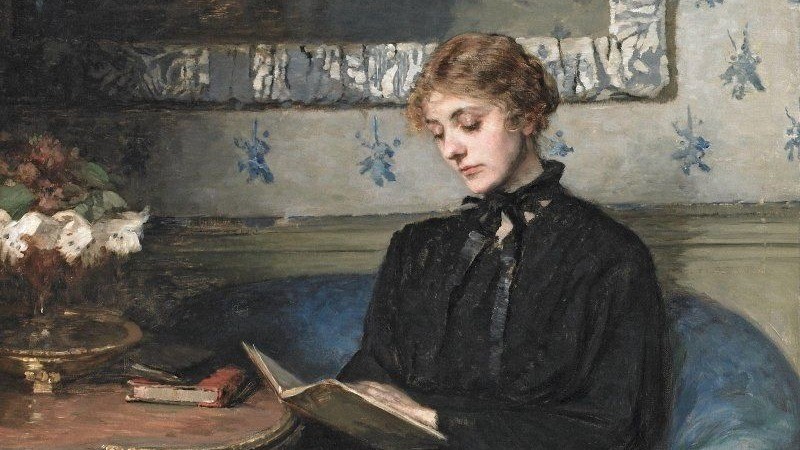
 'Memory and Imagination'
by Sophie Friederike Mereau (née Schubart) (1770 – 1806)
Why does only melancholy pour forth
from your shell, memory?
Why does the silent sorrow of longing
cloud the soul's gaze with gloomy twilight?
It flutters fearfully with paralysed wings
around blossoms of the past, fleeing
forever, as a poor, unforgiven shadow lingers
by his grave mound.
And as if to Eden's blissful fields
belated remorse penetrates with wet eyes,
it looks back at airy creations
that no hope will ever bring back.
Is this your happiness, O you, in the moonlight,
memory? Is this your bliss?
O, flee from me with your withered wreath,
and leave me to the past.
Carry me away on your cheerful wings,
O imagination, from this dark discord!
Already I feel strength penetrating every nerve,
and flee more easily from the arms of melancholy.
You, divine one, you revel in the wreath of being,
not anxiously bound to the present,
delighted all around; in the sunshine,
the immensity of your fatherland shines upon you.
You boldly rise above the meagre realm
of poor necessity, all-encompassing one,
and, intoxicated by the song of the spheres,
plunge into the sea of flames of ideals.
You are not bound by the earthly measure of time,
nor of space; related to the heavenly,
you enjoy in the realm of possibilities
a happiness that no reality can encompass.
In vain does an indissoluble seal
envelop the distant future from mortals;
reflected back from your magic mirror,
it emerges in beautiful twilight.
As a fellow companion, you share the treasures
that blossom deep in the bosom of distant posterity,
and boldly dissolve the laws of finitude,
so that souls glow with immortality.
Inspire me! Already, from its black shell,
the bright dawn of hope breaks forth.
The world is beautiful, and a more beautiful fullness of life
foams up from your magic chalice.
'Erinnerung und Phantasie'
Warum ergießt sich nur der Schwermut Schauer
aus deiner Schale mir, Erinnerung?
Warum bewölkt der Sehnsucht stille Trauer
der Seele Blick mit trüber Dämmerung?
Sie flattert ängstlich mit gelähmten Flügel
um Blüten der Vergangenheit, enteilt
auf ewig, wie bei seinem Grabeshügel
ein armer unversöhnter Schatten weilt.
Und wie nach Edens seligen Gefilden
zu späte Reu' mit nassem Blicke dringt,
schaut sie zurück nach luftigen Gebilden,
die keine Hoffnung je ihr wiederbringt.
Ist dies dein Glück, o du, im Mondenglanze,
Erinnerung? dies deine Seligkeit?
O, fleuch von mir mit deinem welken Kranze,
und überlaß mich der Vergangenheit.
Entführe du auf deinen muntern Schwingen,
o Phantasie, mich diesem finstern Harm!
Schon fühl' ich Kraft durch jeden Nerven dringen,
und fliehe leichter aus der Schwermut Arm.
Du, Göttliche, du schwelgst im Wesenkranze,
nicht ängstlich an die Gegenwart gebannt,
entzückt umher; dir strahlt im Sonnenglanze
die Unermeßlichkeit, dein Vaterland.
Der armen Notdurft kärglichem Gebiete
entschwingst du, Allumfassende, dich kühn,
und stürzest dich, berauscht vom Sphärenliede,
ins Flammenmeer der Ideale hin.
Dich fesselt nicht das ird'sche Maß der Zeiten,
des Raumes nicht; mit Himmlischen verwandt,
genießest du im Reich der Möglichkeiten
ein Glück, das keine Wirklichkeit umspannt.
Vergebens hüllt ein unauflösbar Siegel
den Sterblichen die ferne Zukunft ein;
zurückgestrahlt aus deinem Zauberspiegel,
geht sie hervor in schönem Dämmerschein.
Als Mitgenossin teilest du die Schätze,
die tief im Schoß der fernen Nachwelt blühn,
und lösest kühn der Endlichkeit Gesetze,
daß von Unsterblichkeit die Seelen glühn.
Beflügle mich! schon bricht aus schwarzer Hülle
der Hoffnung lichtes Morgenrot hervor.
Die Welt ist schön, und schön're Lebensfülle
schäumt mir aus deinem Zauberkelch empor.
Georg Wilhelm Friedrich Hegel (1770 – 1831). Philosophy of Mind. Subjective Mind.
(2) Imagination (continued)
§457
In fantasy intelligence has been perfected to self-intuition within itself, inasmuch as its content, derived from its own self, has pictorial existence. This structure of its self-intuiting is subjective; the moment of what is is still lacking. But in the structure's unity of the inner content and the material, intelligence has likewise implicitly returned to identical self-relation as immediacy. As reason, intelligence starts by appropriating what is immediately found within itself (§445, c£ §455 Remark), i.e. by determining it as a universal; correspondingly its activity as reason (§438) is, from the present point on, to determine as a being what within it has been perfected to concrete self-intuition, i.e. to make itself into being, into the thing. When active in this determination, it is self-externalising, intuition producing: ( yy) sign-making fantasy.
- 'Philosophy of Mind'
When selbst, ‘self ’, functions as a prefix normally but not always normally it has a reflexive implication, so Selbstanschauung, ‘self-intuition’, suggests that intelligence intuits itself, which does not mean that it intuits some external object, for instance a painting, that expresses its universal representation:, The reference to art in §456 was a digressionary anticipation and it means that it contemplates a mental image expressing its representation and this is regarded as an intuition since the object subjected to contemplation is pictorial (bildich), and yet as self-intuition, since the image is derived from intelligence itself. The ‘structure’ (Gebilde) is not simply the image, but the combination of representation and image: consult §456 on the ‘individualized structures’. Intelligence as reason moves in two apparently contrary directions. To begin with, it withdraws inwards, transmuting what it immediately finds (sensations, intuitions) into universals, images and then representations and this process sublates immediacy and therefore intelligence is not at this stage in identical self-relation, or relation to itself, as immediacy. It is in some way alienated from its own immediacy but the formation of a representation-image structure or complex implicitly restores intelligence’s relation to itself in its immediacy and this implicit return is made explicit by the second movement and here intelligence takes a plunge outwards giving external embodiment to its inner achievement, making it into ‘a being’ (Seiendes), and making itself ‘into being, into the thing’ (zum Sein, zur Sache), into an external, intuitable entity that is just immediately there. That is to say, intelligence devises intuitable signs for its representations. On being and its contrast with universality, consult §455.
The universal is one’s own (das Eigene), and the inner. Being (das Sein) is being-found (das Gefundensein) and the outer. Prior, in intuition, recollection, and so on these two moments have been synthesized whereby a synthesis is a combination or compound of two or more ingredients, in which, Hegel suggests, each element retains its own nature: consult §§451, 454, 456. In particular, the element of being, the sensory material I find (for instance Mr Smith), remains just ‘found’, only now I apply my image or my representation to it. But with fantasy it is different. The two moments are not just synthesized, they are ‘completely welded into one’ (vollkommen in eins geschaffen). Previously, intelligence was the universal element, the ‘indeterminate pit’; whatever being it had it got from outside. But now it is ‘individuality’, in being as well as universal. That is to say, signs enable intelligence to step forth into the world as a concrete, discernible individual, entering into relation to others, not just itself; it makes its mark in and on the world. Signs are not simply found, they are created by fantasy. They are intuitable entities, but they are not just there, they are charged with universal significance.
'[Remark] Fantasy is the midpoint in which the universal and being, one's own and being-found, the inner and outer, are completely welded into one. The preceding syntheses of intuition, recollection, etc., are unifications of the same moments; but they are syntheses; only in fantasy does intelligence present itself not as the indeterminate pit and the universal, but as individuality, i.e. as concrete subjectivity, in which the self-relation is determined to being as well as to universality. The structures of fantasy are everywhere recognized as such unifications of what is the mind's own or its interior with the intuitive; their more determinate content belongs to different departments. Here we are to conceive of this inner workshop only in terms of these abstract moments. -As the activity of this unification, fantasy is reason, but only formal reason, in so far as the content of fantasy as such is a matter of indifference; whereas reason as such also determines the content to truth.'
- 'Philosophy of Mind'
Everywhere the structures or products of fantasy are unifications of‘ the mind’s own and its universal representation, with the intuitive (des Anschaulichen), and are recognized as such, but not all of us recognize particular signs, because these vary from department to department. For instance the sign x may be a letter, a St Andrew’s cross, a multiplication sign, a mark on a ballot paper, an indication of error, or a mark of affection xxxx but we are concerned here only with the abstract moments like ‘own’, ‘inner’, ‘intuitive’, ‘universality’, ‘being’, that do not vary from department to department.
In §438 reason is disclosed as being the identity of the concept’s subjectivity and objectivity, of the I and the object and fantasy’s sign-making satisfies this condition and so fantasy is reason ands yet only formal reason because it makes no odds what the content is. In its first occurrence in the translation of this sentence content is Gehalt, in its second Inhalt, and the italics suggest that the two words are being distinguished. The indifference of the content (Gehalt), as far as fantasy is concerned may refer to first, it matters not whether Christians symbolize their beliefs with a cross or Nazis symbolize their beliefs with a swastika, and second it matters not whether Christianity is symbolized with a cross or with a fish. The content (Inhalt) that reason determines to truth is more likely to be the content involved in the first, the content of the universal representation. It certainly matters to reason whether one is a Nazi or a Christian yet the content involved in the second, the intuitive sign, might also matter to reason for some ways of expressing an idea are better, more adequate expressions, than others, but this still leaves somewhat less than clear what the difference between Gehalt and Inhalt is, because the contrast between fantasy and reason as such requires that one and the same content matters to reason but not to fantasy.
'Another point calling for special emphasis is this. Fantasy brings the inner content to the image and to intuition, and this is expressed by saying that it determines the content as being. So we must not find this expression surprising either, that intelligence makes itself be, makes itself the thing; for the content of intelligence is intelligence itself, and so is the determination that it gives to this content. The image produced by fantasy is only subjectively intuitive; in the sign it adds intuitability proper; in mechanical memory it completes, inside itself, this form of being.
- 'Philosophy of Mind'
Fantasy determines the content (Gehalt) as being (als seiend) ... a claim I find by no means surprising. What doe surprise me though is when someone comes up behind me and shouts 'Boo!' in my ear when I am not expecting it. What I also find surprising (auffallend) is the claim that intelligence makes itself be, makes itself the thing (sich seiend, sich zur Sache mache). But Hegel contends that the second expression is no more surprising than the first since the content (Gehalt) of intelligence is intelligence itself and the determination it gives to the content, namely being, is also intelligence itself, or at the very least a determination given to intelligence itself, and so when intelligence in the form of fantasy determines its content as being by that very fact it makes itself be.
Intelligence is the the same as its content albeit I might have a variety of ideas some of which I embody in images, some I do not and I may have had different ideas from those I actually have and I have many images that remain dormant so there is more to me or to intelligence than I express in images, however upon expressing my ideas, I am said to express myself, my mind, and so on. The emphasis is on intelligence being not a distinct faculty that underlies its activities and persists unchanged throughout changes in its activities, intelligence is what it does, or at the very least what it does reacts back on it and alters intelligence itself.
'Zusatz. As we have seen in the Zusatz to the previous Paragraph, in fantasy the universal representation constitutes the subjective element which gives itself objectivity in the image and thereby proves itself. This proof is, however, itself immediately still a subjective proof, in so far as intelligence initially still has regard to the given content of the images, is guided by it in imaging its universal representations. This activity of intelligence, which is in this way still conditioned, only relatively free, we call symbolizing fantasy. Symbolizing fantasy selects for the expression of its universal representations only that sensory material whose independent meaning corresponds to the determinate content of the universal to be imaged. Thus, for example, the strength of Jupiter is displayed by the eagle because this is regarded as being strong. -Allegory expresses the subjective element more by an ensemble of individual details. - Finally, poetic fantasy does indeed use material more freely than the plastic arts; yet it too may only select such sensory material as is adequate to the content of the Idea to be exhibited'.
- 'Philosophy of Mind'
The distinction is between symbols that involve an image of something that shares some characteristics with the object of the representation, such as the strong eagle symbolizing the strength of Jupiter, and signs, which do not: consult §457. The image is only subjectively intuitive (anschaulich), not because it is not expressed externally but because it is an image and so has a content that depends upon what we happen to have encountered and is not chosen by us. I cannot, for instance, symbolize Jupiter’s strength by a dove, or for that matter by an eagle, if the only eagles I have ever encountered have been clapped out and lazy. Furthermore for this reason symbols might not be intersubjective, not at the very least intercultural, because different cultures might have different conceptions of eagles, even if they have encountered any. The sign, by contrast, need share no characteristic with the object signified hence there need be no intervening and controlling image, it is plain and simple intuitability (Anschaulichkeit): consult §458. And yet since the sign provides no intrinsic suggestion as to its meaning, signs, in particular linguistic signs, just have to be learned by heart and in this process, the meaning of the signs is repressed and hence they come near to sheer, that is, meaningless, being. On memory, consult §§410, 451.
'But intelligence necessarily progresses from the subjective proof present in the symbol and mediated by the image, to the objective proof of the universal representation, a proof that is in and for itself For since the content of the universal representation to be proved joins together only with itself in the content of the image serving as a symbol, this mediated form of the proof, of this unity of the subjective and objective, turns into the form of immediacy. By this dialectical movement, the universal representation reaches the point where it no longer needs the content of the image for its proof, but is proved in and for its own self, is, therefore, immediately valid. Now the universal representation, liberated from the content of the image, makes itself into something intuitable in an external material wilfully chosen by itself, and thus produces what has to be called, in definite contrast to the symbol, a sign. The sign must be proclaimed a great accomplishment. When the intelligence has designated something, then it has finished with the content of intuition and has given the sensory material an alien meaning as its soul. So for example, a cockade or a flag or a tomb-stone means something entirely different from what it immediately indicates. The wilfulness, emerging here, of the combination of the sensory material with a universal representation has the necessary consequence that the meaning of the sign must first be learned. This is especially true of linguistic signs'.
- 'Philosophy of Mind'
Proves itself (sich . . . bewährt) means something akin to proves its worth, stand the test’ enters the realm of public discourse. Proof (Bewährung) has a corresponding sense throughout this Zusatz: consult §456. On the subjectivity of the proof, consult §457. The plastic (bildenden) arts include chiefly painting and sculpture.
A symbol (Symbol) is an image or picture (another meaning of the word Bild) of something that partakes some features of what the representation is of. It is a kind of picture of the representation, it is intuitable, albeit it might only be expressed in words, in for instance a poem that represents Jupiter as an eagle. The argument for the transition to non-pictorial signs is as follows. Because the content of the representation and of the image are so similar the representation joins together only with itself (sich nur mit sich selber zusammenschließt) in the image and so the image is in fact dispensable and the representation can prove itself without the intervening image, immediately and in and for itself and this does not mean that it can prove itself without any external embodiment, it means that it can adopt almost any intuitable entity, for instance a white rag, as its sign (Zeichen), giving it an entirely different meaning from any that it intrinsically has. On the other hand something adopted as a symbol, for instance the eagle, retains at the very least some of the properties or meaning that it initially has. The eagle need not really be strong to symbolize Jupiter and yet it must be supposed to be strong. This transition is described as a dialectical movement but no clash or unification of opposites is involved, it is merely that the image is so closely attached to the representation that it is no longer needed as I might, for instance become so familiar with the subject of my presentations I need no longer rely on notes to deliver them.
'The Beauties are Coming', 1884, Fausto Zonaro.
§458
'In this unity, stemming from intelligence, of an independent representation and an intuition, the matter of the intuition is of course initially something received, something immediate or given (e.g. the colour of the cockade, etc.). But in this identity the intuition does not count as positive or as representing itself, but as representing something else. It is an image that has received into itself as its soul an independent representation of the intelligence, its meaning. This intuition is the sign'.
- 'Philosophy of Mind'
A cockade is a badge worn on the hat, in particular by servants of court officials and if it is, for instance, blue, we need to have seen blue things in order to adopt this colour but the blue colour has no significance in itself. It signifies a certain status that has nothing to do with blueness that is quite distinct from the use of blue as a symbol of sadness thanks to its tendency to arouse a melancholy mood: consult §401.
'[Remark] The sign is some immediate intuition, which represents a wholly different content from the content that it has for itself; - the pyramid into which an alien soul is transferred and preserved. The sign is different from the symbol, from an intuition whose own determinacy is, in its essence and concept, more or less the content which it expresses as symbol; in the sign as such, by contrast, the intuition's own content and the content of which it is a sign, have nothing to do with each other. In signifying therefore intelligence displays a freer wilfulness and mastery in the use of intuition than in symbolizing'.
- 'Philosophy of Mind'
Two features of the pyramid make it a fitting metaphor for a sign, that in ancient Egypt it served as the tomb of a king, and that it has a geometrical shape with no intrinsic connection or similarity to the dead person inside it. It is not, for instance, shaped like a person.
'In psychology or even in logic the sign and language are usually fitted in somewhere as an appendix, with no thought of their necessity and connections in the system of the activity of intelligence. The right place for the sign is the one indicated: intelligence-which in intuiting generates the form of time and of space, but appears as the recipient of the sensory content and as forming its representations out of this material- now gives its independent representations a determinate reality out of itself, uses the filled space and time, the intuition, as its own, deletes its immediate and peculiar content, and gives it another content as its meaning and soul. -This sign-creating activity may be especially named productive memory (the initially abstract mnemosyne) ; since memory, which in ordinary life is often confused with recollection and used synonymously with it, even with representation and imagination, has in general to do with signs only'.
- 'Philosophy of Mind'
On space and time, consult §448. Intelligence generates (erzeugt) the form of time and of space in the sense that it spontaneously projects the content of its sensations out into space and time. It does not read off the form of space and time from intrinsically spatio-temporal intuitions rather it reads space and time into them. It is not inferred that objects are not really spatio-temporal the thought is that they really are spatio-temporal. With the sensory content that fills space and time, it is otherwise for intelligence does not generate it or read it into things, it reads it off them. The distance of a bush from myself is in some sense my own doing in a way that its yellow colour is not and so intelligence appears (erscheint), that is, makes its appearance, as receiving rather than generating sensory content and forming ideas from it. It does not just appear to do so. Erscheinen, to appear, is very different from scheinen, to seem. Once its ideas are formed they become self-subsistent or independent of sensory intuition, and intelligence can therefore use intuition as it likes, to give them determinate embodiment or reality (Dasein).
Productive memory (das produktive Gedächtnis) is not mentioned elsewhere in 'Philosophy of Mind', and in particular it does not appear among the types of memory listed in §461 but it does appear Hegel’s 'Philosophical Propaedeutic', the notes of his lectures to schoolboys between 1809 and 1811, which were published by Karl Rosenkranz in. 1840:
C Memory
155
(1) The Sign, in general. Representation, being liberated from outer existence and made subjective, the outer existence and the Inner representation stand opposed to each other as different. The arbitrary association of an outer existence with a representation that does not correspond to it but, as regards content, is also different from it so that the outer existence [which] is to be the Representation, or the meaning of the Representation, makes the outer existence into a Sign.
156
Productive Memory, therefore, produces the association of Intuition and Representation, but a free association in which the preceding relation, in which Intuition forms the basis of Representation, is reversed. In the association of Reproductive Memory sensuous existence has no value on its wn account but only the value given to it by Spirit.
157
Through its determinations sensuous existence is generally connected with another existence. But since its determination is a representation made by Reproductive Memory or Mnemosyne it becomes, to that extent, a connection of representations to other thinking beings and therein begins the theoretical communication of these with one another.
158
(2) Language. The highest work of the Reproductive Memory is Language, which is partly vocal and partly written. But, since Reproductive Memory is its source, we can talk of a further source only with regard to the invention of specific Signs.
- 'Philosophical Propaedeutic',
Productive memory contrasts with reproductive memory, the ability to remember and recall the signs produced by productive memory, as in 'Philosophy of Mind', except that reproductive memory includes all the types of memory mentioned in 'Philosophy of Mind' not just what is there called reproductive memory. Mnemosyne comes from mnêmosunê , the Greek word for ‘memory, remembrance’. It was personified as Mnêemosunê, the mother of the Muses, the nine sister goddesses responsible for inspiration in the arts, history, comedy, tragedy, etc. (see Hesiod, 'Theogony', Plato, 'Theaetetus'. She owed her status to the fact that, prior to the invention of writing, poets needed a good memory. Mnemosyne is initially abstract because it is empty until signs are invented.
A question arises as to why memory is limited to signs and why memory is made responsible for the invention of signs rather than simply for their retention and recall, and the reason is, Gedächtnis and the verb gedenken, to remember, are etymologically closely related to denken, to think with its perfect participle, gedacht (thought). Correspondingly, Gedächtnis is closely associated with thinking, which follows it immediately in 'Philosophy of Mind' §465. Thinking is more or less detached from sensory material and so Gedächtnis also needs to be detached from sensory material, in so far as this is compatible with its retaining at the very least some of the functions of memory, enough, that is to say, to warrant the name Gedächtnis. Signs are far enough distanced from sensory material to serve as the objects of Gedächtnis. As for other objects of memory, for instance people’s faces or a trip to a pleasure house at the very least some of these are assigned to our old friend Erinnerung, recollection in the standard sense, remembering a familiar face in a crowd or dwelling upon one’s memories of the trip to the pleasure house. Consult §454. Erinnerung is retained in its usual sense as well as being given the new sense of internalization. Hence because we already have a good enough word for the memory of things other than signs, Gedächtnis could be used for another purpose and once Gedächtnis is reserved for signs it is then natural enough to attribute to it the invention of signs as well as their retention and retrieval. Productive imagination or fantasy is responsible for symbols so it could be attributed to the production of signs, indeed it is simpler to regard imagination as productive rather than memory as the latter is normally conceived as simply reproductive, if it is productive in the way imagination is it amounts to misremembering, to imagining things. And yet in inventing signs, memory is not imagining things, there is nothing to imagine in a sign, a sign is just any common and garden intuition hitched to a representation, whereas imagination, Einbildungskraft, is irretrievably pictorial (bildlich). Sign-creation calls for inventiveness but not for imagination, at the very least not for the type of imagination needed for the creation of symbols, allegories and metaphors. And hence memory, or rather Gedächtnis, assumes the task of sign-creation.
'Two Men And A Young Woman Making Music On A Terrace', Jan Steen, (c. 1626 – 1679)
To be continued ..