

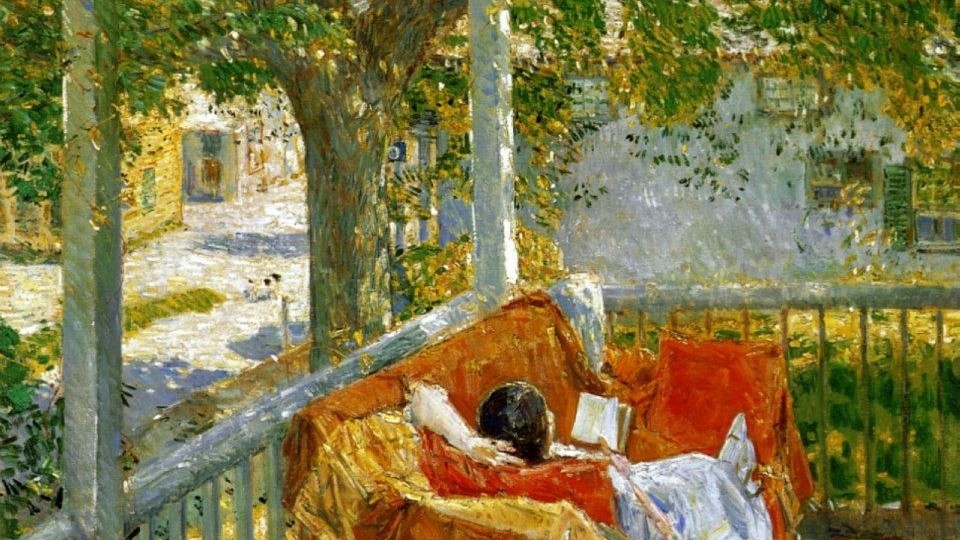
'Spring'
by Sophie Friederike Mereau (née Schubart) (1770 – 1806)
How the branches arch!
Blossoms and flowers jostle,
Roses fill the air!
Mother Nature, how beautiful you are!
How the birds swarm!
Beetles buzz cheerfully around me!
Fish play in the evening glow!
Sweet freedom, how lovely you are!
How the doves coo!
Swallows build their little nests,
searching for little worms!
Love, love, I sense you!
'Frühling'
Wie die Zweige sich wölben!
Blüthen und Blumen sich drängen,
Rosen den Äther umwallen!
Mutter Natur, wie schön bist du!
Wie die Vögelein schwärmen!
Käfer mich fröhlich umsummen!
Fische im Abendglanz spielen!
Holde Freyheit, wie süss bist du!
Wie die Täubelein girren!
Schwalben ihr Nestchen sich bauen,
kleine Würmchen sich suchen!
Liebe, Liebe, ich ahnde dich!

'Flora, Goddess Spring', Humphrey Hooper, (1767 - 1844)
Georg Wilhelm Friedrich Hegel (1770 – 1831). Philosophy of Mind. Subjective mind.
(B) Urges and Wilfulness (continued)
§474
'Inclinations and passions have the same determinations for their content as practical feelings, and likewise have, on the one hand, the rational nature of the mind as their foundation; but on the other hand, belonging as they do to the still subjective, individual will, they are afflicted with contingency, and seem in their particularity to stand both to the individual and to each other in an external relationship and thus with an unfree necessity'.
- 'Philosophy of Mind'
A practical feeling is for instance the pleasure one feels at getting something to drink on a particular occasion, a shot of vodka for instance, I could do with one but it tends to impede my philosophical thinking. An inclination here is equivalent to an urge and is one’s long term disposition to drink when one wants to, which used to be me and vodka but it is behind me now. A passion is an obsessive tendency to drink irrespective of all other considerations. And so they have the same content, for instance drinking, but differ in form. On the contingency and particularity of inclinations, consult §§471, 473. They ‘stand . . . in an external relationship’ to each other since they are not intelligibly connected or ordered with respect to each other. As yet there is no way of answering the question ‘Which of my inclinations should I satisfy now?’ They are externally related to the individual since the individual plays no part in the creation or formation of his or her own inclinations, they are merely there, with no rhyme or reason to them, and so in satisfying an inclination the individual is determined by or at least submitting to an alien force, something other than him or herself, and to be determined by something other than oneself is to be unfree.
'[Remark] Passion involves in its determination that it is restricted to a particularity of the determination of the will, in which the whole subjectivity of the individual immerses itself, whatever the content of that determination may be. But owing to this formality, passion is neither good nor evil; this form only expresses that a subject has placed the whole vital interest of its mind, talent, character, enjoyment in one content. Nothing great has been and nothing great can be accomplished without passion. It is only a dead, too often, indeed, a hypocritical morality which inveighs against the very form of passion'.
- 'Philosophy of Mind'
Passion is a kind of monomania: consult §473, as the impassioned person throws his or her whole weight into one cause.
Take the cause of the Guelphs and the opposing cause the Ghibellines, (factions supporting the pope (Guelphs) and the Holy Roman Emperor(Ghibellines) in the Italian city states of Central and Northern Italy during the Middle Ages) disregarding or demoting many other worthwhile pursuits having nothing to do with this particular dispute
Dante Alighieri (1265 – 1321), became involved in the strife between the Guelfs and the Ghibellines, he became a prominent White Guelf and when the Black Guelfs came to power in 1302 during an absence from Florence, he was condemned to exile. (The two branches were descended respectively from the two wives of the original Cancelliere. The first wife being named Bianca (Blanche), her descendants called themselves the Bianchi (Whites), the descendants of the second wife calling themselves the Neri (Blacks) in a spirit of opposition).
Not to worry. He could put his enemies in Hell:
Amid this cruel and repulsive crop
Of monsters, naked men ran terrified,
Hopeless of hiding-hole or heliotrope;
Their hands were held behind their backs and tied
With snakes, whose head and tail transfixed the loin,
Writhing in knots convolved on the hither side.
And lo! as one came running near our coign
Of vantage on the bank, a snake in a flash
Leapt up and stung him where neck and shoulder join.
Never did writer with a single dash
Of the pen write "o" or "i" so swift as he
Took fire, and burned, and crumbled away to ash.
But as he lay on the ground dispersedly,
All by itself the dust gathered and stirred
And grew to its former shape immediately.
So wise men say the sole Arabian bird,
The phoenix, dies and is reborn from fire
When her five-hundredth year is near expired;
Living, nor herb nor grain is food for her,
Only amomum and dropping incense-gums,
And her last swathings are of nard and myrrh.
As one who falls, nor knows how the fit comes,
By diabolic power, or oppilation
That chokes the brain with stupefying fumes,
Who, when he rises, stares in consternation
All round, bewildered by his late hard throes,
With rolling eyes and anguished suspiration,
So seemed that wretched sinner when he rose.
Stern is thy hand, Divine omnipotence,
That in thy vengeance rainest down such blows!
Then my guide asked him who he was, and whence;
And he: "From Tuscany I came pelting in
To this fierce gullet, and no long time since.
I loved to live as beasts live and not men,
Mule that I was ! - Vanni Fucci, absolute
Beast; and Pistoia was my fitting den."
I told my guide: "Bid him not budge a foot,
But say what brought him here; - I've only seen him
An evil-tempered, bloody-minded brute."
The sinner heard; nor did he try to screen him,
Nor feign, but turned on me his mind and face,
Showing a dismal shame at work within him.
- 'Inferno' Circle 8 : Bowge vii: Thieves: The Serpents.
Vanni Fucci was a Black Guelf from Pistoia. With two accomplices he stole the treasure of San Jacopo from the Church of San Zeno (1293). For this crime an innocent man (Rampino dei Foresi) was arrested, but Vanni Fucci (who had fled the city) laid an information against the person who had acted as receiver. The latter was hanged and Rampino set at liberty.
Contrapasso: suffer the opposite .. in Hell the sinners are punished by their own sin. So for instance in the circle of thieves there are strange hybrid creatures that are part lizard, part snake, and have deadly stingers. One sting from these creatures and the soul turns to ash. There are also snakes that bound and suffocate souls for eternity. There's a strange six legged, worm like demon that can turn a soul into some kind of reptilian. And at one moment, a soul turns into a spider after getting stung by a giant scorpion. The idea behind these punishments is that thieves not only steal material possessions, but also trust in identity. So now these sinners are eternally deprived of their own identity in physical form, constantly shifting and transforming in an endless cycle.
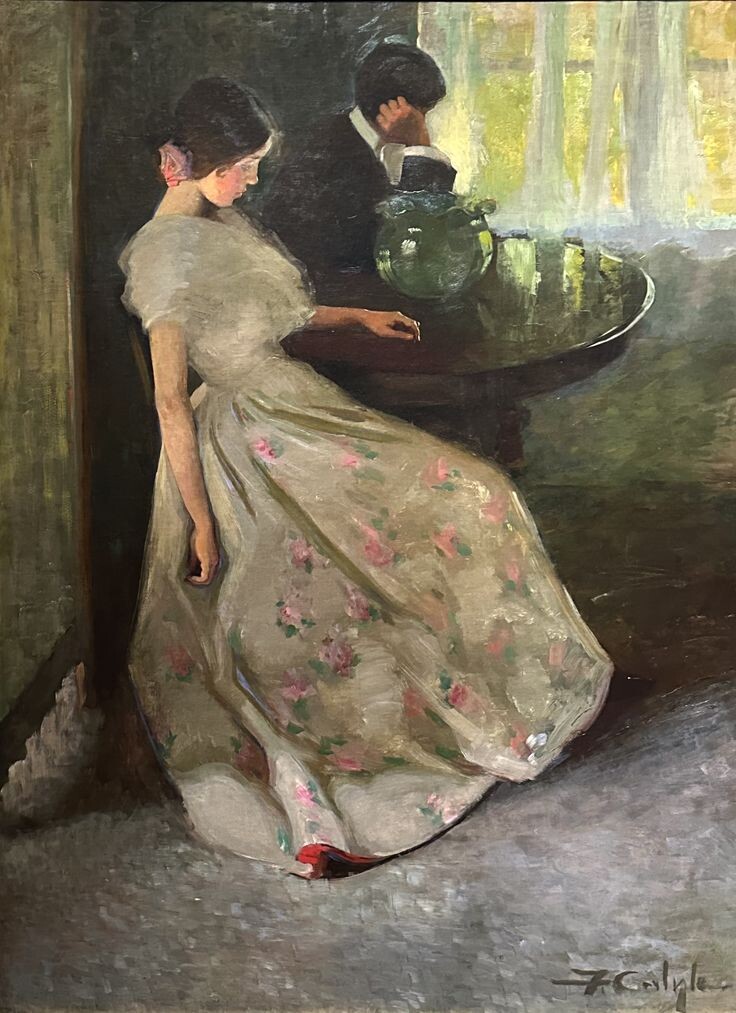
Florence Carlyle, 'The Tiff' c. 1902.
But I digress. There are three objections that may be raised against passion:
(a) The chosen cause chosen may be bad or totally unworthy of single-minded devotion, such as vodka. Hegel concurs, for that reason some passions are evil (böse).
(b) A passion is inevitably one-sided. Ought a philosopher or a historian not be impartial, at least less obsessively partial than the people he subjects to his studies? A response would be that even if the philosopher or historian were not a single-minded Guelph or a single-minded Ghibelline, he or she must be devoted to philosophy or to history at the expense of other pursuits. If people were not one-sided in the way that is fitting, conflicts would not occur and conflicts would not be studied.
(c) It is possible to support a cause, even to support it with unswerving loyalty without passion just as it is possible to want a horse you have backed to come in first without feeling joy when it happens: consult §472. Hence we may endorse partisanship while condemning passion. We may follow the Stoics and contend that passion upsets the balance of the mind. Hegel sides with the Stoics in condemning joy and grief at one’s own good and bad fortune, and yet he did so for the reason that this makes too much of oneself and he dissents from their condemnation of passion in general. Great achievements depend upon single-minded partisanship and this can only be motivated by passion, reason alone can hardly provide an indisputable case for supporting one cause rather than another, besides which it is not so evident that a rationally indisputable case alone can motivate whole-hearted partisanship without it being accompanied by, or in some manner generating, passion.
Nothing great is ever achieved without passion. Hegel says this in the 'Philosophy of History' too.
'We assert then that nothing has been accomplished without interest on the part of the actors; and — if interest be called passion, inasmuch as the whole individuality, to the neglect of all other actual or possible interests and claims, is devoted to an object with every fibre of volition, concentrating all its desires and powers upon it — we may affirm absolutely that nothing great in the World has been accomplished without passion. Two elements, therefore, enter into the object of our investigation; the first the Idea, the second the complex of human passions; the one the warp, the other the woof of the vast arras-web of Universal History. The concrete mean and union of the two is Liberty, under the conditions of morality in a State'.
- 'Philosophy of History'
Michael Inwood (1944 – 2021) has objected that Isaac Newton (1643 – 1727) made great achievements in science, albeit his chief interest was theology, and if science and theology are two distinct contents and Newton was interested in both contemporaneously then he had no passion, since he did not place the whole vitality of his mind, etc. in one content.
I am not sure about that although legend has it he died a virgin, never married, never had a romantic relationship, so maybe he lacked passion in that area. But, whenever I hear of Newton I think of his dog (unfortunately the story is probably apocryphal). His dog Diamond upset a candle, setting fire to manuscripts containing his notes on experiments conducted over the course of twenty years. Newton is reported to have exclaimed: 'O Diamond, Diamond, thou little knowest the mischief thou hast done'.
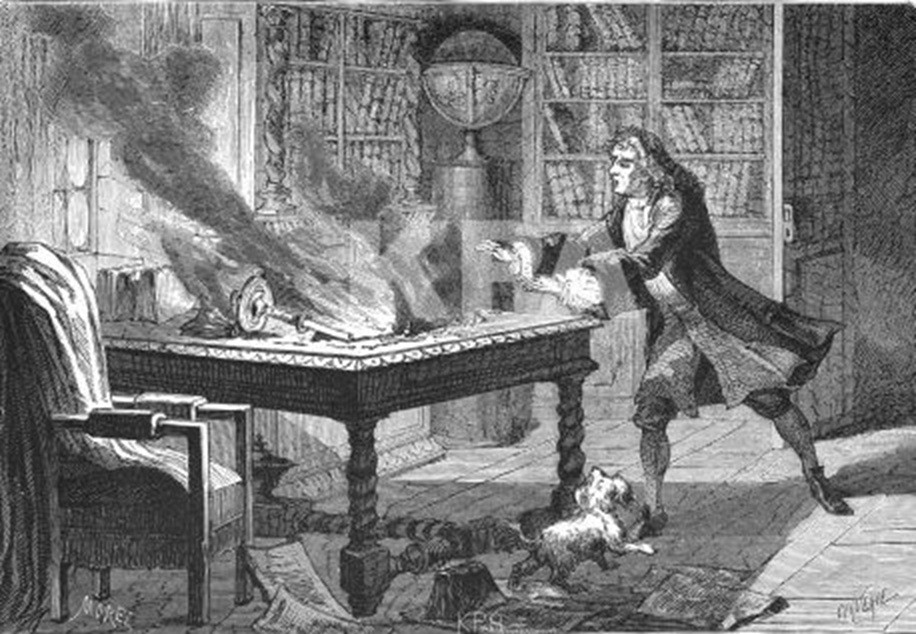
1874 engraving.
'But with the inclinations, the question is immediately raised, which are good and which evil, similarly, up to what point the good remain good, and, since each is a particular type contrasting with the others and there are many of them, how they must, since they all reside in one subject and, to go by experience, can hardly all be satisfied, at least restrain themselves in the face of each other. Initially it is the same situation with these numerous urges and inclinations as with the powers of the soul, the collection of which is supposed to be the theoretical mind-a collection which is now increased by the host of urges. The formal rationality of the urge and the inclination consists simply in their universal urge not to be subjective, but to sublate subjectivity by the activity of the subject itself, to be realized. Their genuine rationality cannot emerge in an examination conducted by external reflexion, which presupposes independent natural determinations and immediate urges, and therefore lacks the single principle and final purpose for them. But it is the immanent reflexion of the mind itself, going beyond their particularity, beyond their natural immediacy, and giving their content rationality and objectivity, in which they become necessary relationships, rights and duties. It is this objectification then, which displays their content as well as their relationship to each other, in general their truth; thus it was with genuine insight that Plato showed that he could explain what justice is in and for itself only in the objective shape of justice, namely in the construction of the state as the ethical life, and also that he included the whole nature of the mind under the right of the mind'.
- 'Philosophy of Mind'
The situation (Bewandtnis) of the numerous urges, etc. is the same as the situation with the powers of the soul. Why? The powers of the soul are not said to be good or evil, nor do they conflict with each other in any evident way, but then consider perceptual illusions, where for instance a stick in water appears bent but our previous experience and our calculations inform us that it is straight. Furthermore, the solution presented here differs in the two instances. The collection of soul-powers are ordered by discerning a rational organization of them within the subjective mind itself and no appeal is made here to anything akin to objective mind, though it is the case that the subjective mind becomes aware of an objective world, yet this is a result of the rational order within the mind rather than a cause of it. On the other hand the disorderly array of urges is reduced to order by objective mind and this difference is related to the fact that whereas the soul powers form (consult §440), a hierarchy progressing towards greater independence of sensory input the urges and inclinations do not but rather all stem from the same soul-power, or at the very least the differences between them are not of such generality that philosophy can arrange them in order. The potential conflict between for instance the sexual urge and the urge to drink can only be side-stepped by non-philosophical means, by, for instance, one’s own conception of joy or ecstasy or by the provisions of objective mind. Philosophy can inform us that this is where the solution lies yet it cannot itself provide it.
The formal rationality of urges, their common or universal urge to be realized, is not genuine rationality, because in cases of conflict, between one urge and another or between the present satisfaction of an urge and its future satisfaction, it does not inform us what to do. External reflexion (äusseren Reflexion) is of no assistance because that merely leaves the urges as they were before, and what is required is the sort of reflection that will induce a development of the mind itself and this can only be a reflection within the mind in question. This type of reflection changes what is reflected, as a light ray is changed by being reflected back from a mirror: consult 'Encyclopaedia Logic' referred to in §402. It is not simply that the mind itself transcends the particularity and immediacy of the urges, that still would not inform us whether or how to satisfy them, rather, the urges themselves are transformed into rights and duties.
The account presented raises a couple of issues:
(a) The reflection of a ray changes the direction of the ray but one wonders how this applies to my urges, the most evident application being that in endeavouring to realize my urges I discover that I cannot do so with satisfaction and that a frustrated urge is reflected back from an impervious world into the mind. And yet this notion hardly appears here albeit it does occur in other places: consult §§396, 410. The notion is rather that in reflecting on my urges I reveal the essence that lies behind their immediate surface and yet a sheer urge does not have an appropriate essence all along, discovering the essence of an urge is not akin to discovering that water is H2O, it is more akin to discovering that I am a pianist by learning to play the piano, a transformation as much as a discovery.
(b) We may reasonably ask why reflection on urges converts them into rights and duties, as Hegel’s objective is not merely to order the urges so that disputes between them can be settled, it is to transcend their immediacy and contingency. The sexual urge is something one contingently happens to have and as an urge it involves a general drive to satisfy itself, and yet one does not have a right let alone a duty to satisfy it and others have no duty to provide such satisfaction (I am certain that women especially would be horrified at the idea) but when it is objectified in objective mind, in particular in the family (consult. §518), one acquires a right to sexual satisfaction from one’s spouse and a corresponding duty to satisfy one’s spouse’s sexual urge, one’s urge has departed from the realm of private subjectivity and moved into the objective public economy. At the same time urges acquire an ordering that settles disputes between them, for instance the sexual urge is not to be satisfied at the dinner table while enjoying one's repast (or maybe some of you may disagree) and by analogy the pieces of metal in one’s private collection may be exchanged for goods yet others have no duty to accept them and they have no fixed value prior to being recognized as valid currency.
Plato, in Books II–IV of the 'Republic' Plato with Socrates as his mouthpiece describes first the ideally just state or city and then the ideally just person and the reason given for describing the just state first is that because the state is larger than a person it is easier to discern justice in a state than in a person. Justice has the same form or structure in a just state and a just person, the just state is a state in which rational, educated guardians, assisted by disciplined and courageous warriors, rule over the class of workers, a just person is one in whom reason, assisted by disciplined emotion, rules over desires. A just state has need of just persons, the guardians are just persons in a complete sense while the warriors and the lowly workers are just in a derivative sense, they are ruled not by their own reason but by the surrogate reason of the guardians. But Plato does not say that a just person requires a just state, it is possible, albeit not so easy, to be a just person in an unjust state, though maybe not in no state at all. Furthermore, it would have been possible, albeit maybe not so easy, for Plato to describe a just person without describing a just state. Plato’s actual reason for starting with justice in the state is that it allows him to present the justice of a person as an internal condition of the soul, as opposed to a matter of external conduct, since the justice of a state is principally an internal condition of the state. Hegel’s account departs from Plato’s as he does not describe the state prior to describing a just person, he begins with the person and lays bare problems which can only be resolved by observing the person in the context of a society. The supposition is that an individual cannot be just unless he or she is in the society described, since the society that Hegel presents to us is not an ideally just society and anyway the state that Plato described was not an ideal society but merely the existing Greek city-state in its basic structure.
Inwood criticises Hegel’s interpretation:
'Hegel, reasonably enough, did not accept that Plato’s only motive for introducing the just state was to clarify our vision of justice in a man He did so, rather, because he saw that ‘justice in its reality and truth is on y in the state’, that ‘the just man exists only as an ethical member of the state . This of course, would not explain why Plato discussed the just state, as opposed to states which are in varying degrees unjust. Hegel, for reasons which will emerge later, tends to see Plato as giving an account of the Greek state as such rather than of some special sort of Greek state. And neither Plato nor Hegel seems to believe that a man can be just only it he belongs to a just state. But why should Hegel (or Plato) believe that a man cannot be just unless he is a member of some state or other? Hegel becomes obscure at this point, but he perhaps has three reasons for this doctrine. Firstly unless there is a state with laws or, at least, customs, there is no way in which a man can decide what he ought to do. So a man’s being just, his acting rightly rather than wrongly, presupposes his membership of a state. Secondly, a man who was not and never had been a member of any society would as a matter of fact be more like a wild animal than a man. Finally, a man needs to express his purposes in external things and to make them conform to, mirror himself'.
- Inwood, ‘Plato, Hegel, and Greek Sittlichkeit’
The last part of the sentence, ‘and also . . . right of the mind’ (auch insofern er unter dem Rechte des Geistes seine ganze Natur befasste — the words make their earlier in the German sentence, not at the end) throws up a couple of issues. First concerning whether the words seine ganze Natur, literally its whole nature, refer to the whole nature of the mind or the whole nature of right, the latter interpretation being possible but the former making more sense. Second, we may ask about what sense, and ask if the whole nature of the mind is included in the right, that is to say, approximately justice, the whole nature of the subjective mind, that is to say, reason, emotion, and desire, or if it also covers objective mind, that is to say, society, as well as subjective mind. On the latter interpretation, the same point is being made as before, namely that in Plato’s view the justice of the mind involves the social order as well as the individual mind, while on the former interpretation a distinct point is being presented, that the right or justice of the mind involves the whole of the individual subjective mind. This may well be an implied criticism of Kant who, according to Hegel's reading of him, contended that emotions and desires play only a negative role in morality and that someone who obeys the dictates of reason might be morally impeccable even if his emotions and desires are totally rowdy and disorderly.
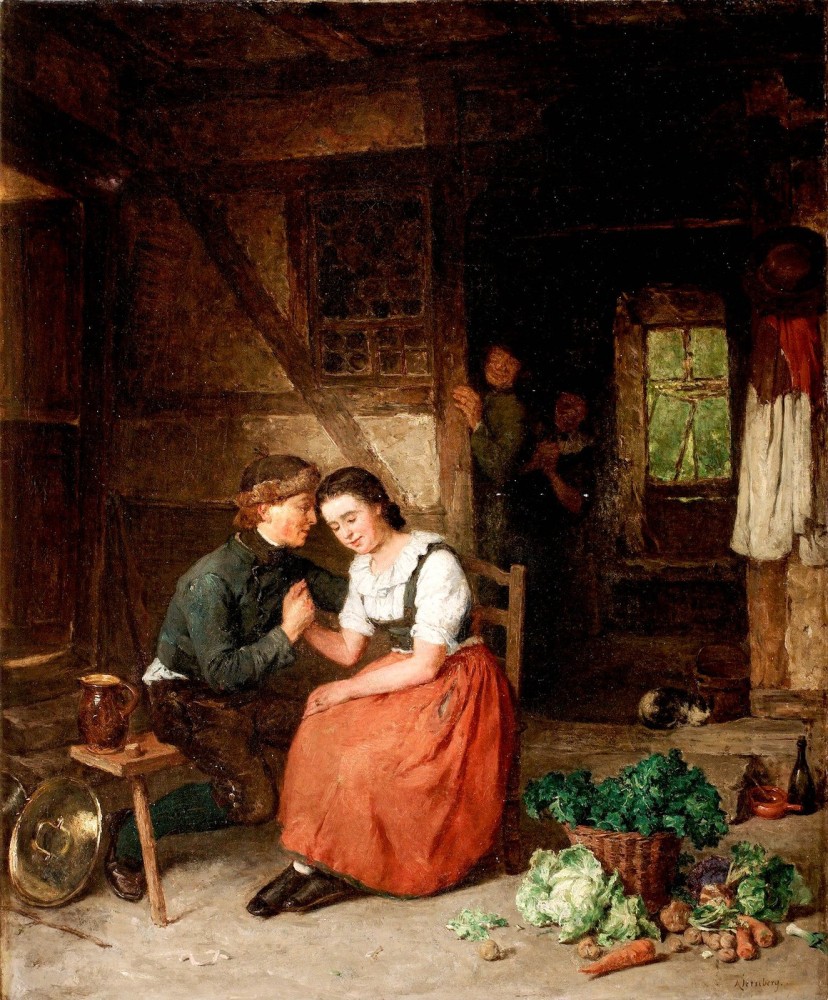
'Rustic Peasant Interior with Courting Couple', August Jernberg, (1826 - 1896)
§475
'The subject is the activity of satisfying urges, of formal rationality, namely of translating the content, which in this respect is purpose, from subjectivity into objectivity, in which the subject joins together with itself. In so far as the content of the urge is distinguished as the important thing from this activity of the subject, the thing which has come about contains the moment of subjective individuality and its activity: this is interest. Nothing comes about therefore without interest'.
- 'Philosophy of Mind'
The subject joins together with itself in the objectivity of its satisfied urge since it gets what it wants, and the ‘important thing’ is the Sache, thing as employed in such expressions as ‘The thing is that . . .’ and ‘The (main, great) thing is to get started’. It might be distinct from the activity of producing it, though presumably the activity itself (for instance drinking) may be one’s purpose rather than the upshot of the activity (for instance satiation), in which case the activity itself is the thing. Interest is Interesse, here in the sense in which it is compatible with disinterest or impartiality. Interest is the subject’s favourable attitude towards the Sache, which is needed to motivate the subject’s activity.
'[Remark] An action is both a purpose of the subject and also the subject's activity which carries out this purpose; it is only because the subject is in this way in even the most unselfish action, i.e. because of its interest, that there is an action at all. -Urges and inclinations are sometimes contrasted with, on the one hand, the empty dream of a natural happiness, by which needs are supposed to find their satisfaction without the subject's activity of producing conformity between immediate existence and his inner determinations. They are sometimes contrasted quite generally, on the other hand, with duty for duty's sake, with morality. But urge and passion are nothing but the life-blood of the subject, by which the subject itself is in his purpose and the execution of it. The ethical concerns the content, which as such is the universal, an inactive thing, that has its activating agent in the subject; the immanence of the content in the subject is interest and, if it lays claim to the whole efficacious subjectivity, passion'
- 'Philosophy of Mind'
‘Most unselfish’ is uneigennützigsten. An action’s unselfishness is totally compatible with the subject’s having an interest in it.
Every one of the positions subjected to criticism implies that action is possible in the absence of an urge or inclination. In paradisal natural happiness (Naturglück) needs are at once satisfied without any delay and without any activity on the subject’s part, so that urges are surplus to requirements. In the second position, morality or the ethical, which are not differentiated here, the subject’s recognition of his or her duty, motivates the subject to activity without any urge or inclination. Hegel’s objection to this, which is Immanuel Kant's view, may be interpreted thus:
(a) A subject’s recognition of his or her duty is never on its own sufficient to motivate action. He or she must also want to perform the action, albeit this want might merely result from his or her desire to do his or her duty. If the subject wants to do his or her duty this is in effect an urge or an inclination although an urge or inclination to do one’s duty.
(b) A desire to do one’s duty is never on its own sufficient to motivate action and the subject must always have some other urge or inclination if he or she is to do his or her duty.
(c) A desire that duty be done is never on its own sufficient to motivate action and what is required to motivate a given subject to do his or her duty is that subject’s urge to do it, whether this stems from a general urge to do his or her duty or from some other urge.
Criticism (a) still gives room for some people doing their duty for duty’s sake, that is to say those who do their duty simply from an urge to do their duty with the help of no other urge. It does however somewhat mar Kant’s contention that such people attain a special sort of freedom, freedom from the motivating influence of their contingent urges and inclinations. The urge to do one’s duty now appears to bee only one among other contingent and motivating urges. Criticism (b) suggests that no one does their duty exclusively for duty’s sake. Criticism (c) implies that no one does their duty for the sake of duty as such but at most for the sake of their own duty. A general desire to maximize the performance of duty may lead one to neglect one's duty. If, for for instance, a woman goes to a shop with two associates they may say to her that if she pay for her goods they will shoplift whereas if she shoplift, they will pay for their goods, and if she believes them then her desire to maximize duty performance or to minimize neglect of duty may leads her to shoplift and it is merely if she has a desire to do her duty that she will disregard their offer and hold fast to her own devices. The will is in essence free and so freedom is the concept of the will, albeit usually a will has other content besides freedom, for instance a desire for drink. A selfish person will satisfy his or her desire for drink by shoplifting if he believes he or she can get away with it, because he or she prefers the particular content (his or her desire for drink and money to the objective content (shoplifting is reprehensible). A good person, never mind the ‘purest . . . will’, will not shoplift if he or does not have some dire need, an unquenchable thirst ... (I disregard the dread of the thief about ending up in Hell, and being bitten by a scorpion and turning into a spider, see Dante above). And yet suppose shoplifting were the only way to avoid a particular misery? There are three possible responses:
(a) He or she will and ought to shoplift in order to avoid literal perishing (zugrunde gehen), that is to say, dying.
(b) He or she will not and ought not to shoplift, even though he does ‘not wish’ (will . . . nicht) and ought not to suffer the inevitable consequence. That x ought not to happen and that my ϕ-ing is the only way of preventing the occurrence of x do not entail that I ought to ϕ. That I ought not to be tortured and that my giving away next year’s examination questions is the only way to prevent this do not entail that I ought to give away the examination questions.
(c) His or her prospective dehydration or other misery is of no relevance to the question whether he or she will or ought to shoplift, because zugrunde gehen does not mean literally perish. He or she may shoplift or, more probably, he or she might not. What he or she will not do is something that he or she does not want to do, in a broad sense of want.
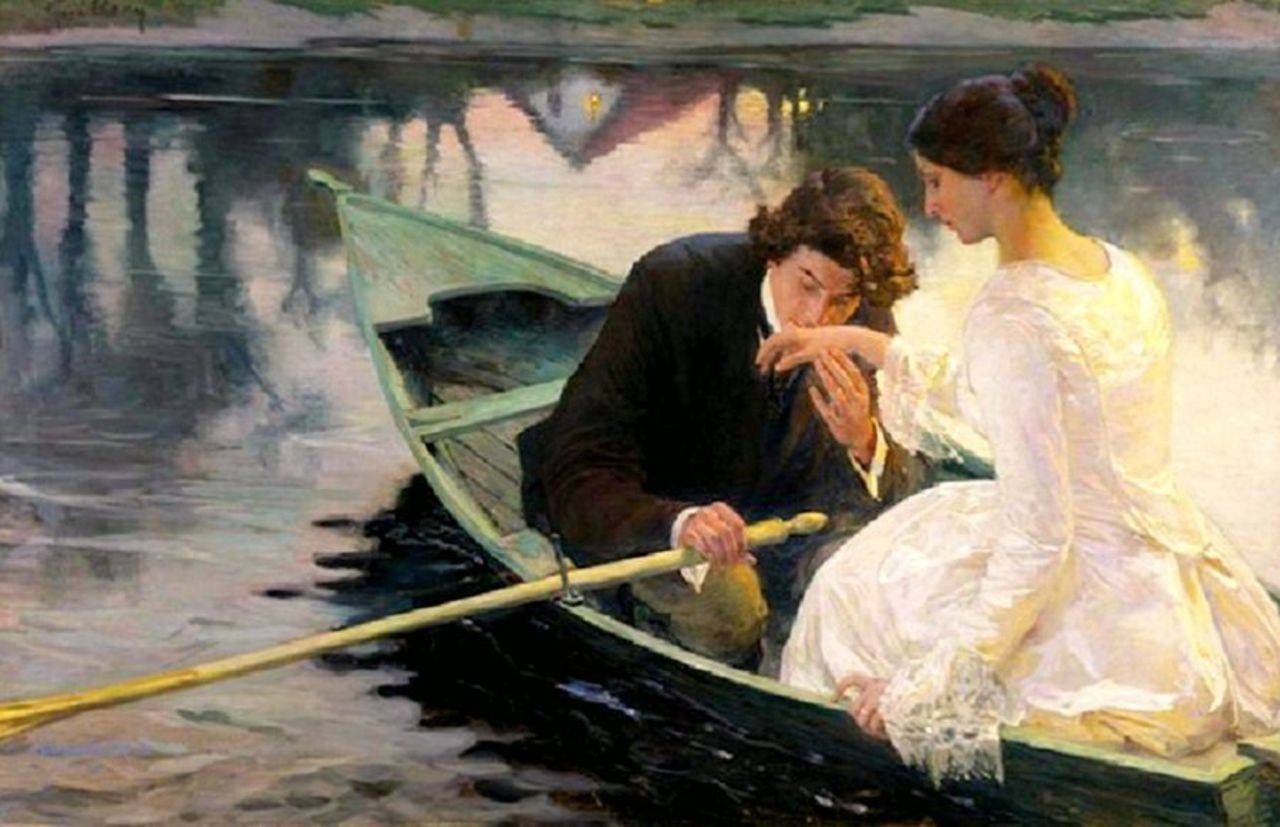
'Courting couple', Giacomo Favretto (1849 - 1887)
§476
'The will, as thinking and implicitly free, distinguishes itself from the particularity of the urges, and places itself as simple subjectivity of thinking above their diversified content. It is thus reflecting will'.
- 'Philosophy of Mind'
Anyone who does not transcend his or her urges in this way is unfree: consult §§473, 474. The will that does transcend the urges and reflect on them is only implicitly (an sich) free, because it is as yet empty, lacking any resolve of its own and it only becomes free for itself upon adopting an urge as its own: consult §§477–8.
§477
'Such a particularity of the urge is in this way no longer immediate, but for the first time the will's own particularity, because the will joins together with it and thus gives itself determinate individuality and actuality. The will is at the standpoint of choosing between inclinations, and is wilfulness'.
- 'Philosophy of Mind'
If I have an urge to drink and an urge to have sex but cannot do both and then decide to drink rather than to have sex the particularity of the urge to drink has been endorsed or adopted by the will and hence gives the otherwise indeterminate will a determinacy of its own. Wilfulness is Willkür, a word formed from Wille (will) and which has not yet acquired its modern sense of arbitrariness and in Kant and Hegel it is not generally a term of disapproval, it indicates a phase of the will, albeit not the highest phase that is free choice.
'Sonnet 136'
by William Shakespeare (1564 - 1616)
If thy soul check thee that I come so near,
Swear to thy blind soul that I was thy Will,
And will, thy soul knows, is admitted there;
Thus far for love, my love-suit, sweet, fulfil.
Will, will fulfil the treasure of thy love,
Ay, fill it full with wills, and my will one.
In things of great receipt with ease we prove
Among a number one is reckon’d none:
Then in the number let me pass untold,
Though in thy store’s account I one must be;
For nothing hold me, so it please thee hold
That nothing me, a something sweet to thee:
Make but my name thy love, and love that still,
And then thou lov’st me, for my name is Will.
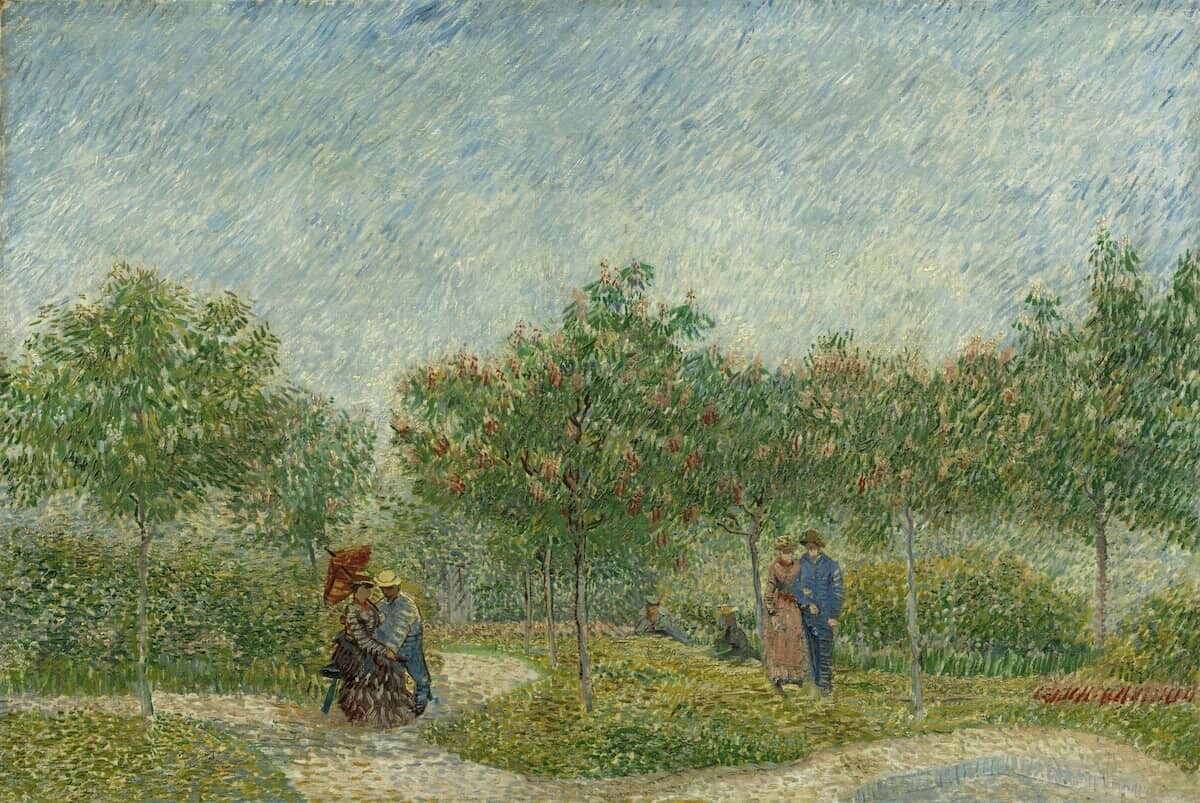
'Garden of Courting Couples', 1887, Vincent van Gogh
For my muse 🌹Every day is another day of courting.
Courting is a pleasure
Between my love and I
And it's down in yon green valley
I'll meet her by and by
It was down in yon green valley
She is my heart's delight
"Molly, lovely Molly
I will stay till broad daylight"
Going to church last Sunday
My true love she passed me by
I knew her mind was altered
By the roving of her eye
Well, I knew her mind was altered
To a lad of high degree
"Molly, lovely Molly
Your looks have wounded me"
Up came her love Willy
With a bottle in his hand
Saying, "Drink this, lovely Molly
For our love will never stand"
Saying, "Drink this, lovely Molly
Let the bottle flask go free
Ten guineas I'll wager
That married we ne'er shall be"
Never marry a fair young maid
With a dark and a roving eye
Just you kiss her and you embrace her
Never tell her the reason why
Just you kiss her and you embrace her
Till you cause her heart to yield
For a faint-hearted soldier
Will never gain the field
Farewell, Ballymoney
Likewise the sweet Bann shore
Farewell unto McCusky braes
Will I never see more
America lies far away
That land I will go see
And may all bad luck attend the one
Who parted my love and me
Coming up next:
Happiness. Yayyyy!!!
It may stop but it never ends.