

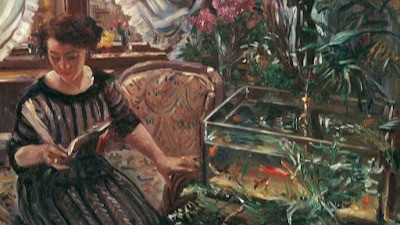
'Love's Rapture'
by Friederike Mereau (née Schubart) (1770 – 1806)
Where the cypress mourns over graves,
often lingers, filled with sorrowful solace,
and shuddering with unknown premonitions,
memory with tearful eyes.
And on hope's gently transfigured paths,
the forsaken wander into the ethereal grove
of the better world to meet his distant friend,
and finds him in holy twilight.
How happy is he to whom that resurrection's
consecrated hope pierces the soul!
How happy when the dream of reunion
swirls the radiant seraphic wing around him!
It will not be for us, now that we part trembling,
beloved, the happiness of this beautiful hope.
Reason compelled us to shun the sweet delusion,
and timidly fled its radiant gaze.
When around the lofty, intensely felt life,
the divine that glows within us,
new, more beautiful forms are woven one day,
another being blossoms from these ruins;
What is to the spirit, born to a new being,
then, what here below has enraptured it to God?
With every sense, a world was lost,
and its most beautiful blossoms are broken.
Shattered, in its finest depths, is
the sweet melody in our breast,
where the seeds of all life's joys slumbered;
we remained none, none conscious of ourselves!
Into what labyrinth am I entangled?
Has a sad necessity
forced this life upon me so terribly?
O, Love! Resolve this anxious conflict!
Yes, I felt, when with sweet trembling
I drew the fire of love from your gaze,
and holy, never-before-felt life,
floated through my soul with divine power.
When first, with dizzying rapture,
my intoxicated spirit entwined itself around your soul,
that, nameless, to bless me through you,
the omnipotence of love compelled me into life.
Separated from you—what can the world give me,
that quells my soul's burning longing?
What is this loveless life to me now,
where nowhere does rest spring forth for my yearning?
Where the blossom of feeling remains unfurled,
no longer awakened by harmony, withers,
and what once ablaze the spirit with ethereal fire,
abandoned by your spirit, dies fruitless;
Where joy's tender roses fade,
the tree of hope bears no blossoms,
fancies sadly depart from me,
and, alas! lifeless reality remains.
And yet—the breeze that cools me, perhaps kissed
the sigh from your lips;
and that star that silently beckons to me, perhaps greeted
a loving, moist glance from you.
I fled the world, forgot how to love you?
your sweet image vanished from me forever?
and thus renounced my better desires,
and would faithlessly betray my passion and you?
No! Would a god, with kind mercy,
offer me a bowl from Lethe's waters,
I would not take the bowl from his arms,
and live eternally with my pain and you.
Ah! Will you too, when with the last star
the sweet nourishment of our presence dries up,
And then, from a deep, hopeless distance,
in the desolate space, the drunken gaze vanishes.
If now time, unenlivened by hope,
shrouds my friend's image in mist,
and every moment widens the chasm,
that horribly presses between mind and mind:
Will you then share the sweet torments?
Lugged by tender fantasies,
rush lovingly to me in silent dreams,
when between us, alas! space and time now lie?
Will the happiness of our more beautiful days then be
your highest ideal forever?
I sense, Selmar, your gentle laments:
through my own pain I understand your torment.
No, do not lament! - When new joys beckon,
when hope weaves fresh garlands for you,
let my image sink into silent slumber:
—love does not shy away from such sacrifices!
I will—may love's divine majesty prevail—
see your heart ablaze with foreign desires,
and, like a ray that vanishes in the air,
perish eternally in your soul.
But, Selmar, no!—Can love perish?
Has nature ever been untrue to herself?
Can harmony be blown away like a breath of spring?
And will your ideal ever be renewed?
Love is eternal!
All creative nature faithfully follows its harmonies;
and even if I, too, should glow in new forms,
I will eternally follow its rosy path.
The sublime harmony that unites us will never perish.
- I will, bound to you,
orbit your sun like a planet,
draw the ray of light sent from you;
rush towards you in a flash of lightning,
be your beloved flower like a bloom,
scent the air with you in the fragrance of blossoms,
and rejoice with you, fluttering and fluttering, like a bird.
Always drawn to you in the circle of creation,
eternal, holy sympathy unites us!
In the dance of the stars and in the song of the waves,
one spirit, the harmony of love, breathes upon us!
'Schwärmerey der Liebe'
Wo über Gräbern die Zypresse trauert,
weilt oft, von trauriger Beruhigung
und unbekannten Ahndungen durchschauert,
mit nassem Auge die Erinnerung.
Und auf der Hoffnung sanft verklärten Wegen
wallt der Verlassne in den Ätherhain
der bessern Welt dem fernen Freund entgegen,
und findet ihn in heil'gem Dämmerschein.
Wie glücklich der, dem jenes Auferstehens
geweihte Hoffnung durch die Seele dringt!
Wie glücklich, wenn der Traum des Wiedersehens
um ihn den lichten Seraphsfittig schwingt!
Uns wird es nicht, jetzt da wir bebend scheiden,
Geliebter, dieser schönen Hoffnung Glück.
Uns zwang Vernunft, den holden Wahn zu meiden,
und schüchtern floh er ihren Strahlenblick.
Wenn um das hohe, starkgefühlte Leben,
das Göttliche, das uns im Innern glüht,
sich einst auch neue, schön're Formen weben,
ein andres Sein aus diesen Trümmern blüht;
Was ist dem Geist, zu neuem Seyn geboren,
dann, was hienieden ihn zum Gott entzückt?
Mit jedem Sinn ging eine Welt verloren,
und seine schönsten Blüthen sind zerknickt.
Zertrümmert ist, in seinen feinsten Tiefen,
das holde Saitenspiel in unsrer Brust,
wo aller Lebensfreuden Keime schliefen;
wir blieben keiner, keiner uns bewusst!
In welches Labyrinth bin ich verschlungen?
Hat eine traurige Nothwendigkeit
mir dieses Leben furchtbar aufgedrungen?
O, Liebe! löse du den bangen Streit!
Ja, ich empfand, als ich mit süssem Beben
der Liebe Gluth aus deinen Blicken sog,
und heiliges, noch nie empfundnes Leben,
mit Götterkraft durch meine Seele flog.
Als sich zuerst mit schwindelndem Entzücken
mein trunkner Geist um deine Seele schlang,
dass, namenlos durch dich mich zu beglücken,
der Liebe Allmacht mich ins Leben zwang.
Getrennt von dir - was kann die Welt mir geben,
das meiner Seele heisses Sehnen stillt?
Was soll mir jetzt das liebeleere Leben,
wo nirgends Ruh für meine Sehnsucht quillt?
Wo unentfaltet der Empfindung Blüthe,
von Harmonie nicht mehr geweckt, verdirbt,
und was mit Ätherglut den Geist durchglühte,
von deinem Geist verlassen, fruchtlos stirbt;
Wo sich der Freude zarte Rosen bleichen,
der Baum der Hoffnung keine Blüthen treibt,
die Phantasieen traurig von mir weichen,
und, ach! entseelt die Wirklichkeit mir bleibt.
Und doch - das Lüftchen, das mich kühlet, küsste
vielleicht den Seufzer von der Lippe dir;
und jenen Stern, der still mir winkt, begrüsste
vielleicht ein liebefeuchter Blick von dir.
Ich flöh' die Welt, verlernte dich zu lieben?
dein süsses Bild entwich' auf ewig mir?
und so entsagt' ich meinen bessern Trieben,
und würde treulos meiner Gluth und dir?
Nein! böt' ein Gott, mit freundlichem Erbarmen,
aus Lethe's Fluthen eine Schale mir,
ich nähm' die Schale nicht aus seinen Armen,
und lebte ewig meinem Schmerz und dir.
Ach! wirst auch du, wenn mit dem letzten Sterne
der Nähe süsse Nahrung uns versiegt,
und dann aus tiefer, hoffnungsloser Ferne
im öden Raum der trunkne Blick verfliegt.
Wenn nun die Zeit, von Hoffnung nicht erheitert,
der Freundin Bild mit Nebelflor behängt,
und jeder Augenblick die Kluft erweitert,
die grausend zwischen Geist und Geist sich drängt:
Wirst du auch dann die süssen Qualen theilen?
von zarten Phantasieen eingewiegt
in stillen Träumen liebend zu mir eilen,
wenn zwischen uns, ach! Raum und Zeit nun liegt?
Wird dann das Glück von unsern schönern Tagen
dein höchstes Ideal auf ewig seyn? -
Ich ahne, Selmar, deine sanften Klagen:
durch eignen Schmerz begreif' ich deine Pein.
Nein, klage nicht! - Wenn neue Freuden winken,
wenn dir die Hoffnung frische Kränze flicht,
so lass mein Bild in stillen Schlummer sinken:
- auch solche Opfer scheut die Liebe nicht!
Ich will - der Liebe Götterhoheit sieget -
dein Herz von fremden Trieben glühen sehn,
und, wie ein Strahl, der in der Luft verflieget,
in deiner Seele ewig untergehn.
Doch, Selmar, nein! - Kann Liebe untergehen?
ward die Natur sich selbst je ungetreu?
Kann Harmonie wie Frühlingshauch verwehen?
und wird dein Ideal dir wieder neu?
Die Lieb' ist ewig! Ihren Harmonieen
folgt treu die ganze bildende Natur;
und werd' auch ich in neuen Formen glühen,
so folg' ich ewig ihrer Rosenspur.
Nie wird der hohe Einklang untergehen,
der uns vereint. - Ich will, an dich gebannt,
mich als Planet um deine Sonne drehen,
den Lichtstrahl saugen von dir hergesandt;
Im Wetterstrahl mich dir entgegen stürzen,
als Blume dir die Gattenblume seyn,
im Blüthenduft mit dir die Lüfte würzen,
und gaukelnd mich mit dir als Vogel freun.
Im Schöpfungskreis stets von dir angezogen,
vermählt uns ewig heil'ge Sympathie!
Im Sternentanz und im Gesang der Wogen
weht uns Ein Geist, der Liebe Harmonie!
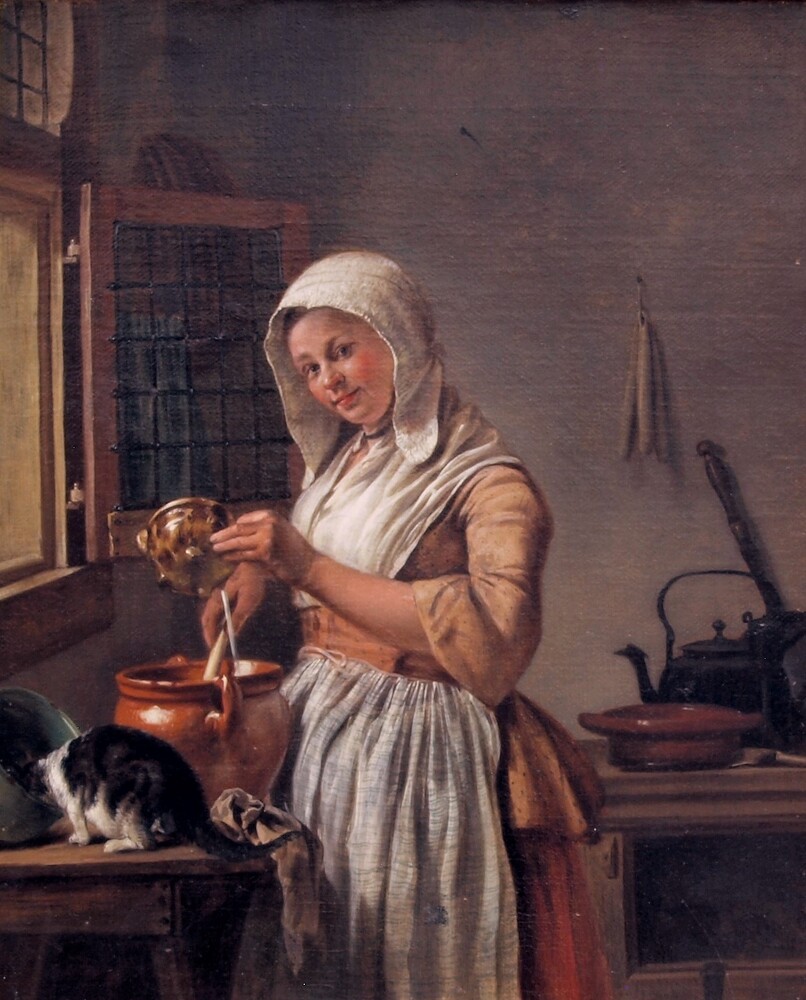
'Milk maid', 'Melkmeisje', 1800, Wybrand Hendriks
Georg Wilhelm Friedrich Hegel (1770 – 1831). Philosophy of Mind. Subjective Mind.
(c) FREE MIND
§481
'The actual free will is the unity of theoretical and practical mind; free will, which is for itself as free will, now that the formalism, the contingency and limitedness of the previous practical content have sublated themselves. By the sublation of the mediation that was involved in all this, the will is the immediate individuality posited by itself, but an individuality that is also purified to universal determination, to freedom itself. 1 The will has this universal determination as its object and purpose, in that it thinks itself, is aware of this concept of itself, is will as free intelligence'.
- 'Philosophy of Mind'
On the unity of theoretical and practical mind consult §443.
Free will is for itself as free will
What does that mean?
(a) it is actual free will and not just potential free will.
(b) it is aware of being free will.
(c) it has itself, free will, as its object and purpose.
Earlier the content of the will was mediated by contingent, limited urges, and this involved formalism because the will’s content was merely a function of the contents together with the relative strengths of the urges. In addition the emergence of the pure will was mediated by the formalism of wilfulness and its sublation. Now all that has been sublated and the will succeeds through its own efforts as an immediate individuality as an individual that has left behind the mediation that previously supplied its content and also the mediation that led to its emergence.
Previously intelligence’ (Intelligenz) had been associated with theoretical mind and distinguished from the will: consult §445. In §443 and §448 free intelligence refers to the highest phase of theoretical mind, and so the emphasis here is on the convergence of theoretical and practical mind in the will. The will thinks [of, about] itself (sich denkt), rather in the manner that thought thinks about thought. As for the practical implications of this, that is not so evident.
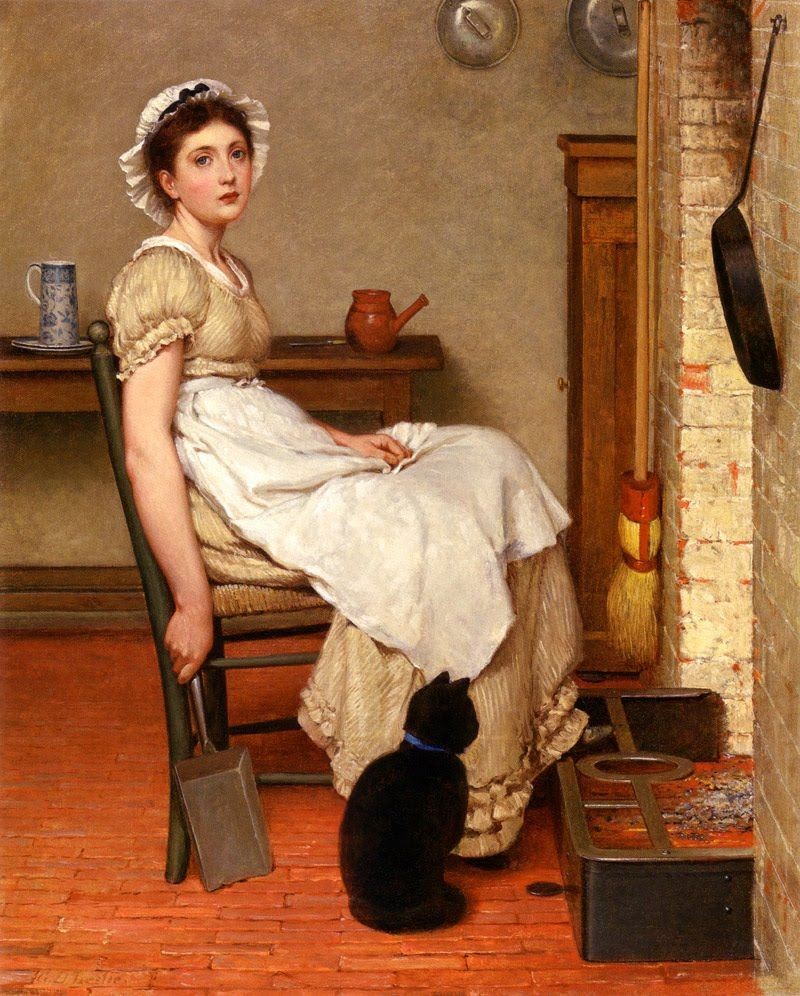
'Her first place', George Dunlop Leslie (1835 –1921)
§482
'The mind which is aware of itself as free and wills itself as this object of itself, i.e. has its essence as its determination and purpose, is first of all in general the rational will, or in itself the Idea, thus only the concept of absolute mind. Since it is abstract the Idea is again existent only in the immediate will, it is the side of reason's reality, the individual will as knowledge of that determination of itself which constitutes its content and purpose, and of which the will is only the formal activity. The Idea thus appears only in the will that is a finite will, but which is the activity of developing the Idea and of positing the Idea's self-unfolding content as reality, which, as reality of the Idea, is actuality:-objective mind'.
- 'Philosophy of Mind'
The logical transition from the free will as expatiated upon in §§480 and 481 is now under construction, that is to say, the will that wills its own freedom, to objective mind. Idea (Idee) in the technical sense here employed is the concept together with its reality (Realität, Dasein, and so on). And so the will that wills itself as its own object and purpose is an Idea and not just a concept, but a concept together with itself as its object. Nonetheless we encounter a couple of shortcomings in this Idea:
(a) It is the rational will in general (überhaupt), that is, not embodied in specific, concrete institutions and procedures. It is in itself the Idea but not for itself never mind in and for itself. And so it is only a concept, the concept of absolute mind. Absolute mind combines subjective and objective minds: consult §§381, 553. If subjective mind is the concept of absolute mind and objective mind its reality then to say that the will is here only the concept of absolute mind suggests that it requires completion by objective mind.
(b) As abstract rather than concrete the Idea exists only in the immediate will, that is, in the will of an individual, but not in concrete institutions and procedures, not in what we may designate as the social will or the general will, a will that is mediated by individual wills. The individual will is a finite will whereas by contrast the social will is implied to be infinite. This abstract Idea is therefore not simply a concept, it is the reality of reason, because it is embedded in individuals who work to realize the Idea as reality (Dasein) and as actuality as opposed to simply potentiality.
The two shortcomings appear to be at odds with one another. In (a) the Idea is the rational will in general, in (b) it exists in the immediate will. In (a) the Idea is a concept, albeit the concept of absolute mind, in (b) it is reason’s reality. The explanation for such discrepancies is as follows. In (a) the Idea of freedom is considered as a general account of free human beings, ignoring the social context to which they belong. The account could as easily apply to any human being at any stage of history, but this Idea is an abstraction as there could not be a human being who is aware of and aims at freedom alone but does not aim at anything more specific and does not belong in any social context. And so we need to bring in the social context, objective mind, to complete the account of the free human being. In (b), by contrast, the Idea of freedom is an Idea in people’s minds, an idea in the more usual sense. We have now moved from the technical sense of Idee to the usual sense in which it has all meanings of ‘idea, from its philosophic use to that of ‘notion’, whether vague or clear, belief, fancy, plan, albeit the use of Idee here still indicates the fact that it is the idea of something especially elevated and significant. The Idea of freedom in this sense applies to all human beings, and yet it does not exist in the minds of all human beings. As Hegel goes on to explain (see below) it arose with Christianity and was then gradually realized in European institutions. Its existence in the minds of individuals is a kind of reality and yet it acquires reality in objective mind only gradually through the activity of individual wills.
The expression objective mind is tinged with a similar ambiguity in that it refers both to (a) the social institutions of any and every time and place, as opposed to the individual human mind, and to (b) specifically modern social institutions that realize and express the essential freedom of every human being. Hegel will focus upon (b) rather than (a). The ambiguity of Idee facilitates the transition from subjective to objective mind. As to the issue of why the Idea of will willing its freedom requires completion in objective mind one supposes in the absence of an obvious answer that this Idea is difficult to make sense of in the absence of some more concrete interpretation and that, besides which, there cannot be human subjective minds without objective mind. In this case the transition will be conducted by our philosopher, dissatisfied with the incompleteness and deficiency o sense in the the picture thus far produced. As to the issue as to why people with the Idea of freedom endeavour to realise it in objective mind the answer is that people with a potent and practicable idea try to realise it and here the transition is not simply from the Idea of freedom but from the Idea of freedom in an objective mind discordant with it to an objective mind that embodies it. This is not a transition made by only by our philosopher but it is made by individual wills transforming their social order.
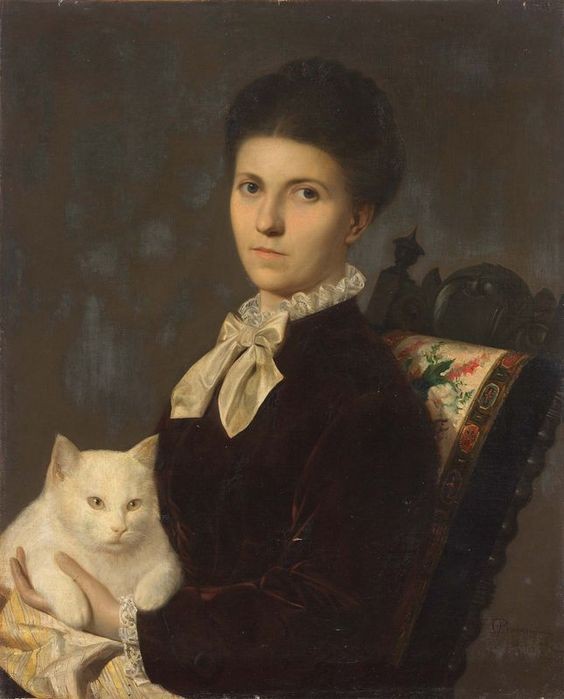
'Portrait of a Lady with a White Cat', 19th Century, unknown artist.
'[Remark] No Idea is so generally recognized as indeterminate, ambiguous, and open to the greatest misconceptions, to which therefore it actually falls prey, as the Idea of freedom, and no Idea is in common circulation with so little consciousness of it. Since the free mind is the actual mind, misconceptions about it have the most tremendous practical consequences, and when individuals and peoples have once got in their heads the abstract concept of freedom that is for itself, there is nothing like it in its uncontrollable strength, just because it is the very essence of mind, and is in fact its very actuality. Whole continents, Africa and the East, have never had this Idea, and are without it still; the Greeks and Romans, Plato and Aristotle, even the Stoics, did not have it; on the contrary, they knew only that man is actually free by birth (as an Athenian, Spartan, etc., citizen) , or by strength of character, education, by philosophy (the wise man is free even as a slave and in chains) . This Idea came into the world through Christianity, according to which the individual as such has an infinite value since it is the object and aim of God's love, destined to stand in its absolute relationship with God as mind, and to have this mind dwelling in himself, i.e. man in himself is destined to supreme freedom. In religion as such man is aware of the relationship to the absolute mind as his essence, but now he has, in addition, the presence of the divine mind, even when he enters the sphere of worldly existence, as the substance of the state, of the family, etc. These relationships are developed through that mind, and are constituted in conformity to it, while by such existence the ethical disposition comes to be indwelling in the individual and then in this sphere of particular existence, of present sensation and volition, he is actually free'.
- 'Philosophy of Mind'
In referring to misconceptions and the uncontrollable strength of the ‘abstract concept of freedom the thought here is in particular of the French Revolution. How does the identification of the free mind with the actual (wirkliche) mind explain the practical consequences of mistakes about it? Do not fundamental mistakes concerning the mind, about thought for instance, not necessarily have momentous practical results. Maybe it is because freedom is the point of connection between the subjective mind and objective mind, which is more or less identified with actuality (Wirklichkeit) at the end of the passage. The affinity of wirklich to wirken, to work, have an effect, might also be working its influence on the thought here.
On ancient views of freedom, consult §433. Two views of freedom are attributed to the Greeks and Romans: (a) Freedom acquired by birth, that is to say citizenship, and (b) freedom acquired by one’s own efforts, an inner freedom or self-mastery that is indifferent towards one’s bodily enslavement. (Although, for instance, in Athens a resident alien such as Aristotle was free, that is, not a slave, albeit he did not enjoy civic rights. The view of freedom introduced by Christianity, the Idea of freedom, is that (c) freedom belongs to all human beings regardless of their birth, social status, and intellectual attainments. The introduction of this Idea involves two stages:
(a) In religion God assigns infinite value to each individual, and man or woman in him or herself (der Mensch an sich), that is, man or woman as such regardless of birth, intellect, etc., is destined (bestimmt) to supreme freedom, one supposes in heaven.
(b) In worldly existence, that is, outside the sphere of religion proper, God is also in some manner present, and social and political institutions are organised so as to realize the freedom promised in religion, making man and woman actually free.
In principle it would be possible for stage (a) to happen without its being followed by stage (b). This is to put it simply what Karl Marx believed had happened, the heavenly freedom and equality promised by religion are a consolation for the absence of worldly freedom and equality. Hegel does not go along with that, rather, heavenly freedom and equality are realized in worldly existence, not through equality of income or of social status, but through the equal recognition as a person that is withheld from the slave (consult 'Encyclopaedia Logic' §163). The religious symbol for the transition from stage (a) to stage (b) is the incarnation, the descent of God into worldly existence. The supposed basic Christian aversion to slavery which needless to point out was not shared by every nominal Christian stretched to the enslavement of non-Christians as well as Christians.
'If knowledge of the Idea, i.e. of men's knowledge that their essence, purpose, and object is freedom, is speculative, then this Idea itself as such is the actuality of men, not an Idea that they have about it, but an Idea that they are.4 In its adherents Christianity has made it their actuality e.g. not to be a slave; if they were made slaves, if the decision on their property were left to someone's discretion, not to laws and law-courts, they would find the substance of their life impaired. This will to freedom is no longer an urge which demands its satisfaction, but the character, - the spiritual consciousness that has become urgeless being. -But this freedom, which has the content and purpose of freedom, is itself initially only a concept, a principle of the mind and heart, and destined to develop into objectivity, into legal, ethical, religious actuality, as well as scientific actuality'.
- 'Philosophy of Mind'
The first sentence can be interpreted in two ways. (a) The ‘if ’-clause invokes a concession, whereby knowledge (Wissen) of the Idea, which is merely speculative, is contrasted with the Idea itself, which is the actuality of men and women. Speculative then means something akin to theoretical, non-practical. (b) The ‘if ’-clause is conditional, that knowledge of the Idea is speculative suggests that the Idea itself is men and women’s actuality. Speculative then means something akin to pertaining to the nature or essence of things. In either case, what is being referred to is the transition from stage (a), the religious conception of freedom, to stage (b), the worldly realization of freedom: consult §482. Another complexity in the sentence is that it equates knowledge of the Idea with knowledge of men and women's knowledge, etc., and the Idea itself with men and women’s knowledge, etc. Maybe the emphasis is upon the second-order character of speculative knowledge, that it is knowledge about knowledge and therefore remote from actuality. And yet the second of (von) might be the philosopher slumbering, maybe brought about by the ambiguity of Idee, which means men and women’s idea of freedom, therefore their knowledge, etc. as well as freedom itself: consult §482. The Idea that men and women have is their idea of freedom, the Idea that they are is freedom itself.
That the Idea is men and women’s actuality and that they are the Idea means not merely that they happen not to be slaves, but that they take freedom, both in the sense of not being a slave and in other senses, for granted as their fundamental characteristic. This contention is limited to adherents of Christianity. Non-Christians might well consider enslavement as a tolerable misfortune, Christians do not, for if they were to be enslaved this would tear apart their entire world, the substance of their life (Dasein). Their will to freedom (Wollen der Freiheit) is not one urge among other urges, not an urge that they may not have, but something that constitutes their very being (Sein). Which is not to say that it follows that a Christian will not be enslaved, the guarantee of that is needed in the historical developments referred to in the next sentence.
The will to freedom of the preceding sentence is initially only a concept, that is to say, not yet realized in objective reality, where Christians may be enslaved, despite their deep loathing to it. This profound, urgeless aversion might account for the abolition of the enslavement of Christians, it does not account to the same degree for the abolition of the enslavement of non-Christians. Scientific (wissenschaftlichen) actuality is one supposes the systematic, philosophical assault upon slavery and other violations of freedom waged by Hegel (you will be pleased to know he was very much against it, slavery that is) and others.
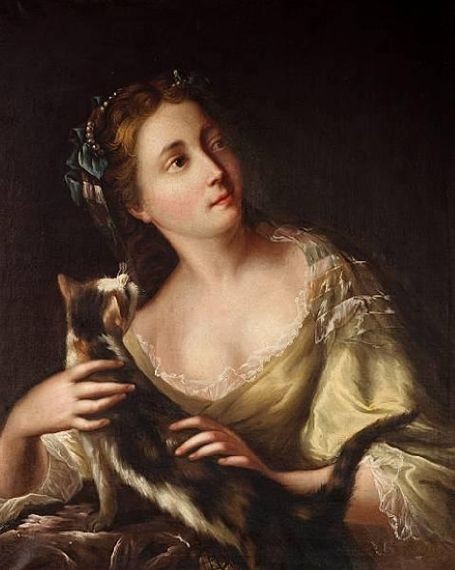
'Young lady with a cat', 18th century, Italian school.
For my muse 🌹
Schlaf hol' mich ein trag' mich fort ganz allein
In die Welt meiner endlosen Träume
Schlaf wieg mich ein weh mich weg ganz allein
In das Reich meiner endlosen Träume
Weh' mich hinaus treib' mich fort und geschwind
In die weite Welt milder Nächte
Laß mich siegen, laß mich sterben
Laß mich lieben, laß mich fliegen
Laß mich siegen, laß mich sterben
Laß mich lieben, laß mich fliegen
La la la la la...
Sleep, take me in, carry me away all alone
Into the world of my endless dreams
Sleep, rock me to sleep, blow me away all alone
Into the realm of my endless dreams
Blow me out, drive me away swiftly
Into the wide world of mild nights
Let me conquer, let me die
Let me love, let me fly
Let me conquer, let me die
Let me love, let me fly
La la la la la,,
Coming up next:
Objective mind.
It may stop but it never ends.