

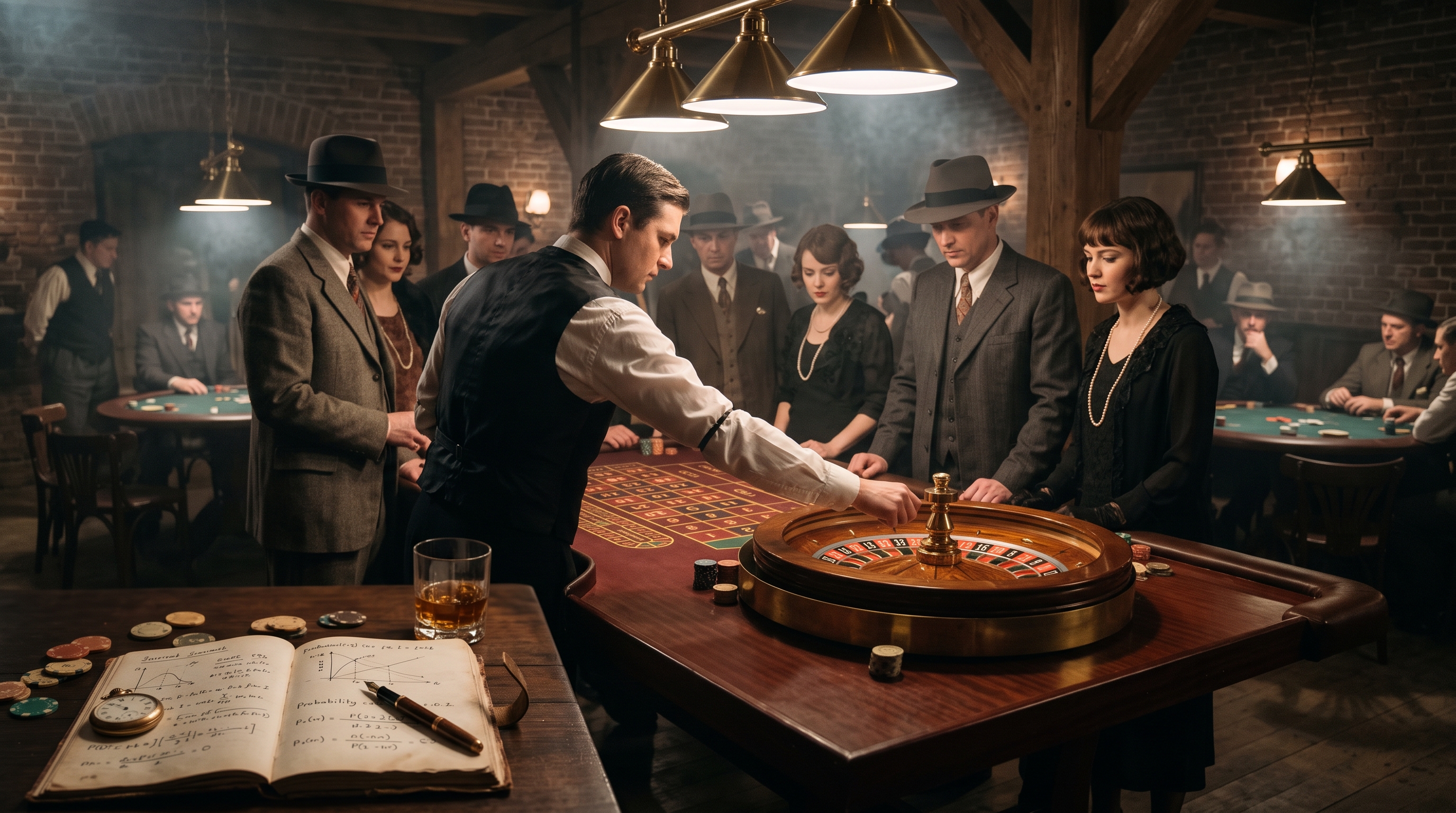
While working on a new chapter of my novel about a 1920s underground casino heist, I wanted to explore the subtle psychology of why people step through the speakeasy doors. In researching gambling history, one truth becomes clear: casinos don't need to force a win—they simply build an atmosphere so compelling that players willingly test their luck against pure mathematics.
Today, let's look at how house algorithms and mechanical design shape player perception from behind the velvet curtain.
1. The "Hot" and "Cold" Session Effect
In 1920s speakeasies, pit bosses knew that a table feeling "favorable" kept seats filled. In modern game design, this myth lives on as "hot" machines due to payout distribution:
High volatility: The mechanics can deliver long stretches of empty spins, creating anticipation and the feeling that a table is "overdue."
Tail risk: Rare high-multiplier hits provide the thrill that keeps the floor buzzing.
A player perceives a streak as a test of patience, but from the house perspective, it is simply a standard variance curve working as designed over a short sample size.
2. 1920s Mechanical Design vs. Modern PRNG
During Prohibition, underground venues relied on physical craftsman details to maintain the house edge without raising suspicion:
Precision-balanced roulette wheels that ensured predictable long-term house returns.
Heavy felt that subtly altered dice bounce.
Uniform card stocks designed to resist wear.
Today, the Pseudo-Random Number Generator (PRNG) handles these probabilities electronically using initial seed parameters.
In the novel, my protagonist treats these house systems not as magical games of chance, but as structured machinery with observable rules waiting to be decoded.
3. What's Next?
The goal of this devlog series is to examine how intellect and mathematical analysis interact with systems designed around human risk and reward.
(In the next post, I'll share an excerpt where the main character first tests his calculations directly against a speakeasy dealer).
💬 Drop a comment below: Which mechanic or game system should we break down next?
🎲 Roulette (Variance vs. classic progression strategies like Martingale).
🚀 Crash / Instant Mechanics (Multipliers and Provably Fair verification).
🃏 Blackjack (Probability matrices and card counting mechanics).