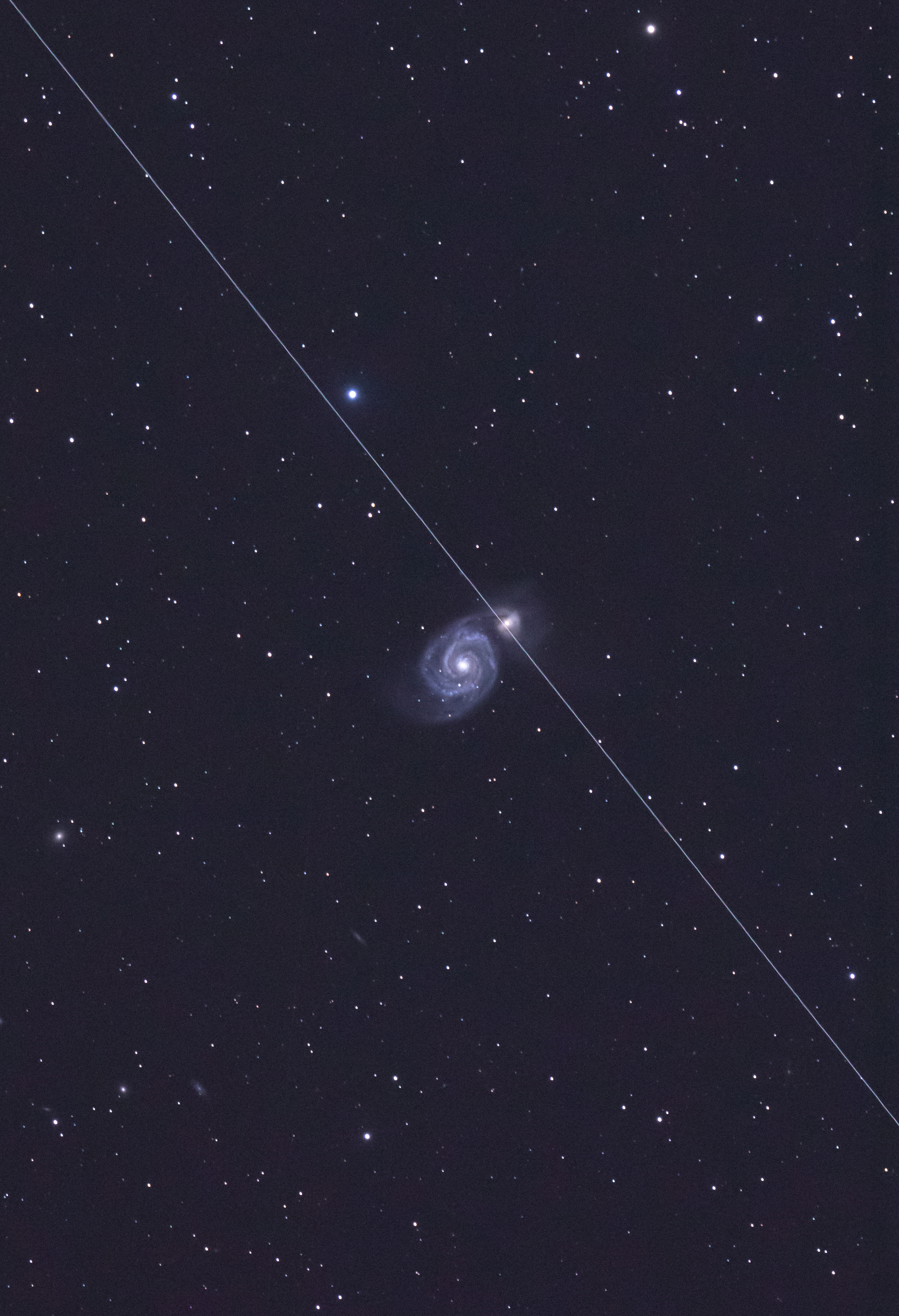

The Whirlpool Galaxy is an iconic object found in the constellation of Canes Venatici below the handle of the Saucepan (Big Dipper). This wonderful object appears in the Messier catalogue as entry number 51.
Charles Messier discovered M 51 on 13 October 1773, and described it as a "very faint nebula, without stars". His friend Pierre Mechain discovered its companion, NGC 5195, in March 1781, and M 51 is mentioned in Messier's 1781 catalog as follows: "It is double, each has a bright center, which are separated 4' 35". The two 'atmospheres' touch each other, the one is even fainter than the other." Messier also added a sketch of the two "nebulae" in his personal copy of the catalog, confirming that he meant the designation M 51 to refer to the larger galaxy, NGC 5194. The smaller companion, NGC 5195, was later assigned its own catalog number by William Herschel: H I.186, and is also sometimes referred to as M 51B.
The Whirlpool's spiral pattern was not seen until 1845, when Lord Rosse discerned it in his 6-foot reflector at Parsonstown, Ireland. Lord Rosse made a very accurate painting of M 51; hence M 51 is sometimes referred to as Ross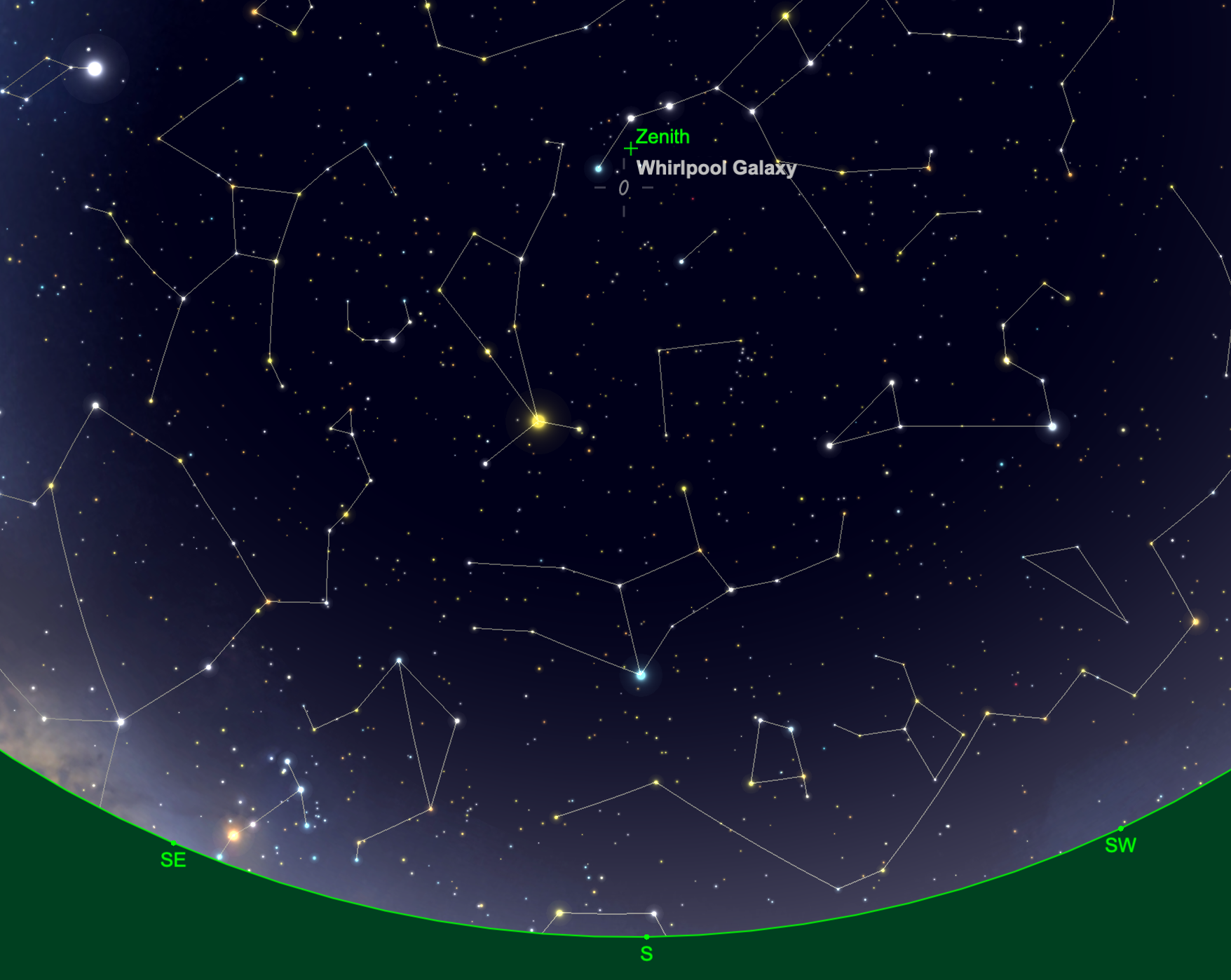 e's Galaxy or Lord Rosse's "Question Mark". At first its spiral pattern was thought to confirm Laplace's Nebular Hypothesis of solar system formation. This misconception was not dispelled until 1923, when it was finally recognized that spiral nebulae are in fact external galaxies, and much more remote that previous suspected.
Halton Arp included M 51 as No. 85, a "Spiral with Large High-Surface-Brightness Companion", in his Catalogue of Peculiar Galaxies.
The very pronounced spiral structure of the Whirlpool Galaxy is believed to be the result of the close interaction between M 51 and its companion galaxy NGC 5195. Decades ago, it was not known with certainty whether NGC 5195 was a true companion, or another galaxy passing at a distance. The advent of radio astronomy, and subsequent radio images of M 51, unequivocally demonstrated that their interaction is real.
Recent simulations support the hypothesis that M 51's spiral structure was caused by NGC 5195 passing through its main disk some 500 to 600 million years ago. In this model, NGC 5195 came from behind M 51, passed through the disk, and made another disk crossing 50 to 100 million years ago, moving to where we observe it now, slightly behind M 51.
Induced spiral structure in the larger galaxy isn't the only effect of the interaction. Significant compression of hydrogen gas leads to the development of starbirth regions. In pictures of M 51, these regions show up as bright blue knots throughout the spiral arms.
The image of M51 below was captured under the dark skies of the Brecon Beacons National Park using a Sky Watcher 120mm Esprit refractor mounted on a SkyWATCHER EQ6PRO R mount, camera Canon 5Dmkiv, ISO6400, 121S. The straight line through it is a Starlink satellite.