

Within most communal structures across America is a quiet, devastating arithmetic at work in everyday social and professional spaces: a white narrative is treated as a verified report, while a Black reality is treated as an unconfirmed allegation.
This asymmetry rarely presents itself with overt malice or slurs. Instead, it operates through the polite mechanics of “credibility” — a currency minted by dominant culture, hoarded by white institutions, and withheld from the Black bodies whose lived experiences are being dissected. The root of this dynamic is not ignorance; it is avoidance. Sourcing truth directly from Black people carries a high relational cost for white people: it demands accountability, ruptures comfortable consensus, and shatters the illusion of racial neutrality. It is far safer, and far more comforting, to simply decide what happened without ever asking the person who survived it.
The Architecture of the Secondary Source
When an incident of racial tension, mistreatment, or microaggression occurs in an office, a university department, or a neighborhood committee, an instinctive information loop activates. Rather than going directly to the impacted Black colleague to ask, “What happened, and how can I support you?” the prevailing white instinct is to consult other white observers.
They confer behind closed doors, trade impressions via direct messages, and solicit the perspectives of supervisors, HR liaisons, or “reasonable” third parties. In doing so, they construct an insulated narrative:
The “Misunderstanding” Defense: Intent is immediately substituted for impact. “Knowing Dave, he couldn’t have meant it that way.”
The Tone Critique: The response to bias is scrutinized rather than the bias itself. “She seemed overly combative in that meeting.”
The Clinical Distance: The situation is treated as an abstract dilemma to be analyzed, rather than an active injury inflicted on a human being.
By the time anyone approaches the Black subject, the narrative has already hardened into institutional fact. The Black person is not invited to provide testimony; they are summoned to respond to an established verdict.
Epistemic Injustice: Why the “Black Body” Is Denied Authorship
Philosopher Miranda Fricker coined the term testimonial injustice to describe the prejudice that causes a hearer to give a deflated level of credibility to a speaker’s word. In the context of race, this deficit is systemic and generational.
White culture has long treated the Black body as an object to be diagnosed, managed, and interpreted, rather than an epistemic authority capable of diagnosing its own condition. When white individuals rely on secondhand white narratives instead of consulting Black peers, they reinforce a deeply patronizing hierarchy:
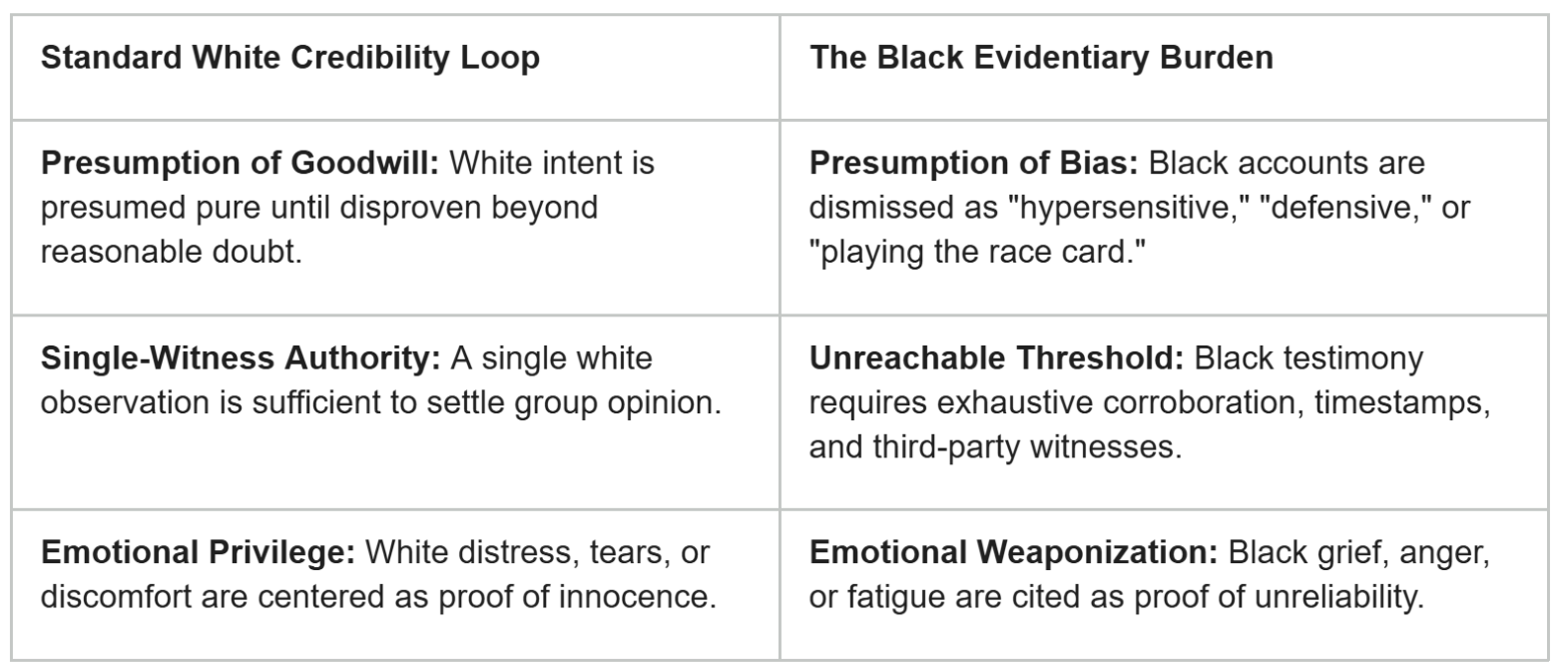 To ask the Black body directly—and to believe the answer—requires acknowledging that the workplace, social club, or friend group is not the meritocratic haven people want it to be. Avoidance preserves the peace of the institution at the direct expense of the marginalized.
The Comfort of Ignorance
At the core of this behavior lies self-preservation. Sourcing the truth from Black people threatens white psychological equilibrium in three distinct ways:
It Eliminates Plausible Deniability
As long as a white peer remains "uncertain" about the details, they bear no moral responsibility to act. To solicit the Black perspective in full clarity forces a confrontation: either intervene on behalf of your colleague, or admit that your silence is complicity. Remaining uninformed provides the perfect alibi.It Fractures White Solidarity
Believing a Black peer often requires breaking ranks with another white peer. The social cost of that rupture is immediate—awkward lunches, strained meetings, lost professional capital. When white people choose to trust the white narrative, they are choosing intra-racial comfort over cross-racial justice.It Demands Relinquishing the Role of Arbiter
White supremacy trains white observers to view themselves as the ultimate judges of fairness. Sourcing truth directly from the source requires an uncomfortable reversal: stepping down from the judge's bench and sitting quietly in the gallery to listen.
Reclaiming the Source: A Mandate for Actual Justice
Justice cannot be negotiated by proxy. Any institution, organization, or social circle that prides itself on equity while filtering Black pain through white interpretation is merely running a PR campaign.
True credibility requires a complete restructuring of our information networks:
Go to the Source First: If a conflict or injury involves a Black peer, their account is primary data, not supplementary commentary.
Stop Laundering Testimony: Do not require Black grievances to be translated into palatable, corporate-friendly jargon by white intermediaries before taking them seriously.
Accept the Discomfort of Reality: Acknowledge that hearing the unvarnished truth will likely disrupt your comfort, implicate people you like, and reveal systems you benefit from.
Until white communities surrender the luxury of deciding what Black people experience without ever deigning to listen to them, "credibility" remains what it has always been: a tool for silencing the injured to comfort the comfortable.