

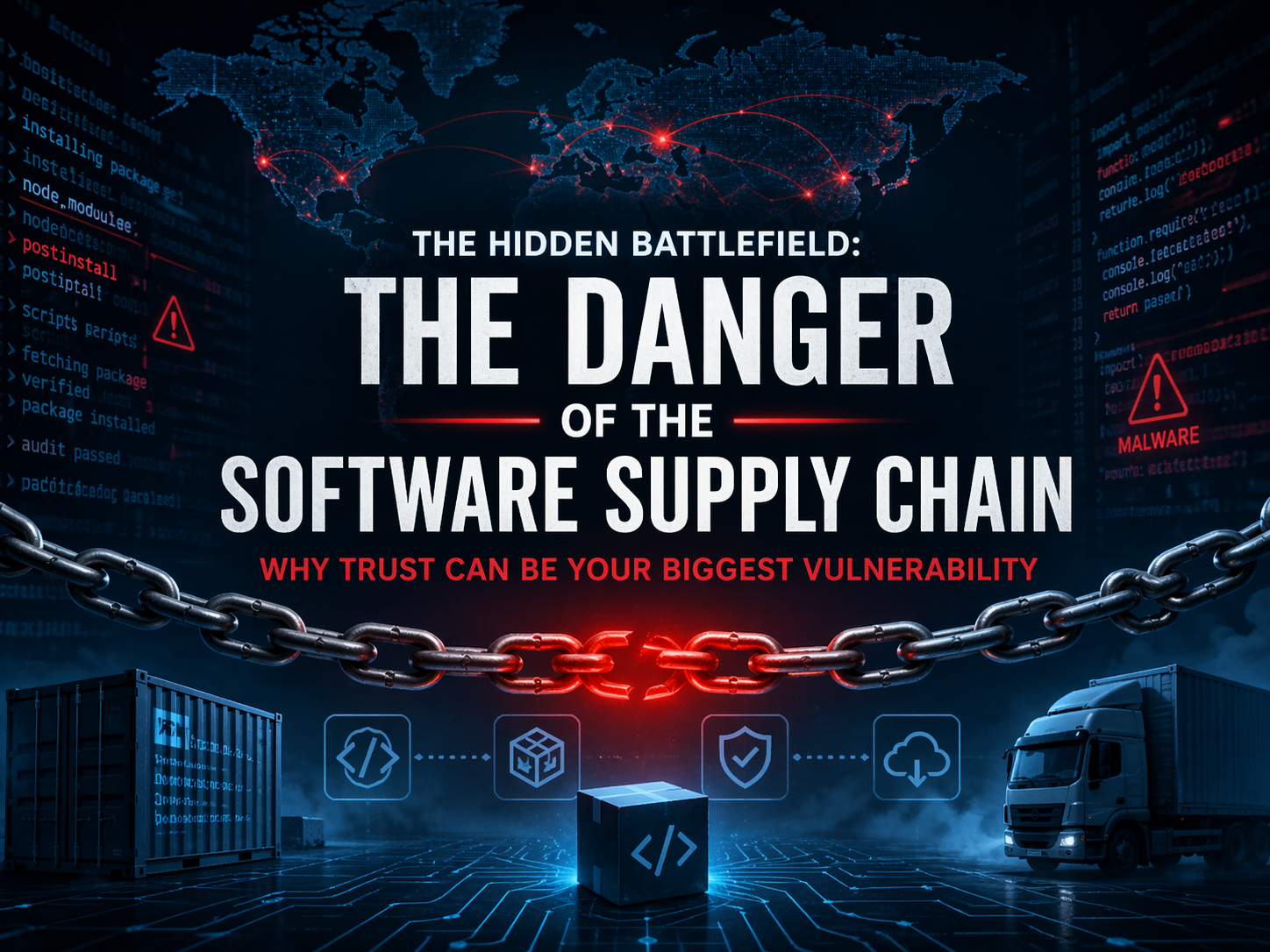
In cybersecurity, the most concerning attacks today are often the ones that do not look like attacks at all. Instead of breaking into systems directly, modern threat actors increasingly exploit something far more subtle and powerful: trust. Recent incidents involving compromised development tools and open-source package ecosystems have made this shift impossible to ignore. They show how fragile the software supply chain has become, and how easily it can be turned into a distribution mechanism for malware at global scale.
At the heart of the issue is a simple transformation in how software is built. Modern applications are no longer written entirely from scratch. They are assembled from thousands of dependencies, open-source libraries, automated security tools, and continuous integration pipelines. This ecosystem is incredibly efficient, but it also introduces an expanded attack surface that is no longer confined to a single organization. Instead, it spans across maintainers, repositories, build systems, and third-party security platforms.
A software supply chain attack takes advantage of this structure. Rather than targeting the final application or its users, attackers compromise a trusted component somewhere in the development lifecycle. This could be a widely used library, a package maintainer account, or even a security tool integrated into CI/CD pipelines. Once that trust anchor is compromised, malicious code can silently propagate downstream into countless projects that depend on it.
What makes these attacks particularly effective is that they do not need to bypass traditional security controls in the usual sense. Firewalls, endpoint protection, and vulnerability scanners are designed to detect suspicious behavior coming from untrusted sources. In a supply chain attack, however, the malicious code originates from systems that are already trusted. It is executed inside build processes, installed as part of legitimate dependencies, and often runs with the same privileges as the development tooling itself. From the perspective of the system, everything appears normal.
This is where the real danger lies. Modern DevOps environments are heavily automated. Dependencies are installed without manual verification, builds are triggered continuously, and code is deployed through pipelines that prioritize speed and consistency. In such environments, even a small compromise can propagate extremely quickly. A single infected package or compromised tool can affect thousands of applications, which in turn may serve millions of users. The result is not a single breach, but a cascading chain of compromises.
The psychological aspect of these attacks is just as important as the technical one. Software development relies on a strong assumption of trust: that open-source packages are what they claim to be, that security tools are correctly analyzing code, and that automation is operating in good faith. Supply chain attacks directly undermine that assumption. They turn trusted infrastructure into a delivery mechanism for malware, effectively hiding malicious activity inside the very systems designed to prevent it.
Defending against this class of threat is particularly challenging because traditional security models are not sufficient. The malicious activity does not always appear anomalous at runtime, and static analysis tools may not detect it if it is embedded in legitimate installation or build scripts. As a result, organizations are being forced to rethink their security posture at a deeper level. The focus is gradually shifting toward software provenance, stricter control over dependencies, isolated build environments, and better visibility into what actually executes during the build process.
Ultimately, what these attacks reveal is a structural issue in modern software development. The more interconnected and automated the ecosystem becomes, the more powerful the supply chain becomes as an attack vector. Security is no longer just about protecting infrastructure or endpoints. It is about protecting the entire chain of trust that allows software to be built in the first place.
And that is what makes supply chain attacks so significant: they do not just exploit vulnerabilities in code. They exploit the way software itself is created.