

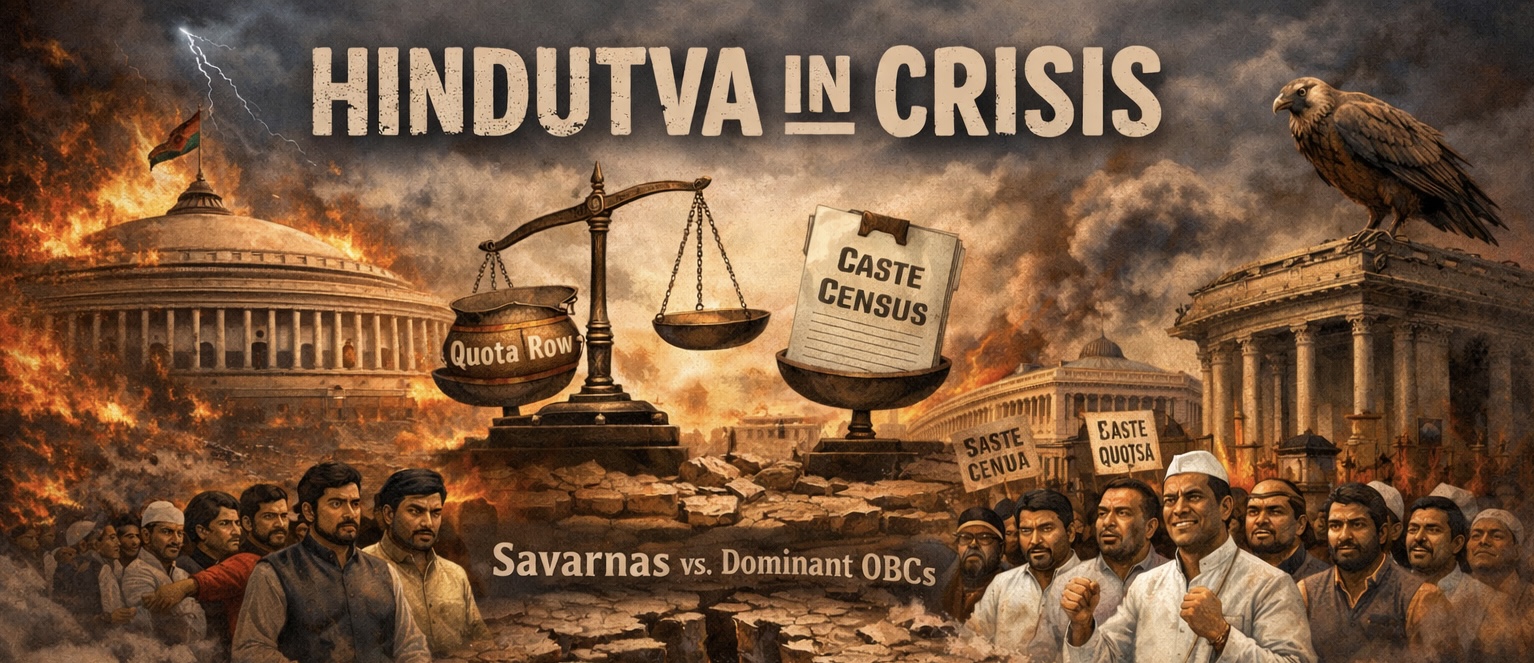
Hindutva at the Edge: How a Victorious Politics Walked into Its Own Crisis
Otto von Bismarck famously warned that a great European war would be ignited by “some damned foolish thing in the Balkans”, a peripheral spark that would expose the internal contradictions of an overconfident order. Political architectures rarely collapse because they are weak, they collapse because they are internally misaligned. The Bharatiya Janata Party today stands precisely at such a moment.
A government that has performed phenomenally well in the domains of the economy, infrastructure, defence, foreign policy, and even electoral politics is faltering on the very social coalition it painstakingly built using the adhesive of Hindutva. What propelled it to power is now proving inadequate to carry the project forward.
A deeper analysis reveals a combination of tactical errors, electoral compulsions, and a lack of long-term political foresight that is steadily consuming the politics of Hindutva itself. A crisis, akin to the one that once hollowed out the Congress Party, now stares the BJP in the face. The difference is instructive - Congress was constrained by the so-called “Savarnas” (particularly Brahmins), while the BJP today is being constrained by the “neo-Savarnas” within the OBCs (Yadavs, Kurmis, Kushwahas, Jats - the dominant OBCs), compounded by resistance from Hindu traditionalists.
Historically, the RSS–Jan Sangh–BJP combine has oscillated between two political approaches, deploying each depending on prevailing circumstances.
The first is ethno-religious mobilisation using Hindu symbolism and cultural issues.
The second is the more pragmatic task of stitching together a social coalition to broaden a narrow base and propel the party to the political centre.
These strategies were alternated over decades - ethno-religious mobilisation in the 1950s–60s (until 1967) and again in the 1980s (particularly post-1984), and coalition-building in the 1970s and 1990s. This pattern closely resembles Gandhi’s Struggle-Truce-Struggle (S-T-S) strategy—alternating mass mobilisation with constructive political accommodation.
Ethno-religious mobilisation, through issues such as Hindi, cow protection, the Ram Mandir, and the Uniform Civil Code, helped mobilise Hindus across caste lines, albeit with a pronounced bias towards Savarnas. Conversely, the stitching together of social coalitions enabled the party to break out of its Brahmin-Baniya mould. The large-scale induction of rising OBC leaders during the Ram Janmabhoomi movement, figures such as Kalyan Singh, Uma Bharti, and Vinay Katiyar, was emblematic of this phase.
During the same period, the Congress Party, essentially a coalition of extremes comprising Savarnas, Scheduled Castes, and Muslims, realised that its social architecture was becoming unsustainable in the face of rising OBC consciousness and their growing demand for representation and power. However, captive to upper-caste dominance within its own organisation, Congress lacked the political courage to alienate its traditional elite base. It chose instead to persist with a conservative social coalition, effectively ignoring OBC aspirations.
Post-Babri demolition, the BJP-RSS leadership correctly assessed the limitations of ethno-religious mobilisation and recognised that identity politics required a broader social coalition. Drawing on its Jan Sangh-era engagement with socialists, the party understood the political potency of OBCs, whose moment had arrived after the implementation of the Mandal Commission in 1990. It therefore moved decisively to incorporate OBCs into its fold. Uttar Pradesh and Madhya Pradesh illustrate this shift clearly, with the rise of leaders such as Kalyan Singh in UP and Uma Bharti, Babulal Gaur, and later Shivraj Singh Chouhan in MP.
This strategy catapulted the BJP onto the national stage and enabled it to form governments at the Centre with the support of alliance partners. Yet the party could not fully overcome Mandal politics. Dominant OBCs remained mobilised under regional satraps - Mulayam Singh Yadav’s Samajwadi Party, Lalu Prasad Yadav’s Rashtriya Janata Dal, and Nitish Kumar’s Janata Dal (United). As a result, the BJP’s social base remained largely confined to Savarnas and a few smaller OBC groups.
A decisive transformation began only with the advent of the Modi-Shah duo. They grasped India’s complex social dynamics and acknowledged the multiplicity of identities within the Hindu fold. Their innovation lay in crafting a broader coalition of Savarnas, non-dominant OBCs, and non-dominant Scheduled Castes. This amounted to a subalternisation of Hindutva - mobilising these groups on ethno-religious lines, particularly against Muslims, while binding them together through a tacit social contract. The promise was clear - the Indian state would deliver welfare, jobs, education, and targeted benefits to those excluded since 1990, while Savarnas would be assured a fair playing field free from the indiscriminate application of atrocity narratives.
The party believed this coalition would endure. It planned to fragment the massive OBC and SC blocks, long treated as monoliths, into sub-categories, thereby weakening dominant caste control and enabling targeted distribution of benefits. Recognising graded inequality within these groups, the BJP instituted the Rohini Commission to recommend sub-classification of OBCs into four or five categories for more equitable quota distribution.
The grant of constitutional status to the National Commission for Backward Classes (NCBC) through the 102nd Constitutional Amendment, a long-standing OBC demand, was astutely bundled with the removal of state governments’ power to identify OBCs in state lists. Cleverly worded, the amendment escaped serious opposition scrutiny. For attentive political observers, this move, combined with the Rohini Commission, signalled an ambitious project to impose uniform OBC sub-classification across both Centre and states. Non-dominant OBCs welcomed the prospect of greater access, while Savarnas perceived it as a dilution of dominant OBC hegemony, potentially restoring political balance.
But opposition politics does not sleep. It waits for openings and strikes where the ruling party is most vulnerable. Dominant OBC leaders, their parties, and Congress began demanding the breach of the 50% reservation ceiling set by the Supreme Court in Indra Sawhney (1992). This was a shrewd manoeuvre by SP, RJD, JDU, and Congress, even AIMIM echoed it during the passage of the 102nd Amendment. Breaching the cap would shield dominant OBC politics from sub-classification while simultaneously antagonising the BJP’s core general-category base, leaving the party politically cornered.
Simultaneously, the demand for a caste census, its natural corollary, gained momentum. BJP, sensing growing traction among dominant OBCs as well (reflected later in the elevation of Mohan Yadav as MP Chief Minister), stalled sub-classification by repeatedly extending the Rohini Commission’s tenure, while maintaining silence on caste census to placate its core base.
By 2021, it became evident that the government would delay the census and resist a caste census. The opposition seized this to portray the BJP as hostile to OBC interests. To politically safeguard itself and alao on account of Maratha reservation, the BJP passed the 105th Constitutional Amendment, restoring states’ power to identify OBCs, which it had earlier curtailed through the 102nd Amendment. The Rohini Commission’s report, once submitted, was quietly shelved. Dominant OBCs sensed victory, but the core base still believed that party has a strategy.
The 2024 Lok Sabha elections altered that calculus. Reduced numbers narrowed the BJP’s room for manoeuvre. In 2025, the government finally announced a caste census to be conducted alongside the 2026 census. This was the inflection point, the threshold beyond which the core base could neither concede nor tolerate further drift.
The UGC controversy then acted like the assassination of Archduke Franz Ferdinand in the Balkans - a seemingly peripheral event that ignited a systemic collapse. The core rebelled; the periphery grew unstable. Every issue, minor or intermediate, was amplified into an existential struggle. The party now faces a dilemma - appeasing the core risks enabling the opposition to consolidate a national-level PDA, ignoring core anxieties risks ideological erosion and electoral losses. The real challenge lies ahead. Once caste census data hits the political tarmac, no other aircraft will take off until it is fully refuelled.
Just as Congress failed to detach itself from Savarna dominance and democratise internally, the BJP appears unable to resist the lure of absorbing dominant OBCs, the new “neo-Savarnas.” This has paralysed OBC sub-classification and stalled democratisation within the OBC category itself. The architecture is shaking, not from an external assault, but from contradictions embedded within its own design.