

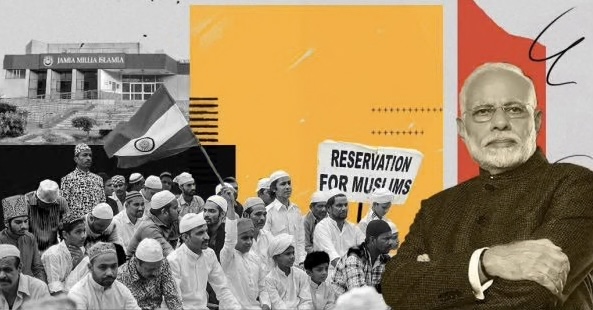
 “Yesterday, the Allahabad High Court ruled that Dalit converts to Christianity or Islam cannot claim Scheduled Caste reservation benefits. You may celebrate this decision, but a much larger war over this claim is unfolding—and both the Central Government and the Supreme Court are tactically navigating it. Our vigilance is essential to maintain pressure on both institutions.”
THE GAME OF RELIGION & RESERVATION
Two fundamental truths must be stated upfront.
First, Scheduled Castes within Hindu society were granted reservation under the Poona Pact of 1932 between Gandhiji and Dr. Ambedkar, an arrangement later carried into our Constitution. This reservation was provided not merely for social, educational, or economic backwardness, but primarily because of the historical reality of Untouchability, a phenomenon rooted in Hindu society, not in religions like Islam and Christianity, which claim egalitarianism and deny the existence of caste or untouchability.
Second, the Constituent Assembly categorically rejected the demand by certain Muslim leaders for inclusion among Scheduled Castes or access to similar benefits.
Thus, through the Presidential Order (Scheduled Castes), 1950, it was declared that only Hindus would be eligible for SC status and its benefits.
This Order was amended in 1956 to include Dalits who embraced Sikhism, and in 1990 to include converts to Buddhism, both being Indic religions, and Article 25 itself defining “Hindus” to include followers of Sikhism, Jainism, and Buddhism.
BEFORE WE REACH THE SUPREME COURT, A WORD ON OBC & ST
Unlike the Scheduled Castes, OBC and ST categories are religion-neutral. Any group, regardless of faith, may be included if it demonstrates social and educational backwardness. Consequently, several Muslim communities find themselves listed under both State and Central OBC and ST categories.
However, various political parties, seeking durable Muslim vote banks, have attempted controversial engineering:
Creating separate Muslim quotas within OBC quotas
(Andhra–Telangana, 2005, under Congress)Including the majority of the Muslim population en bloc in OBC lists
(Karnataka–Congress; West Bengal–TMC)
In each of these cases, the respective High Courts struck down the quota or the en bloc inclusion. The battle continues.
DALIT-MUSLIMS & DALIT-CHRISTIANS
Abrahamic religions, which seek the benefits of Article 25 to propagate their faiths and often advertise caste-lessness as their “USP” in the conversion marketplace, simultaneously demand Scheduled Caste benefits, a contradiction that sits at the heart of this debate.
The legal struggle began with a 1983 petition by Soosai, a member of the Scheduled Caste Adi-Dravida community who converted to Christianity and was subsequently denied SC-specific benefits. He argued that conversion did not erase his caste locations.
In Soosai v. Union of India (1985), the Supreme Court did not settle whether caste survives conversion. Instead, it ruled that mere caste origin is insufficient to claim SC benefits after conversion. The individual must prove that caste-based handicaps continue with the same oppressive force in the new religious community.
In 1996, in a desperate bid to win back Dalits who had moved towards the BSP, the Narasimha Rao government drafted a bill to include so-called Dalit-Christians and Dalit-Muslims in the SC list. The bill was never introduced and lapsed.
The next major push came from Sonia Gandhi’s UPA, which in 2004 established the Ranganath Mishra Commission to recommend whether Dalit-Muslims and Dalit-Christians should be added to the SC list. The Commission recommended inclusion.
Simultaneously, petitions in Ghazi Saaduddin v. State of Maharashtra (2004) challenged the 1950 Order once again. In 2011, the Supreme Court agreed to examine whether excluding Muslims and Christians, while including Buddhists and Sikhs, was constitutional.
By 2022, the Supreme Court was actively deliberating the matter, and a three-judge bench was constituted. But the Modi government expressed strong reservations about extending SC benefits to Muslims and Christians, submitting that it rejected the Mishra Commission recommendations made under UPA.
The Government then appointed a Commission under ex-CJI K.G. Balakrishnan to examine whether Muslims and Christians should be excluded or included in the SC list.
The Supreme Court has now been requested to stay proceedings until the Commission submits its report. Though advocate Prashant Bhushan, representing the petitioners, opposed delaying the case, the Court clearly intends to study the Commission’s report before deciding.
THE STAKES FOR THE REPUBLIC
The future character of the Republic hinges on how the Government and the Supreme Court manage this issue.
Including Muslims and Christians in the Scheduled Caste category would release massive political shockwaves. The Hindu community in general, and Scheduled Castes in particular, would resist any move that fundamentally alters the historical and constitutional basis of the SC category.
Finally, the current Government is also working, though at snail’s pace, on rationalising the inclusion of various Muslim groups in State OBC lists, and both the RSS and BJP are reassessing whether religious converts should continue receiving Scheduled Tribe benefits. The Anthropological Survey of India’s meeting in Kolkata (Jan–Feb 2025) points toward this looming debate.
But that is a subject for another article.
Thank you for reading. If you like my posts, please do consider becoming a Supporter or Member. Your small act will be huge leap of encouragement for me to continue this work. And I will very much appreciate it. Thank you in advance.