

 Hello friends,
This is Nikos from Crete Insiders. Today I want to share with you the long story of Chania, the city I call home. It is a place where history does not sleep. Every stone and street has a memory.
Prehistoric and Neolithic Beginnings (c. 130,000-3000 BCE)
The oldest signs of people in Crete come from the caves near Plakias in the south. Archaeologists found stone tools that may be 130,000 years old. These show that humans reached the island much earlier than we once thought.
Later, during the Neolithic period, farming villages appeared. On Kastelli Hill in Chania we still find pottery and tools from this time. These small settlements were the first step toward the great Minoan world.
The Minoan Age (c. 3000-1450 BCE)
Kydonia, the old name of Chania, grew into one of the main Minoan cities. Pottery, seals and tablets written in Linear A script were found on Kastelli Hill. Streets, houses and shrines show a strong and rich town. Kydonia traded with other Minoan centers like Knossos and also with the wider Mediterranean.
After the Minoans - Classical and Hellenistic Times (c. 1450-67 BCE)
Even after the fall of the Minoan palaces, Kydonia stayed important. In the Classical and Hellenistic periods it was a city-state with its own coins and laws. It sometimes fought with neighbors but also grew strong through trade. Sculptures, inscriptions and coins tell this story and many of them can be seen today in the Archaeological Museum of Chania.
Romans and the First Byzantines (67 BCE-824 CE)
The Romans took Crete in 67 BCE. They built baths, roads and public buildings. The beautiful mosaics that survive in Chania are part of this period.
When the Roman Empire turned Christian, Crete followed. During the first Byzantine centuries, churches and small forts were built around Chania.
The Arab Rule (824-961 CE)
In 824 CE, Arab forces took Crete. The island became a base for pirates who attacked the Aegean. Chania was part of this period of decline and fear. The Byzantines finally won Crete back in 961 under Nikephoros Phokas.
Second Byzantine Period (961-1204 CE)
After the reconquest, new churches were built and cities restored. Christianity grew stronger. This time prepared the way for the later Venetian era.
Genoese and Venetian Rule (1204-1669 CE)
After the Fourth Crusade, the Genoese held Crete for a short while until the Venetians secured control. Chania became the capital of western Crete.
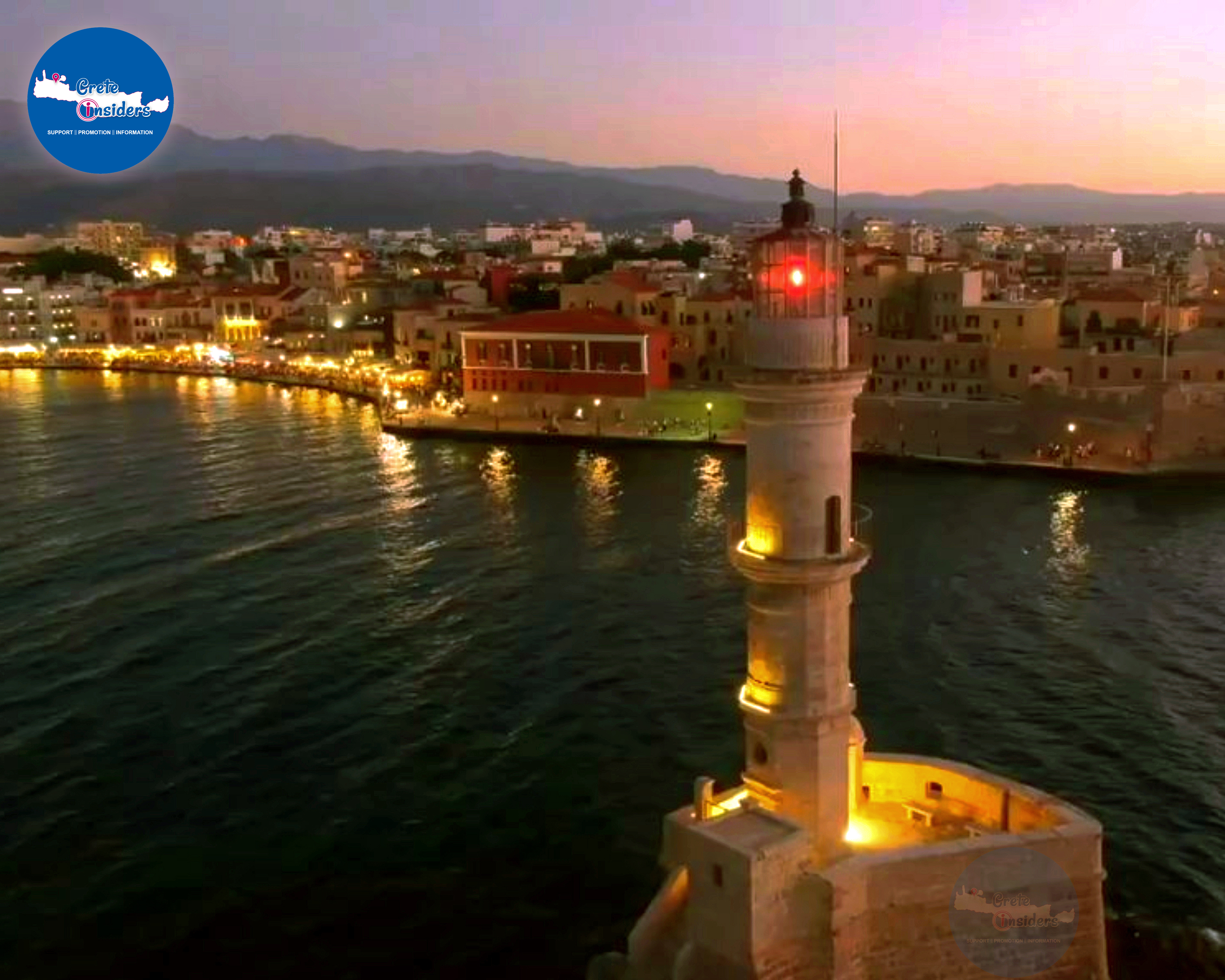
The Venetians shaped the city we still see today. They built the harbor, arsenals, lighthouse and walls. Trade flourished and Chania became a busy port in the eastern Mediterranean.
Ottoman Period (1645-1898 CE)
In 1645, the Ottomans captured Chania. They changed the city with mosques, hammams and fountains. Life was multicultural with Christians, Muslims and Jews. The Etz Hayyim synagogue in the Old Town is a witness to this community.
Chania was also a center of revolts. Monasteries such as Agia Triada and Gouverneto gave shelter to rebels. The Cretans fought many times for freedom.
The Halepa Era and the Cretan State (1878-1913)
In the late 19th century, the district of Halepa in Chania became famous. Foreign consulates and elegant houses were built there. The Pact of Halepa in 1878 gave Cretans more rights under Ottoman rule.
In 1898 the Great Powers forced the Ottomans out and created the Cretan State. Chania was the capital. It had its own flag, parliament and High Commissioner, Prince George of Greece.
Union with Greece and Venizelos (1913)
Crete united with Greece in 1913. From Chania came Eleftherios Venizelos, born in Mournies in 1864. He became the greatest Greek statesman of the 20th century. His home in Halepa is now a museum.
World War II and Occupation
Chania was a main target during the Battle of Crete in 1941. German paratroopers invaded, the city was bombed and many civilians died. The Jewish community was lost when the ship Tanais, carrying them to Auschwitz, was sunk in 1944.
Still, the Cretan spirit of resistance stayed strong. After the war, Chania was rebuilt with care to keep its historic face.
Chania Today
Chania remained the capital of Crete until 1971. Today it is the heart of western Crete and one of the most visited cities in Greece. The Old Town keeps its mix of Venetian, Ottoman and Greek styles.
Tourism, culture and university life give Chania its energy. Visitors can walk the Venetian harbor, explore ancient sites like Aptera and Falassarna, visit monasteries like Agia Triada, or simply enjoy the narrow streets of the Old Town.
Final Thought
From stone tools in Paleolithic caves to the vision of Venizelos in the modern era, Chania shows the full history of Crete. It is not only a city but a timeline of civilizations.
When you walk here you see the past and the present side by side. And that is what makes Chania unique.
Enjoy your time in Crete!
Nikos