
Editor's Note
This essay was originally published in Spanish on July 29, 2026, through Roma's Substack as part of my participation in the Roma Creative Residency program in Buenos Aires.
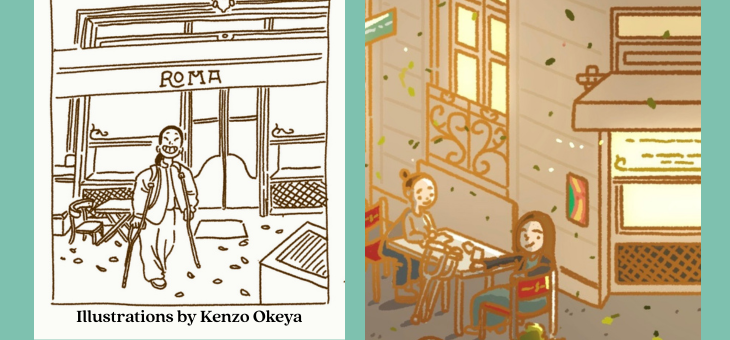
I arrived in Argentina to document Roma, a nearly 100-year-old institution in the Abasto neighborhood, and to learn from the city's bares notables. What follows is the original English-language version of that essay, accompanied by sketches from illustrator Jon Kenzo Okeya as we developed a visual interpretation of Roma's history, people, and place.
Prints, stickers and notebooks with the completed Roma Tiny World illustration will be available for sale on the Okeya stationary website later this year.
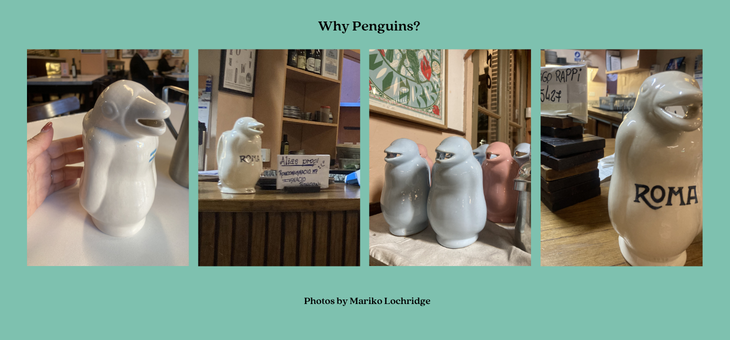 “Why penguins?”
It’s Tuesday, June 2nd and I am on a video conference with Martín, one of the owners of Roma, and Kenzo, my collaborator for my essay’s illustrations.
We are wrapping up our research into the history and ownership transitions of Roma, and Kenzo and I are both obsessed with the ubiquitous ceramic pitchers shaped like penguins that are scattered throughout the restaurant.
“Martín, why penguins?”
“I’m not exactly sure,” he tilts his head and thinks. “In all the older restaurants, we use the penguins as pitchers for wine. Some people even have them in their homes. It’s probably from Europe or something like that. I’m sure you can find the answer online.”
He’s right.
The internet tells me that decades ago wine often arrived in large casks and was not individually bottled. Many families owned their own penguin-shaped pitchers at home, and in restaurants servers would bring wine to the table in those same vessels. Sometimes they’re shaped like other animals but most places in Buenos Aires have penguins.
Today, the pitchers are no longer necessary.
But they have been part of the bares notables for so long that their absence would be noticed.
Something would feel missing.
That’s nostalgia.
 We rarely notice the significance of something familiar until it’s gone.
And that is the balancing act of running a business that has survived for generations.
How do we preserve history while adapting to the realities of the present?
How do we stay recognizable to the people who already belong, while making room for what’s next?
 My creative residency at Roma often made me think about my work with legacy businesses in Los Angeles.
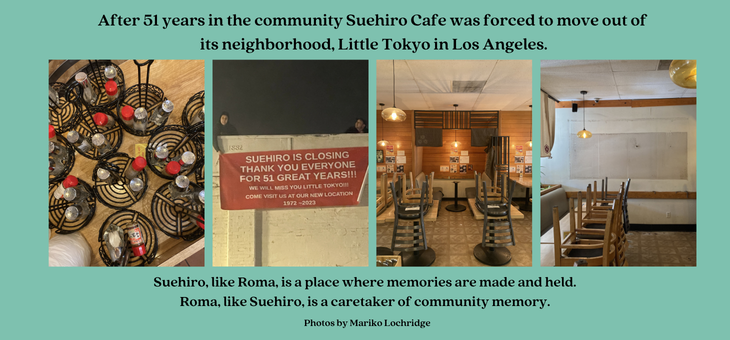
In 2024, a 51-year-old business called Suehiro Cafe was forced to relocate after a lengthy dispute with its landlord.
The community was devastated.
Generations had dined there and the business had less than two weeks to move.
As the relocation approached, we asked customers a few simple questions:
How long have you been coming here?
What is your favorite meal?
What should continue at the new location?
Nearly 1,000 people completed the survey.
Many wanted menu items to stay the same.
But most of the responses weren’t about food at all.
They were memories.
Stories.
Messages of gratitude to the owners.
Suehiro, like Roma, is a place where memories are made and held.
Roma, like Suehiro, is a caretaker of community memory.
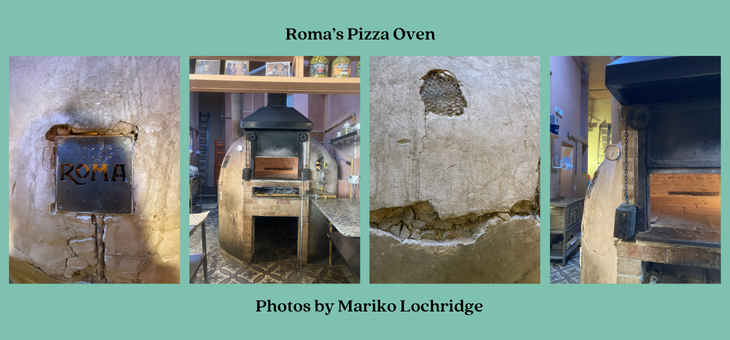 Roma has never been displaced from its home in Abasto, but it is not immune to adaptation.
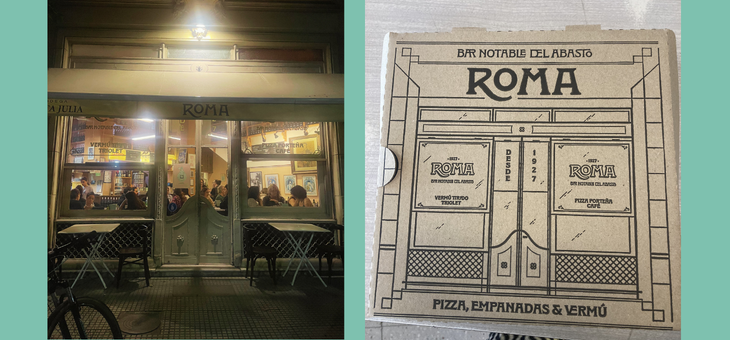
When I first saw the pizza oven, I was convinced it had been there for decades.
Then I learned that the building was once a neighborhood market, later a delicatessen, and only recently became a pizzeria.
The historic-looking oven that anchors the room today is less than five years old.
Roma, like many legacy businesses, is a scavenger hunt of cultural heritage.
As I explored the space, I found myself asking the same questions over and over.
“How long has this been here? Do you remember?”
“The fan?”
“A very long time.”
“The refrigerator behind the bar?”
“Part of a recent renovation.”
“The meat slicer on the counter?”
“Old enough to need repairs.”
History accumulates unevenly.
Some objects survive for decades.
Others are replaced.
What stays and what goes is often a practical choice, not a nostalgic one.
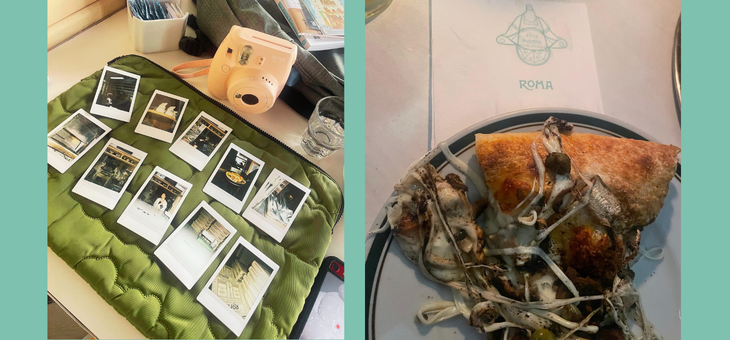 Much of my research was completed from a table inside of Roma while recovering from a broken leg.
My intended project became much smaller during this residency, but my curiosity did not.
As I shared my Roma field notes with Kenzo I wanted the final illustration to feel like the scavenger hunt I experienced during my residency. The artwork needed to be deeply rooted in history but also with the playfulness I’d come to appreciate from its staff, its ownership and Roma herself.
Each part of the illustration represents a slightly fantastical reimagining of Roma.
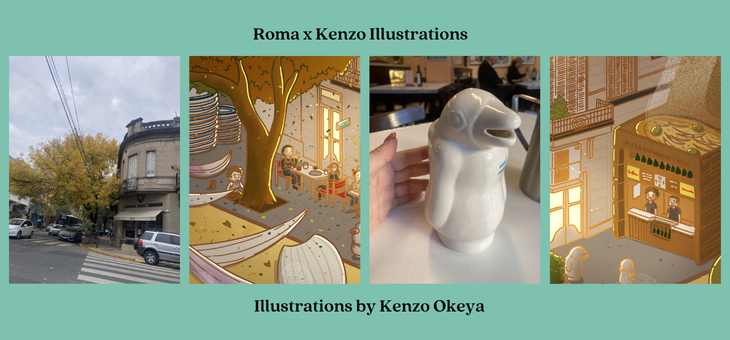 The penguins wandering around this corner of Abasto represent nostalgia for the past.
The tree outside was planted by the third generation of ownership and signals the changing of the seasons and its multi generational ownership.
The older bottles displayed throughout the restaurant were discovered during renovations and preserved as decoration. They represent a small act of historic preservation.
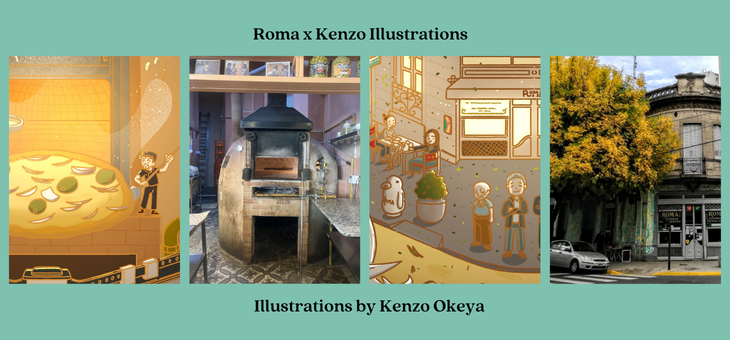 The pizza oven was added by the fourth generation of ownership as a way to expand the menu.
Connected to porteño culinary traditions, this dish is a symbol of cultural heritage.
The colorful artwork on the exterior wall references a mural that once wrapped the corner of Anchorena and San Luis. Its strategic remains are a nod to the arts that flourish because of third spaces like Roma.
And each person in Kenzo’s illustration represents a member of the staff, a regular customer, or someone connected to Roma’s story.
Including me.
 People make places.
We create memories.
And we remember.
 Built from my field notes, photographs, interviews, and conversations, Kenzo’s illustration is imaginative documentation of Roma’s layered history.
A legacy business is a mosaic of past, present, and near future.
Only time can layer culture, memory, and shared experiences onto a space.
Legacy businesses remind us where we came from, who came before us, and how communities adapt without completely letting go of their past.
I think we value legacy businesses because they help us connect with our heritage, our history and our community.
Roma will turn 100 next year.
Kenzo’s illustration captures my interpretation of a moment in that history.
I am deeply grateful to the entire team at Roma for welcoming me into this creative residency, to my collaborator Jon Kenzo Okeya for creating an illustration that captures both the whimsy and history of this remarkable place, and to my friends Luli, Lautaro, and Kiyoshi for helping me survive my unexpected hospitalization and surgery in Buenos Aires so that I could complete this project.