

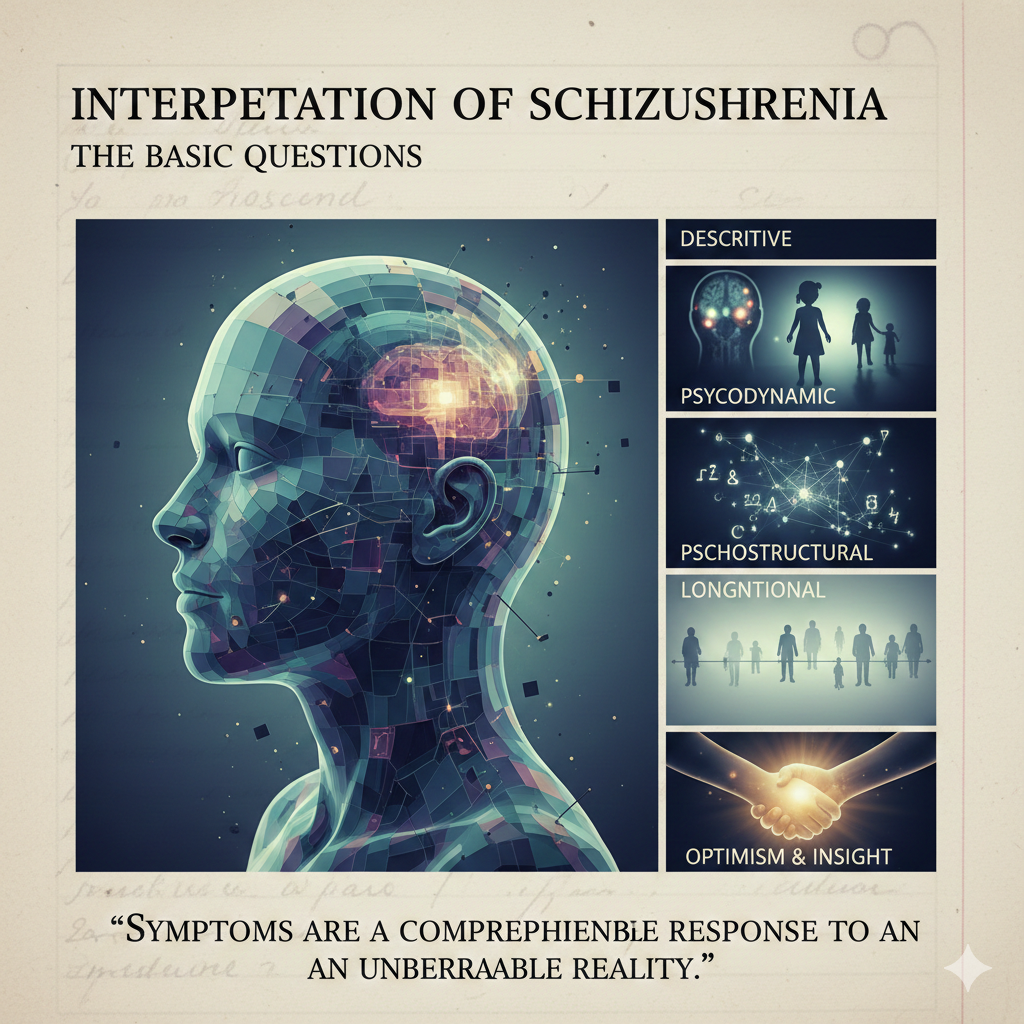
In this crisp and short article, I will share my understanding of the chapter 'The Basic Questions' from Interpretation of Schizophrenia. Before I started studying this chapter, a voice in me was saying it might not offer anything beyond what I already knew about the definition of schizophrenia — but to my surprise, Arieti defines it through a unique lens that genuinely broadened my thinking.
Following are the 5 key takeaways:
1. Arieti argues that schizophrenia cannot be defined or diagnosed by looking at a fixed set of symptoms alone. Two people living with schizophrenia can show completely different symptoms. To truly understand it, one must look through multiple lenses: Descriptive, Psychodynamic, Psychostructural, and Longitudinal.
Descriptive approach involves observing and labeling symptoms as they appear. It is the starting point, but shallow on its own — symptoms alone don't reveal their meaning or origin.
Psychodynamic is understanding the patient's past — childhood experiences, trauma, family dynamics — to uncover the why behind their condition.
Psychostructural is understanding the patient's internal logical reasoning. Every schizophrenic patient operates according to their own inner logic, and decoding that logic is central to Arieti's approach.
Longitudinal means tracking how symptoms evolve over time, from the earliest signs all the way to advanced stages.
2. Arieti rejects defining schizophrenia as simply "a way of living." His objection is two-fold: the phrase is intellectually vague — it could describe almost anything — and it implicitly normalizes a condition that causes genuine, serious suffering.
3. Despite schizophrenia's complexity, Arieti is deeply optimistic. He believes that with proper psychotherapy — and where needed, medication as support — many patients can recover fully, and most others can experience significant improvement.
4. Perhaps Arieti's most important and original insight is the distinction between psychosis and neurosis. In neurosis (such as anxiety or depression), the person knows something is wrong with them — they retain what psychiatrists call insight. In psychosis, the person has lost that insight entirely. They accept their distorted reality as completely normal and don't believe anything is wrong. This is not stubbornness — it is a fundamental shift in how reality itself is experienced. This distinction explains why schizophrenia is so much harder to treat than other mental disorders: the person may not believe they need help at all.
5. What struck me most about this chapter is Arieti's fundamental belief — that schizophrenic symptoms are not random noise, but a comprehensible response to an unbearable psychological reality. The symptoms make sense from the inside. That single idea changes everything about how you approach the subject.