

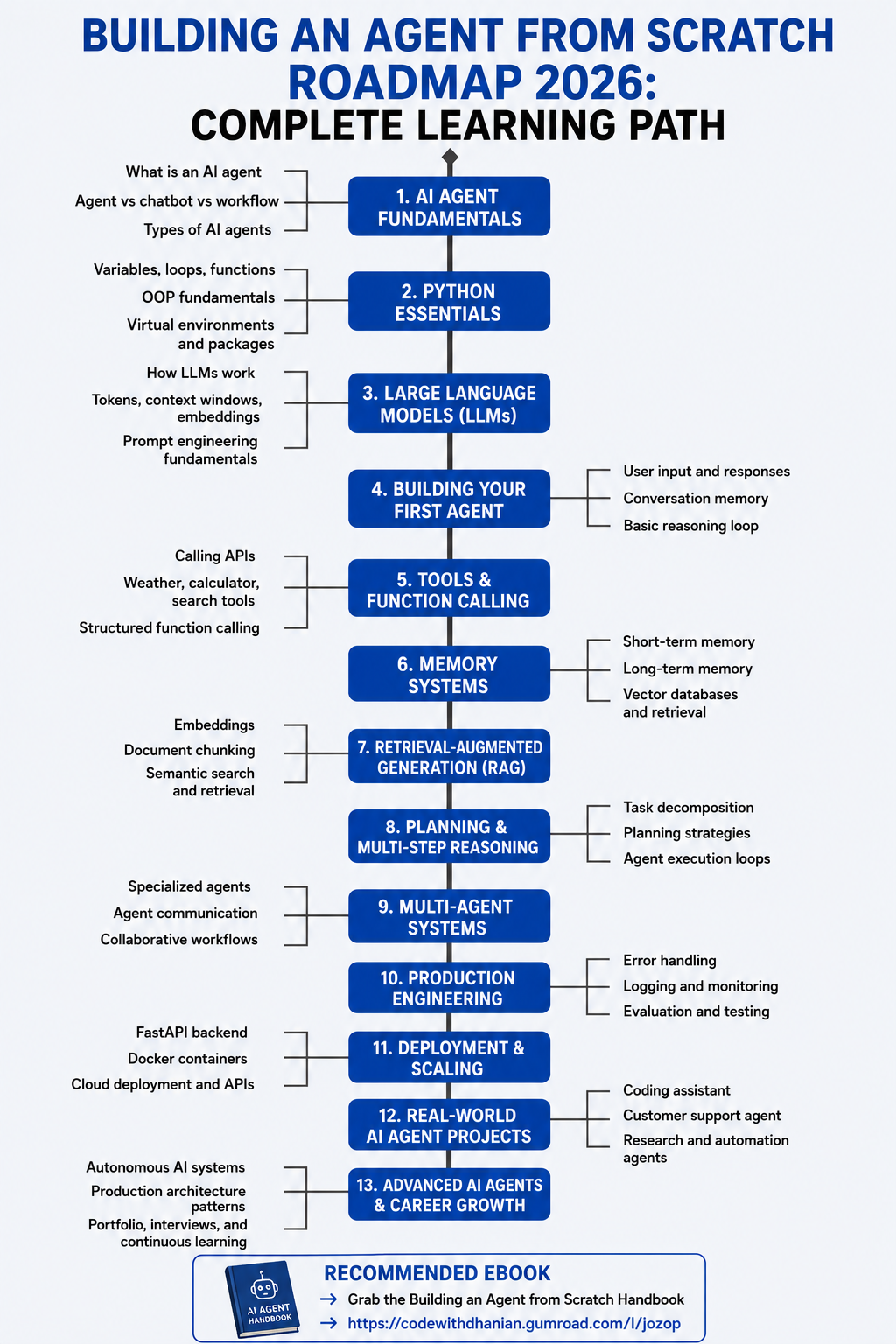
Artificial Intelligence has entered a completely new era.
For years, most AI applications were simple chatbots that answered questions or generated text. Today, AI is evolving into something much more powerful—AI agents.
Unlike traditional AI assistants that simply respond to prompts, AI agents can reason, plan, use tools, retrieve information, interact with APIs, write code, analyze data, and execute multi-step tasks autonomously. This shift is redefining software development and business automation. Industry trends show growing adoption of agentic AI across enterprises, with increasing focus on production-ready agents rather than simple chat interfaces.
Companies across every industry are investing heavily in AI agents.
Startups are building AI-first products.
Large enterprises are creating internal AI assistants.
Developers are integrating agents into SaaS applications.
The demand for engineers who understand AI agents has never been higher.
The exciting part?
You don't need a PhD in Artificial Intelligence to build one.
If you understand the right concepts, follow a structured roadmap, and build consistently, you can go from beginner to creating production-ready AI agents.
This roadmap is exactly how I would learn AI agent engineering from scratch in 2026.
WHY AI AGENTS ARE THE FUTURE OF SOFTWARE
Traditional software follows predefined rules.
Users click buttons.
Applications execute logic.
Everything is deterministic.
AI agents change that completely.
Instead of simply following instructions, agents receive goals.
They decide:
→ What information they need
→ Which tools to use
→ Which APIs to call
→ What actions to perform
→ Whether additional reasoning is required
→ When the task is complete
An AI agent doesn't just answer.
It thinks.
It plans.
It acts.
That makes AI agents fundamentally different from traditional applications. Modern production agents typically combine a reasoning model with tools, memory, planning, and execution loops rather than acting as simple chatbots.
PHASE 1 — BUILD STRONG FOUNDATIONS
Many beginners rush into agent frameworks.
That is a mistake.
Frameworks come and go.
Fundamentals remain valuable forever.
Start by mastering:
→ Python
→ JavaScript or TypeScript
→ Git
→ APIs
→ JSON
→ HTTP
→ Command line
→ Virtual environments
→ Package management
Python remains the dominant language for AI engineering because of its mature ecosystem and extensive AI libraries.
If you're already comfortable with TypeScript, that is also an excellent choice.
The important thing is mastering one language before jumping into frameworks.
LEARN HOW LLMS ACTUALLY WORK
Before building agents, understand the engine behind them.
Study:
→ Tokens
→ Context windows
→ Prompting
→ Temperature
→ System prompts
→ Embeddings
→ Vector representations
→ Reasoning models
→ Tool calling
An AI agent is simply an intelligent system built around an LLM.
If you understand how the model thinks, building agents becomes much easier.
UNDERSTAND WHAT AN AI AGENT REALLY IS
Many people think an AI agent is simply ChatGPT with memory.
That is incorrect.
A true AI agent combines several components:
→ A language model
→ Memory
→ Tools
→ Planning
→ Reasoning
→ State management
→ Decision-making
→ Execution
Most modern agents revolve around an observe → reason → act loop, often implemented with ReAct-style reasoning and tool usage.
PHASE 2 — MASTER PROMPT ENGINEERING
Before writing code, learn how to communicate with AI systems effectively.
Study:
→ Zero-shot prompting
→ Few-shot prompting
→ Chain-of-thought concepts
→ Structured outputs
→ JSON mode
→ Function calling
→ Prompt templates
→ Guardrails
Prompt engineering becomes even more important when your agent needs reliable and repeatable behavior.
PHASE 3 — LEARN HOW TO WORK WITH APIS
Agents become useful because they can interact with external systems.
Master:
→ REST APIs
→ Authentication
→ OAuth
→ Webhooks
→ API keys
→ Rate limiting
→ Error handling
→ JSON parsing
Every serious AI agent eventually communicates with external services.
PHASE 4 — BUILD YOUR FIRST SIMPLE AGENT
Don't start with a massive autonomous system.
Build something small.
Examples:
→ Weather agent
→ Research assistant
→ File organizer
→ Email summarizer
→ Calendar assistant
→ FAQ assistant
The objective is understanding the workflow.
Not building the next billion-dollar startup.
PHASE 5 — LEARN TOOL CALLING
Tool calling transforms an LLM into an agent.
Instead of only generating text, your agent can:
→ Search the web
→ Read files
→ Query databases
→ Execute Python
→ Send emails
→ Schedule meetings
→ Create reports
→ Use external APIs
Tool use is one of the defining characteristics of modern agent architectures.
PHASE 6 — ADD MEMORY
Without memory, agents forget.
Memory allows agents to remember:
→ Previous conversations
→ User preferences
→ Long-term goals
→ Project context
→ Completed actions
→ Important documents
Study:
→ Short-term memory
→ Long-term memory
→ Semantic memory
→ Vector memory
→ Context management
Memory is one of the most important features separating advanced agents from simple assistants.
PHASE 7 — LEARN VECTOR DATABASES
Modern AI agents frequently retrieve information instead of relying solely on model knowledge.
Study:
→ Embeddings
→ Similarity search
→ Retrieval
→ Chunking
→ Metadata filtering
Popular vector databases include:
→ Pinecone
→ Qdrant
→ Weaviate
→ Chroma
→ pgvector
These technologies enable Retrieval-Augmented Generation (RAG), allowing agents to work with private or domain-specific knowledge.
PHASE 8 — BUILD RAG-POWERED AGENTS
Once retrieval is understood, combine it with your agent.
Build:
→ PDF assistant
→ Documentation assistant
→ Internal company knowledge assistant
→ Customer support agent
→ Technical research assistant
This is where AI agents become genuinely useful in production.
PHASE 9 — LEARN PLANNING AND REASONING
Advanced agents don't immediately execute actions.
They plan.
Study:
→ ReAct
→ Plan-and-Execute
→ Reflection
→ Self-correction
→ Task decomposition
→ Goal planning
Planning dramatically improves agent reliability and allows them to tackle multi-step tasks.
PHASE 10 — EXPLORE AGENT FRAMEWORKS
Only after understanding the fundamentals should you adopt frameworks.
Explore:
→ LangGraph
→ LangChain
→ CrewAI
→ OpenAI Agents SDK
→ AutoGen
Remember:
Frameworks accelerate development.
They do not replace understanding.
PHASE 11 — BUILD MULTI-AGENT SYSTEMS
As your skills grow, design systems where specialized agents collaborate.
Examples:
→ Research agent
→ Coding agent
→ Reviewer agent
→ Planner agent
→ Report generator
→ Quality assurance agent
Each agent performs one responsibility exceptionally well.
Together they solve complex workflows.
PHASE 12 — CONNECT REAL TOOLS
Production agents should integrate with real software.
Examples:
→ GitHub
→ Slack
→ Gmail
→ Google Calendar
→ Notion
→ Databases
→ CRMs
→ Cloud storage
This transforms your projects from demos into practical business solutions.
PHASE 13 — DEPLOY YOUR AGENT
A local prototype is only the beginning.
Learn how to deploy agents using:
→ Docker
→ FastAPI
→ Serverless platforms
→ Kubernetes
→ Cloud platforms
→ Monitoring systems
Deployment separates hobby projects from production systems.
PHASE 14 — OBSERVE, EVALUATE, AND IMPROVE
Building an agent is only half the journey.
You also need to measure performance.
Track:
→ Accuracy
→ Task completion
→ Latency
→ Tool failures
→ Cost
→ Hallucination rate
→ User satisfaction
Modern agent engineering places heavy emphasis on observability and evaluation because production success depends on more than simply generating good responses.
BUILD PROJECTS THAT MATTER
Projects accelerate learning faster than tutorials.
Ideas include:
→ AI coding assistant
→ Research assistant
→ Personal productivity agent
→ Customer support system
→ Meeting summarizer
→ Resume reviewer
→ AI travel planner
→ Financial analysis assistant
→ AI tutor
→ Autonomous content generator
Each project teaches different engineering challenges.
COMMON MISTAKES TO AVOID
Avoid these pitfalls:
→ Chasing every new framework
→ Ignoring Python fundamentals
→ Overengineering simple solutions
→ Building without evaluation
→ Ignoring security
→ Skipping memory architecture
→ Forgetting observability
→ Depending entirely on prompts instead of system design
A strong foundation will always outperform hype-driven development.
THE FUTURE OF AI AGENTS
AI agents are becoming one of the most important areas in software engineering.
The future will involve:
→ Autonomous business workflows
→ AI software engineers
→ AI research assistants
→ Intelligent customer support
→ Multi-agent collaboration
→ Personal AI operating systems
→ Scientific discovery assistants
→ Enterprise automation
The demand for agent engineers will continue growing as organizations move from experimentation to production deployments.
QUICK THOUGHTS
Building AI agents is no longer a niche skill.
It is becoming one of the defining capabilities of modern software engineers.
The developers who understand how to combine reasoning, memory, planning, tools, retrieval, and scalable infrastructure will shape the next generation of intelligent applications.
Start with the fundamentals.
Build consistently.
Focus on understanding instead of memorization.
And most importantly, create real projects that solve real problems.
That is how you become an AI agent engineer.
GET THE COMPLETE BUILDING AI AGENTS EBOOK
If you want a structured, practical, and beginner-to-advanced guide to building AI agents from scratch—including LLM fundamentals, tool calling, memory, RAG, agent frameworks, multi-agent systems, deployment strategies, and production-ready projects—grab the complete ebook here:
https://codewithdhanian.gumroad.com/l/jozop
This ebook is designed to help developers move beyond simple chatbots and build intelligent AI agents capable of reasoning, planning, using tools, and solving real-world problems professionally.