

Introduction
Recent policy actions by President Trump have drawn widespread attention, especially his implementation of tariffs on imported goods from multiple countries. While the official narrative centers on protecting American industry, a closer examination reveals a more strategic, long-term economic play. This paper argues that these tariffs, along with other policies, are deliberately tanking the U.S. economy to push it toward a state of widespread poverty. In this environment, workers, are forced to accept low wages and poor working conditions. This plan mirrors economic strategies employed by authoritarian regimes such as Russia, China, and North Korea, where deliberate economic hardship is used to create a cheap labor force and ensure tighter control over society.
The Tariff Strategy
The Policy and Its Impact
Trump’s administration introduced tariffs on a wide range of imports, including goods from all countries in the world. These tariffs raise prices on imported items such as food, vehicles, clothing, fuel, electronic goods, building materials, medication, and shoes.
When accounting for all 2025 tariffs, disposable income is expected to drop 4% for the lower-earning households compared with 1.6% for the highest-earning. This equates to −$3,487 loss per household in the USA.
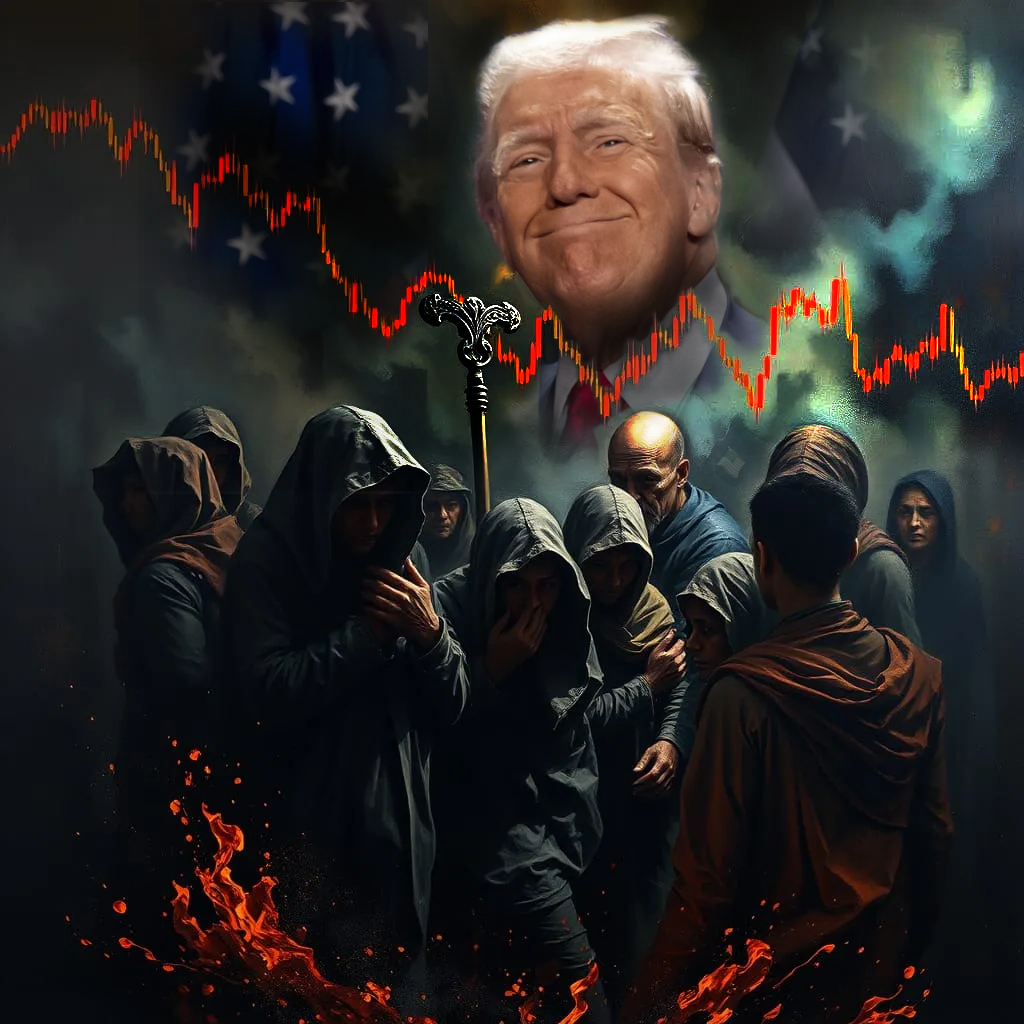
The Stock Market has also been hit hard by the introduced tariffs, Americans have lost 3 trillion dollars in 3 weeks. Which shareholders will want to recoup, this will equate to increase in prices adding to the down turn in US economy.
Also Trump's immigration policies puts pressure on the US economy and creates a shortage of low income workers, this increases the prices, as loss in income for the industries are unable to find workers. This will also lead to higher prices as businesses increase their wages in order to keep functioning.
Another policy of Trump was to get rid of medication subsidies, which has increase the price of medicine greatly in the USA by about 4.5% - 20% depending on the drug.
Trump's policy to remove food stamp support for lower income earning families, will not increase the price of goods, but will increase the level of poverty.
Purpose Beyond Protectionism
While tariffs are publicly justified as measures to protect domestic industries, the broader effects on the U.S. economy suggest a different motivation. By raising prices on consumer goods, these policies create an environment where:
Economic hardship increases: The cost of living rises across the board, especially affecting lower-income workers.
Wages remain suppressed: As the economy slows and inflation pressures mount, businesses have less incentive to raise wages.
Cheap labor becomes abundant: Faced with higher living costs and reduced benefits (as welfare cuts have also been implemented), many workers are forced to accept lower wages and worse working conditions.
Creating Cheap Labor Through Economic Downturn
The Forced Poverty Model
The deliberate imposition of tariffs, combined with a reduction in social safety nets, produces a scenario where a significant portion of the population is pushed into poverty. In this state:
Labor becomes inexpensive: Workers, now desperate for survival, are willing to accept minimal pay and poor conditions.
Employers benefit: Companies can cut labor costs and maintain profit margins even as overall consumer spending declines.
Economic control is tightened: The state can further justify repressive policies by citing economic distress and national insecurity.
This model mirrors strategies used in authoritarian regimes:
Russia uses economic instability and nationalism to keep wages low and control dissent.
China has strategically restructured its economy over decades, using both internal repression and external pressures to maintain a vast, cheap labor pool.
North Korea similarly uses poverty and isolation to suppress workers and ensure compliance with state policies.
The Agricultural Sector: A Case Study
U.S. farmers provide a stark illustration of this model in practice. Currently, there is a shortage of workers in agriculture, a shortage compounded by:
Low wages: With tariffs increasing the cost of inputs and reducing overall demand, farmers are forced to pay minimal wages.
Working conditions: In the absence of strong labor protections, poor working conditions are prevalent, and desperate workers are less likely to protest.
Dependence on cheap labor: With fewer domestic workers willing to take on low-paying, labor-intensive jobs, the gap is often filled by immigrant labor. However, immigration policies have been tightened, further pressuring the labor market.
This situation is not accidental. By deliberately keeping wages low and worker conditions suboptimal, the system creates a cheap, exploitable workforce that benefits employers and, by extension, the regime’s broader goals.
The Larger Geopolitical Play
Aligning with Authoritarian Models
The U.S. under Trump is not unique in employing such strategies. Authoritarian states have long used similar tactics:
In Russia, a combination of economic mismanagement and deliberate policy choices has resulted in a labor market where the average worker remains underpaid and easily controlled.
In China, the “Century of Humiliation” has fueled a long-term strategy that emphasizes tight state control over both the economy and its people, ensuring that even as the country grows, its labor remains cheap and compliant.
North Korea’s model is the most extreme version, where widespread poverty is institutionalized to maintain a grip on the populace.
The Economic Purpose
These strategies serve a dual purpose:
Short-term Economic Control: By keeping wages low and the workforce desperate, the state, or in Trump’s case, the administration, reduces the bargaining power of labor. This makes it easier to enact policies that benefit corporate interests at the expense of workers.
Long-term Political Stability: Economic dependency creates a population that is less likely to rebel. When people are too poor to fight for better conditions, they become more compliant and easier to control politically.
Conclusion
Trump’s tariff policies, when viewed through the lens of long-term economic strategy, reveal a deliberate effort to tank the U.S. economy in order to create a cheap labor force. This tactic is not isolated but is part of a broader trend shared by authoritarian regimes like Russia, China, and North Korea. By deliberately inflicting economic hardship, raising the cost of living while suppressing wages and cutting social benefits, the administration sets the stage for a society where workers have little choice but to accept exploitative conditions.
This paper argues that these policies are less about protecting American industry in the traditional sense and more about reshaping the economy to benefit a select few while keeping the majority in perpetual poverty. In doing so, the U.S. risks following in the footsteps of other authoritarian regimes where economic hardship is not a side effect but a carefully orchestrated tool of control.
References
https://www.usatoday.com/story/money/2025/04/02/how-much-trump-tariffs-will-cost-you/82777080007/