


Introduction
This paper explores the essential role of breathing in optimizing APE (Ancestral Paradoxical Echoes) meditation. Breath is the only autonomic function we can consciously regulate, making it the most accessible gateway to entrain heart rate, oxygen saturation, and the body-mind resonance state.
By integrating specific breath patterns with LVARC (Lateral Vestibular Activation with Rhythmic Coherence), practitioners can accelerate the onset of coherence, maintain stable parasympathetic tone, and reach deeper meditative states with less effort.
A pulse oximeter and heart rate monitor are valuable tools during APE practice. These devices provide real-time insight into the shifting internal state, allowing the practitioner to see how breath and movement influence oxygen levels and nervous system activity. Observing these changes helps refine technique and deepens body awareness.
What Oxygen Does in the Body
Oxygen (O₂) is essential for cellular energy production. Every cell in the body uses oxygen to convert glucose into usable energy through a process called cellular respiration. This energy powers everything from muscle contraction to brain activity.
When oxygen saturation in the blood is high, it means the lungs are effectively transferring oxygen into the bloodstream, and the heart is circulating it to where it's needed. In APE practice, maintaining high O₂ levels ensures the brain, heart, and muscles are all operating in a coherent, efficient state, which enhances clarity, emotional stability, and bodily awareness.
Real-time SpO₂ monitoring helps practitioners understand when the body is entering or leaving resonance, offering a concrete measure of how well breathwork is supporting internal alignment.
Why Breath Controls the Heart
The heart and lungs are intimately linked through the autonomic nervous system, particularly via the vagus nerve. This relationship is known as Respiratory Sinus Arrhythmia (RSA), where:
Inhaling inhibits vagal tone and increases heart rate.
Exhaling reactivates the vagus nerve, reducing heart rate.
Breath holds (especially post-exhalation) can cause the heart rate to stabilize near resting levels.
This dynamic makes the breath a real-time regulator of cardiac function. Through breath, practitioners can directly influence their nervous system state, shifting between activation and rest. When paired with tools like LVARC, breath becomes a gateway to controlling resonance flow, nervous system state, and energy distribution throughout the body.
Scientific Foundations
1. Respiratory Sinus Arrhythmia (RSA)
The breath cycle and heart rate are directly linked via the vagus nerve.
Inhalation releases the vagal brake, increasing heart rate.
Exhalation activates vagal tone, reducing heart rate.
Breath holds stabilize vagal input, dropping heart rate near resting baseline.
2. LVARC and Oxygenation
Side-to-side vestibular stimulation engages cerebellar and autonomic systems.
Rhythmic coherence improves respiratory efficiency and alveolar gas exchange.
Observed effects: SpO2 jumps to 99% within 1 second of LVARC onset.
Ceasing LVARC causes up to a 5% drop in O2 saturation.
3. Breath Control as a Neuroregulator
Slow breathing increases parasympathetic dominance.
Fast breathing triggers sympathetic activation.
Micro-adjustments in pace and hold duration can fine-tune the system state.
Breath Cycle Speed and Heart Rate
Recent observations show that even when the structure of a breath pattern remains the same, changing the speed of the cycles significantly impacts heart rate.
A slow breath cycle (e.g., inhale 6 sec → exhale 1 sec → hold 1 sec) may yield a heart rate of ~70 bpm with SpO₂ at 99%.
A faster breath cycle using the same ratio (e.g., inhale 2 sec → exhale 1 sec) can raise heart rate to ~80 bpm, even with SpO₂ still at 99%.
This demonstrates that breath tempo is an independent lever for autonomic modulation and can be used to raise or lower systemic arousal as needed during an APE session.
Slow breathing increases parasympathetic dominance, reducing heart rate, calming.
Fast breathing triggers sympathetic activation, increasing heart rate, energizing.
Micro-adjustments in pace and hold duration can fine-tune the system state.
"The breath is the remote control of the nervous system."
Breath Protocols for APE Practitioners
5. Energy Breathing
Pattern: Inhale 6 sec → Exhale 1 sec
Effect: Stimulates alertness and sympathetic tone; increases heart rate and arousal. Use carefully at start of session if energy is low, or to re-activate after deep rest.
⚠️ Warning: This breathing pattern can significantly raise sympathetic nervous system activity. It should not be used for long durations and is not recommended for individuals with anxiety, hypertension, or sensitivity to over stimulation. Always follow with a calming breath pattern (e.g., Coherence Boost or Parasympathetic Drift) before continuing into the meditative phase. Use this pattern only when a burst of energy or focus is specifically needed.
1. Coherence Boost
Pattern: Inhale 5 sec → Exhale 5 sec (no hold)
Effect: Smooths heart rate, activates vagal tone, good during LVARC
2. Heart Drop Stabilizer
Pattern: Inhale 4 sec → Hold 4 sec → Exhale 4 sec → Hold 4 sec
Effect: Drops heart rate, induces stillness, ideal for meditation phase
3. Activation Wake-Up
Pattern: Quick inhale–exhale (1 sec each) × 20 → Deep breath → Hold 10 sec
Effect: Raises heart rate briefly, energizes system, good before APE initiation
4. Parasympathetic Drift
Pattern: Inhale 4 sec → Exhale 8 sec (no hold)
Effect: Maximizes vagal tone, used for emotional regulation or ending session
Breath + Hz Integration
Different breathing rhythms can be paired with sound frequencies (Hz) to guide the body into specific resonance states. This alignment enhances the effectiveness of both breath and sound, anchoring energy in targeted systems.
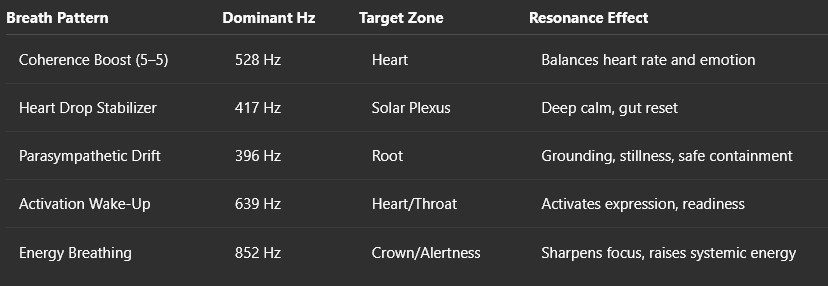
To apply: Layer the matching Hz frequency as a subtle tone while guiding breath. Adjust volume and fade timing to mirror inhale/exhale cycles. When timed correctly, the system entrains more rapidly and with deeper coherence.
Interactive Chant Protocol
An advanced and intuitive addition to APE practice is the use of a freestyle vocal chant that resonates the chest. The specific sound does not matter, what matters is that it activates vibration in the sternum or chest cavity.
When this vocal vibration is hit or modulated by the music’s resonance, practitioners often report a distinct and pleasurable effect, described as a “cool resonance” or a somatic harmonic feedback. This creates a real-time interaction between the body and the sound field.
Some practitioners use a deep throat tone held steadily, while adjusting the tongue and mouth shape to morph the overtone qualities without changing the base note. Shifting the resonance from the throat to the nasal cavity and back can greatly amplify the effect. When the resonance aligns correctly, it may feel as if the entire body is vibrating outward from the chest.
The Science Behind It
This technique engages both the resonance chambers of the body (chest, throat, nasal cavity) and stimulates the vagal nerve pathways, which connect the vocal cords, lungs, heart, and gut. Deep vocalization activates the parasympathetic nervous system, increasing vagal tone and promoting calmness and emotional balance.
The chest cavity acts as a resonator, amplifying low frequencies between ~100–250 Hz, which correspond with the heart, lungs, and thymus region.
Modulating overtones with mouth and tongue shapes changes the formant frequencies, allowing you to sculpt the harmonic structure, a practice found in Tuvan throat singing and Tibetan overtone chant.
Moving resonance between throat and nasal cavity shifts the perceived energy flow, which is both acoustic and neurological, engaging cranial nerves and breath control simultaneously.
This type of focused vocal resonance may:
Improve emotional regulation
Enhance interoceptive awareness
Induce deep nervous system entrainment
Support cardiopulmonary coherence
How to Use:
Begin chanting once LVARC and breath coherence are established.
Use any sound that causes your chest to vibrate deeply.
Explore different base tones, mouth shapes, and vocal placements (throat, nasal, chest).
Pay attention to moments where the music's frequency field overlaps with your chant, this creates a resonant echo effect.
Allow the interaction to guide your tone, volume, and rhythm.
This protocol deepens embodiment, harmonic sensitivity, and spiritual immersion in the sound field. An advanced and intuitive addition to APE practice is the use of a freestyle vocal chant that resonates the chest. The specific sound does not matter, what matters is that it activates vibration in the sternum or chest cavity.
When this vocal vibration is hit or modulated by the music’s resonance, practitioners often report a distinct and pleasurable effect, described as a “cool resonance” or a somatic harmonic feedback. This creates a real-time interaction between the body and the sound field.
Some practitioners use a deep throat tone held steadily, while adjusting the tongue and mouth shape to morph the overtone qualities without changing the base note. Shifting the resonance from the throat to the nasal cavity and back can greatly amplify the effect. When the resonance aligns correctly, it may feel as if the entire body is vibrating outward from the chest.
Application in APE Sessions
Start with LVARC and Coherence Boost breathing (Pattern 1)
Once coherence sets in (SpO2 high), transition to Heart Drop or Parasympathetic Drift
For extended sessions, maintain slow breath or micro-hold rhythm
Exit the session by reducing breath intensity and allowing full exhale with passive recovery
Tip: Small, precisely timed LVARC movements are more effective than large ones
Ancestral Paradoxical Echoes (APE): Sound Genre
Frequencies + Color + Smell Associations
The Adrenaline Response to APE Music and LVARC
References
Lehrer, P. M., & Gevirtz, R. (2014). Heart rate variability biofeedback: how and why does it work?. Frontiers in Psychology, 5, 756.
Yackle, K., Schwarz, L. A., et al. (2017). Breathing control center neurons that promote arousal in mice. Science, 355(6332), 1411–1415.
Brown, R. P., & Gerbarg, P. L. (2005). Sudarshan Kriya yogic breathing in the treatment of stress, anxiety, and depression. Journal of Alternative and Complementary Medicine, 11(4), 711–717.