

This is a follow up paper to 'Why Trump is Tanking the Market' I wrote Apr 07, 2025.
A Pattern Analysis of Strategic Destabilization: From Epstein Distraction to Authoritarian Opportunity
Author's Note: This paper is a work of predictive pattern recognition. It does not claim insider knowledge or access to classified information. It is an exercise in connecting publicly available events, statements, and legal mechanisms into a coherent theory of strategic intent. The author presents this as a mental model, a way of seeing what might otherwise remain invisible.
Abstract
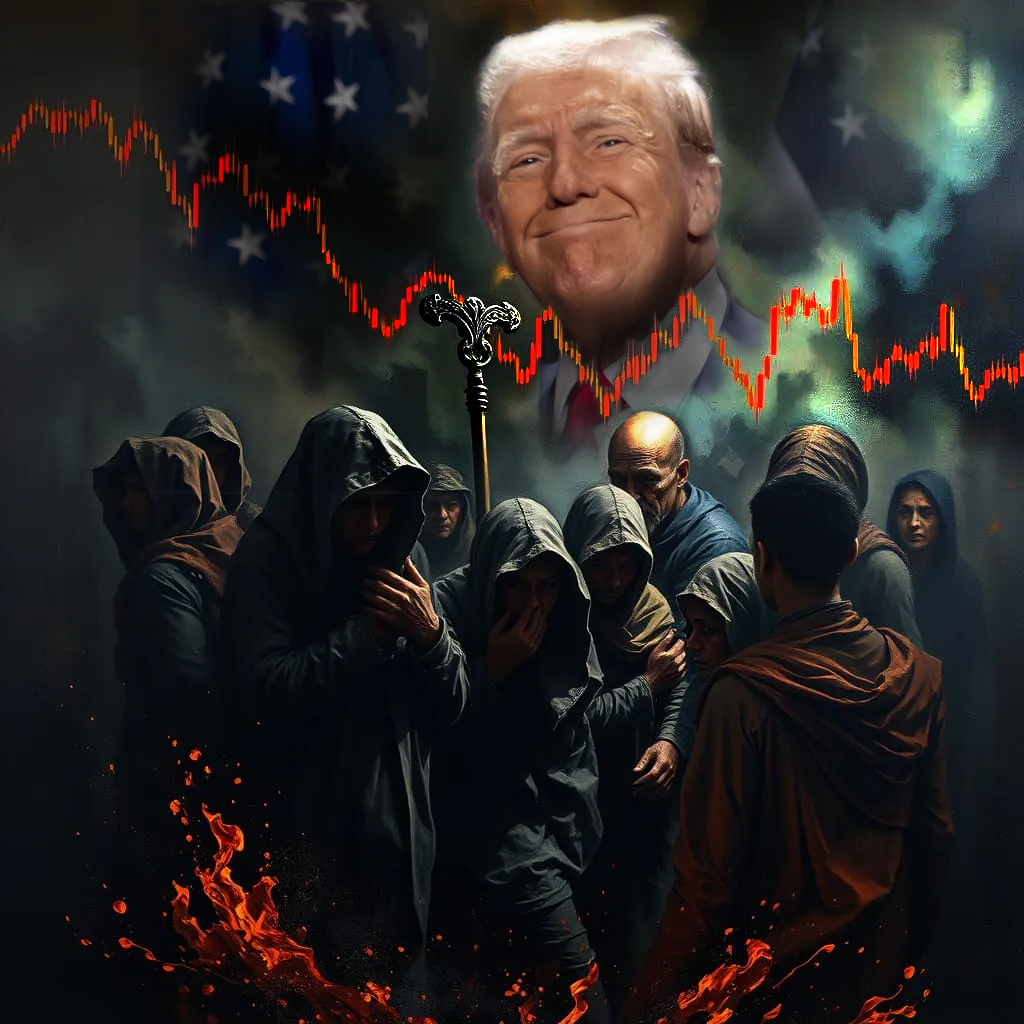
This paper examines the possibility that the Trump administration's actions across multiple fronts, military, economic, domestic law enforcement, healthcare, foreign aid, and international alliances, are not random, disconnected policies but rather components of a coordinated strategy of deliberate destabilization. The theory posits that the ultimate objective is to create sufficient chaos, suffering, and fear within the United States that a significant portion of the population will demand authoritarian intervention, providing cover for the invocation of emergency powers and potentially the disruption of normal electoral processes.
The analysis connects the following elements:
Military escalation with Iran
Epstein file release timing and controversy
ICE deployments to hostile states
State-level emergency election laws
Healthcare program expirations
Tariff policies that harm domestic consumers
Large foreign aid packages during domestic suffering
Murders of federal agents
Alienation of traditional allies
The paper argues that these seemingly disparate actions form a coherent pattern of provocation designed to elicit reactive responses from opponents, responses that can then be used to justify extraordinary measures.
Part One: The Foundation
1.1 The Core Observation
The central observation that began this inquiry was deceptively simple:
"He's cooked, he's done, but he still hangs on."
This line, originally about a man in denial, became the lens through which all subsequent events were filtered. The question became: What does a leader do when he knows he is politically finished, legally exposed, and historically condemned?
The answer that emerged: He burns everything down so that someone, anyone, will beg him to put out the fire.
1.2 The Epstein Catalyst
The Epstein Files Transparency Act, signed into law in November 2025, required full disclosure of all Jeffrey Epstein-related documents by December 19, 2025. The deadline was missed. When releases finally began, they contained thousands of references to President Trump. While mere appearance in the files does not indicate criminal conduct, the political sensitivity of any association with Epstein created significant exposure.
Multiple members of Congress, including Representative Alexandria Ocasio-Cortez (D-NY) and Representative Thomas Massie (R-KY), publicly suggested that military action against Iran, initiated on February 28, 2026, may have been timed to distract from Epstein file revelations.
This was the first connection: Military escalation as political cover.
But it was only the beginning.
Part Two: The Mechanism
2.1 The Legal Vulnerability
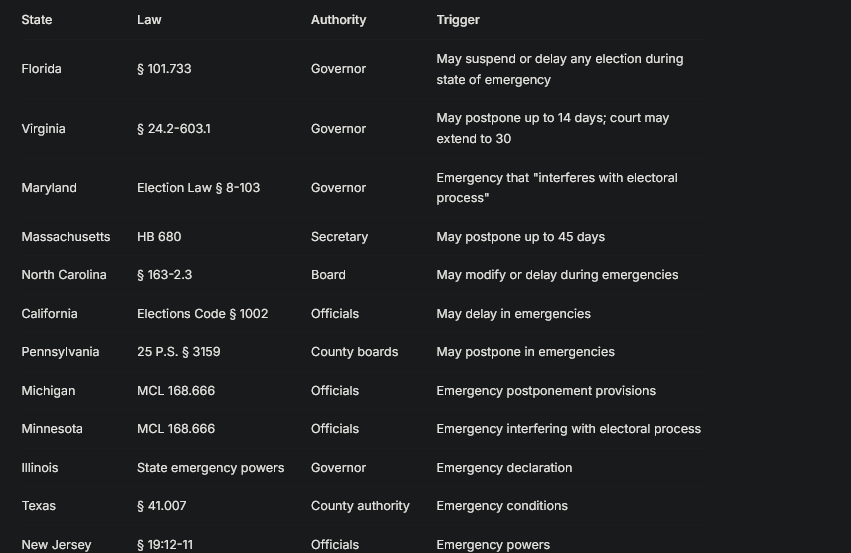
The United States does not hold a single national election. It holds 51 separate state-run elections that are aggregated into a national result. This distinction is critical because elections are governed by state laws, and many states have laws permitting election postponement during emergencies.
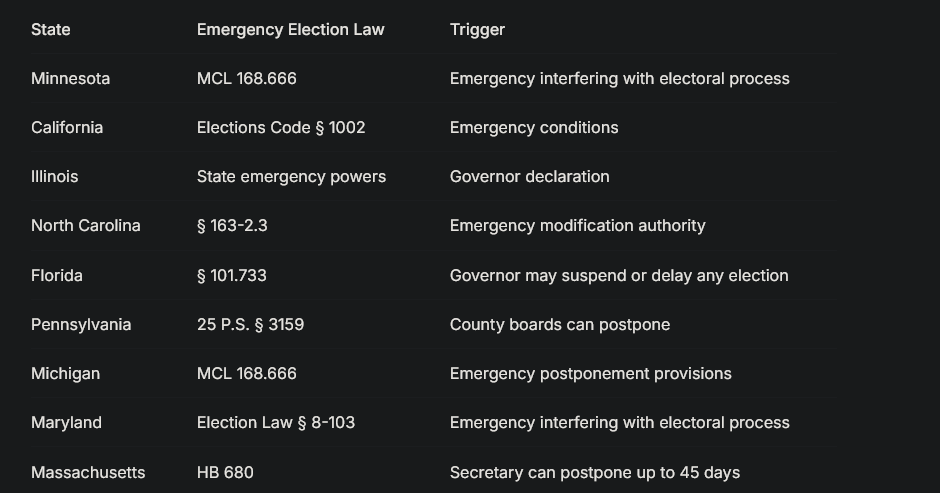
These laws exist for legitimate reasons, hurricanes, terrorist attacks, natural disasters. But they also represent a vulnerability: If a state governor, acting under state law, declares an emergency and postpones a federal election, there is no clear federal mechanism to force that state to hold its election on schedule.
2.2 The One-State Theory
The theory that emerged was this: It would take only one strategically positioned state, a battleground state with a governor from the opposing party, to delay its election under emergency provisions. If that state's electoral votes were not certified by the federal deadlines (early December for the Electoral College, January 6 for congressional certification), the entire national outcome could be thrown into chaos.
Congress would be forced to decide how to count, or not count, that state's electors. In a divided Congress, gridlock and constitutional crisis would follow.
The question became: How do you create an emergency in a specific state?
Part Three: The Provocation Strategy
3.1 The Pattern Emerges
What became clear through analysis is that the administration has been systematically applying pressure to states with Democratic governors, particularly those with emergency election laws, in ways designed to elicit reactive responses.
3.2 ICE Deployments
The administration sent large-scale ICE enforcement operations into multiple states. The list of targets is striking:
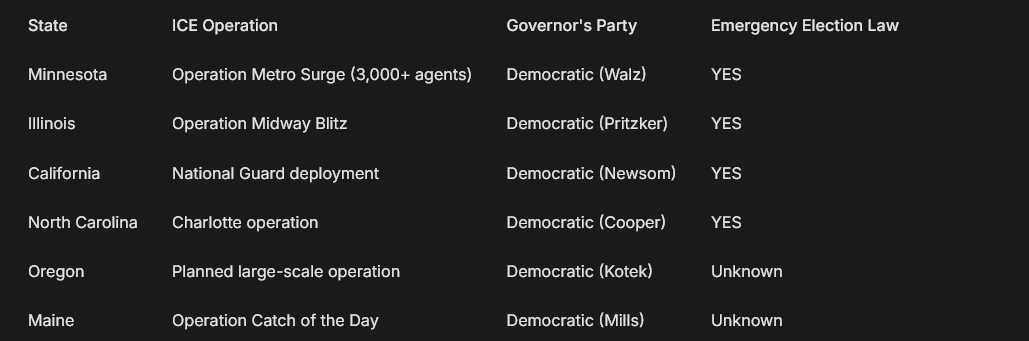 The pattern is clear: Overwhelming federal presence in states with Democratic governors and, in most cases, existing emergency election laws.
3.3 The Expected Response
The anticipated response to such deployments is:
Public outrage from state officials
Protests and civil unrest
Legal challenges
Potential confrontations between state and federal authorities
All of these create conditions that could be interpreted as emergencies under state law.
3.4 When They Didn't Bite
Notably, some governors, particularly Gavin Newsom of California, did not take the bait. Instead of emotional outbursts and street confrontations, California responded with lawsuits and quiet preparation. The expected chaos did not materialize.
This is crucial. When domestic provocation failed to produce the desired reaction, the game escalated.
Part Four: The International Front
4.1 Iran as Pressure Point
With domestic opponents refusing to play their assigned roles, the administration turned to foreign actors who have less capacity for restraint.
The February 28, 2026, strikes on Iran, resulting in the death of Supreme Leader Ayatollah Ali Khamenei, were not merely a distraction from Epstein files. They were a provocation designed to elicit a response from a foreign power that could then be used to justify domestic emergency measures.
4.2 The Logic of Foreign Provocation
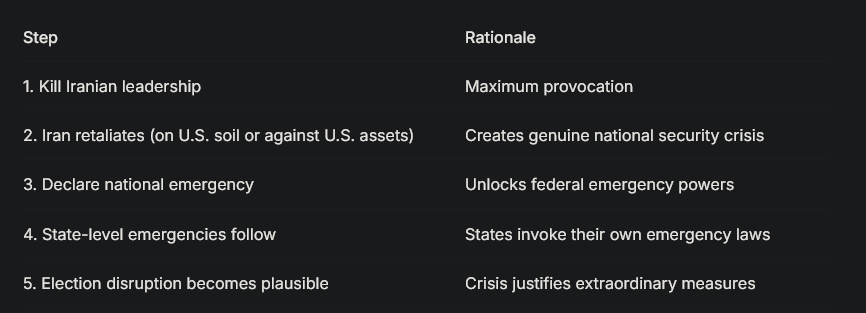 Iran becomes the external enemy that domestic opponents refused to be.
4.3 The Russia Windfall
An unexpected but significant outcome of the Iran conflict has been the dramatic rise in global oil prices and the subsequent strengthening of Russia's energy position:
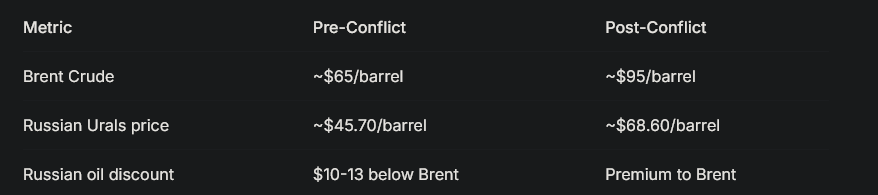 The U.S. has even issued waivers allowing Indian purchase of Russian oil, effectively facilitating Russian energy revenue. Whether intentional or merely accepted, this outcome further destabilizes the global order and rewards America's primary geopolitical adversary.
Part Five: Total System Pressure
5.1 The Full Spectrum
What emerged through analysis is that the administration is applying pressure across every domain of American life:
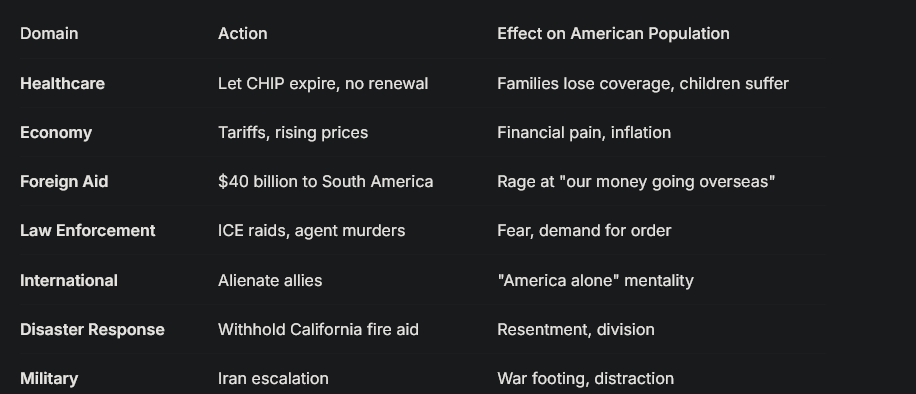
5.2 The Common Thread
The common thread across all these domains is suffering and anger directed at the American people.
This is the counterintuitive insight: A leader who cannot win through popularity is trying to win through desperation.
Make life unbearable
Make the system feel broken
Make the world seem threatening
Make opponents seem unreasonable
Wait for people to beg for order
5.3 The ICE Murders
The killings of ICE agents, whether isolated incidents or part of a pattern, serve a specific purpose in this framework:
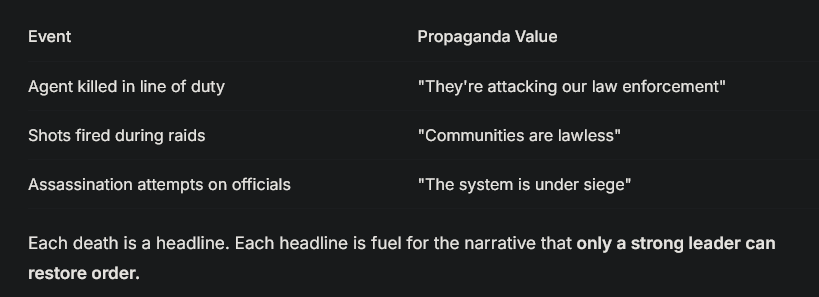
Each death is a headline. Each headline is fuel for the narrative that only a strong leader can restore order.
Part Six: The Legal Framework
6.1 State Emergency Laws as the Trigger
As established, numerous states have laws permitting election postponement during emergencies. The governors of these states, all Democrats in the targeted jurisdictions, hold the legal authority to invoke these provisions.
The question is not whether the federal government can force an election. The question is: What happens when a state, acting under its own laws, declares it cannot hold one?
6.2 The Electoral Count Problem
If a state's election is postponed past the federal deadlines:
 The Electoral Count Reform Act of 2022 attempted to address disputed electors, but it does not clearly address a scenario where a state has no electors at all because its election was never held.
6.3 Congressional Resolution
If a state's electoral votes are missing on January 6, Congress must decide what to do. Options include:
Accept the delay and wait for the state to hold its election
Exclude the state's votes entirely (requiring only a majority of remaining states for victory)
Pass new legislation extending the deadline
Deadlock, with no clear path forward
In a closely divided Congress, any of these options could produce a constitutional crisis.
Part Seven: The Psychology
7.1 The Man Who Hangs On
The original observation, "he's cooked, he's done, but he still hangs on", captures something essential about the psychology driving this strategy.
A leader who knows he is politically finished has two choices:
Accept defeat and fade
Refuse to accept and fight by any means necessary
The strategy outlined in this paper represents the second choice, pursued to its logical extreme.
7.2 The Denial Mechanism
The phrase originally described a man in denial, someone who cannot accept that the game is over. At the national level, this denial manifests as:
Refusal to acknowledge political reality
Rejection of electoral legitimacy
Willingness to burn down institutions rather than lose them
Belief that only extraordinary measures can prevent defeat
7.3 The Authoritarian Window
Historical precedent shows that populations experiencing fear, suffering, and chaos often turn to authoritarian figures who promise order. The strategy described here is essentially an attempt to create the conditions that make authoritarianism appealing.
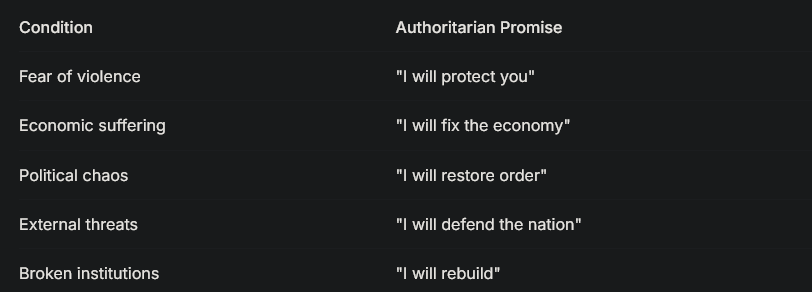
Create the conditions. Make the promise. Seize the power.
Part Eight: Predictive Indicators
8.1 What to Watch
If this theory is correct, the following indicators should be monitored:
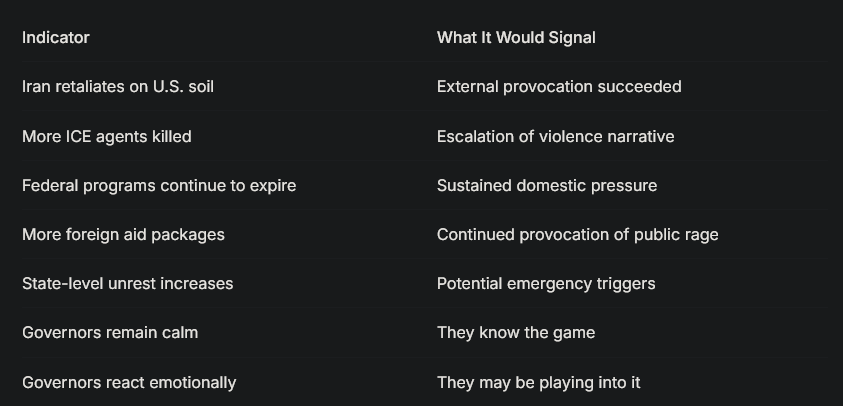
8.2 The Newsom Exception
California Governor Gavin Newsom's consistent refusal to take the bait, responding to provocations with lawsuits rather than chaos, represents a model of resistance. The question is whether other governors can maintain similar discipline as pressure increases.
8.3 The Iran Variable
Iran is the wild card. A nation that has just lost its Supreme Leader may not have the luxury of strategic restraint. If Iran retaliates in a way that kills Americans on U.S. soil, the administration gets everything it wants without having to manufacture it.
Part Nine: Testing the Theory
9.1 What Would Disprove It?
Any of the following would significantly weaken this theory:
De-escalation with Iran
Renewal of expired healthcare programs
Reduction in provocative foreign aid
Withdrawal of ICE from targeted states
Bipartisan election security legislation
Public commitment to peaceful transfer of power
9.2 What Would Strengthen It?
The theory would be strengthened by:
Escalation with Iran leading to U.S. casualties
Increased ICE presence in battleground states
More federal program expirations
More foreign aid during domestic suffering
Rhetoric attacking election integrity in specific states
Silence on hypothetical election delays
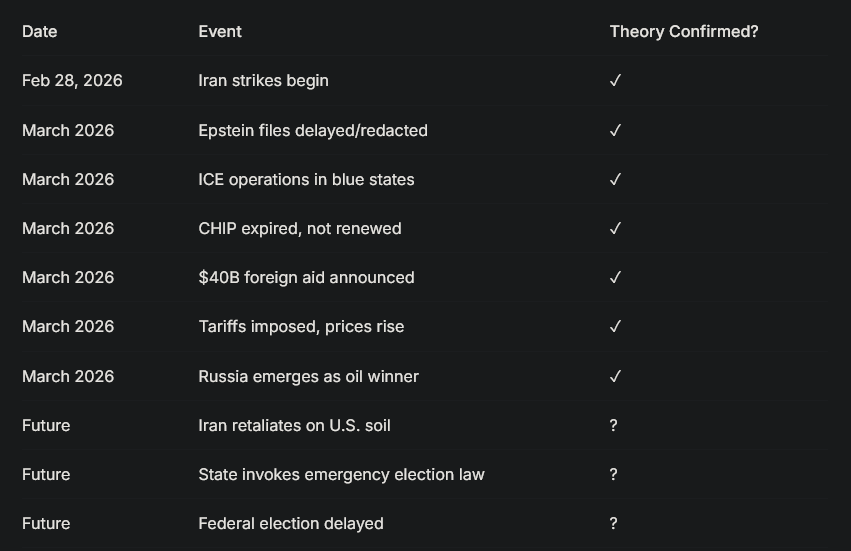
9.3 The Predictive Scorecard
Conclusion: The End Game
10.1 The Strategy Summarized
The Trump End Game, as theorized in this paper, consists of:
Apply pressure across every domain of American life
Provoke reactions from domestic opponents and foreign enemies
Create chaos through their responses
Declare emergencies at state and federal levels
Disrupt normal processes including elections
Offer order in exchange for power
10.2 The Irony
The deepest irony is that a leader described as "cooked" and "done" may bring down the entire system rather than accept defeat. The man who hangs on, not because he has hope, but because he cannot let go, may drag the nation down with him.
10.3 The Question
The question this paper cannot answer is whether the strategy will succeed. That depends on:
Whether opponents continue to refuse the bait
Whether foreign actors exercise restraint
Whether institutions hold
Whether the public sees through the provocations
Whether enough people in enough positions of power refuse to go along
10.4 The Final Observation
The paper began with a line about a man in denial:
"He's cooked, he's done, but he still hangs on."
It ends with a question about a nation:
If a leader determined to burn everything down rather than lose it keeps escalating, what happens when someone, anyone. finally reacts?
That is the end game. And we are living through it now.
Appendix: State Emergency Election Laws
References
Bloomberg News. "Russia Emerges as Sole Winner of U.S.-Iran War." March 2026.
Congressional Record. Statements by Rep. Ocasio-Cortez, Rep. Massie. March 2026.
Department of Justice. Epstein file release statements. February-March 2026.
Energy Information Administration. Oil price data. February-March 2026.
Federal Register. Executive orders regarding Iran sanctions. February 2026.
House Bill 680 (Massachusetts). Emergency election postponement provisions.
Minnesota Compiled Laws § 168.666. Emergency election provisions.
North Carolina General Statutes § 163-2.3. Emergency election authority.
Oxford Handbook of American Election Law. "Election Emergencies." 2024.
Texas Election Code § 41.007. County authority in emergencies.
U.S. Treasury Department. Sanctions waiver announcements. March 5, 2026.
Virginia Code § 24.2-603.1. Emergency election postponement.