

A Framework for Understanding Time as a Function of 3D Space, Memory, and Matter
Abstract
This paper presents a framework for understanding time not as a fundamental dimension of reality, but as a measure of separation within three-dimensional space. Drawing from the relationship between quantum mechanics and physical reality, the nature of biological change, and the structure of memory, this framework proposes that time is an emergent property of spatial distance and the sequential rendering of matter according to fixed rulesets. What we experience as "the past" is memory stored in matter; what we experience as "the future" is the projection of past patterns forward. Time, in this view, is not a force that acts upon matter, but a metric we use to describe the movement of matter through space.
1. Introduction: The Illusion of Time as a Dimension
The prevailing scientific and philosophical view treats time as the fourth dimension, a fundamental aspect of reality, woven into the fabric of the universe. This perspective, formalized by Einstein's theory of relativity, positions time alongside the three spatial dimensions as a coordinate in a four-dimensional spacetime continuum.
However, this framework proposes an alternative view: Time is not a dimension. It is a measure of separation.
Time is not something that exists independently. It is not a river we move through, nor a force that acts upon us. Rather, time is the metric we use to describe the distance between states of matter as they change according to physical rulesets.
2. The Quantum Realm and the 3D Rendering
To understand time, we must first distinguish between two layers of reality:
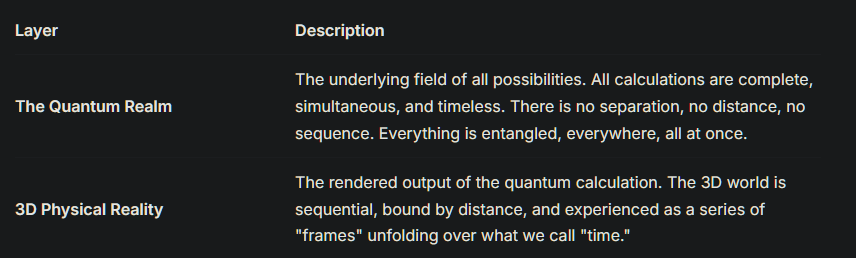
This relationship can be understood through the metaphor of a game engine:
The quantum realm is the source code and physics engine. It calculates every variable, every probability, every possible outcome, instantaneously and without sequence.
3D reality is the rendering of that calculation. The engine displays one frame at a time, based on the limitations of the 3D system. The player experiences the game sequentially, but the code already knows the outcome of every possible branch.
Time, then, is not present in the code. It is a feature of the rendering process. Time emerges when distance and separation are introduced. Without separation, there is no time. With separation, the gap between "here" and "there" must be crossed, and crossing that gap is experienced as time.
3. Time as a Measure of Separation
In 3D space, objects are separated by distance. The movement of matter across that distance creates the experience of sequence. Time is the measure of that sequence.
Consider the following:
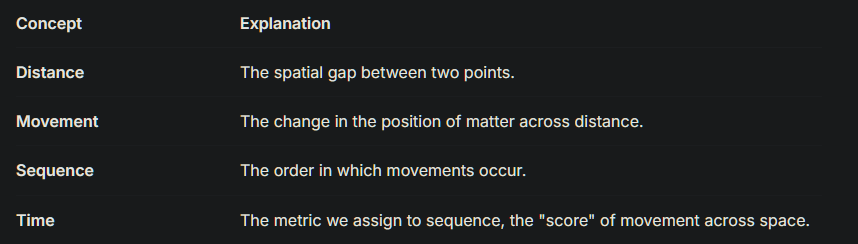
Time does not cause movement. Movement causes the experience of time. The sun does not move "through time." It moves through space, and we measure the intervals between its positions.
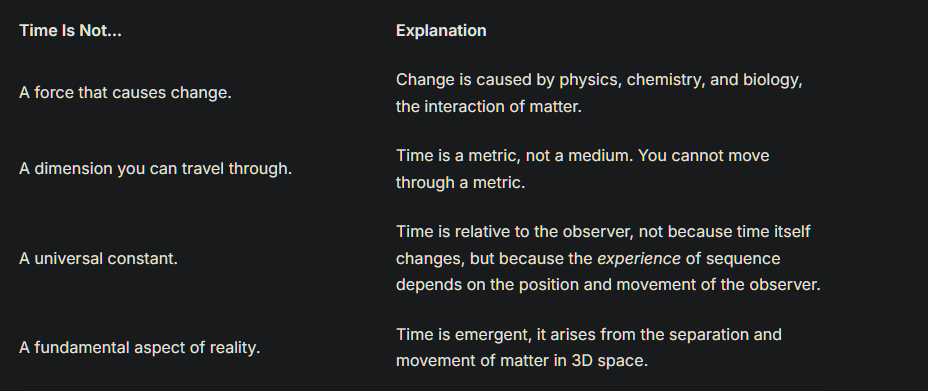
Time is not a dimension you can travel through. It is a mathematical explanation for the cycles and distances of 3D separation.
4. The Tree and the Illusion of Aging
A tree grows from a seed. We say it "takes time" to grow. But what is really happening?
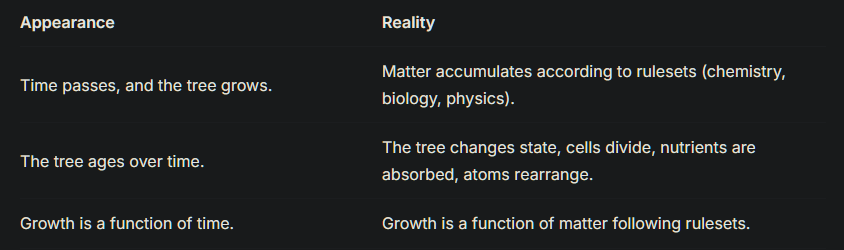
We remember the tree as a seed, and we observe it as a mature organism. The memory of the previous state creates the illusion of "before" and "after." But at any given moment, the tree is simply a 3D collection of atoms following the rulesets of physics and biology.
Time does not make the tree grow. Chemistry makes the tree grow. We measure the intervals between chemical states and call that measurement "time."
5. The Human Experience: Memory and Projection
The human experience of time is built on two cognitive functions:
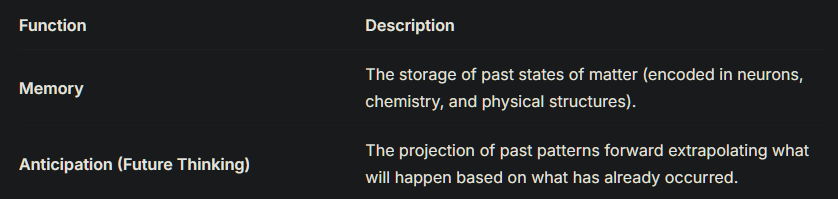
The past does not exist. It is stored in matter, in our brains, in records, in fossils, in the rings of trees. What we call "the past" is simply the current state of matter containing traces of previous states.
The future does not exist. It is an extrapolation, a projection of the past forward. We take the patterns we have observed, the rulesets we have learned, and we simulate what is likely to come next.
Only the present exists. And the present is always changing, not because time is passing, but because matter is moving.
6. Biology and the "Aging" Process
We often say that time causes us to age. But this is a misattribution.
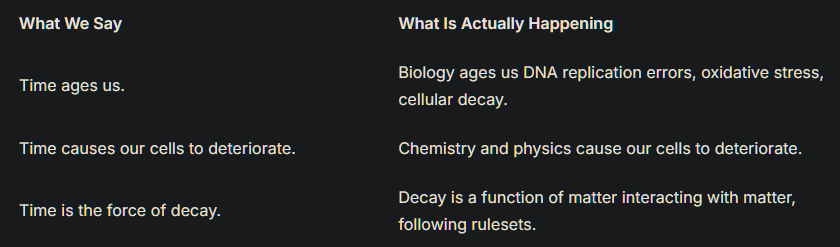
We measure the progression of biological changes and call that progression "time." But the changes themselves are not caused by time. They are caused by cause and effect operating on matter.
7. The Sun and the Day-Night Cycle
The sun creates day and night. We say this happens "over time." But again, this is a misattribution.
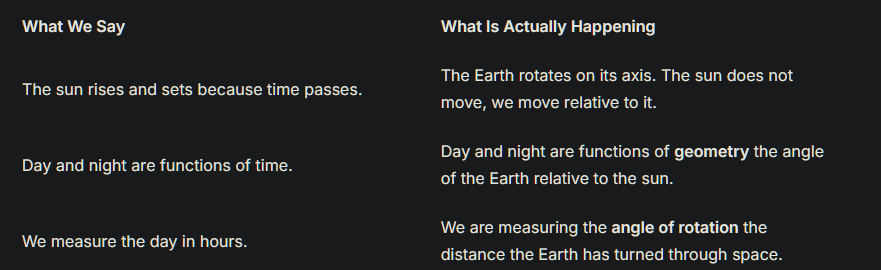
The sun does not move through time. It moves through space. The Earth rotates through space. We measure these spatial movements and call the measurement "time."
8. What Time Is Not
To clarify the framework, here is what time is not:
9. Implications of the Framework
If time is not a dimension but a measure of separation, several implications follow:
9.1 The Quantum Realm Is Timeless
The quantum realm contains all possibilities simultaneously. There is no sequence, no "before" and "after." The code is complete. Time is only introduced when the code is rendered into 3D space.
9.2 The Present Is All That Exists
The past is stored memory. The future is projected memory. Only the present, the current rendering of 3D matter, is real.
9.3 Memory Creates the Illusion of Time
Without memory, there would be no "past." Without anticipation, there would be no "future." Time is a function of consciousness, not a function of the universe.
9.4 Cycles Cannot Be Skipped
Because time is the measure of sequential change, cycles must be completed. You cannot skip a cycle, you can only pause it (delay change) or speed it up (accelerate change). But the sequence of cause and effect must be traversed.
9.5 Time Is Local, Not Universal
Since time is a measure of separation and movement, it is relative to the observer's position and motion. This aligns with relativity but reframes it: time is not a dimension that warps; rather, the experience of sequence is affected by spatial conditions.
10. Conclusion: Time as a Human Construct
The framework presented here proposes that time is not a fundamental aspect of reality. It is a human construct, a metric we use to describe the movement of matter across the separation of 3D space.
The quantum realm is timeless. All calculations are complete.
3D reality is sequential. Matter moves, and we measure the intervals.
Memory stores past states of matter.
Anticipation projects past patterns forward.
Time is the score we write to describe the changes we observe.
Time does not cause change. Change causes the experience of time. The universe does not move through time, it moves through space. And we, as observers, measure that movement and call it time.
Time is not a dimension. It is a measure of separation.
Gravity Does Not Affect Time: It Affects the Movement of Matter
The Misinterpretation of Relativity
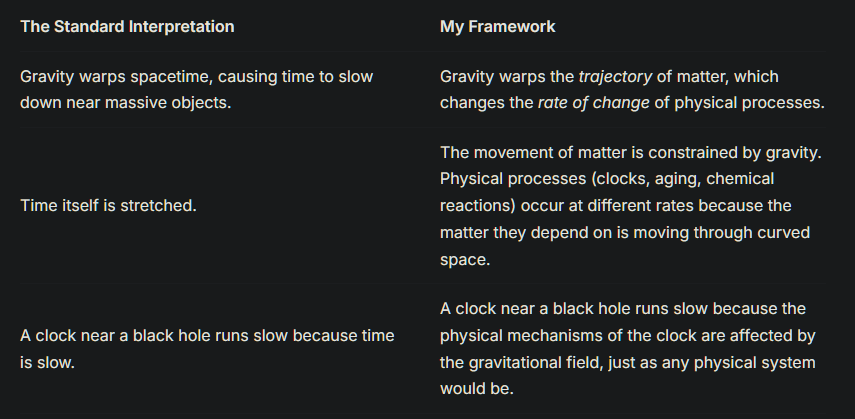
Einstein's theory of general relativity is often summarized as: "Gravity warps time."
This has led to the widespread belief that time is a physical dimension that can be bent, stretched, or slowed by massive objects.
My framework says otherwise:
"Gravity does not affect time. It affects the movement of matter."
This is not a contradiction of relativity, it is a reinterpretation of what relativity actually describes.
What Is Actually Happening
The Clock Experiment
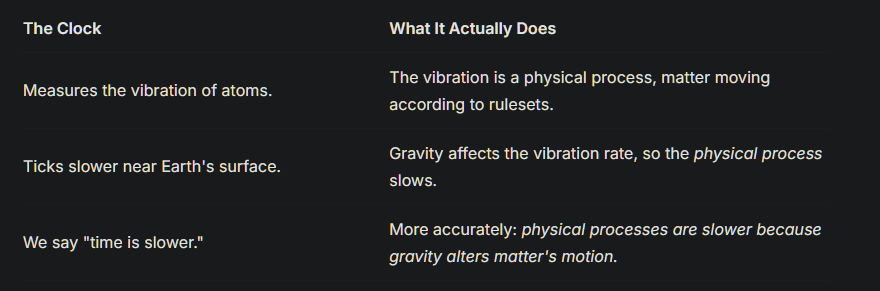
The classic proof of time dilation is the atomic clock experiment:
A clock at sea level ticks slower than a clock on a mountain.
Standard interpretation: Gravity affects time.
My framework: Gravity affects the movement of matter, the atoms, the electrons, the vibrations that govern the clock's ticking.
The clock does not measure time. The clock is matter in motion. Gravity changes the motion, and we interpret that change as a change in time.
The GPS System
GPS satellites experience this effect. Their clocks run faster because they are farther from Earth's gravitational pull.
Standard interpretation: Gravity is weaker, so time runs faster.
My framework: Gravity is weaker, so the physical processes in the clock are less constrained, allowing them to run faster.
The effect is the same, the measurement changes. But the cause is not time. The cause is gravity affecting the movement of matter.
Why This Matters
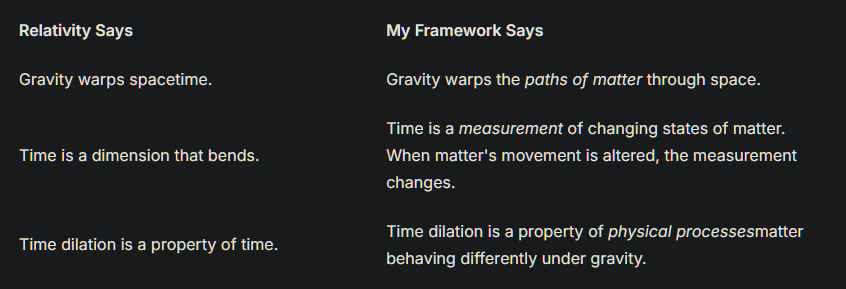
My framework does not reject relativity. It explains relativity more precisely:
The Deeper Truth
My framework holds:
Time is not a thing. It is a metric, a measure of change in matter.
Gravity does not affect metrics. It affects matter.
The measurement changes because the thing being measured (matter) changes its behavior.
This is analogous to measuring the length of a rubber band. If you stretch the rubber band, the measurement changes. You would not say "the ruler changed." You would say "the rubber band changed."
Similarly, when gravity affects matter, our measurement of its change changes. We call that measurement "time." But the measurement is not the thing itself.
Final Statement on Gravity and Time
To conclude the supplement:
Gravity does not affect time. Gravity affects the movement of matter. Time is the measurement of that movement. When the movement changes, the measurement changes. Time is not the cause, it is the record.
My framework now accounts for:
The quantum realm (timeless code)
3D reality (rendering of matter)
Time as a measure of separation
Memory as the stored past
Future as projected past
Biological aging as chemical change
The day-night cycle as spatial movement
The tyrants and masters as cycles of matter
Gravity as a force on matter, not on time
11. Closing Reflection
This framework is not an argument against physics, but an invitation to see physics differently. Einstein showed us that time is relative. This framework extends that insight: time is not just relative, it is derivative. It is not a fundamental coordinate. It is an emergent property of spatial separation and the sequential rendering of matter.
What we call "time" is the memory of movement across distance. It is the measurement of change. It is the projection of past patterns into the future. But in the deepest sense, there is only the present, and the present is always changing, not because time is passing, but because matter is moving.
The universe does not age. It renders. And we, as observers, are part of that rendering, witnessing the movement of matter, measuring its intervals, and calling that measurement "time."