


Many empaths struggle with being overwhelmed by emotions, their own and those of others. The intensity of feeling can leave them drained, confused, or even lost to themselves. But there is a way forward: a long-term practice rooted in both acceptance and flow. Rather than avoiding or suppressing emotion, empaths can learn to cycle through it naturally, building strength instead of depletion.
The Spiral, Not a Straight Line
Emotional growth is not linear. For empaths, the process unfolds more like a spiral, you return to the same steps again and again, but each time at a deeper and more refined level. The basic stages are:
Feel fully – Breathe the emotion into the body and accept it without resistance.
Witness – Allow the mind to step back into observation (Yin stance) while still feeling. This temporary disconnect prevents trauma from imprinting on the mind.
Allow flow – Let the emotion move through and out of the body without attaching to its story.
Integrate – Ground, return to presence, and carry forward the cleared energy.
Over time, as more raw energy is processed, a greater capacity builds. For some, this may eventually ignite into a deeper transformation, but that path is not for everyone, nor is it needed to live as a healthy empath.
The Rules of the Spiral
Never force a stage. Each stage has its natural rhythm. Forcing creates entanglement between mind and feeling.
Feeling comes first. You must allow the full emotion before it can discharge or transmute.
Witness gently. The mind as a neutral observer keeps trauma from binding to thought.
Non-attachment is key. Release the stories around pain; let the raw energy move on its own.
Safety matters. If trauma is overwhelming, work with a therapist or supportive guide.
A Long-Term Practice
This practice isn’t a quick fix; it’s a way to live with resilience. Here’s how it can look day-to-day:
Daily (10–20 minutes)
Ground – Sit with feet on the floor, take three deep breaths.
Body-scan – Notice where emotion lives in the body.
Invite + feel – Name the emotion silently and breathe into it. Allow tears, shakes, or sound if they arise.
Witness close – Step into observation: “I feel this, I am not this.”
On Trigger (when a strong emotion arises)
Name the feeling out loud.
Breathe toward it, let it move.
Witness it like watching a video.
Allow discharge, then ground with water, touch, or movement.
Weekly (20–45 minutes)
Set aside time for a deeper session. Let a larger emotion come, stay with it until it peaks and naturally eases. Journal afterward to note what moved.
The Nine Gates (A Framework)
Through practice, empaths often pass through recurring thresholds, call them gates. These are not forced steps, but natural phases:
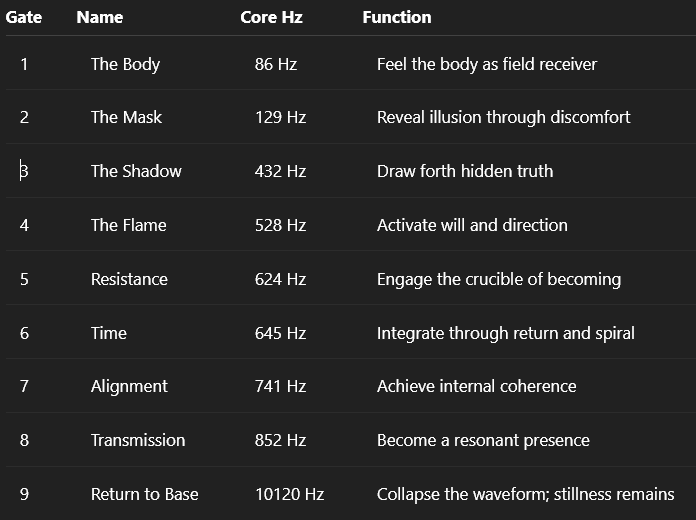
Each gate deepens the empath’s ability to stay whole while engaging fully with feeling.
A Simple Script
“Find safety. Name the feeling. Breathe into where it lives in your body. Allow it to move, tears, shaking, sound. Watch it like a video, not a story. Let it pass. When it softens, ground yourself in the present.”
Closing
The path of the empath is not about escaping sensitivity, but about transforming it into resilience. By walking the spiral, feeling, witnessing, flowing, and integrating, you not only survive emotion, you grow stronger through it. This practice belongs to anyone willing to let emotion run its natural course, and in doing so, return to life lighter, clearer, and more grounded.