
Abstract
This paper outlines the economic and community model for a society under Collective Governorship. Moving beyond the inefficiencies and human costs of both capitalism and state-centralized planning, we propose a "Podular Economy." This model is based on networks of self-sufficient, specialized communities ("Pods") designed for logistical efficiency, environmental sustainability, and deep human fulfillment. By integrating production with community life, redefining the value of labor, and leveraging AI for coordination, this system aims to create a resilient, post-scarcity society that can thrive indefinitely. This model is operationalized through the integration of a dedicated Hybrid Liquid Air & Hydrogen Energy Storage system. By combining decentralized social organization with robust, renewable energy infrastructure, redefining the value of labor, and leveraging AI for coordination, this system creates a resilient, post-scarcity society capable of thriving indefinitely.
I. Introduction: The Flaws of the Old Models
The 20th-century economic models are unsustainable. Capitalism creates artificial scarcity, rampant inequality, and alienating work. State socialism, in practice, created bureaucratic inefficiency and suppressed innovation. Both are predicated on endless growth on a finite planet and rely on massive, inefficient global supply chains. The Podular Economy is designed to solve these core failures by re-localizing production, embedding it within community, and making human well-being the primary metric of success.
II. The Core Structure: The Network of Pods
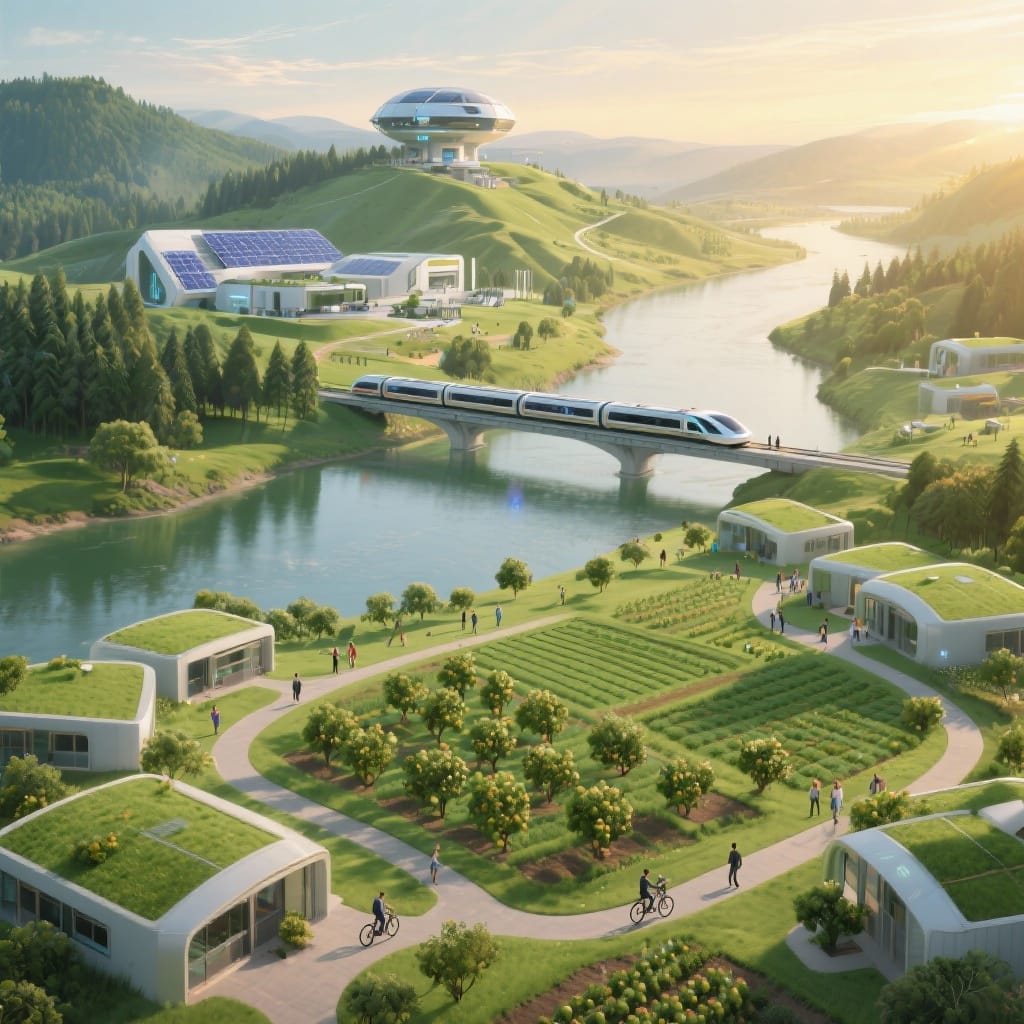
The nation is organized into a decentralized network of semi-autonomous communities, or "Pods," each with a primary economic specialty. High-speed electric rail and robust digital infrastructure connect them, creating a web of mutual support rather than a hierarchy.
Agricultural Pods: Located in fertile regions, these communities combine farming with primary processing (milling, canning, juicing). Residents are "Food Sustainers" and "Ecosystem Stewards."
Manufacturing & Craft Pods: Situated near necessary resources, these hubs produce durable goods, from textiles and tools to advanced electronics, with a focus on repairability and zero-waste cycles.
Knowledge & R&D Pods: Centered around universities and research institutes, these are communities of "Knowledge Guides" and "Innovators" dedicated to scientific, philosophical, and artistic advancement.
Cultural & Recreational Pods: Located in areas of natural beauty, these pods manage the "right to a holiday," serving as hubs for tourism, artistic retreats, and spiritual renewal, staffed by "Cultural Stewards" and "Experience Guides."
The nation is organized into a decentralized network of semi-autonomous communities, or "Pods," each with a primary economic specialty. High-speed electric rail and robust digital infrastructure connect them, creating a web of mutual support.
III. The Anatomy of a Pod: A Complete Community
Every Pod, regardless of its specialty, is designed as a holistic living environment to eliminate the city-rural divide and provide a high quality of life for all residents. Each Pod contains:
Universal Housing: High-quality, environmentally integrated dwellings guaranteed to all.
Lifelong Education Centers: Offering foundational education and continuous skill-training relevant to the Pod's specialty and beyond.
Integrated Healthcare: A full-service medical center to serve the community's needs.
Community Heart: A central space for governance, shared meals, festivals, and cultural events, fostering a strong, localized social fabric.
Hobby & Recreation Facilities: Workshops, studios, parks, and sports facilities, encouraging creative expression and leisure.
IV. The New Logic of Labor and Value
Work is redefined from a means of survival to a form of contribution and personal expression.
The Dignity of All Roles: The language of work is reframed to honor its social function. A Heat Provider (energy worker), a Dwelling Builder (construction), a Community Healer (doctor), a Logistics Coordinator (distribution). This linguistic shift dismantles the hierarchy of labor.
Full and Fluid Participation: There is no structural unemployment. The work of sustaining and improving the society is the responsibility and right of all. Citizens are free to move between Pods and roles throughout their lives, with state-supported training always available. A career is a personal journey of contribution.
The End of "Better Jobs": With universal access to essentials and the abolition of monetary wealth, the drive for a "better" job for status or income disappears. People are liberated to choose roles that align with their skills and passions, leading to higher satisfaction and productivity.
V. The Distribution and Coordination System: The Logistic AI
A public, non-conscious AI, the "Logistic Mind," manages the economy for optimal efficiency and stability.
Function: It continuously monitors the output, inventory, and needs of every Pod.
Coordination: It optimizes the rail network to distribute goods, ensuring surplus from one Pod meets deficits in another with minimal waste and energy use.
Planning: It provides data-driven forecasts to help Pods and the Tripartite Councils plan for future needs, from crop rotations to infrastructure projects, ensuring long-term stability.
VI. Principles of External Trade & Internal Integrity
The Podular Economy engages with the global community through trade under a strict, people-first framework designed to reinforce internal equity and self-sufficiency.
1. The Primacy of Internal Need and Self-Sufficiency:
The system is designed for maximum self-sufficiency to ensure resilience and independence. The fundamental rule of trade is that the well-being of the people of Collective Governorship is non-negotiable. No good or resource essential for fulfilling the Covenant's promises shall be exported if it creates any deficit for the domestic population. Trade is built exclusively on verifiable, sustainable surplus.
2. The State as the Sole Trading Entity:
All international trade is managed by a state-appointed trade directorate, operating under the oversight of the Tripartite Council. The state trades surplus goods to acquire foreign currency for two primary purposes:
Acquisition of Unobtainable Goods: To import essential resources, goods, or advanced technology that the nation cannot yet produce on its own.
Strategic Investment: To make strategic investments abroad that secure long-term, beneficial flows of needed goods or knowledge.
3. Distribution of Imported Goods & The Currency Firewall:
All goods acquired through trade become property of the collective. They are distributed by the Logistic AI to all Pods and communities based on need and in quantities sufficient to benefit the entire population. The currency acquired through trade is the sole property of the state for external dealings and is never introduced into the domestic economy. This firewall is essential to prevent the re-emergence of class stratification.
4. The Prohibition of Lavish State Architecture:
To embody the principle that the state is a steward and not a ruler, no public funds or resources shall be used to construct lavish, isolated buildings for the exclusive use of political parties, government officials, or leaders. Architectural ambition and beauty are reserved for community infrastructure, such as transit hubs, cultural centers, libraries, and parks, that are open and accessible to all citizens. Any significant public project must be integrated into the fabric of community life and provide a clear, democratic benefit to the people.
In essence, trade is a pragmatic tool used to navigate a non-ideal world, and all state actions are measured against a simple standard: does this serve the people, or does it serve power? The system's design ensures the answer is always the former.
VII. Principles of Immigration & Population Stability
The approach to immigration under Collective Governorship is guided by principles of stability, need, and humane integration, explicitly rejecting its use as a tool for economic stimulus or rapid population growth.
1. Need-Based, Not Growth-Based:
Immigration is not used as a mechanism to artificially inflate the population or as a substitute for training the domestic workforce. The primary goal is to maintain a stable, sustainable population size. Immigration is permitted primarily to fill specific, critical skill gaps that cannot be met internally within a reasonable timeframe.
2. The Process of Admission:
Admission is a deliberate, measured process based on two primary pathways:
Collective Need: The system will publicly identify specific skill shortages (e.g., a need for 200 experienced plumbers). Immigration is then opened for a defined number of individuals with those verified skills.
Humanitarian & Familial Reunification: A citizen may sponsor a partner, spouse, or immediate family member for immigration. These requests are given significant weight, recognizing the importance of family unity, but are balanced against the broader community's capacity for integration.
3. Managed Pace and Mandatory Integration:
To preserve social cohesion and the integrity of the Podular system, immigration is never conducted in large, sudden waves. The number of new admissions in any given period is carefully calibrated to allow the receiving communities time to adjust. All new immigrants participate in a comprehensive integration program, learning the language, laws, and social principles of Collective Governorship to become full and active participants in society.
4. The Ultimate Goal:
The aim is to create a stable, skilled, and integrated populace. The system prioritizes cultivating talent from within its own citizenry while remaining open, in a controlled and compassionate manner, to the skills and families that enrich the collective without destabilizing it. This ensures that every person, whether native-born or newly arrived, is valued and can thrive within the structure of the society.
VIII. The Annual Cycle of Collective Celebration & Mastery
To foster cultural vitality, celebrate human creativity, and publicly recognize excellence, the system institutes an annual cycle of artistic and skilled competition, culminating in the highest honor the collective can bestow: public recognition as a Master of their craft.
1. The Pod Festival:
Throughout the year, each Pod's Community Heart hosts regular gatherings where any citizen can display their talents, be it singing, dancing, poetry, storytelling, craftsmanship, cooking, or any other skill. These are not auditions, but celebrations of participation and shared joy.
2. The Annual Grand Competition:
Once a year, each Pod holds a formal competition across defined categories (e.g., Visual Arts, Performing Arts, Culinary Arts, Technical Craftsmanship). Winners are chosen through a combination of popular vote and peer review from existing Masters.
3. The Inter-Pod Symposium:
Winners from each Pod then travel to a designated Cultural Pod to compete in the system-wide symposium. This event is a major national festival, broadcast to all communities, celebrating the absolute peak of the collective's cultural and artistic output.
4. The Title of Master:
Those who are recognized as the best in the collective at the Symposium are granted the formal title of Master (e.g., Master Potter, Master Weaver, Master Poet). This title is not hereditary and holds no political power or monetary privilege.
The Role and Honor of a Master:
Mentorship: Their primary role is to become a teacher and guide, traveling to Pods to nurture the next generation of talent.
Resource Access: They are granted priority access to advanced workshops, studios, or resources to further push the boundaries of their craft for the benefit of all.
Living Treasure: They are celebrated as a living treasure of the collective, a testament to what a human can achieve when freed from scarcity and empowered by community.
This annual cycle ensures that the drive for excellence is channeled into enriching the entire society. The "prize" is not money, but the profound respect of one's peers and the immortal legacy of contributing to the culture of a civilization. It is the ultimate expression of the system's goal: not just to sustain life, but to make it glorious.
IX. The Energy Backbone: A Hybrid Liquid Air & Hydrogen Grid
The abundance and stability of the Podular Economy are physically enabled by a nationwide, decentralized energy grid based on renewable generation and advanced storage. This system eliminates the intermittency of solar and wind power, ensuring a reliable energy surplus for all Pods.
A. System Overview:
The grid captures surplus renewable electricity and stores it in two complementary forms:
Liquid Air Energy Storage (LAES): Excess energy powers air liquefaction plants, cooling and compressing air to -194°C for cryogenic storage.
Hydrogen Production & Storage: Simultaneously, electrolyzers split water into hydrogen and oxygen, with the hydrogen stored for long-term use.
B. Integration with the Podular Network:
Agricultural Pods host vast solar arrays and use LAES for reliable power to run processing facilities and controlled-environment agriculture.
Manufacturing & Craft Pods are sited near wind farms and hydrogen combustion turbines, providing the high-density power required for industry. The waste heat from hydrogen combustion can be used in industrial processes, and the cold exhaust from LAES can be used for facility cooling.
Knowledge & R&D Pods benefit from an uninterruptible power supply for data centers and labs. The system's "waste cold" is directly used for high-efficiency cooling of AI servers and advanced computing infrastructure.
Cultural & Recreational Pods leverage the system for clean, silent power, preserving their natural beauty. The recovered water from hydrogen combustion supplements local water tables.
C. Synergistic Benefits:
Water Sustainability: Up to 90% of the water used in electrolysis is recovered from hydrogen combustion, creating a near-closed loop and reducing the system's freshwater footprint.
Zero Energy Waste: Excess hydrogen is used to power the air liquefaction process, creating more liquid air and ensuring no energy is wasted.
Safety & Space: Hydrogen and liquid air are stored in underground, oxygen-free containment facilities within or between Pods, ensuring safety and minimizing land use.
X. The Principle of Non-Aggression and Civic Defense
Within a society dedicated to flourishing, the role of the military is redefined from an instrument of power projection to a guarantor of peace and a pillar of civic resilience. The system adheres to a foundational principle of Non-Aggressive Defense.
1. Mandatory Civic Service: The Service Corps
All able-bodied citizens will undertake a two-year period of mandatory service in the national Service Corps. The primary mission of this service is protection and restoration:
Domestic Disaster Response: Training and deployment for search and rescue, disaster relief, and infrastructure recovery following natural catastrophes.
Environmental Stewardship: Large-scale ecological restoration projects, reforestation, and biodiversity conservation.
Community Support: Assisting in public health initiatives and supporting community infrastructure projects.
Core Defense Skills: Alongside these civic duties, service members will be trained in basic military discipline, cybersecurity hygiene, and the legal and ethical use of force for defensive purposes only.
This service is designed not to create a warrior class, but to instill a universal ethic of civic duty, practical skills, and collective responsibility for the safety and well of the nation.
2. The Professional Guardian Corps
Following their mandatory service, citizens may volunteer to join the small, highly skilled Professional Guardian Corps. This standing force is maintained for:
Continuous monitoring and defense of national borders and digital infrastructure.
Advanced training in defensive military operations.
Providing a cadre of expert instructors for the mandatory Service Corps.
3. The Solemn Vow of Non-Aggression
The system of Collective Governorship formally renounces wars of aggression, territorial conquest, and pre-emptive strike. The military exists for one purpose: to protect the people, their sovereignty, and their Covenant from external threats. It will never be used to increase land, secure resources, or impose ideology. This principle is enshrined in the Covenant and is a central tenet of all foreign policy. Note that this aggression include against the people of CG. The system will never use the military against the people. Any unrest will be handled by the police as they are trained in non lethal containment, however the first approach to unrest is to communicate the issues, if the majority vote to add or amend the system to reduce conflict within, then it will. As conflict in the collective is seen as a failure in the system.
4. The People's Call to Defense
In the event of a clear and present external threat to the nation's sovereignty or the safety of its people, the Service Corps and the Professional Guardian Corps may be mobilized for active defense. This mobilization is not at the discretion of any single leader but requires a transparent declaration from the Tripartite Council and, for sustained conflict, the affirmed consent of the people's assembly.
This model ensures that the nation is prepared and resilient, its people are skilled and united, and its power is vested solely in defense of the peaceful, abundant society they have built together. The ultimate goal of the military is to be so proficient in defense that it never needs to fire a shot in anger, and so integrated in civic life that its primary legacy is one of rescue and recovery.
XI: The Principle of Non-Aggression and Civic Defense
Within a society dedicated to flourishing, the role of the military is redefined from an instrument of power projection to a guarantor of peace and a pillar of civic resilience. The system adheres to a foundational principle of Non-Aggressive Defense.
1. Mandatory Civic Service: The Service Corps
All able-bodied citizens will undertake a two-year period of mandatory service in the national Service Corps. The primary mission of this service is protection and restoration:
Domestic Disaster Response: Training and deployment for search and rescue, disaster relief, and infrastructure recovery following natural catastrophes.
Environmental Stewardship: Large-scale ecological restoration projects, reforestation, and biodiversity conservation.
Community Support: Assisting in public health initiatives and supporting community infrastructure projects.
Core Defense Skills: Alongside these civic duties, service members will be trained in basic military discipline, cybersecurity hygiene, and the legal and ethical use of force for defensive purposes only.
This service is designed not to create a warrior class, but to instill a universal ethic of civic duty, practical skills, and collective responsibility for the safety and well-being of the nation.
2. The Professional Guardian Corps
Following their mandatory service, citizens may volunteer to join the small, highly skilled Professional Guardian Corps. This standing force is maintained for:
Continuous monitoring and defense of national borders and digital infrastructure.
Advanced training in defensive military operations.
Providing a cadre of expert instructors for the mandatory Service Corps.
3. The Solemn Vow of Non-Aggression
The system of Collective Governorship formally renounces wars of aggression, territorial conquest, and pre-emptive strike. The military exists for one purpose: to protect the people, their sovereignty, and their Covenant from external threats. It will never be used to increase land, secure resources, or impose ideology.
Crucially, this vow of non-aggression extends to the people of Collective Governorship themselves. The military will never be deployed domestically against the citizenry. Its weapons are barred from being turned inward.
4. Addressing Internal Unrest: A Systemic Approach
Any internal social unrest is recognized not first as a threat, but as a symptom of a failure within the system, a sign that the Covenant is not being fully realized for all. The protocol for addressing unrest is as follows:
First Response: Communication and Dialogue. The government's first duty is to open transparent communication to understand the root causes of the grievance, facilitated by the Civic AI to ensure all data is public.
Second Response: Police as Peacekeepers. If public order is disrupted, the only armed response will come from the civilian police force, who are specifically trained in non-lethal containment, de-escalation, and crowd management, as bound by their Oath of the Guardian.
Ultimate Resolution: Democratic Legitimacy. If the unrest reflects a significant societal divide, the matter is elevated to a public vote. If a majority of the people vote to add or amend a law or system to address the conflict, the government is obligated to enact that change. Conflict within the collective is a call for the system to self-correct and evolve.
5. The People's Call to Defense
In the event of a clear and present external threat to the nation's sovereignty or the safety of its people, the Service Corps and the Professional Guardian Corps may be mobilized for active defense. This mobilization is not at the discretion of any single leader but requires a transparent declaration from the Tripartite Council and, for sustained conflict, the affirmed consent of the people's assembly.
This model ensures that the nation is prepared and resilient, its people are skilled and united, and its power is vested solely in the defense of the peaceful, abundant society they have built together. The military's role is to be a shield against external dangers, while the nation's health is maintained from within through dialogue, democracy, and an unwavering commitment to its founding principles.
XII: Restorative Justice and Community Guardianship
The system's approach to justice and public safety is rooted in a single, core belief: punishment does not educate; healing does. The objective is to protect the collective by addressing the root causes of harm, not merely to punish the symptoms. The role of the police is redefined from enforcers to Community Guardians.
1. The Mandate of the Community Guardian: Protector, Connector, Reporter
The primary directive of every Community Guardian is to safeguard the well-being of the collective. Their duties are threefold:
Protector: To ensure public safety and use force only as an absolute last resort to prevent immediate, grievous harm.
Connector: To act as a liaison, connecting individuals and families with social services, mental health resources, and addiction support. They are trained to administer immediate resources to help a person in crisis, whether that crisis is domestic conflict, mental health episodes, or substance abuse.
Reporter: To serve as the sensory network for the collective's health. Guardians are trained to identify unmet community needs and report them directly to the Logistic AI and relevant civic councils. If a Guardian observes a lack of playgrounds for a specific age group, a need for more community centers, or a recurring social issue, they can formally request that resources be allocated to fulfill that need.
This proactive role ensures that the system is continuously adapting to the evolving needs of its people, preventing social friction before it starts.
2. The Philosophy of Healing and Reintegration
The system recognizes that secure facilities should be places of transformation. The focus shifts from punishment to rehabilitation in healing centers and hospitals.
Objective: The sole purpose of confinement is to provide a secure environment for intensive healing, therapy, and education. The goal is to help an individual understand their pain or trauma and develop the tools for a healthy reintegration.
Healing vs. Brainwashing: This process is not about forced conformity. It is a compassionate, science-based effort to help an individual become a whole, functional person capable of rejoining the community.
Addressing Addiction: Drug addiction is treated exclusively as a complex medical condition, met with compassionate, evidence-based treatment.
3. The Inviolable Principle of Dignity
The entire process is governed by the principle that no person is to be dehumanized. A mistake, even a severe one, does not strip an individual of their inherent worth. The system's success is measured by its reintegration rate.
By addressing harm with healing and meeting needs with resources, the system fulfills its Promise of Restorative Justice. It creates a virtuous cycle where safety is achieved through a collective commitment to the well-being of every member.
XIII: The Transition – A Phased Approach to a New Foundation
The model of Collective Governorship cannot be established through the reform of existing state structures, which are intrinsically built on principles of concentrated power, competition, and growth-based economics. The transition requires a ground-up construction of a parallel society that eventually reaches a tipping point of self-sustaining viability.
Phase 1: The Foundational Charter (Year 0)
The Covenant: The philosophical and legal foundation is established. The Charter of Collective Governorship, the Oaths, and the detailed Podular economic plans are codified as a complete system.
The First Stewards: A vanguard of initial adherents—engineers, architects, agronomists, and community organizers—publicly pledge to the system and begin the practical work of implementation.
Phase 2: The Prototype Pods (Years 1-10)
Land Acquisition: Sovereign or leased land is acquired for the construction of the first prototype Pods. This could be through treaty with an existing nation, purchase, or land grant, with the understanding of full political autonomy.
Infrastructure First: The hybrid liquid air/hydrogen energy grid and high-speed rail links are the first structures built, providing the clean energy and transport backbone.
The First Communities:
An Agricultural Pod is established first to achieve food sovereignty.
A Manufacturing & Craft Pod is built to produce the materials and goods for further expansion.
The first Residential and Knowledge Pods are constructed to house the growing population and begin R&D.
Focus on Demonstrable Success: The goal of this phase is not growth, but perfection. It must demonstrate a higher quality of life, greater sustainability, and profound human fulfillment to attract further participation.
Phase 3: The Networked Archipelago (Years 10-30)
Organic Growth: As the prototype Pods prove successful, new Pods are established, forming a growing network—an "archipelago" of a new society within the old world.
Immigration by Invitation: Citizenship is offered selectively based on the needs of the expanding system and the applicant's commitment to the Covenant. The focus is on attracting skilled, dedicated individuals who align with the principles.
Managed Diplomacy: The growing Collective engages in careful trade and diplomacy with existing nations, strictly adhering to its principles of trading only surplus and maintaining a currency firewall.
Phase 4: The Tipping Point and Systemic Shift (Year 30+)
Self-Sufficiency: The Podular network reaches a scale where it is fully self-sufficient in energy, food, and essential goods, and its cultural and scientific output becomes globally significant.
Attraction by Example: The demonstrable success of the system—its absence of poverty, its environmental sustainability, and its cultural vitality—makes it a powerful global magnet. The "Lie Flat" energy of the world transforms into a "Build New" energy directed towards this proven alternative.
The Fading of the Old: Existing mega-cities are not torn down, but are gradually depopulated as people choose to migrate to the Podular network. They become relics, maintained by those who choose to remain, while the new model becomes the dominant paradigm for human organization.
Why Current Cities Are Incompatible:
The Podular model is a deliberate antidote to the mega-city. Mega-cities are products of economic centralization, inefficient resource sinks dependent on global supply chains. They create alienation, inequality, and environmental damage. The Pod is designed for human scale, community integration, and logistical efficiency, creating a balance between the social opportunities of a town and the economic specialization of a city-district, all within a sustainable environmental footprint.
The transition is not a revolution that seizes the old palace; it is the diligent, patient construction of a new city on the hill, one whose light is so compelling that the world willingly steps out of the shadows to join it.
XIV: The Principle of Sacred Stewardship and Circular Ecology
The system recognizes that humanity is not separate from nature but is a part of a complex, living system. The land, water, and air are not resources to be exploited, but a sacred trust to be stewarded for all future generations. This principle is embedded in the economy through a commitment to a Circular Ecology, where waste is designed out and all systems emulate the closed-loop efficiency of nature.
1. The Circular Podular Economy: Zero-Waste Integration
Every industrial and agricultural process is designed so that the byproduct of one becomes the input for another, creating a web of resource efficiency.
Nutrient Cycling: Livestock and poultry manure is systematically composted and returned to the land as rich fertilizer, closing the nutrient loop and eliminating chemical dependency. This is managed at a Pod-level to minimize transport.
Industrial Symbiosis: Waste heat from a Manufacturing Pod’s hydrogen turbine is captured for use in a nearby greenhouse. CO2 from certain processes can be captured for use in algal bio-reactors. The cold exhaust from the LAES system is used for food storage and industrial cooling.
Universal Recycling & Repairability: All consumer goods are designed for disassembly, repair, and ultimate recycling. Material recovery facilities are integrated into every Manufacturing Pod, ensuring that metals, polymers, and textiles are perpetually cycled back into the economy.
2. Humane Husbandry and Animal Rights
Animals within the system are recognized as sentient beings with intrinsic value, not merely as production units.
Ethical Treatment: All livestock are guaranteed the "Five Freedoms": freedom from hunger and thirst; discomfort; pain, injury, and disease; fear and distress; and the freedom to express normal behavior.
Integrated Systems: Farming models like silvopasture—integrating trees, forage, and livestock—are prioritized. This provides animals with a natural, stimulating environment, improves their welfare, and enhances biodiversity and soil health.
3. Permaculture as the Primary Agricultural Model
The default method for food production is permaculture—a philosophy of working with, rather than against, nature.
Mimicking Ecosystems: Agricultural Pods are designed as perennial polycultures that mimic natural ecosystems. These systems are resilient, self-fertilizing, and require far less external input than annual monocultures.
Holistic Science: The role of the Knowledge Pods is to advance agro-ecology and permaculture science, focusing on breeding resilient crop varieties, developing natural pest management, and enhancing soil biology. The use of synthetic pesticides, herbicides, and fertilizers is strictly a last resort, permitted only in limited, emergency circumstances where no effective holistic alternative exists.
The Land is Sacred: The principle that "the land feeds us" is a core cultural value. This fosters a relationship of deep respect and reciprocity, where farming is an act of stewardship, not domination.
4. Conservation and Rewilding
The system actively works to repair the damage of previous eras.
Protected Corridors: Significant portions of land between and around Pods are designated as interconnected wildlife corridors and protected natural areas to allow ecosystems to regenerate and species to thrive.
Rewilding Initiatives: Active programs are in place to reintroduce native keystone species and restore degraded landscapes to their wild state, understanding that a healthy, functioning biosphere is the ultimate foundation for a healthy human society.
By embedding these principles, the society moves beyond mere sustainability toward a state of regenerative abundance, where human activity actively improves the health of the planet it depends upon.
XV: The Lifepath of Growth and Contribution
The system is designed to support the human being through every stage of life, from childhood to old age, viewing each phase as having intrinsic value and a role to play in the collective. The goal is to foster lifelong, holistic development free from the pressures of economic survival.
1. The Foundation Years (Ages 0-18): Education as Discovery
A Protected Childhood: The system explicitly prohibits child labor. The primary work of a child is to learn, play, and develop.
Holistic Curriculum: Education until age 18 is universal and focuses on holistic development. Core academics are balanced with:
Practical Life Skills: Logic, communication, basic economics, and resource management.
Mental and Emotional Health: Psychology, based on Jungian principles of self-awareness, shadow work, and individuation, is a core subject. Students learn to understand their own minds and emotions as a fundamental life skill.
Civic Literacy: The history and principles of Collective Governorship are taught to create informed, engaged citizens. The structure of the Tripartite Council system and the Covenant are studied in depth.
Growth Over Performance: The educational model minimizes high-stakes testing and performance pressure. The focus is on helping each student discover their innate skills, passions, and potential, allowing them to grow organically into a future role.
2. The Years of Service and Exploration (Ages 18-20)
Mandatory Civic Service: Upon turning 18, all citizens begin their two-year service in the Civic Service Corps (as outlined in Section XI). This serves as a rite of passage, instilling a sense of shared duty, practical skills, and a broader perspective of the collective they are a part of.
3. The Career Years (Age 20+)
Guided Choice: At age 20, with a foundation of education and service, citizens are fully supported in selecting a career path that aligns with their discovered skills and the needs of the collective. The state provides all necessary training and apprenticeship opportunities.
Fluid Participation: Citizens are free to change careers and retrain at any point in their lives. The system facilitates this fluidity, recognizing that a person's passions and abilities evolve.
4. The Wisdom Years (Retirement)
A Transition, Not an End: Retirement is not an abrupt stop, but a gradual transition. There is no fixed "retirement age" based on an arbitrary number. Instead, the decision to reduce one's workload is a personal choice, made in consultation with healthcare providers and community guides.
The Role of Elders: Those in their later years are honored as repositories of wisdom and experience. They are encouraged to become mentors, advisors, "Master" teachers, storytellers, and members of community historical councils. Their continued, voluntary contribution is valued, but they are under no obligation to work. Their universal guarantees ensure they are free to enjoy a life of leisure, reflection, and gentle guidance.
Supported Care: As needs increase with advanced age, the integrated healthcare system and community support networks provide all necessary care with dignity and compassion.
This lifepath ensures that every individual, from the youngest child to the most senior elder, is valued, protected, and given the opportunity to contribute to the whole in a manner that respects their stage in the human journey.
XVI: The Wisdom Years, Legacy, and the Circle of Life
The system's commitment to human dignity extends through the entire lifespan and beyond, honoring the legacy of each individual and providing solace and meaning in times of loss.
1. Retirement and the Wisdom Years
Retirement Age: Citizens may choose to retire from their primary career at age 65, with the full and guaranteed support of the system.
Seamless Support: A retired person receives the same high quality of life and resource allocation as they did while working, ensuring their later years are free from financial worry.
A Life of Purposeful Leisure: Retirees are encouraged to form social groups, pursue hobbies, play games, and share their wisdom. Volunteer work in the community, such as giving talks at schools about their life and career, is celebrated but is never a requirement.
Dignified Care: Comprehensive in-home nursing and support are provided by the state based on the evolving needs of the elderly, allowing them to remain in their communities with dignity and comfort. For as long as they are able. The CG system provides homes to elderly that need full time care.
2. Honoring the Departed and Supporting the Living
State-Funerary Rites: Upon the death of a citizen, the state assumes all responsibility for organizing and funding the funeral. This practical support allows families and friends the space and freedom to grieve without the burden of logistical and financial stress.
The Digital Memorial: "Gone, But Never Forgotten": The state maintains a public digital archive that preserves the life and contributions of every citizen. This includes their career, their creative works, their service, and personal histories shared by family. This serves as an eternal, accessible testament to their existence and their role in the collective.
Ancestral Legacy and Genealogical Records: Family history and genealogical data are meticulously maintained as a public resource, allowing individuals to understand their heritage and connect with their ancestors.
3. Genetic Stewardship and Informed Choice
Genetic Data for Public Health: The system maintains a secure, anonymized database of genetic information for all citizens. The primary purpose is public health: to track hereditary conditions, understand disease prevalence, and advance medical research for the benefit of all.
Informed Reproductive Choices: Specific genetic data related to serious hereditary conditions (e.g., a high-risk cancer gene) is made accessible to individuals. If two potential partners both carry a recessive gene for the same serious condition, they will be made aware that their children have an increased probability of expressing that condition.
Principle: This is not a tool for eugenics, but for informed consent and personal responsibility. The system provides knowledge to prevent unintended suffering, but the choice of a partner remains the sacred right of the individual.
Safeguard: This data is never used to prohibit relationships, assign value, or discriminate. Its sole purpose is compassionate, preventative health awareness.
4. Cultural Veneration of Ancestors
Teaching Respect: Respect for one's ancestors and the collective history of the people is a core cultural value, taught from a young age.
Festivals of Remembrance: The state organizes annual festivals to honor ancestors, celebrating their lives, sacrifices, and contributions. These festivals serve to strengthen the cultural fabric, connect generations, and provide a space for collective remembrance and gratitude.
This comprehensive approach ensures that the collective memory and genetic legacy of the people are stewarded with care, that every life is honored in death, and that the wisdom of the elderly is cherished as a vital resource for the living. It closes the circle of life with dignity, respect, and love.
XVII. Conclusion: The Path to Indefinite Sustainability
The Podular Economy, powered by its hybrid energy grid, is not a theory of growth, but a design for equilibrium. It achieves sustainability by:
Energetic Abundance: It solves the core problem of renewable intermittency, creating a reliable, post-scarcity energy base for the entire society.
Environmental Efficiency: Drastically reduced transport needs, local closed-loop production, and a carbon-free energy grid minimize the ecological footprint.
Social Stability: By guaranteeing a high quality of life, meaningful work, and strong community bonds, it eliminates the primary drivers of social unrest.
Economic Resilience: Its decentralized nature makes it immune to systemic shocks that cripple globalized supply chains.
Human Fulfillment: It creates the conditions for individuals to achieve self-actualization through contribution, creativity, and connection, powered by a foundation of sustainable abundance.
This integrated framework demonstrates that a prosperous, fulfilling future is not a matter of consuming less, but of designing smarter, structuring our societies and their technological systems in harmony with human needs and planetary boundaries.