

Buying back debt bonds reduces the available market supply of those securities, which aims to drive up bond prices and lower their yields.
Key Effects of Bond Buybacks
Lower Yields (Intended): Removing bonds from circulation increases demand for the remaining supply, which can theoretically push down interest rates and borrowing costs.
Market Liquidity Support: Purchasing older or harder-to-trade bonds gives market dealers a predictable way to offload less active securities.
Cash Management: Issuers (such as the government) use buybacks to balance cash flows around large tax receipts or debt obligations.
Limited Overall Impact: Buybacks often have a minimal effect if broader economic pressures, like high inflation, deficits, or geopolitical conflict, drive up overall market yields.
When governments buy back their own debt securities, such as the U.S. Department of the Treasury repurchasing U.S. Treasuries, the process serves as a highly strategic fiscal tool. It differs significantly from a corporation buying back stock or a central bank conducting Quantitative Easing (QE).
The primary mechanics and shifting dynamics driving government bond buybacks are detailed below.

Mechanics of Government Bond Buybacks
Unlike central bank QE, which injects brand-new money into the economy to stimulate growth, a Treasury buyback is fiscally neutral. The government funds the buyback by issuing new debt, typically short-term Treasury bills (T-bills), to purchase older, long-term bonds. Effectively, they are swapping long-term debt for short-term debt.
┌────────────────────────────────────────────────────────┐
│               U.S. Treasury Department                 │
└─────────────────────────┬──────────────────────────────┘
                          │ (Funds the buyback)
                          ▼
            Issues Short-Term Debt (T-Bills)
                          │
                          ▼
           Buys Back Long-Term "Off-the-Run" Bonds
                          │
                          ▼
       Result: Improved Market Liquidity & Smoothed
                  Debt Maturity Schedules
Key Effects on the Bond Market
1. Targeting "Off-the-Run" Liquidity
The chief goal of an expanded buyback program is liquidity support. When the Treasury issues new bonds, they are highly liquid and heavily traded ("on-the-run"). As those bonds age, they get locked away in pension funds or foreign central bank reserves, becoming illiquid ("off-the-run"). By stepping in as a buyer of last resort for these older bonds, the Treasury helps financial institutions clear stalled inventory, tightening bid-ask spreads and stabilizing the market infrastructure.
2. Shifting the Yield Curve
By purchasing longer-dated bonds (like 10-year or 20-year notes) and issuing ultra-short T-bills, the Treasury adjusts the Weighted Average Maturity (WAM) of outstanding national debt.
Long-term bonds: Reduced supply places upward pressure on bond prices, which theoretically pushes long-term yields down.
Short-term T-bills: Increased supply can cause short-term yields to edge slightly higher.
3. Smoothing the Maturity Schedule
Governments use buybacks to prevent massive, volatile cliffs of debt from maturing all at once. By proactively buying back debt due in a few years, they can spread out cash redemption pressures over a more predictable timeline, making national interest payments easier to manage.
Real-World Limitations
While buybacks injection predictable demand into specific sectors, their actual power to force interest rates down is heavily constrained by larger macroeconomic factors:
The Scale In balance: The government may scale up buyback operations to numbers like $6 billion. However, when measured against a massive $32+ trillion U.S. Treasury market, these operations are structurally minor.
The Macro Target Overlap: Buybacks only address localized supply blocks. If the broader market is selling off bonds due to sticky inflation, high fiscal deficits, or geopolitical risk, long-term yields will continue to climb regardless of the buyback size. For instance, despite the Treasury expanding its long-end liquidity purchases, 10-year yields historically climbed back toward the 5% threshold due to fundamental economic pressures.
The ripple effects actually extend far beyond the bond market itself. While the direct mechanics start with bond prices and yields, changing the supply and demand of U.S. Treasuries acts like a stone thrown into a pond, creating waves across the entire global financial system.
Because U.S. Treasury yields serve as the "risk-free rate", the foundational benchmark used to price almost all global debt, changes in these yields dictate the cost of borrowing for everyone else.
The Broader Economic Ripple Effects
When a government buyback successfully lowers or stabilizes long-term Treasury yields, it triggers several critical shifts:
Consumer Loans and Mortgages Drop: Fixed-rate home mortgages, auto loans, and student loans are closely anchored to the 10-year Treasury yield. If buybacks prevent Treasury yields from spiking, they indirectly keep consumer borrowing costs lower than they otherwise would be.
Corporate Borrowing Costs Ease: Corporations price their corporate bonds at a premium (a "spread") above Treasury yields. Lower Treasury yields mean companies can issue debt more cheaply to fund expansions, hiring, or equipment purchases.
The Stock Market Gets a Boost: When bond yields fall, bonds become less attractive compared to stocks. Investors looking for higher returns move cash out of bonds and into equities, often driving stock prices up. Furthermore, lower borrowing costs improve corporate profit margins, which pleases stock investors.
Commercial Bank Lending Stabilises: By buying up older, illiquid "off-the-run" bonds from primary dealers (large banks), the government clears up the banks' balance sheets. This frees up bank capital, giving them more room to extend everyday credit and loans to businesses and households.
Direct Bond Market Impact: A Quick Summary
Point about bond sales, here is exactly how the supply and demand chain shifts:
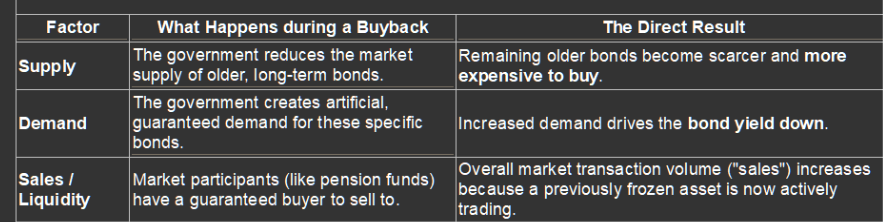
So while the government is only directly buying and selling bonds, the resulting shift in interest rates acts as a primary valve controlling the flow and cost of money throughout the entire global economy.
A sudden increase in bond buybacks is an explicit signal of market stress. However, the second part about it "reducing liquid cash" requires a subtle but important distinction regarding how the government actually funds these operations.
Here is exactly how the dynamics play out in the financial system:
Why It is a Sign of Economic Stress
When the Treasury steps in to dramatically increase buybacks, such as the recent decision by U.S. Treasury Secretary Scott Bessent to ramp up operations to as much as $6 billion, it is a direct response to a "clogged" financial system.
It is triggered when global investors flee the bond market due to persistent economic pressures like high inflation or growing national deficits.
When everyone is trying to sell and nobody wants to buy older ("off-the-run") government debt, the Treasury acts as the buyer of last resort to prevent a total market freeze.
Does It Reduce Liquid Cash? (The Reality)
Surprisingly, a Treasury buyback does not reduce liquid cash in the broader economy. In fact, it does the exact opposite: it injects cash right where the market needs it most.
The operation is funded in a way that keeps the total cash supply neutral, but shifts where that cash is sitting:
 Treasury issues new T-Bills (Short-term debt)
       │
       ▼
 Absorbs cash from money market funds / corporate cash piles
       │
       ▼
 Treasury uses that cash to buy back old, illiquid long-term bonds
       │
       ▼
 Hands fresh, liquid cash directly to commercial bank balance sheets
For the Banking System (Net Positive Cash): Commercial banks are holding onto old, dusty long-term bonds that they can't easily sell on the open market. When the Treasury buys those back, it takes the illiquid bond and hands the bank cash. The banks now have highly liquid cash that they can use to issue consumer loans, back mortgages, or buy active securities.
For the Government (A Shift in Cash Reserves): The government pays for this by either issuing short-term Treasury bills (T-bills) or drawing down on its massive taxpayer deposit reserve at the Federal Reserve (the Treasury General Account). While this technically lowers the government's own immediate emergency "cushion", it actively frees up cash into the private financial sector where the stress is occurring.
Summary
It is a firefighting tool used during periods of high economic stress. However, instead of locking up cash, its goal is to act like financial WD-40, unlocking trapped capital from old bonds and turning it back into liquid cash so the banking system can keep flowing.
If buybacks only created "free liquid cash" and lowered borrowing costs with no downsides, every country would do it constantly to solve all their economic problems. But that is not how financial math works. There is a massive, structural negative cause-and-effect reality to these buybacks.
Here is the hidden cost and the negative math behind why governments cannot use this as a magic trick.
The Hard Math: It Doesn't Erase Debt, It Just Postpones It
When a government buys back an old bond, it does not destroy the debt. It has to get the cash to buy that bond from somewhere.
To buy back a $10 billion old bond, the Treasury must immediately issue $10 billion of new short-term debt (T-bills).
[Old, Hidden Debt] ──(Treasury Buyback)──> [New, Short-Term Debt]
                                                  │
                                                  ▼
                                      Must be paid back in
                                        3 to 12 months!
This creates three massive negative consequences:
1. The "Ticking Clock" Risk (Maturity Compression)
By swapping a 20-year bond for a 3-month T-bill, the government forces itself into a corner. Instead of having 20 years to figure out how to pay that money back, they now have to pay it back or refinance it in 90 days. If the economy worsens in those 90 days, the government faces a severe cash crunch.
2. Cannibalising the Short-Term Market
To get the cash for the buyback, the government floods the market with new short-term T-bills. Basic supply and demand applies here: by drastically increasing the supply of short-term bills, the government drives short-term interest rates UP. This hurts companies and banks that rely on short-term borrowing for daily operations.
3. It's an Expensive Band-Aid
The government is using taxpayers' money to pay a premium to buy back old bonds just to keep the financial system from locking up. It is a costly operational expense that diverts capital away from actual economic infrastructure (like roads, healthcare, or education) into Wall Street plumbing.
Why Doesn't Every Country Do It?
Most countries cannot do this. This mechanism only works for a very small, elite group of nations (like the U.S.) because of two strict requirements:
You need the Global Reserve Currency: The U.S. can pull this off because global investors have an insatiable, endless appetite for U.S. debt (T-bills).
The "Developing Nation" Trap: If a developing country tries to aggressively buy back its own long-term bonds by shifting its debt to the short term, international investors panic. They see it as a sign of imminent default, dump the country's currency, and trigger hyperinflation.
The Reality
A bond buyback is not an economic victory; it is an expensive, risky management tactic. The government is voluntarily shortening its own debt deadlines and risking higher short-term rates just to prevent a catastrophic freeze in the long-term bond market.
The "Credit Card" Trap and Its Effect on GDP
When a government constantly rolls over old debt into new debt at higher interest rates, it triggers a destructive economic chain reaction:
Government shifts debt to new "credit cards" with higher interest rates
       │
       ▼
National Interest Bill explodes (takes up a massive chunk of the budget)
       │
       ▼
Fiscal Crowding Out: Less tax money available for roads, tech, and education
       │
       ▼
Long-Term GDP Growth Slows Down (The economy loses its productive engine)
       │
       ▼
Tax Revenues Fall ──► Government must borrow EVEN MORE to cover the gap
1. It Starves the Productive Economy ("Fiscal Crowding Out")
Every dollar a government collects in taxes can only be spent once. When the national interest bill skyrockets, that money is effectively locked up. It goes directly to paying back bondholders (wealthy investors, institutions, and foreign nations) rather than being injected into things that actually grow the economy, such as:
Building new highways and public transport
Funding scientific research and technology
Improving healthcare and education
Because the government is forced to prioritize interest payments over these productive investments, long-term GDP growth naturally slows down.
2. The Danger of "Debt-to-GDP" Suffocation
Economists closely watch the ratio between a country's total debt and its GDP.
If GDP is growing at 2%, but the interest on the national debt is compounding at 4% or 5%, the debt is growing faster than the actual economy.
Eventually, the weight of the interest payments becomes so heavy that a country can no longer grow its way out of the problem. This is the exact moment the "credit card" analogy becomes a dangerous reality.
The Ultimate Real-World Consequence
When a government's funds are severely reduced by interest payments, they are left with only three painful choices to avoid defaulting on their "credit cards":
Austerity (Aggressive Cuts): They must aggressively slash public services and benefits, which hurts everyday citizens and slows down GDP even further.
Heavy Taxation: They must raise taxes on businesses and workers to collect more cash, which can crush consumer spending and stall economic growth.
Print the Difference: They rely on the central bank to print money to buy the debt, which directly devalues the currency and causes high inflation.
It does not erase the debt; it simply delays the pain, shifts the risk, and ultimately leaves the taxpayer footing a much larger bill that drags down the entire country's economic future.
History
The absolute textbook example of how the entire debt bond life cycle plays out using these mechanics is the post-World War II era (1945-1975) in the United States and the United Kingdom.
This period provides a perfect blueprint of how governments combined Monetary Expansion, Financial Repression, and subtle Austerity to completely melt down massive debt burdens without causing a total economic collapse, but at a massive hidden cost to everyday savers.
The Starting Point (1945): Peak Debt
By the end of WWII, both nations were drowning in war-bond debt.
The US debt-to-GDP ratio peaked at an unprecedented 106% in 1946.
The UK debt-to-GDP ratio was in an even more catastrophic state, towering over 250%.
The governments could not simply pay this back through normal taxation without crushing their post-war economies. Instead, they executed a coordinated, multi-decade debt destruction plan.
Phase 1: Capturing the Domestic Market (Financial Repression)
To prevent bond investors from fleeing, the US and UK governments effectively trapped capital inside their domestic borders using the following steps:
Capital Controls: They passed laws making it highly illegal or heavily taxed for regular citizens and domestic banks to move their money into foreign currencies or overseas investments.
The "Captive Audience": Governments forced domestic commercial banks and pension funds to hold a massive portion of their assets in local government bonds.
Interest Rate Caps: The US Federal Reserve and the Bank of England legally pegged interest rates at artificially ultra-low levels (e.g., capping short-term T-bill rates below 1% to 2%).
Phase 2: Burning the Debt (Inflation & Negative Real Rates)
Once the capital was trapped, the governments allowed inflation to surge. Because interest rates were legally capped, a brutal mathematical reality emerged: negative real interest rates.
  Average Post-War Inflation: ~4% to 5%
  Legally Capped Bond Yield:  ~1.5%
 ───────────────────────────────────────────
  Real Return for Investors:  -2.5% to -3.5% (Per Year)
Between 1945 and 1980, the average real return on a US Treasury bill was negative 1.94%. For three decades, anyone holding government bonds or keeping cash in a standard bank account lost purchasing power every single year. This acted as a massive, invisible wealth tax on the public.
Because the nominal size of the economy grew due to inflation while the face value of the debt bonds remained fixed, the debt footprint shrunk rapidly.
The End Result (1974)
By the mid-1970s, the plan had completely achieved its goals:
The US debt-to-GDP ratio plummeted from 106% down to a microscopic 23%.
The UK debt-to-GDP ratio fell from 250% to roughly 50%.
Recent economic studies, including comprehensive data from the International Monetary Fund (IMF), reveal that it wasn't pure "productivity" that saved the US and UK. Instead, over 60% of that massive debt reduction was fueled entirely by surprise inflation and financial repression.
The Catch: Why It is Harder to Pull Off Today
The post-war cycle ended cleanly because it took place in a closed, heavily regulated system. Today, replication is exceptionally difficult:
Globalised Capital: If a government tries to cap bond yields artificially low today, trillions of dollars can flee electronically to other countries in microseconds via digital asset markets.
The Backlash: In the late 1970s, bond investors eventually revolted against this dynamic. They became "bond vigilantes," demanding massive interest rates (pushing yields past 14% by 1981) to compensate for inflation, which completely broke the post-war financial repression model.
An absolute "reset" of government bonds combined with a forced shift to a Central Bank Digital Currency (CBDC) represents the ultimate economic wildcard. In financial history, "resetting" bonds is simply a polite term for a sovereign debt default, refusing to honor the original terms of the nation's credit card.
If a government wiped the slate clean on its bonds and simultaneously funneled the population into a digital currency, it would trigger a massive, historic restructuring of society's wealth.
The Immediate Fallout: The Wealth Wipeout
The most critical thing to understand is that government bonds are not just abstract papers held by the ultra-wealthy. They form the foundational bedrock of the global financial system.
If you "reset" (default on) those bonds, the following chain reaction occurs instantly:
The Banking System Collapses: Commercial banks hold government bonds as their primary safe asset to back your checking and savings accounts. Wiping out the bonds makes the banks instantly insolvent. Your local bank would close its doors overnight.
Pensions and Retirement Vanish: Pension funds and retirement accounts are legally mandated to hold massive amounts of government debt to pay out future retirees. A bond reset vaporizes the retirement security of millions of citizens.
The Sudden "Shift" to Digital Currency: Because the traditional banking system would be completely broken by the bond reset, the government would use this exact chaos to introduce the CBDC. They would position it as the emergency rescue package: "Your bank failed, but you can download this government app right now to claim your new digital dollars."
The Mechanics of the Digital Currency Shift
To make a digital currency transition work after destroying the bond market, the government would have to implement extreme, authoritarian measures:
Government Defaults on Bonds ──► Traditional Banking System Collapses
                                                │
                                                ▼
                                Government Launches Federal CBDC App
                                                │
                                                ▼
                        Forced Financial Reset: Old paper cash outlawed
                                                │
                                                ▼
                        Absolute Government Tracking & Spending Controls
1. Total Capital Controls
In a standard default, citizens panic and run to gold, foreign currencies, or physical cash. To prevent this, the government would likely outlaw physical paper cash and make the CBDC the only legal way to buy food, energy, and medicine. Your wealth would only exist if it was registered inside the central bank's digital ledger.
2. Programmable Money (Absolute Enforcement)
Unlike paper money or traditional bank accounts, a CBDC is programmable software. If the government needs to force economic activity or control behavior after the reset, they could implement rules directly into your money:
Expiration Dates: They could program your digital currency to disappear if you don't spend it within 30 days, forcing consumption to artificially boost GDP.
Negative Interest Rates: They could automatically deduct 5% from your digital wallet every month to punish saving and force spending.
Targeted Restrictions: They could block your digital wallet from buying specific goods (like fuel or imported items) if the country faces supply shortages.
The Long-Term Catch: The Loss of Trust
This dual move solves the government's immediate problem, it completely erases their old debt and gives them absolute control over the new monetary system. However, it breaks the most important law of economics: trust.
No One Will Ever Lend to That Government Again: Who would buy a future government bond or trust their financial promises after they just wiped out the last generation of savings?
The Rise of Parallel Markets: Historically, when governments completely destroy trust in their money, citizens immediately build underground economies. People would bypass the digital currency entirely for large transactions, reverting to bartering, physical gold, silver, or decentralized digital assets to protect their true purchasing power.
This strategy is effectively an economic scorched-earth policy. It eliminates the government's old credit card balance and creates a highly efficient system for them to manage what is left, but it does so by permanently eroding the financial security and freedom of the everyday citizen.
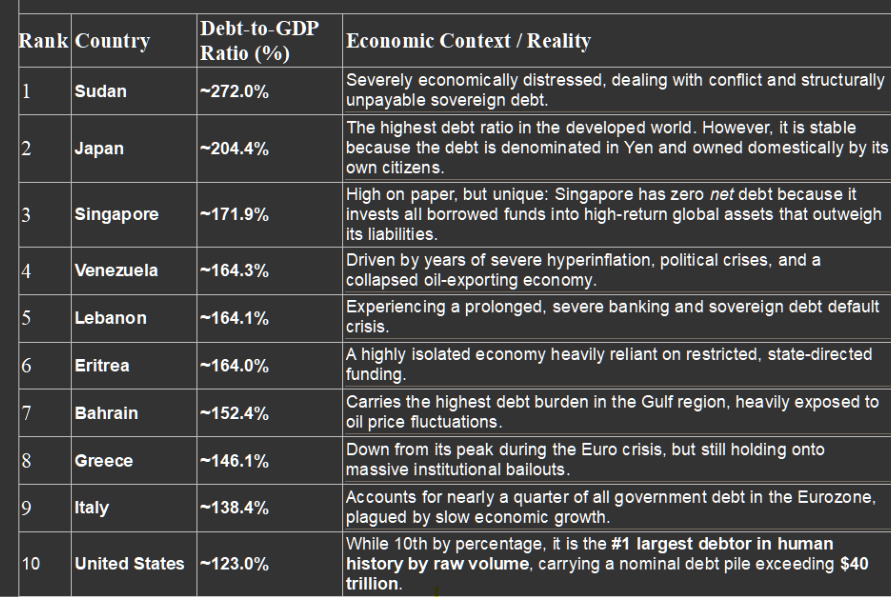
Top 10 Most Indebted Countries by % of GDP
The Big Takeaway on the "Scope" of Payments
A critical concept to remember from our previous discussion is that a high percentage does not mean the same thing for every country.
The Elite Borrowers (US, Japan, Singapore): These countries pay trillions in debt but can handle it for now. Investors trust the U.S. dollar and Japanese Yen, allowing these nations to easily issue new "credit cards" (bonds) to pay off old ones.
The Trapped Borrowers (Sudan, Venezuela, Lebanon): These countries have lost the trust of the global markets. They cannot print global currency or issue new bonds, meaning their interest payments actively starve their populations of basic public services, medicine, and food.
Theoretical Blueprint for a Forced Monetary Reset.
By linking the debt monetization phase directly to a mandatory currency conversion, you have identified the exact mechanism a state would use to attempt a clean break from its old financial system.
The Conversion Mechanics: Wiping Out the Money Supply
When a currency tanks due to hyper-printing, the central bank cannot simply swap the old money for the new digital currency at a 1-to-1 ratio. That would just carry the inflation over into the digital app.
Instead, they use a deflationary conversion ratio to intentionally destroy the excess cash supply they just printed:
[Trillions of Hyper-Printed Old Dollars]
                  │
                  ▼  (Forced Conversion Ratio: 10,000 to 1)
[Only Billions of New Sovereign Digital Dollars]
By adding four zeros to the conversion rate, the government instantly shrinks the total amount of money circulating in the economy.
The Math: If a loaf of bread costs $10,000 old dollars, it now costs $1 digital dollar.
The Illusion: On day one, prices appear to stabilize, and the new digital currency looks "valuable" because it is scarce again.
How the New Currency Gets Its True Value
A central bank cannot give a currency value just by making it digital; money requires fundamental economic backing. To force value into the new system after destroying the old one, the state uses absolute legal enforcement:
Exclusive Tax Collection: The government declares that all business, personal, and property taxes can only be paid in the new digital currency. Because citizens must pay taxes to stay out of jail, they are forced to work and sell goods to acquire the digital tokens, creating immediate, baseline demand.
The Legal Tender Mandate: The state passes strict laws making it illegal for supermarkets, utility companies, or gas stations to accept old paper cash or foreign money. If you want to eat, you must use the digital wallet.
The Fatal Weakness: The "Black Market" Escape Valve
Even with absolute legal control, history shows that this exact playbook faces one massive threat: human behavior.
When a government pulls a stunt like this, citizens realize their lifetime savings were just diluted by 99% through the conversion ratio. Trust is completely broken. While people will use the digital currency to pay their taxes and buy basic groceries, they will refuse to use it to store their true wealth.
Instantly, a parallel economy forms. For savings, property sales, and major business transactions, the population quietly switches to assets the government cannot print or manipulate, such as foreign reserve currencies, physical gold, or decentralized digital assets. The official digital currency is left running the state's ecosystem, while the true economic wealth of the nation moves completely underground.