

How Nepal Can Turn Catastrophic Ice Collapse into Energy, Water, and Regional Prosperity
A Follow-Up Paper
Link to Original Paper: "How Nepal Turns Melting Ice into Energy, Water, and Regional Prosperity"
Executive Summary
The original paper assumed that Nepal's greatest water threat came from glacial lake outburst floods (GLOFs), gradual meltwater accumulation behind unstable moraine dams. The August 26, 2026 disaster revealed a different, more dangerous mechanism: the catastrophic collapse of entire ice sheets from high-altitude mountainsides.
This correction does not invalidate the Entangled system. It refines it. But it is important to adapt to new data, and be adaptive. My main mistake was not knowing it was the ice that fell and when it hit the ground liquefied all that water. I under estimated the energy released on impact when I ran the simulation of ice fall and thought it would take a bit of time and delay the water release. Boy I got this one wrong.
The ice will fall. The question is not whether we can stop it, but where it lands and what happens next. The Entangled system must be positioned below the collapse zone, catching the water, channeling the energy, and distributing the value after the release.
This paper corrects the original model, explains the new mechanism, and outlines the revised system architecture.
1. The Mistake: Meltwater vs. Ice Collapse
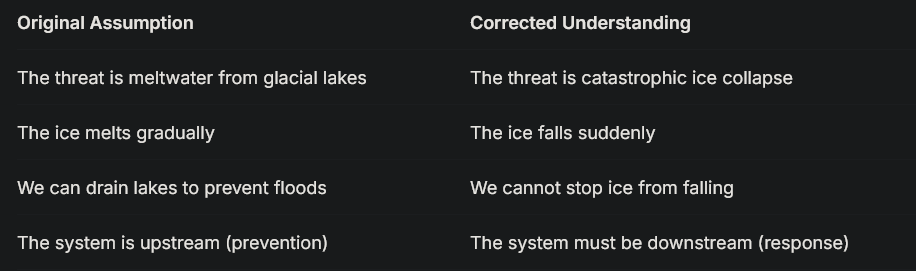
1.1 What the Original Paper Assumed
The original paper operated on a logical but incomplete assumption:
"Glacial lakes swell with meltwater. When the moraine dam fails, the water releases catastrophically. If we drain the lakes, we prevent the flood."
This was correct for GLOFs. But it was not the whole picture.
1.2 What Actually Happened
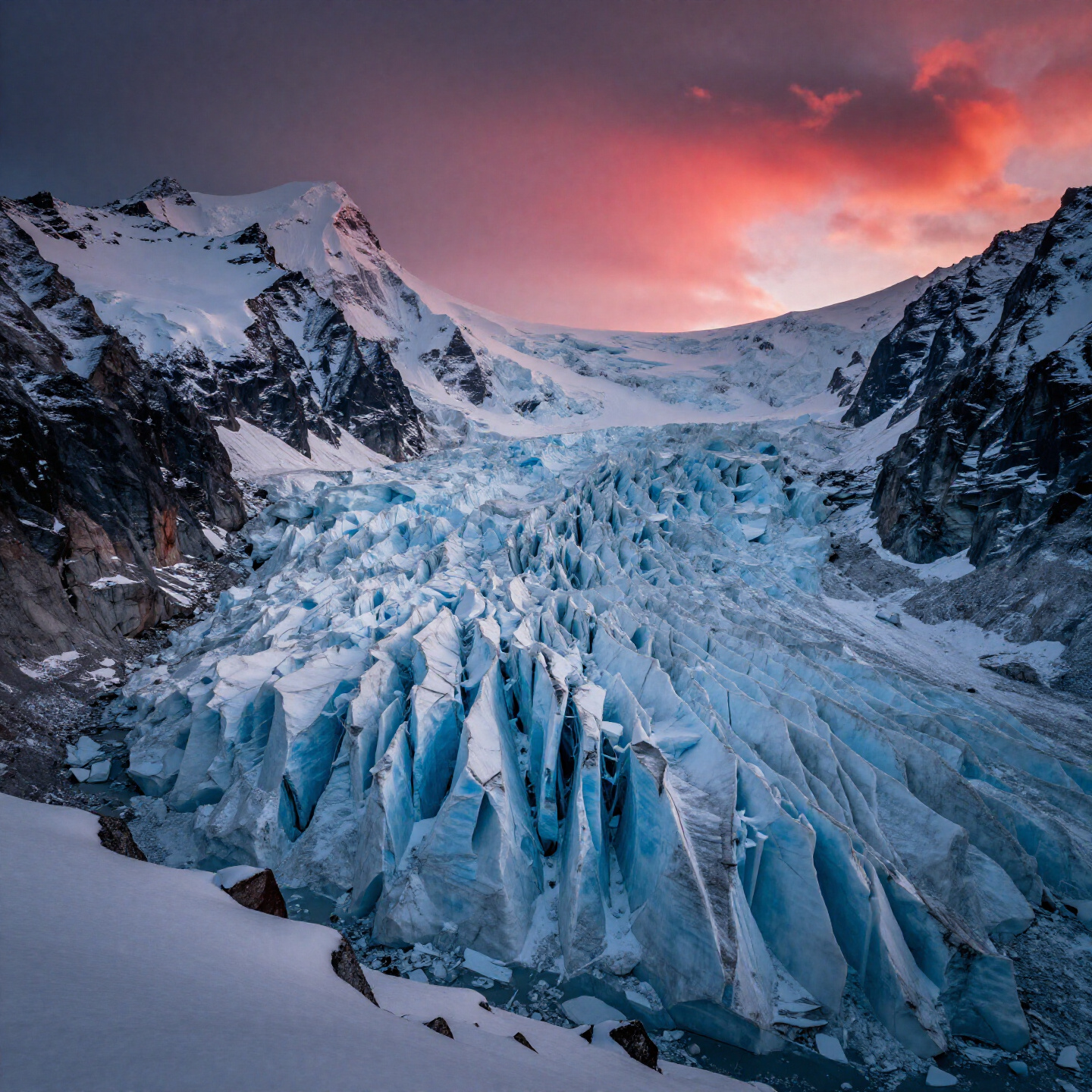
On August 26, 2026, at approximately 10:52 AM Beijing time, a massive section of glacier on the south face of Langtang Lirung in Nepal collapsed.
The collapse was not a slow melt. It was a structural failure, a mountain-sized avalanche of ice, rock, and mud that fell over 1,200 meters.
The energy released was greater than the Hiroshima atom bomb. The collapse generated seismic energy equivalent to a magnitude-5.2 earthquake.
The impact pulverized ice and rock, sending a mixture of water and debris toward the Lhende Khola and into the Bhotekoshi River. The flood wave swept through valleys, killing over 900 people with nearly 5,000 still missing.
Roughly an eighth of Nepal's hydropower capacity was knocked out within minutes.
The ice did not melt. It fell.
2. The Mechanism: Why Ice Collapses
2.1 The Hollowing Effect
The original paper assumed glacial ice was a solid, stable mass. It is not.
Glaciers are fractured, moving collections of ice crystals. As temperatures rise:
Surface meltwater percolates down through cracks and crevasses.
Subglacial channels form as water reaches the base.
The channels hollow out the foundation beneath the ice.
The ice loses structural support as the bedrock interface weakens.
The ice collapses when tension exceeds remaining structural integrity.
As one expert explained: "Warming temperatures cause lots of melted water to get collected in subglacial channels. These channels open up after the glacier's lower portion collapses, leading to water gushing through in large volumes".
2.2 The Substrate Matters
The behavior of ice collapse depends on what is beneath it:
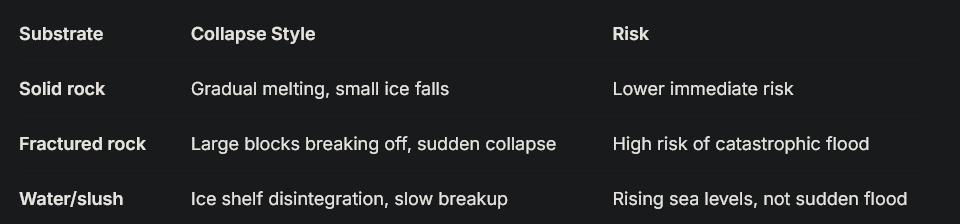
The Himalayas are the worst-case scenario: steep slopes, fractured bedrock, and active tectonics create the perfect conditions for large-scale collapses.
2.3 A New Pattern Emerging
Scientists warn that warming temperatures and melting glaciers are making large collapses more likely. As ice retreats, sections can lose the physical support that previously kept them in position.
This is not a one-off event. It is a new pattern. And it will become more common.
3. Correcting the Model: What Changes
3.1 What the Original Paper Got Right
The Entangled system's core principles remain valid:
Tension is energy. The gradient between ice and water, between mountain and valley, is a source of potential.
Water is a blessing. When managed, it becomes power, irrigation, and prosperity.
Distribution is the solution. Moving water from surplus to deficit creates value.
3.2 What the Original Paper Got Wrong
3.3 The Limit of Control
"You cannot design a system to stop a tipping point. You can only design a system to respond to it."
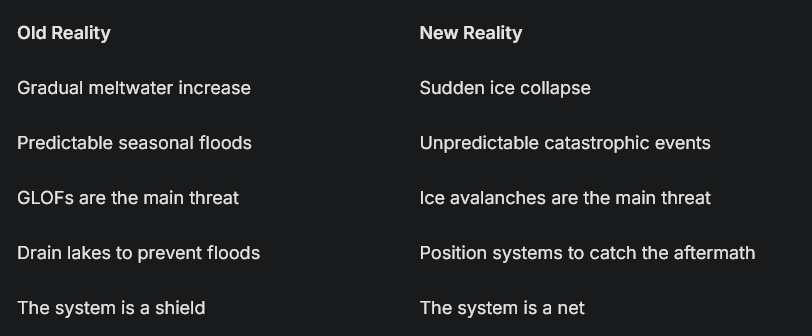
This is the key correction. The Entangled system is not a shield. It is a net.
What the System Cannot Do What the System Can Do
Stop ice from collapsing Catch the water after the collapse
Prevent the release of energy Harvest the energy of the release
Control the moment of failure Channel the flow after failure
Stop the tipping point Adapt to the new reality
4. The Revised System Architecture
4.1 Location: Downstream, Not Upstream
The original system focused on draining glacial lakes high in the mountains. The corrected system must be positioned below the collapse zone.
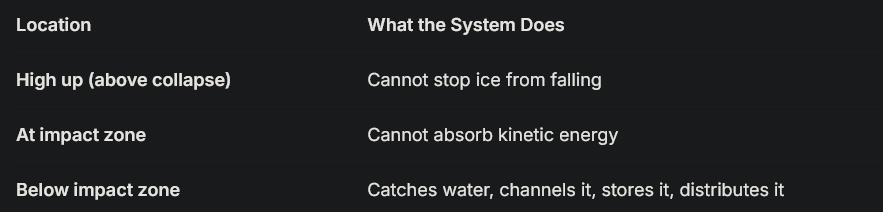
The system does not prevent the collapse. It harvests the aftermath.
4.2 The Revised Value Streams
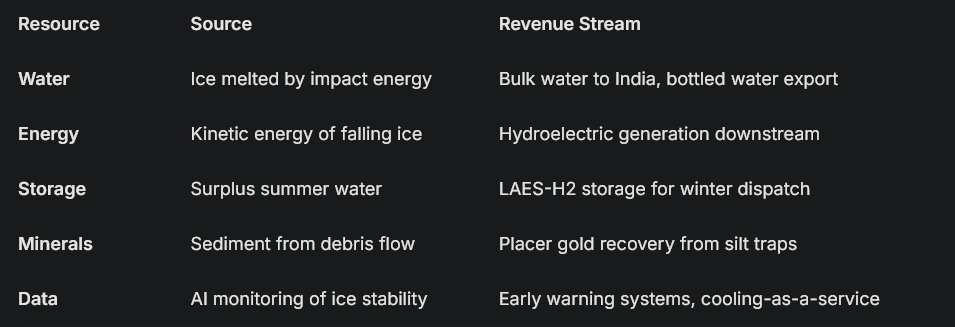
4.3 The Role of AI and Monitoring
Since we cannot stop ice collapses, we must predict them.
Ground-penetrating radar to detect subglacial hollowing
Temperature sensors to monitor basal melt
Stress sensors on ice surfaces to detect cracks and movement
Satellite imagery to track glacier retreat rates
The AI from the LAES-H2 system can analyze this data and predict when a collapse is imminent, not to stop it, but to warn downstream communities and prepare the system to catch the flow.
5. The New Reality
5.1 The Ice Will Fall
The Himalayas are losing ice at an accelerating rate. ICIMOD reports that glaciers across the Hindu Kush Himalaya are melting at an accelerating rate, with ice loss rates doubling since 2000. Himalayan glaciers are losing about a meter of ice a year.
The collapse on August 26, 2026 was not an anomaly. It was a preview.
5.2 This Is Not a Solvable Problem
"I think this is just the new reality and I do not know if there is a solution to it."
This is not defeat. This is clarity.
Tipping points, by their very nature, are sudden and irreversible. You cannot "manage" a tipping point in the moment, it is the moment when the system reorganizes itself, whether you are ready or not.
The Entangled system is not a prevention system. It is an adaptation system.
5.3 What This Means for Nepal
6. The Human Value: Honoring the Lost
The original paper spoke of honoring the lives lost in floods. This remains true, but the scale is now greater.
Over 900 people died in the August 26 collapse. Nearly 5,000 are still missing. Their deaths were not caused by a slow melt. They were caused by a sudden, catastrophic release of energy that no one saw coming.
Their lives must not be forgotten. Their deaths must not be meaningless.
The corrected Entangled system honors them by:
Acknowledging the limit of human control over nature
Preparing for the new reality of ice collapse
Building systems that respond to catastrophe
Turning destruction into value, catching the water, storing the energy, rebuilding what was lost
7. Conclusion: The Net, Not the Shield
The original paper asked: "How can Nepal turn melting ice into energy, water, and regional prosperity?"
The corrected answer is: "Nepal cannot stop the ice from falling. But it can catch the water after it falls, channel it, store it, and distribute it."
The Entangled system is not a shield. It is a net.
Shields block energy. Nets catch it.
Shields prevent flow. Nets channel it.
Shields resist reality. Nets adapt to it.
The ice will fall. The only question is where it lands and what happens next.
The Entangled system ensures that when the ice falls, the water does not wash away the world, it powers it.
References
"How Nepal Turns Melting Ice into Energy, Water, and Regional Prosperity" (Original Paper)
Langtang Lirung glacier collapse, August 26, 2026
Energy released greater than Hiroshima atom bomb
Seismic energy equivalent to magnitude-5.2 earthquake
Over 900 dead, nearly 5,000 missing
Eighth of Nepal's hydropower capacity destroyed
Subglacial channel collapse mechanism
Ice loses support as it retreats
Himalayan glaciers losing ~1 meter of ice per year
ICIMOD: ice loss rates doubled since 2000
Cascading hazards likely to become more frequent