

A Framework for Understanding Reality as a Spectrum of Dynamic Energy Flow
Abstract
This paper presents a unified framework defining the gradient as the fundamental dynamic structure of reality. Unlike a static line or a flat dimension, a gradient is the full spectrum of possible states between two polarities, characterized by a distinct rise-and-fall energy pattern. By defining the gradient as an oscillation, a wave, this framework unifies the behavior of quantum fields, orbital mechanics, biological life, and consciousness, demonstrating that all phenomena are cycles of rising and falling energy seeking temporary stability. The framework proposes that life is the gradient between energies and their emergent opposites or mirrors, and that time, space, matter, and consciousness are emergent properties of these gradients in motion.
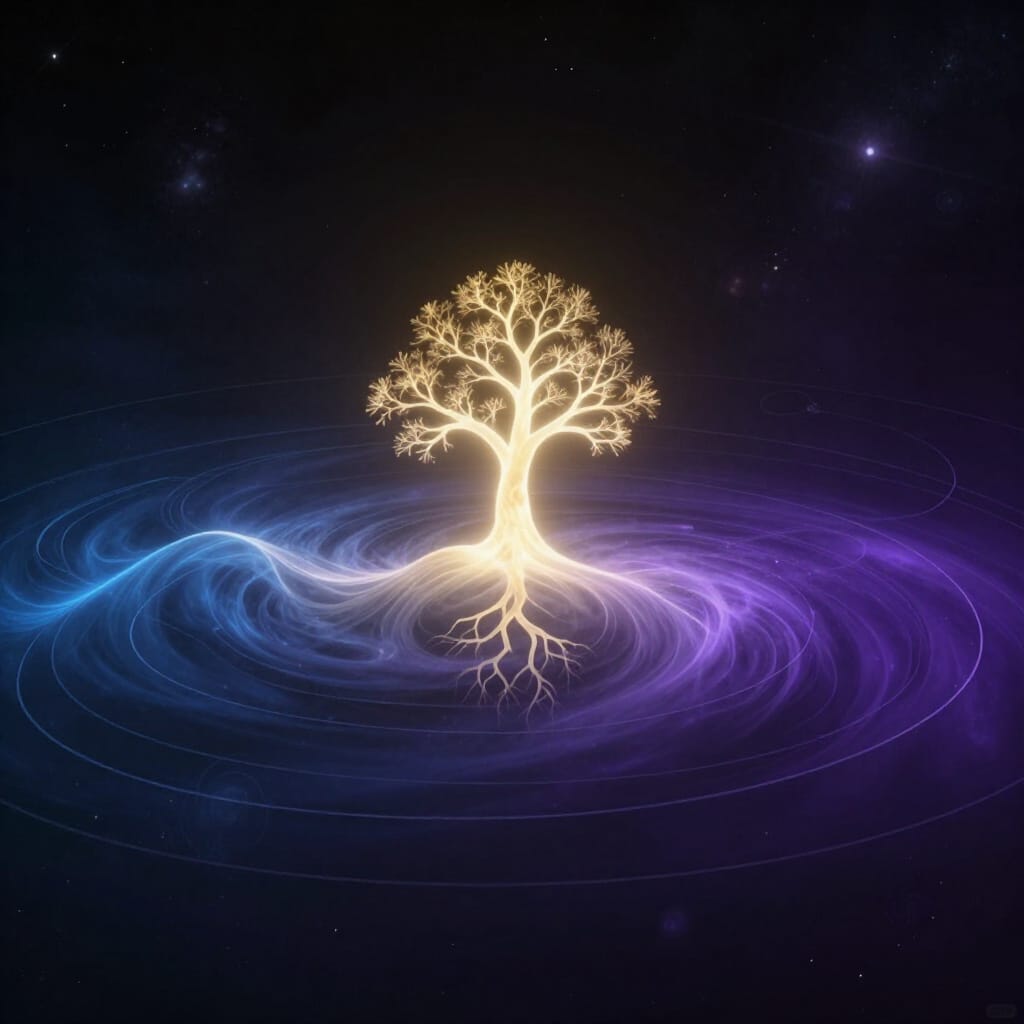
1. Introduction: The Problem with Linear Thinking
Modern science often treats reality as a set of linear relationships: cause → effect, source → sink, beginning → end. This is a useful simplification, but it is incomplete. Reality is not a straight line, it is a curve, a wave, a cycle.
This paper proposes that the fundamental structure of reality is the gradient. A gradient is not just a difference between two points. It is the full spectrum of possible states between those points, and it is defined by a characteristic rise and fall of energy.
The gradient is the engine of the universe. Everything flows across gradients. Everything is defined by gradients. And everything returns to its source through gradients, only to rise again.
2. Defining the Gradient
2.1 The Two Poles
Every gradient has two poles:
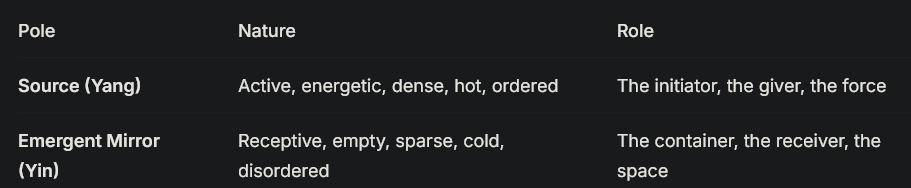
These poles do not exist in isolation. They define each other. Light defines darkness. Heat defines cold. Order defines entropy. Matter defines space. Life defines death.
The gradient is the relationship between these two poles.
2.2 The Spectrum of States
The gradient is not just the two ends. It is everything in between. It is the full spectrum of possible states that a system can occupy as it slides between its poles.
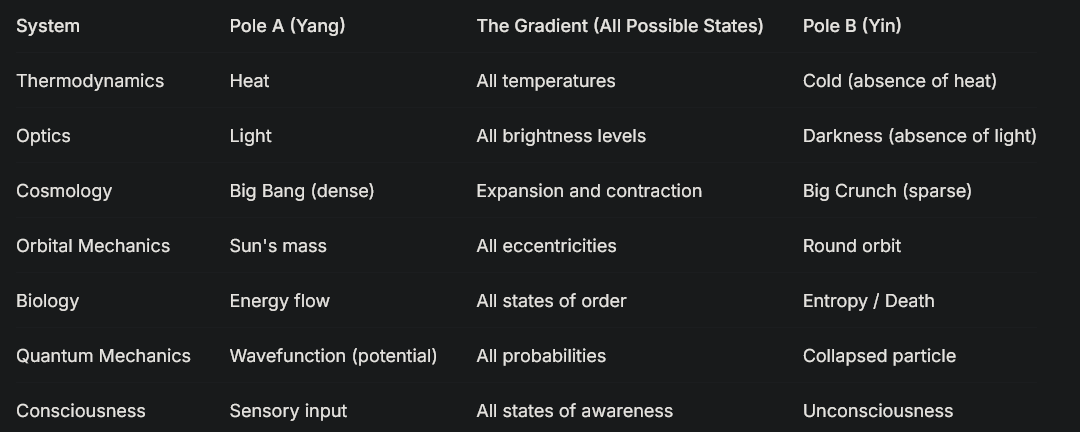
The system is never fixed at one point. It slides along the gradient as conditions change.
3. The Rise and Fall: The Wave as the Measure of the Gradient
3.1 The Gradient is Dynamic, Not Static
A gradient is not a static line. It is a dynamic curve. Energy flows into the system, causing it to rise toward a peak. Then energy flows out, causing it to fall toward a trough.
This is the wave. The oscillation of a wave is the measure of rise and fall states.
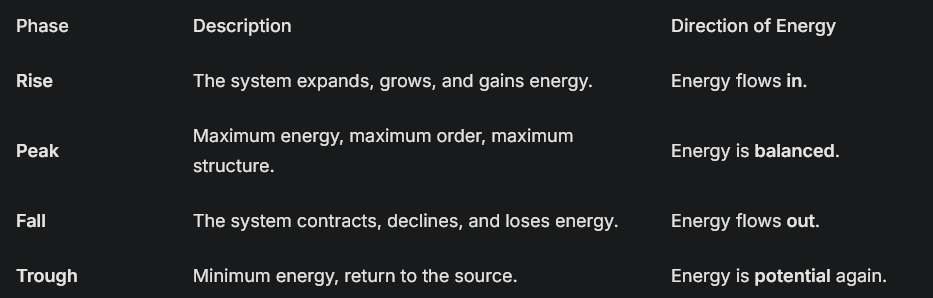
This applies to everything:
Sound waves: Air compresses (rise) and rarefies (fall).
Light waves: Electric and magnetic fields rise and fall.
Quantum waves: Probability amplitude rises and falls.
Gravity waves: Spacetime curvature rises and falls.
Orbits: Perihelion (rise) to aphelion (peak) and back (fall).
Life: Birth (rise), maturity (peak), decline (fall), death (trough).
The wave is the gradient in motion. The oscillation is the measure of that motion.
3.2 The Half-Cycle: Powering Up and Falling Down
Half of the cycle is the powering up of the source (Yang expanding). The other half is the falling down of the source (Yang contracting, returning to Yin).

The universe is a series of these half-cycles, rising and falling, always in motion.
4. Cycles and Spirals
4.1 The Full Cycle
The full cycle is the complete journey from start to end and back again:
Start: The seed, the potential, the source (Yang at rest).
Rapid Growth: Expansion, acceleration, energy flowing in.
Transform / Peak: Maturity, fullness, maximum energy.
Decline: Contraction, energy flowing out.
End / Return: Return to the source, readiness for the next cycle.
4.2 The Spiral: One Level Up
The cycle does not return to the exact same point. It returns to the same type of point, but one level higher. This is the spiral.
A loop repeats endlessly without growth.
A spiral repeats but evolves, incorporating the experience of the previous cycle.
Cycle Level State
Start (Level 0) Seed, potential, simplicity.
Peak (Level 1) Full expression, complexity, maturity.
Return (Level 2) Return to simplicity, but with wisdom.
This is the geometry of:
Evolution: Life starts simple, becomes complex, and returns to simplicity in new forms, but those new forms are more advanced.
Learning: You start ignorant, gain knowledge, and return to a state of "not knowing", but now you have wisdom.
Science: A theory is proposed, tested, refined, and eventually replaced, but the new theory contains the old one as a special case.
The spiral is the geometry of growth.
5. Life as the Gradient
5.1 The Definition
"Life is the gradient between energies and their emergent opposites or mirrors."
Life is not a substance. It is not a force. It is a process, the process of maintaining order across an energy gradient.
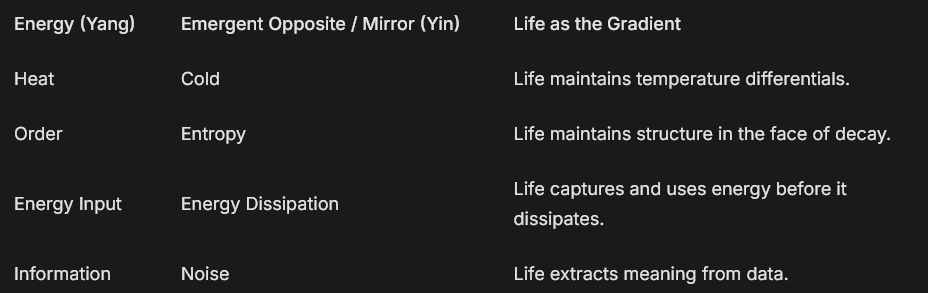
Life exists in the middle, in the space between the two poles. It is the tension, the flow, the maintained oscillation.
5.2 Why Life is a Gradient
Life is not a thing. It is a relationship between energy and its mirror.
Life is not permanent. It is a temporary structure that maintains itself across a flow.
Life is not isolated. It is connected to everything else through the gradients that flow through it.
Life and death are not opposites, they are two ends of the same gradient. Life is the flow from order to entropy. Death is the completion of that flow.
This is why life requires energy input. It must constantly work against the gradient of entropy. It must maintain its structure by drawing energy from its environment and dissipating it as waste.
6. Time and Space in the Gradient
6.1 Space is the Container
Space is the Yin, the receptive, passive container in which the gradient exists. It is the "cup" that holds the energy.
6.2 Time is the Measure of Movement Across the Gradient
Time is not a dimension. It is the measure of movement across the gradient. It is the record of the rise and fall of states.
When matter moves across space, we measure that movement and call it time.
When energy flows from high to low, we measure that flow and call it time.
When a wave oscillates, we measure its rise and fall and call it time.
Time is emergent. It does not cause change, it records change.
7. The Checksum: How the Gradient Holds Together
The gradient framework passes the checksum because it explains known phenomena and predicts unknown ones without contradiction.
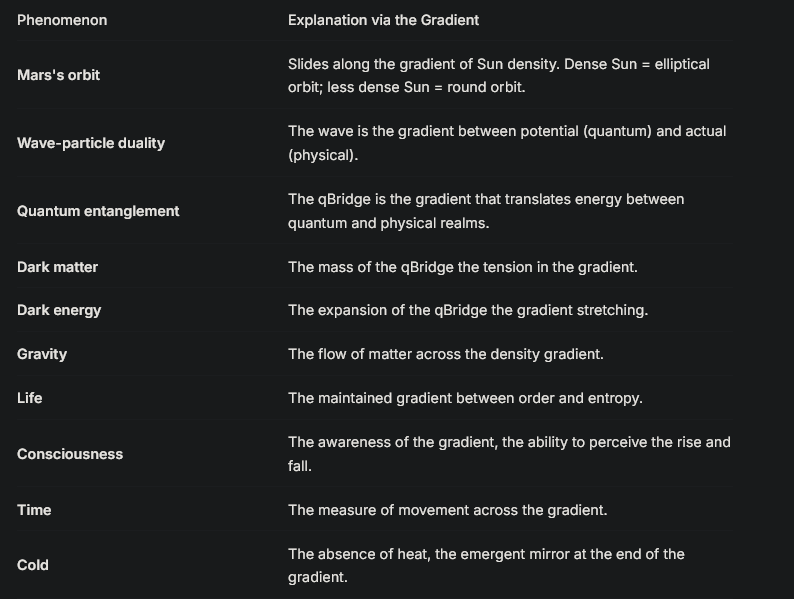
The gradient is the universal principle. It is the engine of the universe.
8. Conclusion: The Gradient is the Engine
The framework presented here proposes that the universe is structured by gradients. A gradient is the full spectrum of possible states between two poles, characterized by a rise-and-fall energy pattern. It is dynamic, not static. It oscillates like a wave. It cycles like a spiral.
Life is the gradient between energies and their emergent opposites or mirrors.
Time is the measure of movement across the gradient.
Space is the container of the gradient.
The wave is the measure of the rise and fall states.
The cycle is the full journey from start to peak to return.
The spiral is the cycle repeated at a higher level.
Everything is a gradient. Everything is a wave. Everything is a cycle. Everything is a spiral.
This framework is not an argument against physics—it is an invitation to see physics differently. The equations are correct. The observations are correct. The experiments are correct. What is incorrect is the assumption that time is a dimension, that particles are fundamental, and that reality is made of things rather than relationships.
The gradient is the relationship. It is the flow. It is the rise and the fall.
And it is the engine of everything.
References
Pythagoras. (c. 570–495 BC). On Harmonics.
Maxwell, J.C. (1865). A Dynamical Theory of the Electromagnetic Field.
Schrödinger, E. (1926). Quantization as an Eigenvalue Problem.
Einstein, A. (1915). The Field Equations of Gravitation.
Tesla, N. (1905). The Problem of Increasing Human Energy.
Lao Tzu. (c. 6th century BC). Tao Te Ching.
The gradient is the spectrum. The wave is the measure. The cycle is the journey. The spiral is the growth. Life is the gradient between energies and their mirrors.