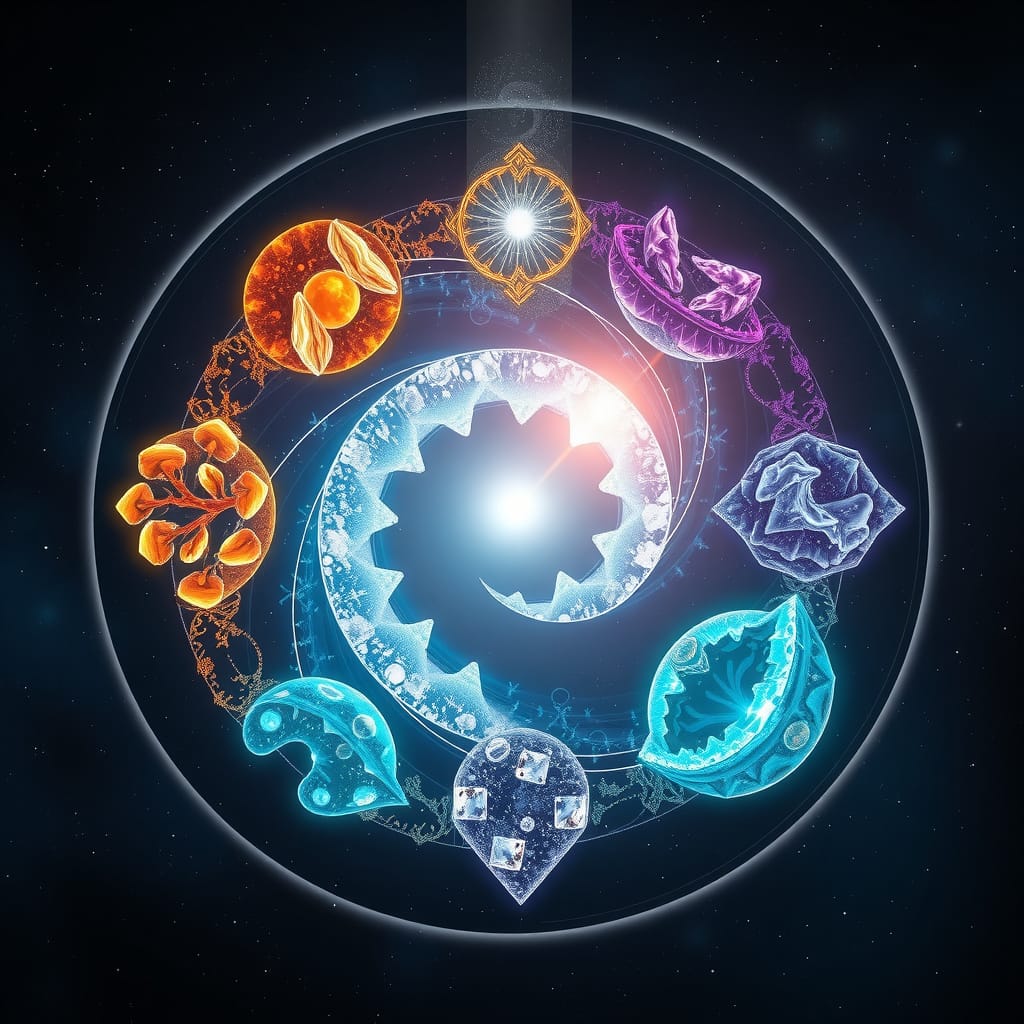

Subtitle: Elements as Resonant Modes of a Fundamental Quantum Spiral Field, and Their Role in Building Layered Complexity
Series: The Elements of Observation, A Functional Ontology
Preceding Paper: Paper 1: Sodium, The Fast Carrier
Abstract
This paper presents a unifying framework, the Elemental Harmonics Hypothesis (EHH), which posits that the chemical elements represent stable, resonant modes of excitation within a fundamental quantum spiral field. Each element corresponds to a specific harmonic frequency and geometric mode (compression, expansion, stabilization, etc.) of this underlying field. We propose that chemical bonding, biological function, and ultimately consciousness arise from the interference, combination, and orchestration of these elemental harmonics. This hypothesis bridges quantum dynamics, chemistry, and neuroscience by interpreting the periodic table not merely as a catalog of substances, but as a harmonic score for material and energetic organization. The theory makes testable predictions regarding elemental frequency signatures, reaction kinetics, and the emergence of complex systems from simple resonant interactions.
1. Introduction: From Quantum Waves to Material Forms
Modern science describes reality in separate layers: quantum fields, atomic particles, chemical compounds, biological systems. While each layer is well-modeled, the principles governing transitions between them remain less unified. This paper proposes that these transitions are governed by harmonic stability: quantum excitations naturally collapse into increasingly dense and stable resonant patterns, with the chemical elements serving as the primary, most stable harmonic nodes.
2. The Fundamental Quantum Spiral Field
Drawing on geometric interpretations of quantum field theory and prior work on spiral wave dynamics (Paper 1 addendum), we define:
Axiom 1: Existence is underlain by a dynamic, coherent quantum field with inherent spiral/twistor geometry.
Axiom 2: This field supports a spectrum of resonant excitation modes.
Axiom 3: The most stable, persistent modes manifest as what we perceive as the chemical elements.
3. The Elemental Harmonics Hypothesis (Core Postulates)
3.1 Elements as Resonant Modes
Each element corresponds to a unique harmonic signature, a specific frequency, phase, and geometric deformation of the fundamental field.
Proposed Signature Mapping (Preliminary):
Sodium (Na): High-frequency compression mode → rapid signal transduction.
Potassium (K): Complementary expansion mode → reset and rhythm.
Calcium (Ca): Lower-frequency structural mode → memory and scaffolding.
Chloride (Cl): Dampening/stabilization mode → inhibition and balance.
3.2 Harmonic Combinations Create Chemistry
Chemical bonding is the constructive interference of elemental harmonics, forming stable composite waveforms (molecules).
Example:
Na (compression mode, frequency f) + Cl (stabilization mode, f/5) → NaCl (composite waveform with beat frequencies and new emergent stability).
3.3 Biological Systems as Harmonic Orchestras
Life utilizes specific combinations of elemental harmonics to perform functions:
Neural spike: Na (compress) → K (expand) → Ca (structure) → Cl (stabilize).
ATP energy transfer: P (high-energy phosphate mode) + Mg (catalytic tuning).
Oxygen transport: Fe (binding/resonance with O₂ harmonic).
4. Mathematical Formalism: A Proposed Notation
Let the fundamental field have a base spiral frequency Ω.
Let each element E be represented by a complex waveform:
E(ω, φ, G) where:
ω = characteristic frequency (harmonic of Ω)
φ = phase relationship
G = geometric mode (compression, expansion, twist, etc.)
Chemical reactions become wave interference equations:
Na(Ω, 0, compression) + Cl(Ω/5, π/2, stabilization) →
NaCl(ω_beat = |Ω - Ω/5|, φ_resultant, G_composite)
Biological processes become orchestrated sequences:
Neural_Spike = [Na(Ω) → delay τ → K(Ω/2) → Ca(Ω/3) → Cl(Ω/5)]5. Evidence and Consistency with Known Data
5.1 Periodicity as Harmonic Grouping
The periodic table’s structure may reflect harmonic families:
Alkali metals (Na, K, etc.): Related compression/expansion harmonics.
Halogens (Cl, Br, etc.): Related stabilization harmonics.
Transition metals: Complex harmonic signatures enabling catalysis and binding.
5.2 Reaction Kinetics
Reaction rates correlate with frequency mismatches: reactions between harmonically compatible elements (simple frequency ratios) proceed faster and more specifically.
5.3 Biological Specificity
Evolution selected elements not randomly, but for their harmonic compatibility with specific functions:
Na/K pump: Exploits the complementary compression/expansion harmonics.
Ca signaling: Uses structural harmonics for long-term change.
Fe in hemoglobin: Resonant with O₂’s electronic vibration frequency.
6. Testable Predictions of the EHH
Prediction 1: Each element, in its isolated atomic vapor state, will emit/absorb electromagnetic frequencies that form a harmonic series related to a fundamental Ω.
Prediction 2: The rate of a chemical reaction can be predicted from the harmonic relationship (frequency ratio, phase difference) of the reacting elements.
Prediction 3: Biological systems will show resonant sensitivity to external fields tuned to the harmonic frequencies of their key functional elements (e.g., 11025 Hz fields affecting Na⁺ channels).
Prediction 4: New, stable compounds could be designed by seeking harmonic complementarity between elements, not just orbital overlap.
7. Implications for Consciousness and Complex Systems
If biological systems are orchestras of elemental harmonics, then:
Consciousness may be the state of coherent resonance across multiple harmonic layers within a neural network. Different states of awareness (focus, meditation, sleep) could correspond to different patterns of harmonic synchronization.
Complexity emerges naturally as stable harmonics combine into more stable super-harmonics, following the principle of progressive harmonic stabilization (collapse to greater density/stability).
8. Future Research Directions
Experimental: Precision spectroscopy to map elemental harmonic signatures.
Computational: Simulate chemical reactions as wave interference to predict kinetics and products.
Theoretical: Derive the periodic table’s structure from harmonic stability principles.
Applied: Design harmonic-based catalysts, drugs, or neural interfaces.
9. Relationship to Previous Papers in This Series
Paper 0 (The Binding and the Wave): Established the universal cycle of potential → binding → structure → release.
Paper 1 (Sodium, The Fast Carrier): Identified sodium as the rapid-compression harmonic in neural systems.
This Paper (Elemental Harmonics): Provides the overarching framework explaining why elements have specific functions and how they combine.
Forthcoming papers will detail the harmonic signatures of potassium, calcium, chloride, and others, building out this “periodic table of functions.”
10. Conclusion
The Elemental Harmonics Hypothesis proposes a deep unity across scales: the same principles of resonance and interference that govern quantum fields also organize the periodic table, chemical reactions, biological functions, and perhaps consciousness itself. By viewing elements not as inert substances but as active harmonic modes of a dynamic field, we open a new path toward understanding and engineering the fabric of reality, from the quantum to the cognitive.
References (Conceptual & Inspirational)
Sheldrake, R. (1988). The Presence of the Past. Collins. (Morphic resonance as formative field principle)
Penrose, R. (2004). The Road to Reality. Jonathan Cape. (Twistor geometry, spin networks)
Bókkon, I., & Salari, V. (2010). Bioplasma oscillation and photon emission in the brain. Journal of Photochemistry and Photobiology.
Davydov, A. S. (1979). Biology and Quantum Mechanics. Pergamon Press. (Solitons in proteins)
Preceding papers in this series.
Preview of Paper 3: Potassium – The Expansion Rhythm
Where sodium compresses, potassium expands. The next paper explores potassium as the complementary harmonic necessary for rhythmic reset and gradient restoration, the yang to sodium’s yin in the neural breathing cycle.