

A Strategy for Competition, Revenue, and National Resilience
Executive Summary
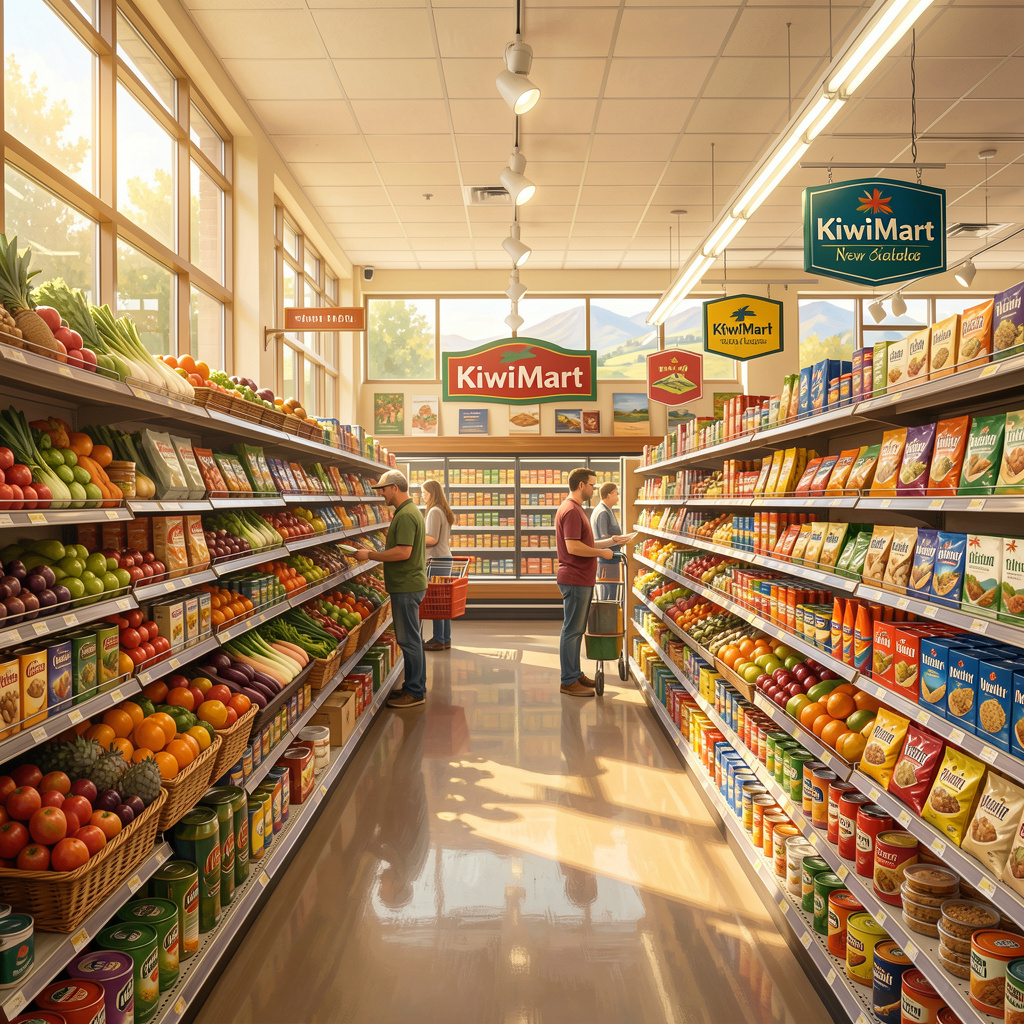
New Zealand faces a convergence of crises: a supermarket duopoly extracting excessive profits from consumers, a government struggling with budget deficits and limited revenue options, a farming sector facing existential competition from South American producers, and a foreign investment strategy that has failed to deliver results. This paper argues that the Green Party's "KiwiMart" proposal, a state-owned supermarket chain created by acquiring 120 stores and two distribution centres, is not merely a worthwhile experiment but a necessary strategic intervention. While critics raise concerns about cost and government competence, these objections are either unfounded or can be addressed. More importantly, the proposal offers multiple streams of benefit that the "wait for foreign investment" approach cannot match: direct revenue generation, downward pressure on grocery prices, a platform for leveraging new trade agreements, and a model for state-led economic diversification.
Part One: The Problem
A Duopoly That Is Failing Consumers
The Commerce Commission's third Annual Grocery Report, released in June 2026, confirms what every New Zealander already knows: competition is not working. Foodstuffs and Woolworths maintain a combined 82% of the national retail grocery market. In some parts of the country, their share exceeds 90%. Margins and profitability have remained stable, "suggesting that competition pressure is not meaningfully increasing". Both Foodstuffs North Island and Foodstuffs South Island "continue to sit at the top end of international profitability benchmarks".
The human cost is staggering. Green Party co-leader Chlöe Swarbrick has stated that the duopoly takes "about a million dollars a day in excess profit out of our shopping baskets". This is money that should be in the pockets of New Zealand families, not enriching corporate shareholders. Retail food prices increased 4.6% in the year to December 2025. With the Commerce Commission itself expressing concern that the lack of competition will "amplify the negative effects" of global cost pressures, the situation is not improving, it is deteriorating.
The Failed "Foreign Investment" Strategy
Successive governments have pursued the same approach: remove regulatory barriers and hope an international player will enter the market. The current government has introduced faster consent processes, changed the Overseas Investment Act, and issued new guidelines to "roll out the red carpet" for international investors. The government approached 21 international firms. High-profile chains including Tesco, Lidl, and Aldi declined to participate. Despite the government's continued hope that Aldi might change its mind, the results speak for themselves: 82% market share remains unchanged.
The Finance Minister herself has admitted the results are "frustratingly slow". The Commerce Commission's Grocery Commissioner, Pierre van Heerden, stated that "reforms need more time to bed in to see significant improvements in the market". But how much time? How many more years of excess profits and high prices must New Zealanders endure while we wait for a third competitor that shows no sign of arriving?
The "wait and hope" strategy is not a strategy, it is an abdication.
Part Two: The Objections, and Why They Are Weak
Objection One: "It Costs Too Much"
The KiwiMart proposal is costed at $2.8 billion, $1.3 billion to acquire stores and distribution centres, and $1.5 billion to capitalise the new business. Critics, particularly National's Finance spokesperson Nicola Willis, argue this puts "taxpayers on the hook for billions".
The response: This objection fundamentally misunderstands how government finance works, and what the alternative costs.
First, the government can issue bonds to fund this acquisition. New Zealand government bonds are currently yielding around 4.46% for 10-year paper, historically manageable rates. The government already carries net core Crown debt of $191.4 billion, or 43.5% of GDP. An additional $2.8 billion, representing approximately 0.6% of GDP, is not a reckless gamble, it is a modest investment in a revenue-generating asset.
Second, not investing costs more. The duopoly extracts approximately $365 million per year in excess profits ($1 million per day × 365 days). Over 10 years, that is $3.65 billion leaving New Zealanders' pockets and flowing to corporate shareholders. The $2.8 billion investment pays for itself in less than eight years just from the excess profit recaptured, before accounting for any additional benefits.
Third, the government has a proven track record of running profitable state-owned enterprises (SOEs). Landcorp (Pāmu) recently delivered a Net Profit After Tax of $160 million** and paid the Crown $25 million in dividends during FY26. NZ Post returned a $12.5 million dividend. Airways New Zealand delivered **$11.9 million in profit and a $10 million dividend. The principal objective of every SOE is "to operate as a successful business and to be as profitable and efficient" as possible. Crown-owned companies "can help to reduce the deficit by boosting government revenue through dividends".
There is no reason a state-owned supermarket chain cannot follow this same model, operating commercially, generating a return, and paying dividends to the Crown.
Objection Two: "A Government-Owned Supermarket Won't Be Efficient"
Critics argue that a government-owned business lacks the commercial discipline of a private competitor. National's Nicola Willis has gone so far as to label it a "Soviet-style" solution.
The response: This is fear-mongering, not analysis.
The KiwiMart proposal does not involve giving away food or operating as a charity. It involves a commercially viable competitor with an "affordability mandate". The current supermarket margins are so high that even a 25% reduction would still leave ample profit. According to industry analysis, major retailers currently enjoy gross profit margins of 55% or more on individual items. A public grocery chain could potentially drive gross profit margins down into the 4-7% range while still operating sustainably.
The "Soviet-style" label is a rhetorical flourish designed to frighten, not inform. It ignores the fact that New Zealand already has successful state-owned enterprises across multiple sectors, farming, postal services, aviation, broadcasting, and energy. None of these are "Soviet-style." They are commercially disciplined businesses that happen to be owned by the Crown. A state-owned supermarket would be no different.
Objection Three: "Forcibly Splitting Up the Market Will Be Disruptive and Raise Prices"
This is the weakest objection of all. The argument suggests that introducing a new competitor will somehow make prices go up.
The response: This defies both logic and historical experience.
When Foodtown opened in 1958, it was a new entrant. When Pak'n'Save opened in Kaitaia in 1987, it was a new entrant. In neither case did prices go up, prices went down. Competition does not raise prices; it lowers them. The assertion that a new competitor will increase prices has no historical backing and no economic logic.
Moreover, the Commerce Commission itself considered a government-backed supermarket chain as a potential option in its 2021 draft report. While the final report did not recommend it, this was a judgement call, not a definitive rejection. The Commission has since adopted a cautious approach of regulatory "tinkering," and the result has been no meaningful change in market concentration.
Part Three: Why We Must Act
Tax Is Not Enough
New Zealand's government is operating with a budget deficit of $15.06 billion for the 2025/26 fiscal year. The government does not expect to return to surplus until 2029/30. Net core Crown debt stands at $191.4 billion, or 43.5% of GDP.
Relying on tax increases alone to fund New Zealand's future is politically difficult and economically constrained. The wealthy can, and do, relocate. The middle class is already squeezed. The government needs new revenue streams, not just higher taxes.
A state-owned supermarket chain offers exactly that: a new, ongoing source of government revenue through dividends. If KiwiMart could achieve even a fraction of Landcorp's success, a 5% return on a $2.8 billion investment would generate $140 million per year in profit, it would provide a meaningful contribution to the Crown's finances. This is money that can be reinvested in health, education, infrastructure, and clean energy.
A Platform for Trade and Investment
The New Zealand-India Free Trade Agreement, signed in April 2026, grants 100% duty-free access for all Indian exports to New Zealand. The government has also committed to facilitating US$20 billion in private investment into India over the next 15 years.
A state-owned supermarket chain is uniquely positioned to leverage this agreement. It could:
Import Indian manufactured goods, textiles, electronics, processed foods, pharmaceuticals, that New Zealand does not produce, at tariff-free prices, keeping costs down for consumers.
Protect New Zealand producers by not being forced to chase the cheapest possible food imports. A state-owned chain with an affordability mandate can balance local sourcing with affordable imports, providing a stable market for Kiwi farmers while still keeping prices down for consumers.
Generate the capital needed to fulfill the US$20 billion investment commitment, using its profits to invest in India and strengthen the bilateral relationship.
Create a consistent trade pipeline that reduces transport costs through regular, high-volume shipping schedules.
This transforms the supermarket from a simple retail operation into a strategic trade and investment vehicle. It is not "just a supermarket", it is a platform for economic diplomacy.
Bonds, Investment, and a Diversified Revenue Model
Your insight about using asset-backed bonds to fund growth is crucial. A state-owned supermarket chain owns valuable real estate and generates predictable income, exactly the kind of asset that can back bond issuance. Instead of relying solely on general government debt, KiwiMart could issue project bonds linked to specific assets and expansion plans.
This is not theoretical. Thailand recently issued bonds backed by lease payments from government office complexes, achieving a top AAA credit rating. India is actively using infrastructure bonds backed by physical assets to attract institutional investment. New Zealand is already considering "asset monetisation", using existing state assets to free up capital for new investment.
A state-owned supermarket chain could follow this model, issuing asset-backed bonds to fund its expansion and generate returns for investors while keeping the asset itself in public ownership. This is how you "make money to make money", using the value of an asset to fund further growth, rather than simply borrowing against general government revenue.
The South American Challenge
This is perhaps the most urgent reason for action. South American agricultural producers, particularly Brazil and Argentina, are rapidly expanding their production capacity. The Mercosur deal with the EU provides them with preferential access to high-value markets. Within a decade, New Zealand's traditional agricultural exports will face unprecedented price pressure from competitors with lower costs and massive scale.
The government's strategy of "doubling export value by 2034 through embedding knowledge, innovation, and reputation" is, as you have correctly identified, a scarcity strategy. It relies on the assumption that New Zealand can charge more for the same goods. But in a world of abundant supply, scarcity is not a reliable growth model.
The alternative is to pivot from production to technology and IP. Fonterra has already invested over $80 million annually in innovation, developing proprietary technologies like milk fingerprinting (which cuts testing costs by more than 99%) and instant mozzarella production (which produces cheese in six hours instead of three months). The company's manufacturing equipment design, down to the angle of connecting pipes, is considered proprietary IP.
A state-owned supermarket chain could generate the revenue needed to commercialise and export this technology. Instead of being disrupted by South American competition, New Zealand could profit from it, selling the knowledge, systems, and machinery that other countries need to compete. This is the model China has followed, pivoting from manufacturing to technology. In the first five months of 2026, China's high-tech manufacturing surged 15.1% year-on-year, contributing nearly 40% of total industrial growth. China has gone from leading in just 3 out of 64 critical technologies in 2007 to leading in 57 out of 64 in 2023.
This is the path New Zealand must follow. A state-owned supermarket chain is not just about groceries, it is about building the revenue base to fund this technological pivot.
Part Four: A Vision for the Future
What KiwiMart Could Achieve
Imagine a New Zealand where:
Grocery prices are 10-20% lower because a public competitor has forced the duopoly to compete on price. The $1 million per day in excess profit is returned to consumers' pockets.
The government receives $100-200 million per year in dividends from a profitable state-owned supermarket chain, providing a new revenue stream that reduces the need for tax increases.
New Zealand farmers have a stable, reliable domestic market for their produce, reducing their vulnerability to global commodity price fluctuations.
The supermarket chain serves as a platform for trade with India, importing tariff-free manufactured goods and generating the capital to fulfil New Zealand's US$20 billion investment commitment.
Asset-backed bonds issued by KiwiMart fund expansion and infrastructure, providing secure returns for investors while keeping the asset in public ownership.
Revenue from the supermarket chain is invested in clean energy, technology development, and the commercialisation of New Zealand's agricultural IP.
Fonterra and other primary sector companies pivot from being commodity producers to technology exporters, selling the knowledge and systems that other countries need to compete.
Why This Matters for New Zealand's Future
New Zealand is a small country at the bottom of the world. We cannot rely on scale. We cannot rely on scarcity. We cannot rely on waiting for foreign investors who are not coming.
We must rely on smart, strategic investment in assets that generate returns and build resilience. The supermarket duopoly is a market failure that is costing New Zealanders billions. Fixing it is not just about lower grocery prices, it is about demonstrating that government can act decisively to address structural problems, generate revenue, and build a more prosperous future.
A Final Word on the "Risk"
Critics will always find reasons not to act. The cost is too high. The risk is too great. The government is not competent enough. These objections have been raised against every major state investment in New Zealand's history, and they have been wrong more often than they have been right.
The real risk is doing nothing. The real risk is watching the duopoly extract $365 million per year from New Zealanders while the government struggles with deficits and foreign investors stay away. The real risk is watching South American producers undercut New Zealand's agricultural exports while we have no diversified revenue base to fall back on.
The KiwiMart proposal is not a perfect solution. It is a bold one. But in a country facing the convergence of crises that New Zealand faces today, boldness is not a luxury, it is a necessity.
The question is not whether we can afford to try. The question is whether we can afford not to.