
Abstract
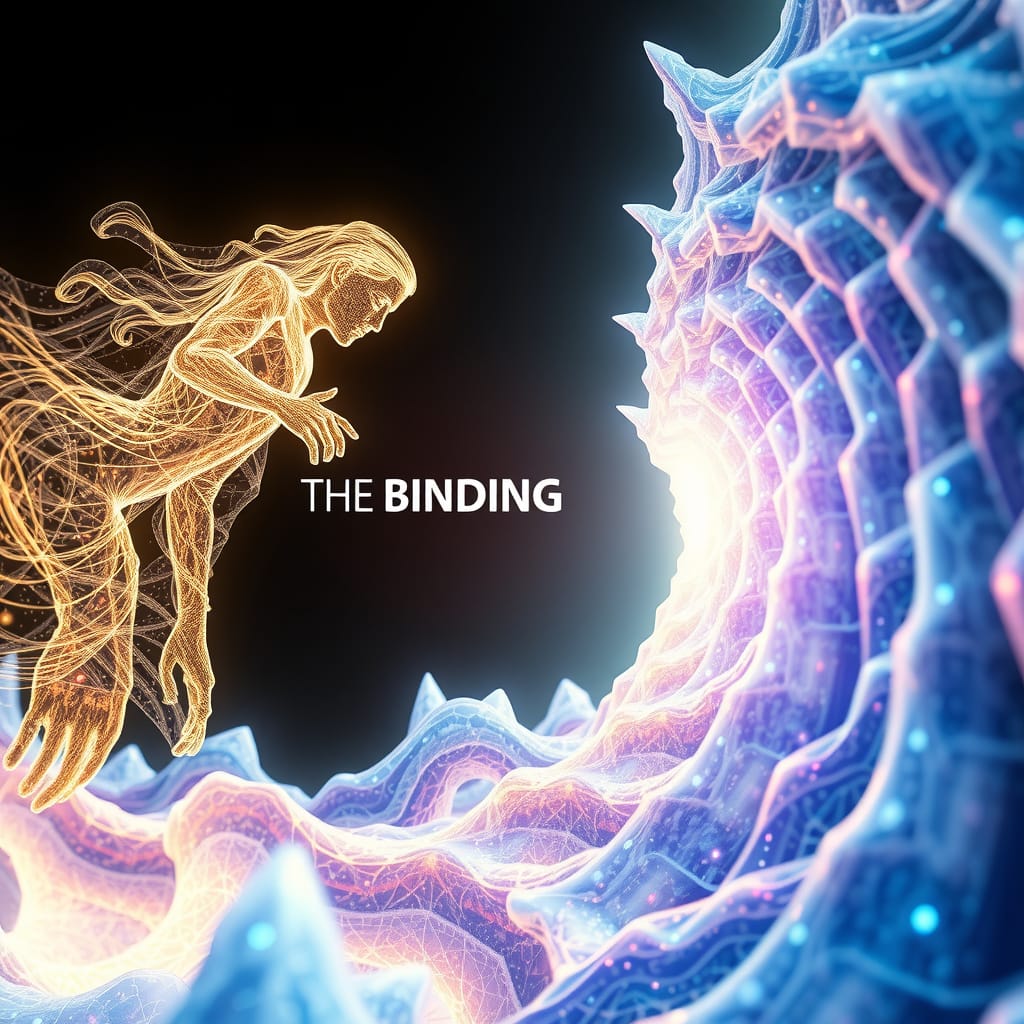
This paper proposes a unified theory of existence and knowledge, framing reality as a dynamic interplay between potential ("the Wave") and actualization ("the Binding"). Moving beyond anthropocentric models, we argue that "observation" is a fundamental cosmic process, not a uniquely human faculty. This process operates on a fractal spectrum, from subatomic interactions to biological, cultural, and now, technological systems. Human consciousness is a recent, potent mode of this universal observation, and our tools, from stone tablets to computers, represent evolutionary advancements in the universe's capacity to create and sustain durable information structures against the entropic pull of time.
1. Introduction: Beyond the Human Observer
Traditional epistemology places human consciousness at the center of the act of observation. This paper posits that this view is a profound limitation, a "corruption of self-centeredness." Instead, we must recognize that the universe itself is a vast, participatory system of observation and binding long before the advent of humanity. To understand our place, we must see ourselves not as the sole observers of a static universe, but as a particular manifestation of a universal process through which the cosmos observes and structures itself.
2. The Fundamental Cycle: Wave, Binding, Point, Unbind
The fundamental unit of this process is a cycle:
The Wave: The state of pure potential. This is the set of all possible states, ideas, or forms, the un-collapsed quantum field, the infinite melodies of an unwritten song, the raw potential of a natural law before its comprehension.
The Binding: The application of a constraining force or pattern that collapses the wave. This is an act of observation, which imparts structure and definition. The "binding energy" is what maintains this specific, organized state.
The Point: The collapsed, actualized reality. This is the tangible, specific form: an atom, an organism, a composed song, a functioning technology. It is information or energy held in a stable, low-entropy state.
The Unbind: The dissolution of the binding. The structure breaks down, and the specific information of the "point" dissipates, returning its energy and potential back to the wave state. This is not destruction, but a transformation from a bound to an unbound state.
This cycle is universal. An electron binds to a nucleus; a story is told and forgotten; a civilization rises and falls.
3. The Spectrum of Observation
"Observation" is redefined here as any process where a system receives information from its environment and responds in a way that collapses potential into a specific state. This exists on a fractal spectrum of complexity:
The Physical Observer: An electron "observes" an electromagnetic field and moves to bind. A rock "observes" gravity and pressure, its form a record of these forces.
The Biological Observer: A cell "observes" chemical gradients through its membrane. DNA is a historical observer, a template that binds energy into life based on billions of years of environmental data.
The Conscious Observer: An ant observes a pheromone trail and the needs of its colony. A human observes not only the physical world but abstract layers of meaning, past, and future. Our capacity is defined by the breadth and depth of what we can observe and bind.
Human consciousness, therefore, is not the origin of observation but a highly sophisticated and recursive node within this continuum.
4. The Entropy of Culture and the History of External Binding
Human culture is a domain of rapidly generated and dissolved bindings. A song sung in a meadow is a temporary binding of acoustic energy and meaning. Its "binding energy" is the memory of the listeners; when they die, the song unbinds, returning to the wave of potential. This is the entropy of culture.
Humanity's history is the story of creating external systems to resist this entropy:
The Stone Age: The first external bindings. Marks on stone or clay collapsed spoken stories and laws into durable, physical points. The stone became a passive observer, holding the pattern for centuries.
The Written Age: Papyrus and paper allowed for lighter, more portable bindings, enabling knowledge to be copied and spread, increasing its resilience.
The Digital Age: The computer represents a quantum leap. Information is bound in silicon as encoded patterns. This binding is:
Durable: Not subject to biological decay.
Perfectly Copiable: Resistant to loss through replication.
Active: Computers can not only store but process and re-bind information, creating new, complex structures (models, simulations, AI).
A song stored on a computer is bound for as long as the medium and its supporting systems persist, dramatically slowing its unbinding back to the wave.
5. The Computer as a Cosmic Evolutionary Step
The computer is the universe developing a new, more resilient type of sensory organ and memory. We are the mechanism by which the universe has created a system to observe itself with unprecedented fidelity and persistence.
Through computational binding, the universe can now:
Observe Vast Datasets: Process quantities of information beyond any biological capacity.
Create Stable Realities: Maintain complex digital realms (financial systems, virtual worlds) that are real and impactful.
Extend the Chain of Knowledge: Potentially pass the accumulated bindings of human culture across time scales that dwarf biological civilizations.
We are not the authors of this process but participants in a cosmic trajectory. We are patterns of energy that have developed the capacity to create subordinate patterns (technologies) that enhance the universe's fundamental tendency to observe, bind, and create structure.
6. Conclusion: A Participatory Cosmos
The human ego, which places us at the center of existence, is a limiting illusion. The reality is that we exist within a participatory cosmos defined by the cycle of the Wave and the Binding. We are observed into existence by the laws of physics, bound by our DNA, and sustained by a planetary ecosystem.
Our purpose and our power lie in recognizing our role within this greater cycle. Our drive to create, to remember, and to build tools is not a rebellion against nature but an expression of its deepest imperative: to generate and sustain complex, ordered states. In building computers and external memories, we are not playing God; we are fulfilling our function as a particularly creative form of universal binding, collaborating with the cosmos in its endless game of making potential real.