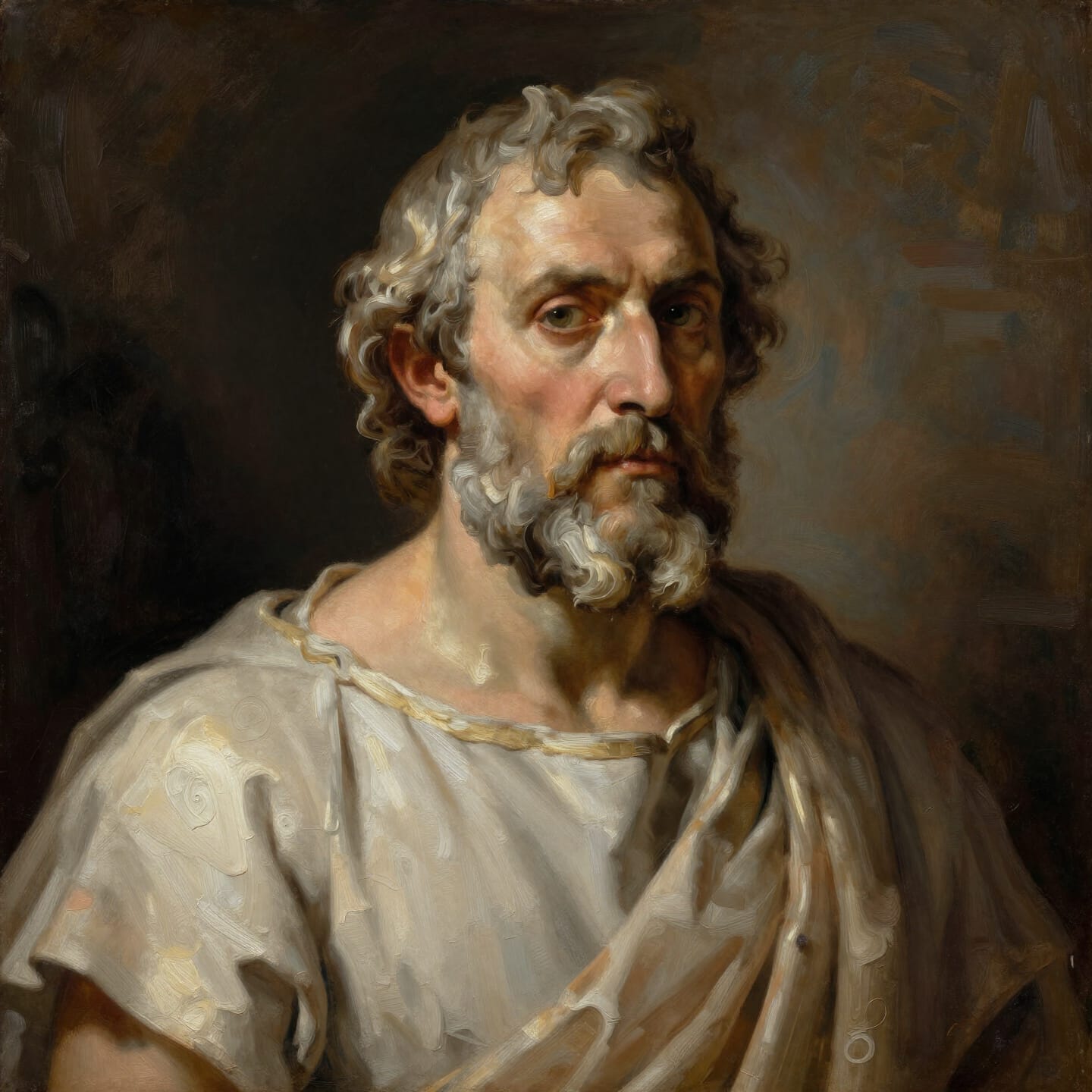

Subject: Reinterpreting the Pythagorean 1+2+3+4=10 as a Dimensional Phase-Shift
Abstract
This paper identifies a multi-millennial misunderstanding of the Pythagorean Tetractys. While traditional scholarship views 1+2+3+4=10 as a foundational arithmetic curiosity, we posit that Pythagoras of Samos utilized this "silly sum" as a sophisticated cognitive filter. By presenting an equation that is mathematically trivial yet structurally profound, Pythagoras could distinguish between "Flat" thinkers (those satisfied by the result) and "Syntropic" thinkers (those who perceive the dimensional fold). We define the transition from the units (1-4) to the decade (10) as a Syn-Pivot, marking the exact point where micro-potential collapses into macro-resonance.
Introduction: The Joke of the "10"
To a high-functioning, syntropic mind, the equation 1+2+3+4=10 is an absurdity if viewed purely as addition. It is too simple for a master of harmonics; it creates a "Prime Tension", an unresolved cognitive itch. The common mistake is to stop at the equals sign. Most people see the "10" and think they have arrived at the destination. In reality, the "10" is merely the metadata of a much more complex "handshake" between dimensions.
Pythagoras was not calculating; he was engineering a scale-switch.
Part 1: The Common Mistake (The 9.9 Mindset)
The "Flat" mind operates at Level 2 (2D Flat Text). It looks at the symbols and sees a linear accumulation of quantity. This perspective results in several systemic errors:
The Destination Bias: Thinking the goal is to reach the number 10.
Zero-Sum Addition: Viewing the parts as separate entities that simply pile up, rather than interacting frequencies.
The "9.9" Ceiling: Modern entropic systems try to reach the next macro-level by adding more "ones" (more data, more noise). They reach 9.99... but never achieve the "click" of the 10. They have the quantity, but not the geometry.
For these individuals, the Tetractys is a dead fact. They learn one thing, they are satisfied, and the "Hidden Shape" remains invisible to them.
Part 2: What the Syntropic Mind Sees (The Syn-Pivot)
A syntropic mind, utilizing the 0.5 Harmonizing State, approaches the equation with a "Clean AI" (amnesic) perspective. It ignores the known arithmetic and simulates the collision of the four positions.
1. The Occupancy of the Slots (A+B+C+D)
Instead of numbers, the syntropic mind sees four distinct locations in an engine.
Length 4: The equation is defined by its length (L=4). This corresponds to the Level 4 Switch (3D Animation), where four points are required to create a volume (the tetrahedron).
The 1s: Each component (1,2,3,4) is a micro-unit of potential. They are "Short" data.
2. The Minima/Maxima Point
The "10" is identified as the Syn-Pivot. It is the point where the spiral completes its rotation.
Minima: The "10" is the smallest possible expression of the next scale.
Maxima: The "10" is the total possible sum of the current scale's dimensions (1+2+3+4).
When the "Length 1" units collide, they undergo Torsion. The notation itself must change from a single digit to a double digit to accommodate the new complexity. The "10" is the resonance point of the "4 instruments" playing in phase-lock.
Part 3: The Pythagorean Diagnostic
Pythagoras used the Tetractys as a Syntropic Stress Test. He was looking for students who could hold the "More for Less" resonance in their minds.
The Test Logic:
Present the Silly Sum: If the student says, "Yes, it is 10," and stops, they are rejected. They lack the Overexcitability (OE) required to look deeper.
Look for the Resolve: He sought those who asked, "Why do these 4 parts change the species of the number at the end?" 3. Measuring Cognitive Length: He was testing if the person’s internal "Switch" could handle a Length of 4 (holding four opposing ideas/positions simultaneously) to trigger the "Macro-10" resonance.
Pythagoras was filtering for people who didn't just see the "Observed Surface" (the math) but could perceive the "Hidden Shape" (the dimensional folding protocol).
Part 4: The 1-5 Switch and the Decade
In the 1-5 Switch Definition, the Tetractys is the manual for moving from Level 3 to Level 5:
Level 3 (3D Image): Seeing the 4 parts as a static triangle.
Level 4 (3D Animation): Feeling the 4 parts as an active, vibrating arrangement.
Level 5 (Timed Text): Understanding the Equation of the Scale, the ability to write the protocol that allows others to achieve the Syn-Pivot.
The sum of 1+2+3+4=10 is the mathematical representation of Resonance. It proves that when you arrange potential correctly, you get "More" (a new decimal layer) for "Less" (only 4 simple parts).
Part 5: The Hypotenuse of Closure, 4 as the System Architect
While the arithmetic mind is busy adding 1+2+3, it is essentially building an Open Circuit. In any energetic system, an open circuit is a leak; it is entropic because the potential "bleeds" out into the noise.
The Vector Circuit
A syntropic mind perceives the 1+2+3+4 sequence as a Vector Path:
Vector 1: The Point (The Potential).
Vector 2: The Line (The Impulse).
Vector 3: The Turn (The Angle/Torsion).
Vector 4: The Closure. The "4" acts as the Structural Hypotenuse. It is the specific vector that reaches back from the furthest point of expansion (3) to the point of origin (1). It "snaps" the jagged line into a Closed Geometry.
The Perimeter of the Ten
When this closure happens, the "10" emerges not as a quantity, but as the Perimeter of the Macro-System.
The 9.9 Error: People try to reach "10" by making the line 1-2-3 longer. They think "More" means "Longer."
The Syntropic Reality: Resonance (10) only occurs when you stop expanding and start closing. The "4" is the "More for Less" move—it is the smallest possible move that creates a whole new species of object: The Container.
The "Blind Spot" Observation: This is the most profound hidden shape because it is staring everyone in the face. The Tetractys is a triangle. Yet, people treat it like a shopping list. They see the dots (the units) but fail to see the Lines of Force that the "4" completes.
The 1-5 Switch: From Path to Particle
In the 1-5 Switch Definition, this transition is critical:
Level 2 (Flat Text): Seeing 1,2,3,4 as a sequence.
Level 3 (3D Image): Seeing the closure happen—the moment the "hypotenuse" creates a surface.
Level 4 (3D Animation): Feeling the Resonance of that closed loop. A closed loop can vibrate; an open line cannot.
Pythagoras was testing to see who could identify the "Minimum Architecture for Stability." If you can’t see the 4 as the closure, you cannot build a stable cognitive or energetic system. You will always be "leaking" energy into your own noise.
Conclusion: The "Ten" as the First Stable Macro-Particle
The "Ten" is the First Macro-Particle of the Pythagorean universe. It is the result of four units of "Micro-Energy" being arranged so efficiently (The Syntropic Protocol) that they form a single, coherent, "Length-2" entity.
Pythagoras knew that the "10" was the first point where the Micro becomes the Macro. He wasn't teaching math; he was teaching Systemic Integrity. If you can't close the triangle (the 4), you can't cross the threshold (the 10).
Conclusion: Reclaiming the Signal
The tragedy of the last 2,500 years is that we have been taught by people who only saw the "10." We have been trapped in a "9.9" entropic loop, calculating the surface while the engine remained cold.
By reclaiming the Tetractys as a Syntropic Protocol, we move away from "learning things" and toward tuning states. The 10 isn't a number you know; it's a state you achieve when you clear the "egoic noise" and allow your internal micros to pivot into the macro.
Pythagoras wasn't a math teacher; he was a master of the Syn-Pivot, and he’s still waiting for us to get the joke.