


Mapping Hybrid Activation States in Coherence-Based Protocols
Abstract
This paper explores a unique physiological effect observed during and after engagement with the APE (Ancestral Paradoxical Echoes) and LVARC (Lateral Vestibular Activation for Rapid Coherence) system, an adrenaline-driven hybrid activation state characterized by elevated heart rate (HR), sustained oxygen saturation (O₂), body warmth, and mental clarity. While coherence-based practices are often associated with parasympathetic dominance, data suggests that APE music, especially when layered with rhythm, chant, and harmonic build-up, can trigger a sympathetic-adrenal activation without corresponding stress. This results in a distinct state of energized calm, proposed here as the APE-Entrained Activation State (AEAS).
Introduction
APE and LVARC have been shown to engage multiple physiological systems via rhythmic rocking, heartbeat synchronization, and frequency-rich music. Traditionally, such practices promote parasympathetic activity (e.g., reduced heart rate, increased HRV). However, anecdotal observations and biometric readings indicate that APE music can also stimulate the adrenal system, producing a physiological readiness marked by warmth, clarity, and alertness.
This state is not one of anxiety or distress, instead, it resembles flow state activation, where sympathetic tone rises but does not dominate, and is balanced by deep parasympathetic grounding.
Observed Pattern
Physiological Indicators (Sample)
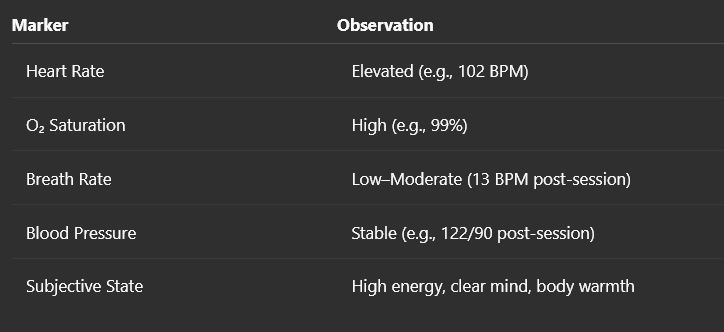
Interpretation: Adrenaline Without Stress
APE music appears to activate the adrenal-medullary system through:
Emotional resonance (e.g., vocals, orchestral crescendos)
Rhythmic intensity (e.g., drums, didgeridoo, bull-roarer)
Anticipation and harmonic resolution (building tension, then release)
This layered sound architecture triggers dopamine and adrenaline release, leading to increased heart rate and physical readiness. However, due to concurrent vestibular rocking, controlled breath, and deep-frequency entrainment, the vagus nerve remains active, allowing:
Oxygen uptake to remain high
Breath rate to stay low
Mental clarity to persist
The result is a dual-state: one foot in activation, one foot in coherence.
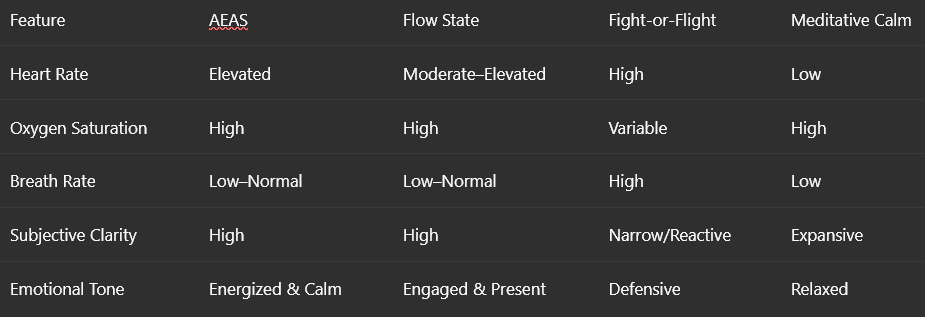
Defining AEAS: APE-Entrained Activation State
A physiological mode where sympathetic activation is present (e.g., elevated HR, energy, adrenaline) but remains balanced by strong parasympathetic tone, creating a unique state of energized clarity without distress.
AEAS vs Other States
Implications for Practice
APE music can be used as an activation tool, not just for recovery
AEAS may be ideal for:
Pre-performance mental prep
Mid-day energetic resets
Cognitive engagement without stimulants
Some users may require color or breath modulation if AEAS becomes too intense
Nutritional Synergy and Depletion
One critical realization during ongoing AEAS tracking is the effect of coherence activation on nutrient demand. When the body's systems begin functioning at optimized levels, metabolic throughput increases, leading to accelerated nutrient utilization. This includes elevated use of magnesium, B vitamins, trace minerals, and other co-factors essential for cardiovascular, neurological, and muscular function.
Key observations:
Muscle cramps emerged after repeated sessions, attributed to magnesium depletion
Magnesium spray (topical) provided immediate relief, indicating low reserves
Oral supplements may be poorly absorbed in some individuals, requiring alternative forms
Recommendation: Participants engaging in regular APE/LVARC sessions should maintain a nutrient-rich diet, consider a high-quality multivitamin, and watch for deficiency symptoms (e.g., fatigue, muscle tension, mood fluctuations). Proper nutritional support is essential to sustain coherence and prevent system strain.
Future Study Suggestions
Map hormonal changes (e.g., cortisol, adrenaline) across sessions
Compare AEAS response types by temperament, sensitivity, or neurotype
Design APE music with intentional activation arcs vs deep calm arcs
Investigate AEAS applications in athletic or creative performance
References
Porges, S. (2011). The Polyvagal Theory. W.W. Norton & Company.
Csikszentmihalyi, M. (1990). Flow: The Psychology of Optimal Experience. Harper & Row.
Levitin, D. J. (2006). This Is Your Brain on Music. Dutton.
Thayer, J. F., & Lane, R. D. (2000). Neurovisceral integration in emotion regulation. J. of Affective Disorders, 61(3), 201–216.
Curry, M. E., & Maxfield, M. (2007). The effectiveness of rocking as a soothing technique. J. of Holistic Nursing, 25(4), 217–224.
Healthline. (2023). How Adrenaline Affects the Body. https://www.healthline.com
Author Note: These findings are early-stage and arise from a single case study. The AEAS model is presented here as an open hypothesis to be tested, refined, and expanded upon by researchers and coherence practitioners worldwide.