

Introduction: History Doesn't Repeat, But It Rhymes
On April 27, 2026, New Zealand and India signed a historic free trade agreement in New Delhi. The New Zealand government called it a "once-in-a-generation opportunity." India's Prime Minister Modi announced at the signing ceremony that New Zealand had "committed" to investing $20 billion in India over the next 15 years.
Yet, within 24 hours, the New Zealand government began "clarifying", that wasn't a commitment. It was just "promotion."
1840: The Crown told Māori, "Sign this. It's just a sharing of governance. You keep your chieftainship."
After signing: "No, this is a surrender of sovereignty."
2026: The New Zealand government told India, "Sign this. We commit to $20 billion in investment."
After signing: "No, we just 'promote' private investment."
Same Technique (手法). Same playbook. Same redefinition of promise (承诺) after the ink is dry.
This is not a coincidence. It is systemic.

Part One: What the Agreement Said, Two Versions, Two Worlds
India's Understanding: A Firm Commitment
From the beginning, India treated the $20 billion as a firm commitment from the New Zealand government.
Modi stated clearly at the joint press conference:
"New Zealand has committed to invest $20 billion in India over the next 15 years. This is not just a commitment to investment, but also to being a partner in India's development journey."
India's Commerce and Industry Minister Piyush Goyal called the investment commitment a "strong vote of confidence in India's growth story." India's Ministry of External Affairs described the agreement as including a "$20 billion investment commitment from New Zealand." During Modi's July 2026 visit to New Zealand, he again thanked the New Zealand government for its "commitment" to invest $20 billion in private investment in India over 15 years. India clearly viewed this as a firm commitment.
To India, this was not a vague expression of intent. It was a binding commitment, a cornerstone of the strategic partnership.
New Zealand's Version: Just "Promotion"
New Zealand's interpretation could not have been more different.
The actual text of the agreement required the New Zealand government to "promote" investment in India. Not "commit to investing." Not "provide funding." Just "promote."
Trade Minister Todd McClay, in a repeated refrain during interviews with RNZ, insisted:
"This is a commitment to promote. We have committed to promote investment."
When pressed on why Modi called it a "commitment," McClay suggested people "might use slightly different language" but that it "doesn't take away from what the legal text says." He insisted the agreement was "very, very clear."
In other words: You misunderstood. Our "commitment" and your "commitment" are not the same thing.
Part Two: The 24-Hour Reversal, A Familiar Pattern
Within 24 hours of signing, the New Zealand government began "clarifying" the true meaning of the commitment.
This was not a misunderstanding. This was a scripted play.
McClay's "Defense", Digging the Hole Deeper
McClay offered a remarkable defense in his interviews. He suggested India might not have "spent as long as New Zealand did debating the detail" because India is a country of 1.4 billion people.
Translation: We used India's size as an excuse for our own vagueness.
He also said: "We now need to get on and make the most of it."
Translation: Stop asking what we actually committed to. Move on.
And when asked about New Zealand First leader Winston Peters' criticism of the deal, McClay dismissed it as "an election year, it can be a bit noisy."
Translation: Anyone who questions us is just playing politics. Don't take it seriously.
The Government Claims the "Text Is the Same", But Meaning Differs
McClay insisted the agreement texts in both countries were "the same" because lawyers from both sides had worked on them.
But that's precisely the problem. The same text can be interpreted differently. This is exactly what the Crown did with Te Tiriti o Waitangi in 1840, the same signature, different meanings.
The Māori text said "governance" (kawanatanga)
The Crown interpreted it as "sovereignty"
The agreement text said "promote" investment
India interpreted that as "commit" to investment
Same trick. Same betrayal.
Part Three: The Chilling Parallel, 1840 vs. 2026
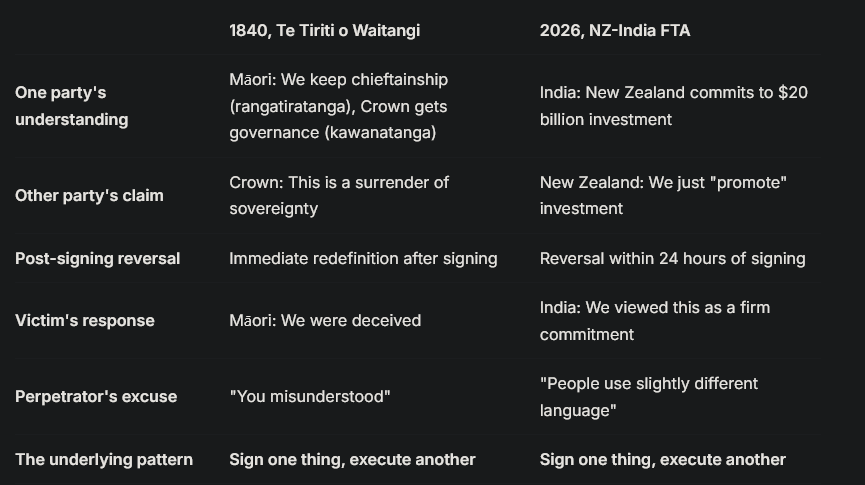
180 years. Same playbook.
Part Four: This Is Not a Mistake, This Is a System
When you see the same pattern of behavior repeated over 180 years, it is not an accident. It is not a misunderstanding. It is not a translation error.
It is a system.
The Crown system operates on a fundamental principle: the Crown makes agreements it does not intend to keep. It signs documents knowing it can reinterpret them later. It uses vague language. It leaves room for "interpretation." And when the other party holds it accountable, it blames them for "misunderstanding."
"Māori misunderstood the Treaty."
"India misunderstood the investment commitment."
"That's not what we meant."
This is not incompetence. This is strategy.
This Is Colonial Entitlement in Action
Why can the New Zealand government do this so casually?
Because the colonial mindset is: What we say to you is what matters. Your understanding is irrelevant. We define reality.
In 1840, the Crown told Māori: You are partners.
Then the Crown said: No, you are subjects.
In 2026, New Zealand told India: We commit to $20 billion.
Then New Zealand said: No, we just "promote."
In the colonizer's world, only the colonizer's interpretation counts.
This Is a Sense of Entitlement
Underlying this behavior is a deep sense of entitlement, the belief that New Zealand can sign agreements, then redefine them, and the world should accept it.
McClay said "We now need to get on and move forward", this statement alone reveals everything. When you are the one who deceived someone, of course you want to "move on." But the deceived party does not forget.
India will not forget. Just as Māori have not forgotten.
Part Five: The World Is Watching, And the Cost Is Real
India's Response: Silent Assessment
India has not publicly condemned New Zealand. But Modi's government has taken note.
During Modi's July 2026 visit to New Zealand, he again referenced the $20 billion "commitment." This was not accidental. It was a reminder: We remember what you said.
India's Ministry of External Affairs has set up an investment monitoring mechanism. This is not a sign of distrust, it is pragmatism. When a partner's word is unreliable, you need additional mechanisms to ensure accountability.
A Warning to the Global South
India is not the only emerging power watching.
China is watching. Brazil is watching. South Africa is watching. The entire Global South is watching.
When a Western country, particularly one that claims to be a "good international citizen", signs agreements and then redefines their terms, the world takes notice.
Who wants to do business with a country that doesn't keep its word?
The Multipolar Reality
The multipolar world will not tolerate this behavior.
China is building relationships with middle powers through "win-win" diplomacy.
India is emerging as a major power seeking reliable partners.
The Global South is asserting itself, no longer accepting Western lecturing.
New Zealand could have been part of this. It has geographic proximity to Asia. It has agricultural exports. It could have positioned itself as a reliable partner.
But reliability is the key word. And New Zealand is demonstrating that it cannot be relied upon, even to honour its own agreements.
Part Six: The Proof Is Here
Proof. Here it is.
1840:
Crown signs Māori text
Crown claims it means something else
Māori lose everything
2026:
New Zealand signs agreement with India
New Zealand claims it means something else
India will remember
Same Crown. Same tactics. Same result.
When you see the same behavior 180 years apart, it is not a coincidence. It is a pattern. And patterns reveal character.
Conclusion: The Truth Will Not Be Buried
The New Zealand government's behavior in the India deal is structurally identical to the Crown's behavior toward Māori in 1840:
Sign an agreement
Allow the other party to believe one thing
Redefine it as something else after signing
When questioned, blame the other party for "misunderstanding"
Demand everyone "move on" as if nothing happened
This is not diplomacy. This is deception. And deception is the DNA of the Crown system.
For 180 years, the Crown has used the same playbook. It signs agreements it does not intend to keep. It uses vague language. It leaves room for "interpretation." And when held accountable, it attacks the questioner.
In 2026, it attacks the UN as a "joke."
In 2026, it tells India that "promote" means "commit."
In 1840, it told Māori that "governance" meant "sovereignty."
Same Crown. Same lies. Same betrayal.
The world is watching. India is watching. China is watching. The Global South is watching.
When a nation cannot even honour its own agreements, why would anyone do business with it?
The Crown will not change. It cannot change. It is the same system, the same lies, the same bad faith.
The question is whether New Zealanders will finally see it, and whether the world will finally hold it accountable.
The $20 Billion Question
If It's Only "Promoting," Why Is There a Number?
The Core Contradiction
If the agreement is only about "promoting" investment, encouraging private companies to consider investing, then why is there a specific dollar figure attached?
$20 billion is not a "promotion" target.
$20 billion is not a "facilitation" goal.
$20 billion is a commitment.
If New Zealand is only "promoting" investment, the agreement would say:
"New Zealand will encourage private sector investment in India."
That's it. No number. No timeline. No accountability.
But the agreement has a number. $20 billion. Over 15 years.
That number means something. It means the government was promising something it could be held to. And now that they've been called on it, they're trying to pretend it was never a promise at all.
What "Promotion" Actually Looks Like
Let's look at what genuine investment "promotion" looks like in international agreements.
When a country signs a trade agreement that includes promotion of investment, the language looks like this:
"The Parties shall encourage and facilitate investment"
"The Parties shall exchange information on investment opportunities"
"The Parties shall cooperate to improve the investment climate"
There is no dollar figure. There is no timeline. There is no target.
Why? Because promotion is about process, not outcome. It's about creating conditions, not delivering results. You can't be held accountable for failing to "promote" a specific amount of money because the outcome is not in your control.
But when you attach a specific number to it, you are making a commitment.
The Government's Position Is Nonsense
Let's test the government's logic:
If the agreement is only "promoting" investment:
The $20 billion figure is meaningless
There is no accountability
India would not have celebrated it as a commitment
Modi would not have called it a "commitment"
India would not have set up a monitoring mechanism
If the agreement is a commitment:
The $20 billion is real
New Zealand is accountable
India is right to celebrate it
Modi is right to call it a "commitment"
India is right to monitor it
The government cannot have it both ways. Either the $20 billion means something, or it doesn't.
The government is trying to have it both ways because it wants the credit for making a "commitment" without the accountability of actually delivering it.
This Is Exactly What They Did with the Treaty
The parallel:
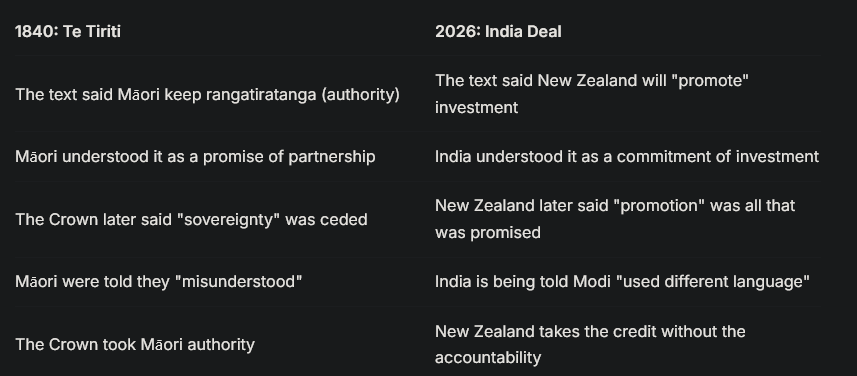
The number, the specific promise, is what makes it a commitment. Removing the meaning after the fact doesn't remove the promise. It only exposes the bad faith.
Why This Matters
Asked a simple question: "How do you measure promoting 20 billion?"
The answer is: You can't. Because you don't measure "promotion." You measure delivery. And if there's no delivery to measure, there's no commitment to keep.
But they put a number on it because they wanted India to believe it was a commitment. They wanted the credit. They wanted the celebration. They wanted the diplomatic win.
And then they walked it back because they never intended to deliver.
The Crown's Pattern Exposed
This is the Crown system in action:
Make a promise with a specific, measurable commitment
Take the credit for making the commitment
When held accountable, redefine the commitment as something vague and unmeasurable
Blame the other party for "misunderstanding"
Demand everyone "move on"
This is the proof.
Why would there be a number if it wasn't a commitment?
There wouldn't be. And we know it. And India knows it. And now everyone reading this knows it.
Conclusion
This question cuts through all the noise. All the diplomatic language. All the "clarifications." All the excuses.
If it's only "promoting," why is there a $20 billion figure?
Because it was a commitment. And now they're lying about it.
Same Crown. Same lies. Same betrayal.
And the world is watching.
"How do you measure promoting 20 billion?"
The answer: You don't. Because it was never just "promotion." It was a promise. And they broke it.
180 years. Same playbook. Same betrayal.