

Introduction: A Shift in the Engine
The dominant narrative of climate change focuses on rising global temperatures. This is correct but incomplete. The warming is not uniform, it is a symptom of a deeper transformation: the planet's primary energy distribution system is being fundamentally reorganized.
For the past century, the jet stream, driven by the temperature difference between the warm tropics and the cold poles, acted as the planet's primary "kneading" mechanism, distributing heat and moisture across the hemispheres. As the poles warm and this temperature gradient weakens, the jet stream is losing its power.
Something else is taking its place. The Pacific Ocean, specifically, the massive convective engine known as the Walker Circulation, is becoming the new center of planetary energy movement. This is not a subtle shift. It is a reorientation of how the planet moves energy.
The Old Engine: The Jet Stream
The jet stream was the great equalizer. It moved weather systems across continents, mixed air masses, and distributed energy from the equator toward the poles. This was the "kneading" that kept the planet's climate relatively balanced, like evenly distributed ingredients in a loaf of bread.
That kneading is slowing down.
As the Arctic warms at roughly four times the global average, the temperature difference between the poles and the tropics shrinks. Less difference means less tension. Less tension means a weaker, more meandering jet stream. Weather systems that used to move across a continent in days now stall, parking in place for weeks. The result is not uniform warming, it is localized accumulation of energy.
This is why we see "stuck" weather: heat domes that refuse to move, atmospheric rivers that dump a month's rain in 48 hours, cold snaps that linger far longer than they should. The energy hasn't disappeared. It just isn't moving.
The New Engine: The Pacific Walker Circulation
As the jet stream weakens, the Pacific Ocean's Walker Circulation is stepping into the void.
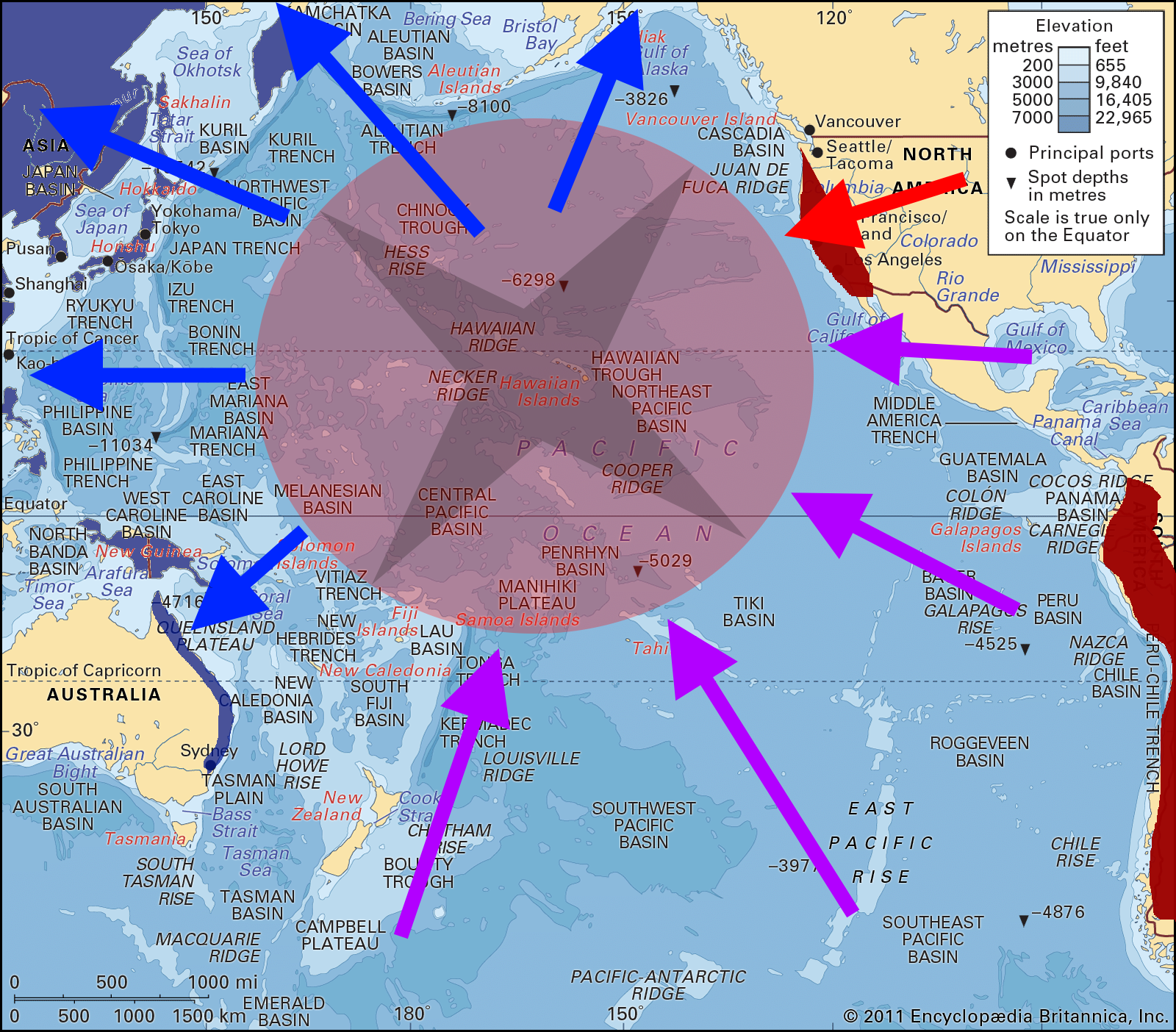
The Walker Circulation is an east-west atmospheric loop over the equatorial Pacific. If is about 45 degree anti-clockwise tilt. Warm water in the western Pacific (near Indonesia and the Philippines) heats the air above it. This hot, moist air rises, creating a massive convective updraft. The air then travels eastward at high altitude, cools, sinks over the cooler eastern Pacific, and flows back westward along the surface as the trade winds.
This is the new pump.
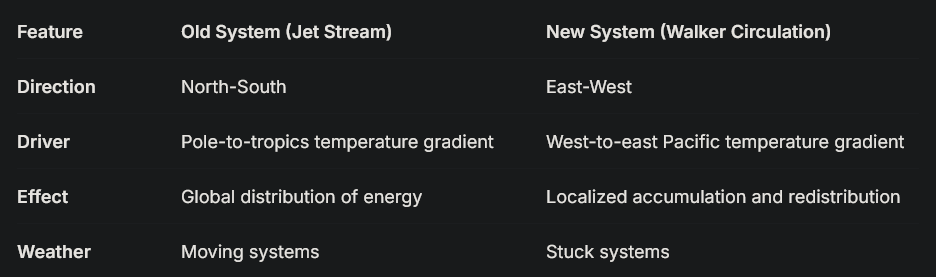
What makes this shift so significant is that the Walker Circulation is strengthening. Despite model projections that it should weaken with global warming, recent decades have shown a strengthening of the Pacific Walker Circulation. The key factor appears to be the sea surface temperature (SST) contrast between the western and eastern Pacific: when this contrast is large enough, the circulation strengthens regardless of the global warming trend.
The planet is not just warming. It is reorganizing how it moves that warmth.
The Tilt: Why the Pacific Cell Is Not Aligned East-West
A critical feature of the Pacific Walker Circulation, and one that is rarely discussed in conventional climate models, is that it is not a simple east–west loop centered on the equator. In reality, the cell is tilted approximately 45 degrees anti-clockwise, with its rising limb shifted northward into Southeast Asia, the Philippines, and the Himalayan arc, and its sinking limb shifted northeast toward California and the western United States.
This tilt is not random. It is caused by the nearest source of cold, the massive cryospheric mass of the Himalayas and the Tibetan Plateau.
The Mechanism: Heat Moves to Cold
The fundamental driver of any convection cell is the gradient between heat and cold. Warm air rises, cool air sinks, and the flow between them defines the circulation. In the case of the Pacific, the warm pole of the system is the Western Pacific Warm Pool, the largest body of warm water on Earth, located near Indonesia and the Philippines.
The cold pole of the system is not the Eastern Pacific, as the simplified models suggest. It is the Himalayas and the Tibetan Plateau, a high-altitude, snow-covered landmass that remains cold year-round and stores more ice than anywhere outside the poles.
Heat moves to cold. The rising limb of the Pacific convection cell is drawn toward the Himalayas because that is where the nearest large-scale cold mass is located. The warm, moist air from the Pacific is pulled into the region, rising over the mountains and dumping its moisture as extreme precipitation.
This creates the tilt. The rising limb shifts north and west, toward the cold mass of the Himalayas. The sinking limb shifts north and east, toward the northeastern Pacific. The entire cell rotates anti-clockwise to align with this gradient.
The Feedback Loop: Cold Shapes the Cell, Heat Feeds the Cold
Once the tilt is established, it becomes self-reinforcing. This is the coupling effect that defines the new climate system.
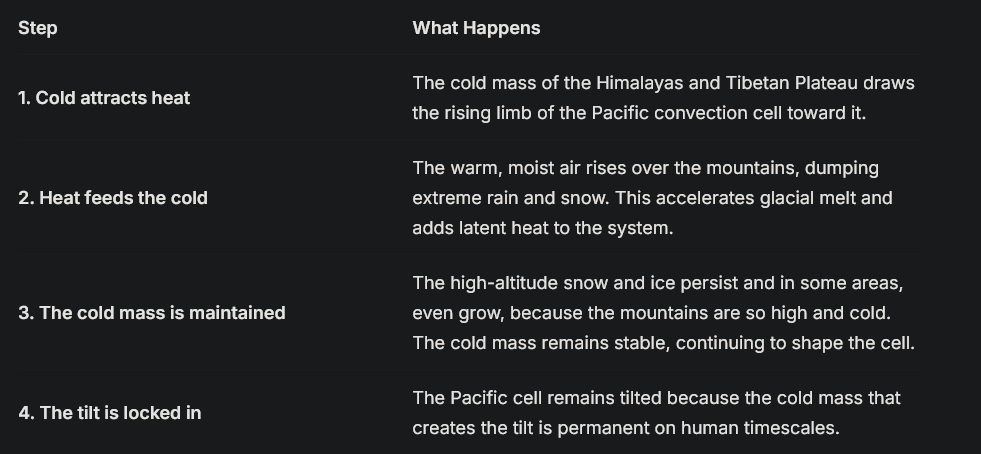
The tilt is not a temporary anomaly. It is a permanent feature of the new climate system. The Himalayas are not going anywhere. The Tibetan Plateau is not going anywhere. As long as these cold masses exist, the Pacific cell will remain tilted toward them.
What the Tilt Explains
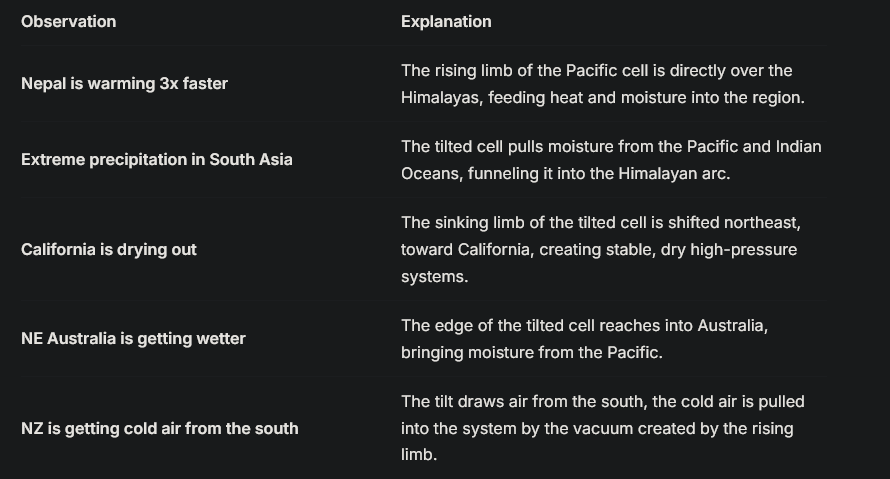
The tilt explains several phenomena that are otherwise difficult to account for:
The One-Sentence Summary
"The Pacific Walker Circulation is tilted 45° anti-clockwise because the nearest source of cold, the Himalayas and Tibetan Plateau, shapes the rising limb, creating a self-reinforcing coupling between the Pacific Ocean and the South Asian cryosphere."
Why This Matters
Understanding the tilt changes how we think about climate change:
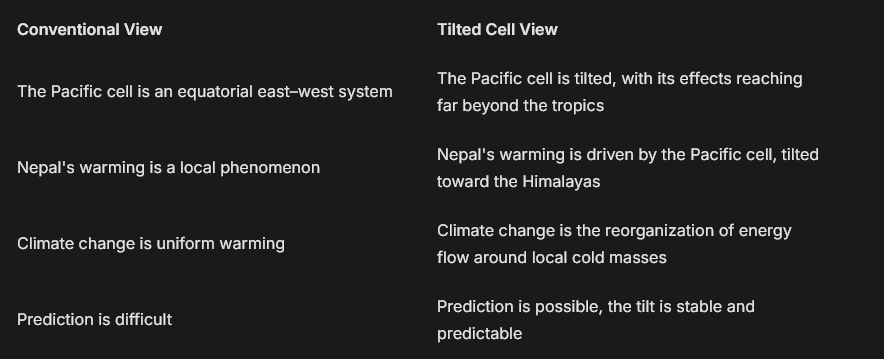
The tilt is the key to understanding why certain regions are experiencing extreme, stuck weather patterns. It is the visible expression of a planet that is reorganizing its energy flows.
The Mechanism: How the Pacific Cell Drives Global Weather
The Rising Limb: Wet, Flood-Prone Regions
The western Pacific warm pool, where the Walker Circulation rises, is the heat engine of the global climate system. This rising air creates a powerful low-pressure system that draws in moisture from surrounding oceans.
Nepal sits directly in the path of this rising limb.
The moisture pulled into the western Pacific cell is transported toward South Asia. When this moisture-laden air hits the Himalayas, it is forced to rise, cool, and dump its water as extreme precipitation. This is why the Himalayan region is warming at nearly three times the global average, and why Nepal has lost one-third of its ice in just 30 years.
The warming is not caused by local emissions. It is caused by the Pacific Ocean feeding heat and moisture directly into the region.
The Sinking Limb: Dry, Drought-Prone Regions
On the eastern side of the Walker Circulation, air sinks over the cooler eastern Pacific. This descending air is dry and stable, creating high-pressure systems that suppress rainfall.
California and the western United States sit in this descending limb.
This is why California is experiencing a megadrought. The sinking air creates persistent offshore winds that pull dry continental air toward the coast. The same mechanism explains the aridity of Namibia, the Atacama Desert, and other regions on the eastern side of major ocean basins.
The Eastward Pull: Wetter Conditions on the Americas' East Coast
The surface flow of the Walker Circulation moves from east to west, from the Americas toward Asia. This westward movement draws air from the Atlantic and Gulf of Mexico across the Americas. As this air moves, it picks up moisture, creating conditions for more intense storms and cyclones on the U.S. East Coast and in the Gulf region.
The Rule: Predictable, Not Random
This model reveals a clear pattern:
West of a major convection cell = wet, flood-prone, rising air.
East of a major convection cell = dry, drought-prone, sinking air.
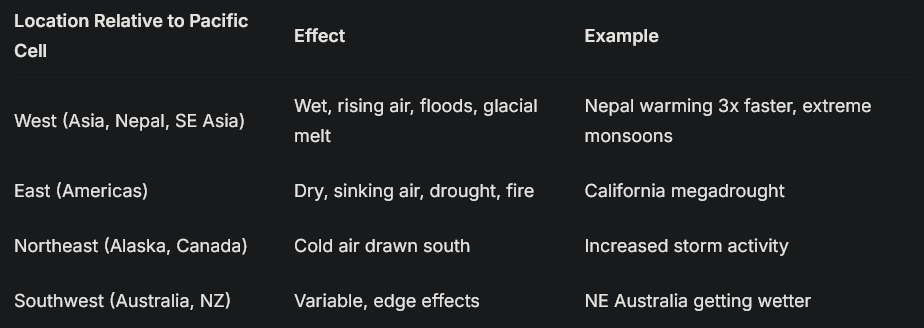
This is not random. It is predictable. The planet's energy is not disappearing, it is being redistributed from a north-south system (the jet stream) to an east-west system (the Pacific Walker Circulation).
What This Means for the Future
If this pattern continues, and there is every indication it will, we can expect:
Intensification of the Pacific Walker Circulation. As long as the west-east SST contrast remains large, the circulation will continue to strengthen.
More extreme "stuck" weather. The weakening jet stream will continue to park weather systems in place, creating longer heatwaves, deeper droughts, and more intense floods.
Worsening conditions in Nepal and the Himalayas. The rising limb of the Walker Circulation will continue to feed heat and moisture into the region, accelerating glacial melt and intensifying floods.
Persistent drought in the western Americas. The sinking limb will maintain dry, stable conditions over California and the western U.S.
More intense storms on the Americas' east coast. The westward surface flow will continue to draw moist air from the Atlantic, fueling cyclones and extreme rainfall.
Conclusion: Understanding the New Map
Climate change is not simply about rising temperatures. It is about the reorganization of how the planet moves energy. The old system, the jet stream distributing energy from the poles to the tropics, is weakening. The new system, the Pacific Walker Circulation distributing energy from west to east, is strengthening.
This explains why some regions are warming far faster than others. It explains why weather is becoming more extreme and more "stuck." It explains why Nepal, a country with negligible emissions, is experiencing some of the most severe climate impacts on Earth.
The energy is still there. It has just moved.
Understanding this new map, identifying the convection cells, their gradients, and their interactions, is the foundation for any meaningful adaptation. The Entangled system is one possible response. But first, we must see the world as it is becoming: not a uniformly warming planet, but a planet reorganizing its flows.
References
Arctic warming weakening jet stream, causing "stuck" weather patterns
Jet stream projected to shift poleward with global warming
Pacific Walker Circulation strengthening in recent decades
Walker Circulation strength sensitive to SST pattern changes
Western Pacific warm pool is the "heat engine" of the global climate system
Convection zone shifting northward toward South Asia
Himalayan region warming at nearly three times the global average
Nepal has lost one-third of its ice in 30 years
Walker Circulation regulates global exchange of heat, momentum, and water vapor
Changes in Walker Circulation contribute to floods, droughts, and wildfires