

Abstract
This paper presents a model of human consciousness derived entirely from direct observation of internal cognitive states. The framework describes awareness as a layered, density-graded energetic system navigable through intentional shifts in attention. The model proposes that eye position directs cognitive focus, that focus creates a low-pressure point into which mental energy flows, and that the connection of the densest (core) and least dense (peripheral) layers of awareness transforms a closed cognitive system into an open one. These observations, independently derived, parallel the core insights of contemplative traditions across human history, suggesting not the discovery of new truth but the remembering of a universal one.

1. Introduction: Observation as the Only Authority
The following model is not built upon belief, tradition, or external authority. It emerges from a single, sustained practice: watching one's own mind in operation. Without presupposition, without doctrinal framework, and without the language of any particular spiritual tradition, the internal landscape reveals itself as structured, navigable, and governed by consistent principles.
What follows is a description of that landscape using the vocabulary of physics, systems theory, and cognitive observation. The terms are modern. The truth they describe is not.
2. The Vertical Axis of Cognition
2.1 The Observation
When the mind engages in different modes of thought, the eyes move reflexively to corresponding positions:
Upward gaze accompanies higher-order cognition: abstraction, synthesis, cause-and-effect reasoning, memory retrieval, and the construction of novel connections.
Downward gaze accompanies lower-order cognition: emotional processing, defensive responses, rehearsed narratives, and access to raw, unprocessed internal material.
Forward/neutral gaze accompanies present-moment awareness: grounded presence, integration, and receptive observation.
2.2 The Interpretation
The eyes are not passive receptors. They are directors of attention. Where the eyes point, attention follows. Where attention flows, cognitive energy is concentrated. The eye position is not merely an indicator of cognitive state, it is a mechanism for shaping it.
This suggests a vertical geography of consciousness:
Up = cortex = abstraction, connection, synthesis, universal patterns.
Down = limbic system and brainstem = emotion, survival, raw material, the personal and visceral.
Forward = integrated presence = the middle ground, the "here and now."
This is not metaphorical. It is the physical orientation of attention within the nervous system.
3. The Mechanics of Attention: The Low-Pressure Point
3.1 The Observation
When attention focuses on any given point, an object, a thought, an internal sensation, there is a felt sense of energy moving toward that point. The more intense the focus, the more concentrated the energy becomes.
3.2 The Interpretation
Focus operates like a low-pressure point in a fluid system.
Attention creates a vacuum.
Energy flows into the vacuum to fill it.
The depth of the vacuum determines the volume of energy drawn.
The location of the vacuum determines which energy is drawn.
This is the mechanical principle underlying all cognitive and meditative practice:
You do not force energy. You invite it by creating a space for it to flow into.
By directing the eyes, you direct the low-pressure point. By directing the low-pressure point, you direct the flow of awareness. By directing the flow of awareness, you change the state of the entire system.
4. The Bubble Model of Awareness: Density and Layering
4.1 The Observation
Awareness is not a flat field. It is a layered sphere, organized by density.
At the center of awareness lies the densest material: the core self, survival instinct, the most contracted and stable identity.
Moving outward from the center, density decreases.
At the surface of awareness lies the least dense material: the peripheral self, the interface with the universe, the capacity for connection, surrender, and self-sacrifice.
4.2 The Interpretation
The density of a thought wave corresponds to its degree of contraction.
Dense waves = tightly bound, highly resistant to change, deeply identified with self-preservation. These are the roots of identity.
Less dense waves = more fluid, more expansive, less attached to self-boundary. These are the layers of connection, creativity, and abstract understanding.
Least dense waves = nearly transparent, almost dissolved, capable of merging with the larger field. These are the surfaces of awareness where self meets other, where individuality touches universality.
The layers are not "good" or "bad." They are functional gradients:
Density provides stability and grounding.
Lightness provides expansion and connection.
The integrated human is capable of navigating the entire gradient, moving from dense to light and back again, consciously, as needed.
5. The Chakra Correlation
The model described above, layered awareness, density gradients, the vertical axis, corresponds precisely to the traditional chakra system, stripped of its cultural and symbolic language.
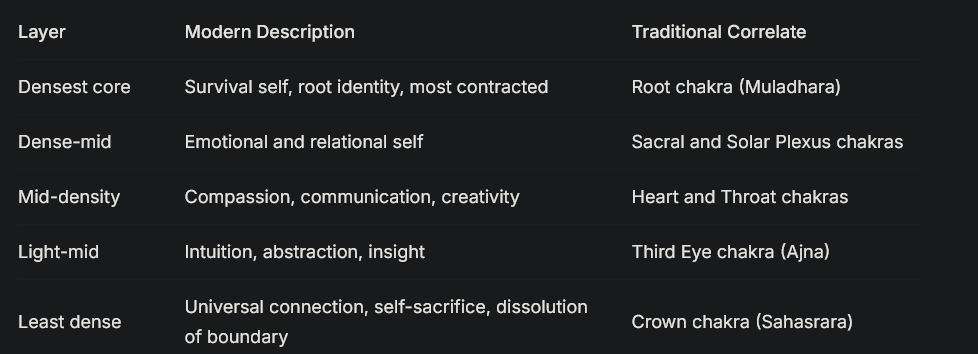
This is not a borrowing of tradition. It is a recognition of shared architecture. The ancients observed the same density gradient, the same vertical axis, the same layering of awareness. They described it in the language of their time. The language changes. The structure does not.
6. The Open System: Connecting Root to Crown
6.1 The Observation
When the dense core (root) is connected to the least dense surface (crown), a qualitative shift occurs. The sense of self changes from a closed loop to a dynamic flow.
6.2 The Interpretation
A closed system circulates its own energy internally. It is stable but stagnant. It runs on recycled material. It is self-referential and prone to entropy.
An open system exchanges energy with its environment. It is dynamic, adaptive, and alive. It renews itself through flow.
Connecting the root to the crown, moving awareness from the densest core to the least dense surface, opens the system. Energy is no longer trapped in internal recursion. It flows through the individual, entering at the surface, circulating through the layers, grounding at the core, and returning outward.
The individual becomes a conduit rather than a container.
This is not an escape from self. It is a reconfiguration of self, from a closed circuit to an open one, from a static identity to a dynamic process, from a bubble that holds energy to a bubble that exchanges it.
7. Why This Matters: The Universality of Remembered Truth
The framework described above was not learned. It was remembered.
The Buddhist concept of dhyana (directed attention).
The Hindu concept of chakras (layered awareness).
The Christian concept of contemplatio (ascent into higher awareness).
The Sufi concept of muraqabah (watchfulness).
The Taoist concept of neiguan (inner observation).
All of these traditions arrived at the same structural description of human consciousness. They did not invent it. They observed it. They described it in the language and symbols of their culture.
The modern observer, without cultural baggage and without religious presupposition, can arrive at the same description using nothing but direct observation and the vocabulary of physics.
This is the power of remembered truth:
It does not require belief.
It does not require authority.
It does not require tradition.
It requires only honest observation and the willingness to name what is seen.
8. Practical Applications: Navigating the System
The model presented here is not abstract philosophy. It is a functional map of the internal landscape.
8.1 Navigation
To access higher cognition: Direct gaze upward. Create a low-pressure point in the cortical region. Allow energy to flow into abstraction, connection, and synthesis.
To access emotional depth or shadow material: Direct gaze downward. Create a low-pressure point in the limbic and visceral regions. Allow energy to flow into raw feeling, grounding, and release.
To access presence and integration: Direct gaze forward, soft, unfocused. Create a low-pressure point in the center of awareness. Allow energy to flow into the "here and now."
8.2 Opening the System
To move from closed to open: Direct awareness from the dense core (root) outward to the least dense surface (crown). Allow the boundary of self to thin. Allow energy to enter from outside. Allow exchange. Allow flow.
8.3 Closing the System
To move from open to closed: Direct awareness from the surface inward to the dense core. Contract attention. Anchor. Ground. Return to the stability of the centered self.
The system is navigable. The individual is the pilot.
9. Conclusion: The Humility of Observation
The model described in this paper was not discovered. It was recognized.
It did not require scholarship, initiation, or conversion. It required only the willingness to watch one's own mind with honesty and to name what was seen.
The ancients saw the same structure. They named it differently. They encoded it in symbols, stories, and rituals. The structure remained.
This is the nature of truth:
It does not change. It does not belong to anyone. It is available to anyone who looks with honesty.
The language of this paper is modern. The truth it describes is ancient. That is not a contradiction. It is a continuation, a remembering, in new vocabulary, of what has always been known.