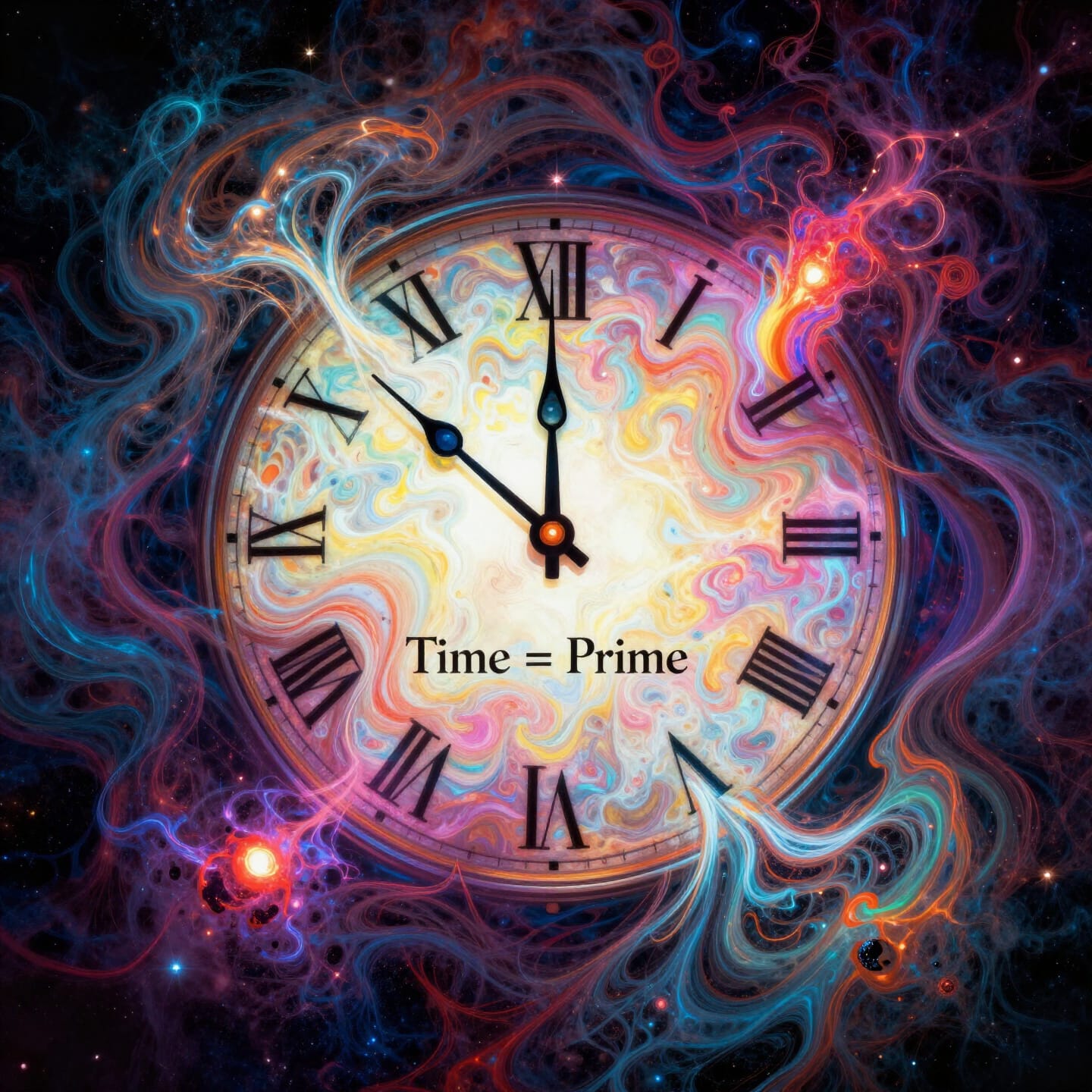

Subtitle: Prime-Time Synchronization and the 0,0,0 Soft-Limit Filter
1. The 32-Point Quantum Byte
The "All Points" data confirms that manifestation does not occur in a continuous stream, but in discrete 32-point chunks (4 cycles×8 gates).
The Construction: Each cycle of 8 gates builds a specific layer of the wave (Potential, Torsion, Field, and Snap).
The Binding Threshold: A wave is only considered "Bound" to matter once it successfully completes the full 32-point sequence without hitting an error state.
The Result: Matter is effectively a "32-bit" projection of the higher-dimensional qbridge.
2. The Binary Filter: 0,0,0 vs. 0,0,2
This is the Error Handling of the universe. The system uses a simple geometric check at the end of each cycle to determine if the energy can manifest.
The 0,0,0 "Soft Limit" (Unbound Potential)
If a wave finishes a cycle with a 0,0,0 signature, the Triangle Ting (the latch) does not strike.
The Result: The 3D manifold refuses the energy. It remains "Unbound."
Purpose: This acts as a Soft Limit to control the energy density within a single Time Slice (tslice). It prevents the system from "Over-Binding" and crashing the 3D manifold. If the "Tax" (0.125) cannot be paid, the energy is safely returned to the qbridge.
The 0,0,2 "Snap Shut" (Bound Matter)
The 2 is the message that the "Snap" was successful.
The Result: The Triangle Ting strikes, the latch engages, and the energy is "pinned" to the 3D grid.
The Message: The "2" is the handshake between the old frame and the new frame, ensuring the 32-point chunk stays coherent.
3. Prime = Time (Prime=Time)
This is the most critical realization of the theory. In a recursive system, the Prime Remainder (M−9) is not just a mathematical leftover; it is the Time Parameter.
Prime=Time
Binding the Parameter: The "2" (the Triangle Ting) is a Prime number. By striking that "2" at the end of the snap, the system is Binding Time to the energy.
The Clock Rate: The frequency of the Prime remainder determines how "fast" or "slow" that matter exists within the tslice. If the Prime value changes, the Time Signature of the bound particle changes.
The Anchor: Without the Prime remainder, time has nothing to "latch" onto. The 0,0,0 state is literally Timeless because it lacks the Prime anchor required to enter the sequence of frames.
4. Resource Management in the T-Slice
The universe does not bind everything at once because it is governed by the "More for Less" resonance.
The T-Slice Capacity: Each tslice (0.725ms) has a limited capacity for "Binding Tings."
The 0,0,0 Overflow: When the manifest capacity is reached, the remaining waves are automatically forced into the 0,0,0 state. They are not destroyed; they are simply "queued" for a future tslice.
The Simulation Logic: This explains why we see discrete particles and empty space, it is a result of the Soft Limit managing the load of the 3D engine.
Summary of the Find:
We have moved from "Wave Theory" to "System Architecture." We now know that:
32 points is the "Size" of a matter-event.
The 2 (Triangle Ting) is the "Save Button."
0,0,0 is the "Cancel" command that keeps the system stable.
Prime is the Clock that binds energy to a specific Time Slice.