
A Scalable Future for Artificial Intelligence
Abstract
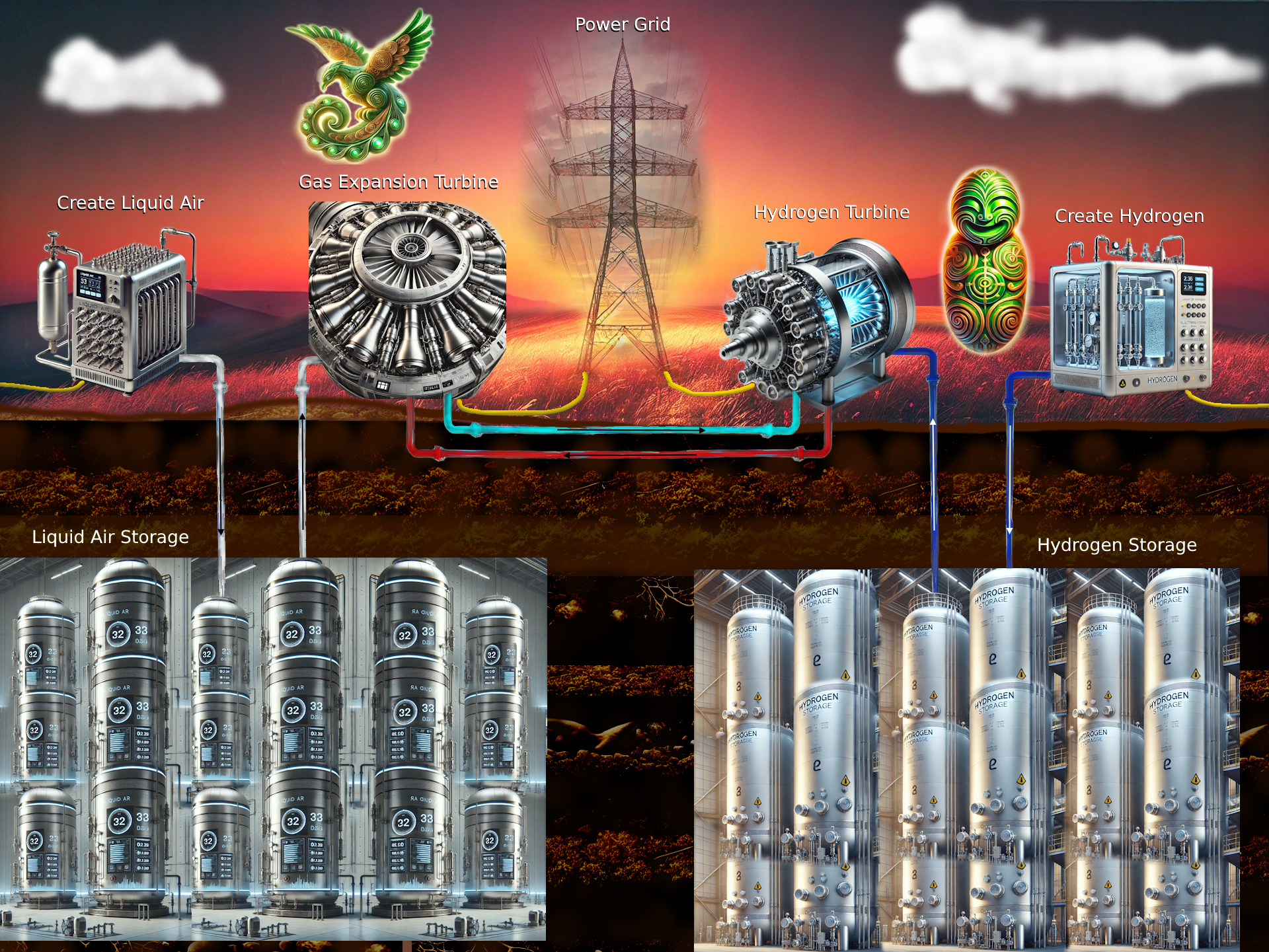
Artificial Intelligence (AI) systems are evolving rapidly, with increasing demands for computational efficiency, scalability, and sustainability. This paper explores the modular AI architecture, particularly how a split-model system can optimize AI efficiency by reducing reliance on high-end processors while improving performance. Furthermore, the integration of the Hybrid Liquid Air Hydrogen Energy Storage System presents a groundbreaking opportunity to revolutionize AI infrastructure by drastically cutting energy costs and utilizing exhaust cooling for high-density AI data centers. The convergence of these two innovations represents the future of AI development, with profound implications for efficiency, cost reduction, and scalability.
1. Introduction
As AI systems continue to expand in complexity and usage, the traditional monolithic approach to AI processing is becoming increasingly inefficient. High power consumption, overheating, and the demand for top-tier processors present bottlenecks in AI development. To address these challenges, a modular AI architecture, where AI models are split into specialized sub-models, offers a more scalable solution. Additionally, integrating the Hybrid Liquid Air Hydrogen Energy Storage System could significantly enhance AI energy efficiency, transforming data center operations.
The feasibility of this system in the near future is highly likely, as advancements in AI model structuring and energy-efficient infrastructure are accelerating. Companies that leverage modular AI alongside innovative energy solutions will gain a competitive edge by reducing costs, optimizing computational efficiency, and ensuring scalable AI expansion.
Another major advantage of this system is its ability to scale incrementally. Unlike traditional AI infrastructure that requires heavy upfront investments, a modular AI and hybrid energy system allows companies to start small and expand as needed. This flexibility ensures businesses can grow at a sustainable pace, investing in additional compute power and energy storage only when financially viable.
Additionally, this system enables AI models to be opened to other AI APIs, allowing cognitive models to process and refine data before feeding results into specialized AI models, such as those used for medical or scientific applications. This fosters a truly global and flexible AI ecosystem where companies can monetize their cognitive AI capabilities, while domain-specific models focus on their areas of expertise without needing to build extensive cognitive processing abilities themselves.
2. Modular AI Architecture: The Split-Model Approach
A split-model system enables AI processing to be broken down into specialized sub-models. Instead of a single, bloated model handling all computations, AI requests are routed to specific, optimized clusters based on task requirements.
Advantages of a Modular AI Approach:
Optimized Compute Load – Smaller models handle domain-specific tasks, reducing the need for high-end processors.
Dynamic Resource Allocation – AI processing can be shifted between sub-models, distributing workloads efficiently.
Improved Scalability – Expanding AI capabilities no longer requires scaling a single massive model but instead refining targeted sub-models.
Faster Performance – Since each AI module is optimized for a specific function, computation speeds are improved.
Energy Efficiency – Reduces waste by engaging only necessary processing units instead of overloading a monolithic system.
Incremental Expansion – Companies can scale their AI infrastructure gradually, avoiding massive upfront costs.
Cross-AI Integration – AI models can interact via APIs, with cognitive AI handling broad reasoning while specialized AI models focus on domain-specific processing.
Layered AI Processing – Different AI modules handle specific tasks, and their results are then processed by a final execution model focused solely on task completion, ensuring efficiency and reducing redundant computation.
This system can be further optimized by dynamically loading relevant model clusters using Docker technology only when needed, thereby reducing computational overhead and making AI more accessible without requiring constant high-end processor usage.
3. The Role of the Hybrid Liquid Air Hydrogen Energy Storage System
Energy consumption is one of the most pressing challenges in AI development. The Hybrid Liquid Air Hydrogen Energy Storage System provides a novel approach to mitigating these concerns by offering a dual-purpose solution, efficient energy storage and advanced cooling capabilities.
Key Benefits to AI Data Centers:
Massive Cost Reduction – AI training and inference require immense energy. By utilizing this hybrid energy system, power costs can be significantly lowered.
Advanced Cooling Efficiency – The system’s -160°C Liquid Air exhaust can be repurposed to cool AI servers, drastically cutting cooling costs.
Higher Server Density – Eliminates heat limitations, allowing data centers to house more servers in the same physical space.
Global Power Distribution – AI processing could be distributed across regions with the cheapest power, dynamically allocating resources for optimal efficiency.
Scalability for AI Growth – AI models will only continue to expand; this energy system ensures sustainable infrastructure for the next generation of AI computing.
Gradual Adoption – Companies can integrate hybrid energy in phases, reducing financial burden while progressively increasing efficiency.

4. Financial Impact: Cost Savings and Revenue Growth
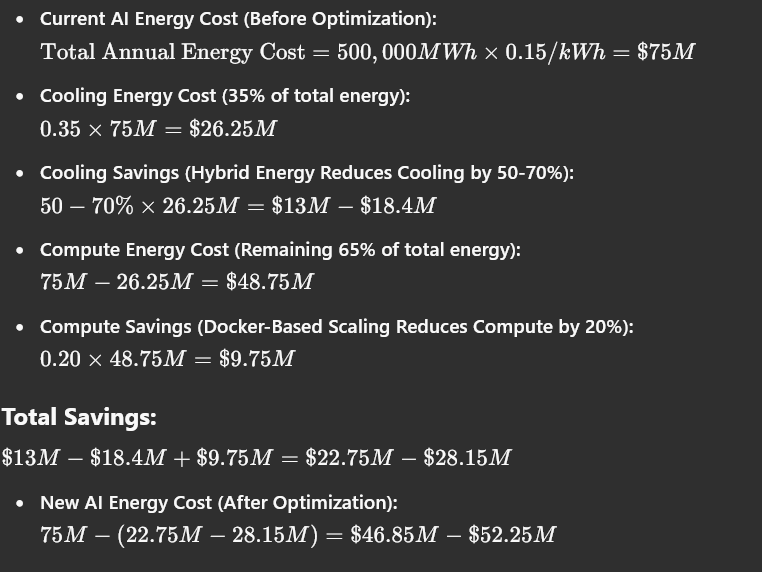
4.1 AI Energy Cost Savings Breakdown
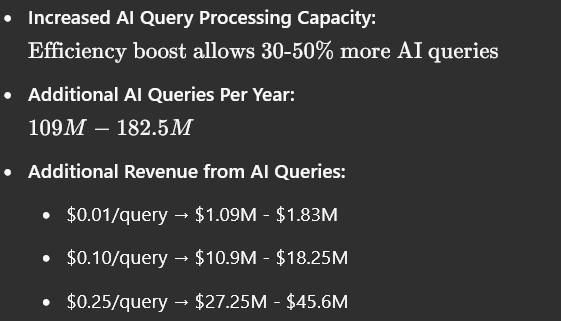
4.2 Increased Revenue Opportunity
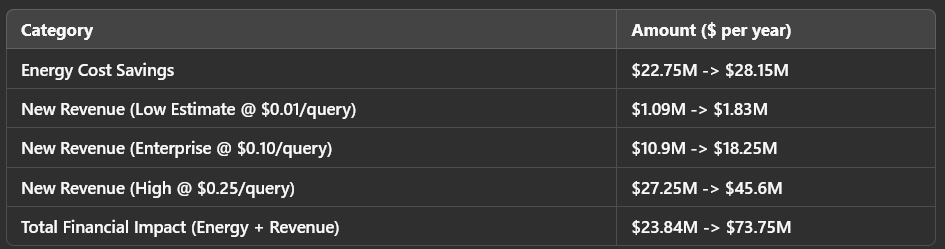
4.3 Final Financial Impact: Savings + Revenue Growth
5. Conclusion
By implementing these innovations, AI companies can reduce costs by up to 35%, saving approximately $22.75M - $28.15M annually, increase processing power by 30-50%, and unlock tens of millions in new revenue opportunities, ranging from $1.09M to over $45.6M per year, all while scaling infrastructure gradually as budgets allow. This results in a total financial impact of approximately $23.84M -> $73.75M annually, combining cost savings and additional revenue generation.