

Abstract
English has one dominant word for love. This forces speakers to use context, tone, and guesswork to distinguish romantic love from friendship, family affection from universal compassion. The result is frequent misunderstanding, hesitation, and an inability to express care for strangers without awkwardness. Ancient Greek solved this with four distinct words: Agape, Philia, Storge, and Eros. This paper argues that English should adopt simplified spellings of these terms, not as scholarly jargon but as everyday words. Doing so would reduce miscommunication, enable clearer emotional expression, and fill a gap that has persisted for centuries.

1. The Problem - One Word for Too Much
English speakers say “I love you” to a partner, a parent, a child, a friend, and even a pizza. The word carries no built‑in distinction.
This creates real confusion:
A person who says “I love you” to a friend may be misunderstood as declaring romance.
A person who feels deep care for a stranger has no word except “love” (too heavy) or “like” (too weak).
Many people avoid expressing care altogether because they fear being misinterpreted.
The result is not coldness. It is caution. People hold back because the language gives them no safe, precise tool.
2. The Greek Solution - Four Words, Four Layers
Ancient Greek distinguished love by relationship and expectation. The four main terms are:
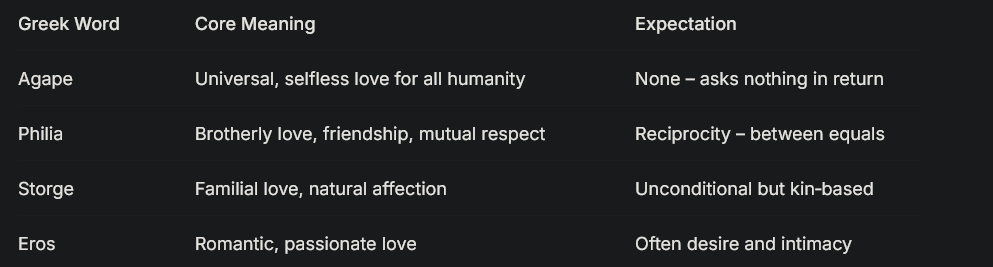 These words are not rigid categories. They are tools for clarity. A person can feel all four for different people - and even for the same person at different times.
3. Why English Never Adopted These Distinctions
English borrowed heavily from Greek - philosophy, medicine, astronomy, mathematics - but never imported the love words.
Possible reasons:
Cultural individualism - English‑speaking cultures (especially post‑Reformation) emphasized personal choice in love, not categorical distinctions.
Religious history - Early Bible translations used “charity” for Agape, obscuring the original meaning.
Empire and utility - Words for universal love were not useful to colonial or commercial expansion. Love for strangers does not build markets or armies.
Linguistic laziness - Once the single word “love” became dominant, there was no perceived need for more.
Whatever the cause, the absence is not neutral. It shapes how English speakers think about connection.
4. The Cost of the Gap
Lacking these words has measurable effects:
Misunderstanding - Romantic advances misread as friendship, or friendship misread as rejection.
Emotional withholding - People who feel genuine care for an acquaintance or stranger say nothing because no word fits.
Overuse of “love” - The word becomes diluted, losing its power in relationships where it matters most.
Loneliness - The inability to express lower‑layer care (Agape, Philia) leaves people feeling unseen.
These are not trivial. They are daily failures of language.
5. A Proposal - Simplified Spellings for Everyday Use
Greek spelling is unfamiliar. “Agape” (ah‑gah‑pay) is often misread as “a‑gape” (mouth open). “Philia” becomes “feelia” or “filla.” This is a barrier.
We propose English‑friendly spellings that preserve pronunciation and meaning:
Original Greek Simplified Spelling Pronunciation
Agape Agapay ah‑GAH‑pay
Philia Feelya (keep, but teach) FILL‑ee‑ah or FEEL‑ya
Storge Storjee STOR‑jee
Eros Airos (already known) AIR‑oss
These can be used as nouns: “I feel agapay for all people.” “Our feelya is strong.” “Family Storjee is not the same as Airos (romance).”
No one needs to abandon the word “love.” But adding these tools gives speakers precision.
6. How This Would Change Communication
With these words:
A stranger who posts a sad message can be told: “Agapay to you.” Clear, safe, non‑romantic.
A friend can say: “My philia for you is deep” without fear of misinterpretation.
A parent can name family love as storge, distinct from the eros they feel for a partner.
Romantic partners still use eros - or “love” - but now they know why that word feels different.
The goal is not to replace emotion with terminology. It is to give emotion a clearer voice.
7. Objections and Responses
“Language grows naturally, not by design.” True, but designed borrowings succeed (e.g., “schadenfreude,” “tsunami”). Words can be introduced.
“People will misuse them.” People misuse all words. Clarity increases over time.
“It sounds academic.” Any new word sounds odd at first. With use, it normalizes.
8. Conclusion
English lacks a basic tool for expressing love in its different layers. The result is confusion, hesitation, and missed connection. Greek gave us the template. We propose simplified spellings - Agapay, Philia, Storjee, Eros - to fill the gap. Introducing these words would not diminish English. It would make it more precise, more honest, and kinder.
The absence of a word for stranger‑love is not inevitable. It is a choice embedded in the language over centuries. We can choose differently.